
The best place for a home solar inverter is a shaded, well-ventilated wall close to your main distribution board. It should be out of the rain, easy to reach for service, and clear of any staircase or exit people use to leave the building. For most houses that means a covered terrace wall, a verandah or a utility wall. It does not mean a cupboard, a stairwell shared with neighbours, or a sunny open parapet if a shaded wall is available.
The reason is not looks. An inverter is a box of electronics that works for years. Heat shortens that job, water can get in through careless cable entries, and a bad position makes every later service visit harder.
What this is built on
- Qbits facts come from the Qbits datasheet for the QB 4.6/5/6KTLS single-phase on-grid inverter and the hybrid catalogue page for the QBH 3KS to 6KS48P, plus the product data on this site. The July 2026 Qbits product catalogue prints the same values for the rows used here. Other Qbits families have their own datasheets. Read the one for your model.
- The photos are from the Qbits installations gallery. We describe only what the photos show. They do not tell us the owner or the system size.
- Limit: we did not cite the National Building Code of India or any state fire rule here, because we could not open the code text from an official source. On exits, batteries and society rules, this post gives practical cautions and tells you what to ask. It does not quote a clause.
Which spot in the house suits a solar inverter best?
The table below compares nine usual choices. “Verdict” is our practical view, not a rule.
| Location | What is good | What to watch | Verdict |
|---|---|---|---|
| Terrace or roof wall, shaded (pergola, stair-head room wall, roof overhang) | Short DC cable run from the panels, outdoors so heat leaves easily, easy to reach | Rain splash, theft on an open roof, a long AC cable run down to the main board | Good choice for most homes |
| Terrace or roof wall, open to full sun | Same as above | The enclosure sits in afternoon sun on top of a hot ambient day. See the heat section below | Acceptable only if the maker’s documents say so for your model. Shade is safer |
| Verandah or covered entrance wall | Roof overhead, close to the meter and board, simple to service | Neighbours or visitors can reach it. Hot western wall | Good, if the wall is on the cooler side |
| Garage or parking wall | Covered, near the meter in many houses, strong wall | Vehicles can hit it, dust, closed shutters trap heat | Good if mounted high enough and away from the vehicle path |
| Utility or service room | Protected from rain and theft | Poor airflow, humid wash areas, a closed door in summer | Good only if the room is ventilated and dry |
| Balcony | Convenient in a flat | Rain blown in, sun on a west or south face, society and facade rules, long cable route from the roof | Check permission first. Usually second choice |
| Stairwell or under a staircase | Out of the weather, handy to service | Exit routes, shared space, heat trapped in a closed core, battery risk | Only in a private stair, after asking your installer and society. Never for batteries |
| Beside the main board and meter | Shortest AC cable, easy for the electrician and inspection | Only works if the wall is shaded and ventilated | Good when the rest of the list is satisfied |
| Inside a closed cupboard or false-ceiling space | Hidden | The inverter cools by natural air movement | Avoid |
Once you have a shortlist of walls, the residential solar page shows which Qbits families are grouped for homes. The rest of this post explains the reasons behind the table.
What do the Qbits datasheets say about where an inverter can go?
Two Qbits documents we read give the numbers that matter for a location: one for a single-phase on-grid family and one for a single-phase hybrid family.
| Item | QB 4.6/5/6KTLS (on-grid, single phase) | QBH 3KS to 6KS48P (hybrid, single phase) |
|---|---|---|
| Enclosure protection | IP66 | IP66 |
| Operating temperature | -25 to +60 °C | -25 to 60 °C, “frequency-decreasing above 45°C” |
| Cooling | Natural cooling | Natural cooling |
| Humidity | 0 to 100% non-condensing | 0 to 95% |
| Weight | 9 kg | 20 kg |
| Size (W x H x D) | 347 x 368 x 167 mm | 198 x 427 x 554 mm |
| Noise | Not listed | Less than 55 dB |
What this means for you:
- IP66 means the enclosure is built to keep out dust and strong water jets. Read what IP65 and IP66 do and do not cover. The rating covers the sealed box. It does not cover a loose cable gland, a cable left lying in a puddle, or water that runs down a wall into the cable entries.
- Natural cooling means there is no fan. The inverter loses heat to the air around it. Stuffing it in a cupboard, or boxing it in, takes that away.
- The temperature range is about the air around the unit. Neither document says that full afternoon sun on the casing is fine. We do not make that claim for any model. If you plan an open sunny wall, ask your installer to get the maker’s written position for your exact model.
- The hybrid sheet flags a limit above 45 °C. Its temperature row reads “frequency-decreasing above 45°C”. We read that as reduced output in heat, but the sheet gives no curve or percentage, so ask Qbits what is reduced and by how much. A hybrid in a hot closed room may therefore give less than its rating on a summer afternoon. This guide shows how to read a temperature curve.
- Weight matters for the wall. A 20 kg hybrid on a thin partition or a hollow block wall needs proper fixings. Brick or concrete is better.
- Clearances and mounting height are in the user manual. We could not open the manual from the QR code, so this post gives no clearance figure. Ask your installer to show you the page.
These two rows come from one on-grid and one hybrid family. For a three-phase or larger on-grid model, read its own datasheet, because the weight and size change.
Can you install a solar inverter on the terrace or roof?
Yes, and a terrace wall is where most homes end up, because the panels are on the roof and the inverter sits near the DC cable end. Less DC cable means less loss and fewer joints in the sun.
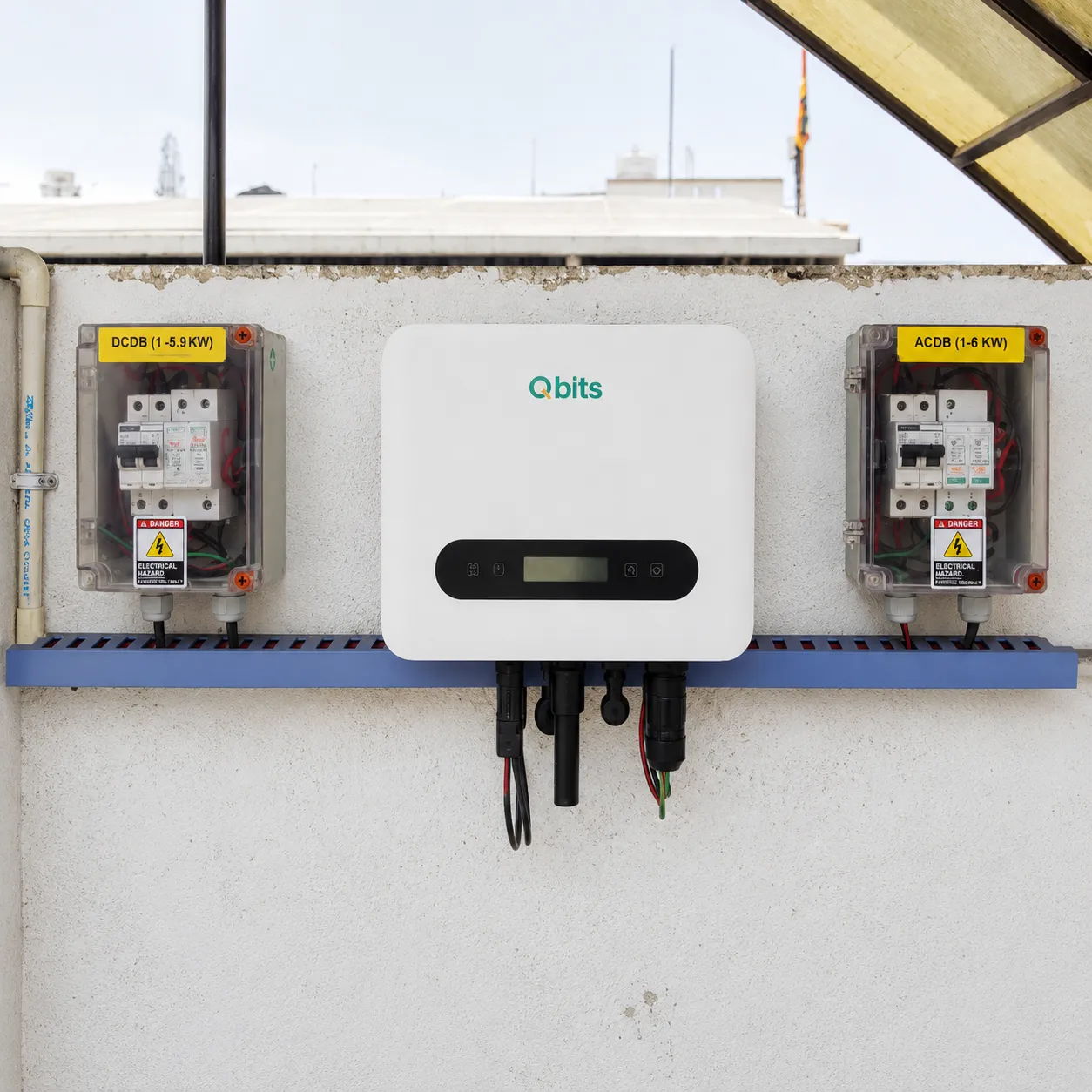
A Qbits inverter on a terrace wall, with a DC box on one side and an AC box on the other. Part of a roof sheet shows at the top right. The photo does not tell us the location, the owner or the system size.
Notice three things in this photo:
- The cables hang from the bottom of the inverter. Leave clear space below the unit so cables are not bent sharply and so rain running off the face does not land on the connectors.
- The two boxes sit level with the inverter on one cable tray. Short, tidy runs are easier to inspect and to isolate.
- There is something overhead. We cannot say how deep that cover is, but a roof above the unit is what we mean by “shaded”.
Practical points for a terrace:
- Rain. Choose a wall under cover, or mount high enough that splash and standing water cannot reach the bottom connectors. Ask for a drip loop in each cable so water drips off before it reaches the entry.
- Heat. A west-facing open wall gets sun in the hottest part of the day. A wall on the north or east side of a stair-head room is often cooler.
- Theft and tampering. An open roof is not watched. Ask whether a lockable box or a position near the roof door is sensible.
- Cable run to the board. Keep the AC run in mind. It is explained below.
Can a solar inverter go on a balcony?
A solar inverter can go on a balcony, but it is usually not the first choice for a full rooftop system. The panels are on the roof, so a balcony means a long cable path through the building, and in a flat that path may cross common shafts and walls that are not yours to drill.
The facade is the second issue. A box fixed to the outside of a flat is a change to the building, so most societies will want written approval. See solar for apartment complexes and RWAs for how permissions usually work.
Do not mix this up with plug-in balcony solar kits. That is a different product with its own legal grey zone, covered in balcony solar in India. Here we mean the inverter of a regular rooftop system.
If a balcony is the only option, pick a wall the rain does not reach, avoid a hot west face, and keep the unit away from the open edge.
Can a solar inverter go in a stairwell or under a staircase?
Only in a private stair, and only after you have asked your installer and society. A stairwell looks tempting. It is covered, close to the roof access, and handy for service. The photo below shows an inverter under a staircase in an interior setting.
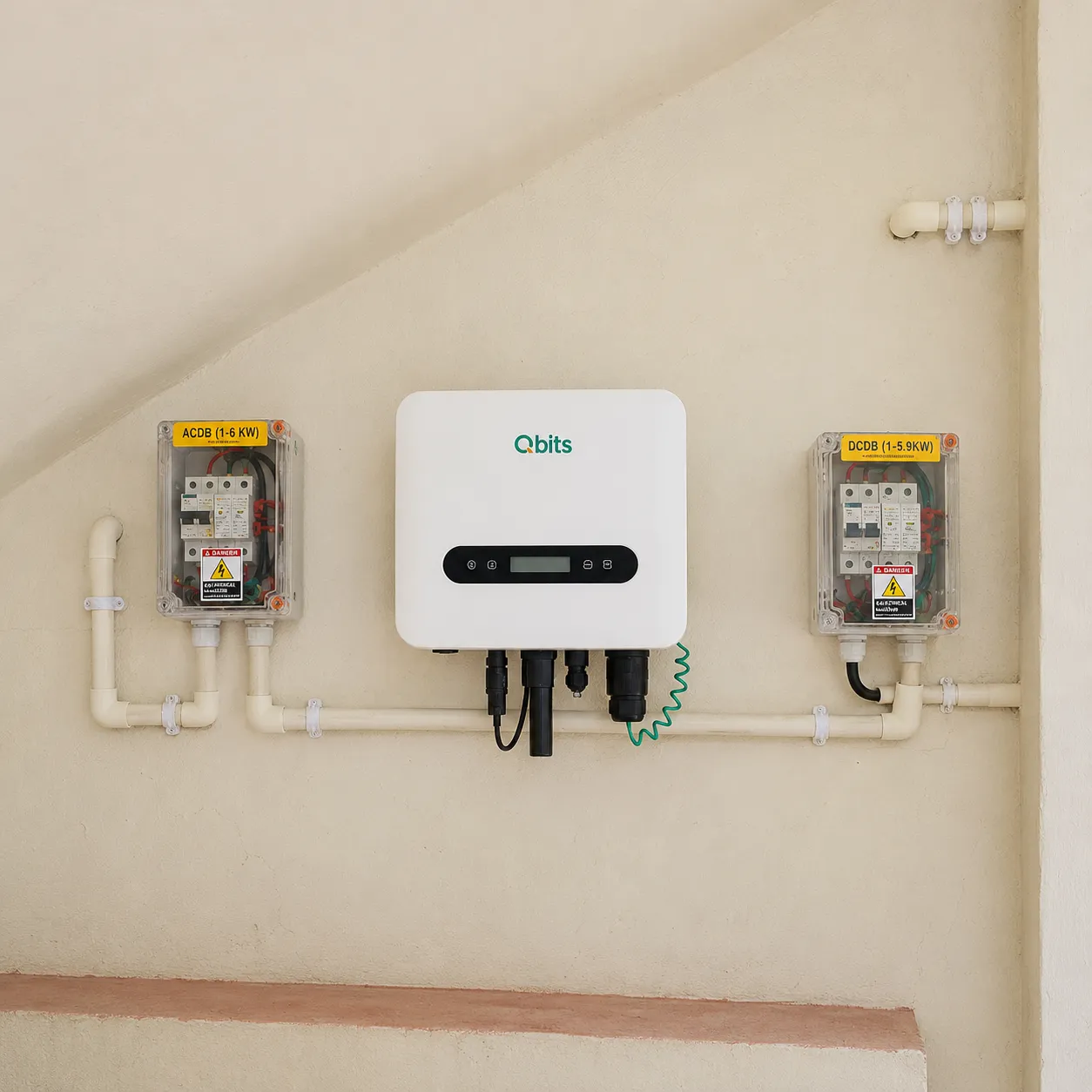
A Qbits inverter on a stairwell wall. The sloping line above is the underside of a staircase. The photo does not show whether this stair is private or shared.
That last sentence is the whole issue. A private stair inside your own house is a very different place from a stair shared by neighbours or used as the way out of a building.
- Exit routes. Staircases are how people leave a building in a fire. Anything fixed in or near that path can be a problem, and some buildings have rules about it. We did not verify the National Building Code text for this post, so we do not quote a clause. Ask your installer and your building society, in writing, whether this exact spot is allowed.
- Heat. A closed stair core can trap heat in summer. Natural cooling needs air movement.
- Do not put batteries here. For a hybrid system, keep lead-acid and lithium batteries out of a stairwell. This is a practical caution. We are not quoting a standard. See the battery section below.
- Headroom and knocks. Mount it where nobody brushes the box while carrying things.
In a flat, the common stair usually belongs to the society. Do not start work without approval.
Can a solar inverter go in a utility room or garage?
Yes, a utility room, garage or parking wall works when it is dry, ventilated and shaded.
- Utility or service room. Good protection from rain and theft. Poor if the room has a washing machine or geyser that steams the air, or a door that stays shut. The on-grid datasheet above says non-condensing humidity, which means water must not form on the unit. A damp steamy room is the opposite of that.
- Garage or parking wall. A strong wall near the meter in many homes. Mount it above vehicle reach and out of the car’s turning path, and do not hang it over a petrol or diesel point. Dust on the casing is a cooling problem, so plan to wipe it.
Should the inverter sit beside the main distribution board?
It can, and this is the neat option when the wall is also shaded and ventilated. The AC cable between the inverter and the board is short, the electrician reaches both at once, and whoever checks the net meter sees the work in one place.
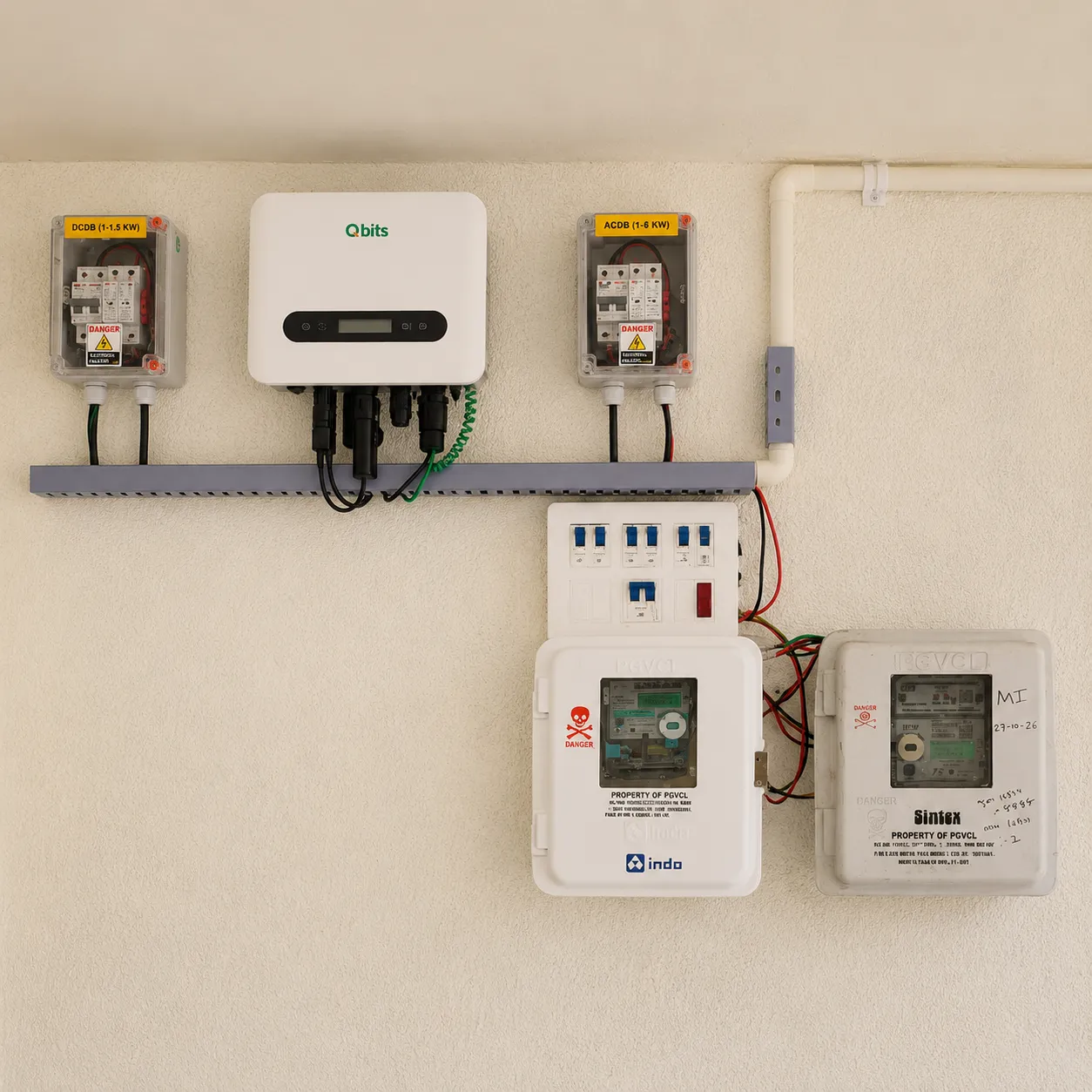
A Qbits inverter with its DC and AC boxes on a shared cable tray, above a small distribution board and two utility meter boxes. The photo does not tell us the DISCOM rules for this site.
Net metering rules on where the inverter or its isolator must be placed are set by your DISCOM and installer, not by us. Ask your DISCOM or installer whether it wants the AC isolator within reach of its staff. The net metering approval itself is a separate process, and a house with two electricity connections has its own questions, covered in solar for a house with two electricity connections.
How does cable length change the best location?
Distance is the part people forget. Every metre of cable between the panels and the inverter, and between the inverter and the board, wastes a little power as heat in the wire.
The simple rule: voltage drop is 2 x length x current x resistivity, divided by the cable cross-section. Copper resistivity is about 0.0175 ohm mm² per metre at 20 °C. Real cables run warmer, so the true drop is slightly higher. These are illustrative values, not a design.
| Case (copper cable) | Current | Resistance of the loop | Drop | Share of line voltage |
|---|---|---|---|---|
| DC, 4 mm², 20 m one way | 13 A | 0.175 ohm | 2.3 V | 0.6% of 360 V |
| DC, 4 mm², 60 m one way | 13 A | 0.525 ohm | 6.8 V | 1.9% of 360 V |
| AC, 6 mm², 20 m one way | 25 A | 0.117 ohm | 2.9 V | 1.3% of 230 V |
The 360 V figure is the “recommended MPP” voltage on the QB 4.6/5/6KTLS datasheet. The 25 A is its maximum output current for the 5 kW model. The 13 A is a typical panel short-circuit current. All three are inputs for the example, not promises about your system.
What to take from this:
- Tripling the DC run triples the loss, so a rooftop wall near the panels beats a ground-floor wall far below.
- The AC run to the board is shorter in most homes, but a long run raises the voltage at the inverter. That can push it towards its grid voltage limit. If the run is long, ask for a thicker cable.
- Ask your installer for the cable size, the length and the expected drop in writing. A good one answers in a minute.
Earthing, surge protection and isolators
- Earthing. The inverter and its boxes need a proper earth connection. Our grounding guide lists what to check. A location far from the earth pit means a long earth cable, so the pit position should be settled before you fix the wall.
- Surge protection. The QB 4.6/5/6KTLS datasheet lists surge protection as “Yes”. Boxes on the DC and AC side may also carry their own devices.
- Isolators. The same datasheet lists an integrated DC switch. Ask where the separate AC isolator will be, and whether you can reach it quickly from a safe spot.
Where do the batteries go in a hybrid system?
A hybrid inverter works with a battery bank, and the battery is a heavy, heat-sensitive item with its own placement needs. The hybrid catalogue lists lead-acid or lithium on 48 V. See lithium versus lead-acid solar batteries for the trade-offs.
Our practical cautions, without citing any standard:
- Keep batteries out of stairwells, passages and any place people must pass to leave.
- Follow the battery maker’s own manual for the room, spacing and ventilation. Ask your installer to show you that page.
- Do not box the battery in with the inverter in a closed cupboard.
- Keep the battery away from direct sun, water and cooking heat.
Where can a flat owner install the inverter?
If you live in a flat, three things decide where the inverter can go. The roof may belong to the society. The stair and the facade are common property. And the cable route may cross shafts that you do not control.
- Get written approval from the society before any drilling.
- Ask which wall, terrace or meter room the society will allow.
- Ask whether the cable route is permitted.
The guide to solar for apartment complexes and RWAs covers the process in more detail.
Can a technician reach the inverter easily?
The best location is no use if nobody can reach it. Before you sign off, check that a technician can stand comfortably in front of the unit, read the display, reach the DC switch, and open the boxes. Keep the front and underside free of stored items. A ladder-only position is a poor choice for a box you may need to look at.
Questions to ask your installer
Take this list with you. Ask for the answers in writing.
- Which wall have you chosen, and why not a shaded one?
- Will the unit be in direct sun at any time of day?
- What does the datasheet for my exact model say about operating temperature and mounting?
- What clearances does the user manual require, and how will you keep them?
- How long is the DC cable from the panels, what size is it, and what is the expected voltage drop?
- How long is the AC cable to the main board, and what size is it?
- Where is the earth pit, and where will the AC isolator sit?
- Is the spot on a staircase or shared exit? Does the society or building allow it?
- For a hybrid, where do the batteries go, and what does the battery maker’s manual say about that room?
- How will rain be kept out of the cable entries?
- Can a technician reach and read the unit without a ladder?
If the answers are vague, that is information too.
Your next step: walk the house with this list
Walk your house with the list above and note three walls: the best shaded wall near the panels, the wall nearest your main board, and any wall you are unsure about. Photograph them and measure the distances in metres. With those, an installer can say in one visit whether one wall does both jobs.
To see which Qbits inverter families are grouped for homes, go to the residential solar page. If you already have a system and the location is causing trouble, use the authorized service partners directory and confirm a partner’s status with Qbits first. To size the panels for your inverter, read how many solar panels a 5 kW inverter takes.
Qbits inverters for this guide
Specs below come from each model's datasheet. Confirm the exact model and current written terms with Qbits before you buy.
QB 4.2/4.6/5/5.4/6KTLS
- Power
- 4.2–6 kW
- Phase
- Single-phase
- MPPT
- Single-MPPT
QB 4/5/6 KTLD
- Power
- 4–6 kW
- Phase
- Single-phase
- MPPT
- Dual-MPPT
QBH 3KS/3K6S/4KS/4K6S/5KS/6KS48P
- Power
- 3–6 kW
- Phase
- Single-phase
- MPPT
- 1 or 2 MPPTs by model

Keyur Rakholiya CTO, Qbits Energy
Listed by Qbits as its CTO. Current role, technical responsibilities and credentials require confirmation by the company owner.