
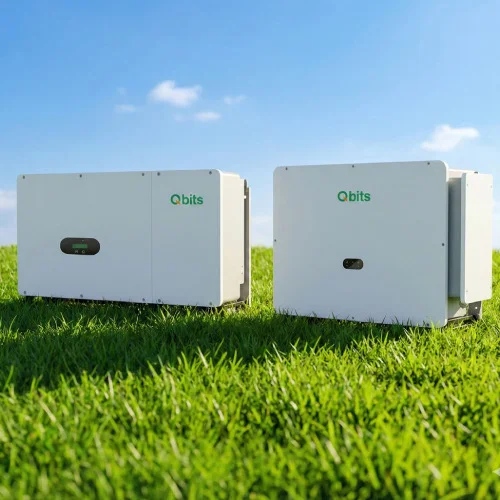
Commercial & Industrial Solar Inverters
Choose an inverter for your grid connection, PV array and project requirements. Request exact-model documents and a site-specific quotation.
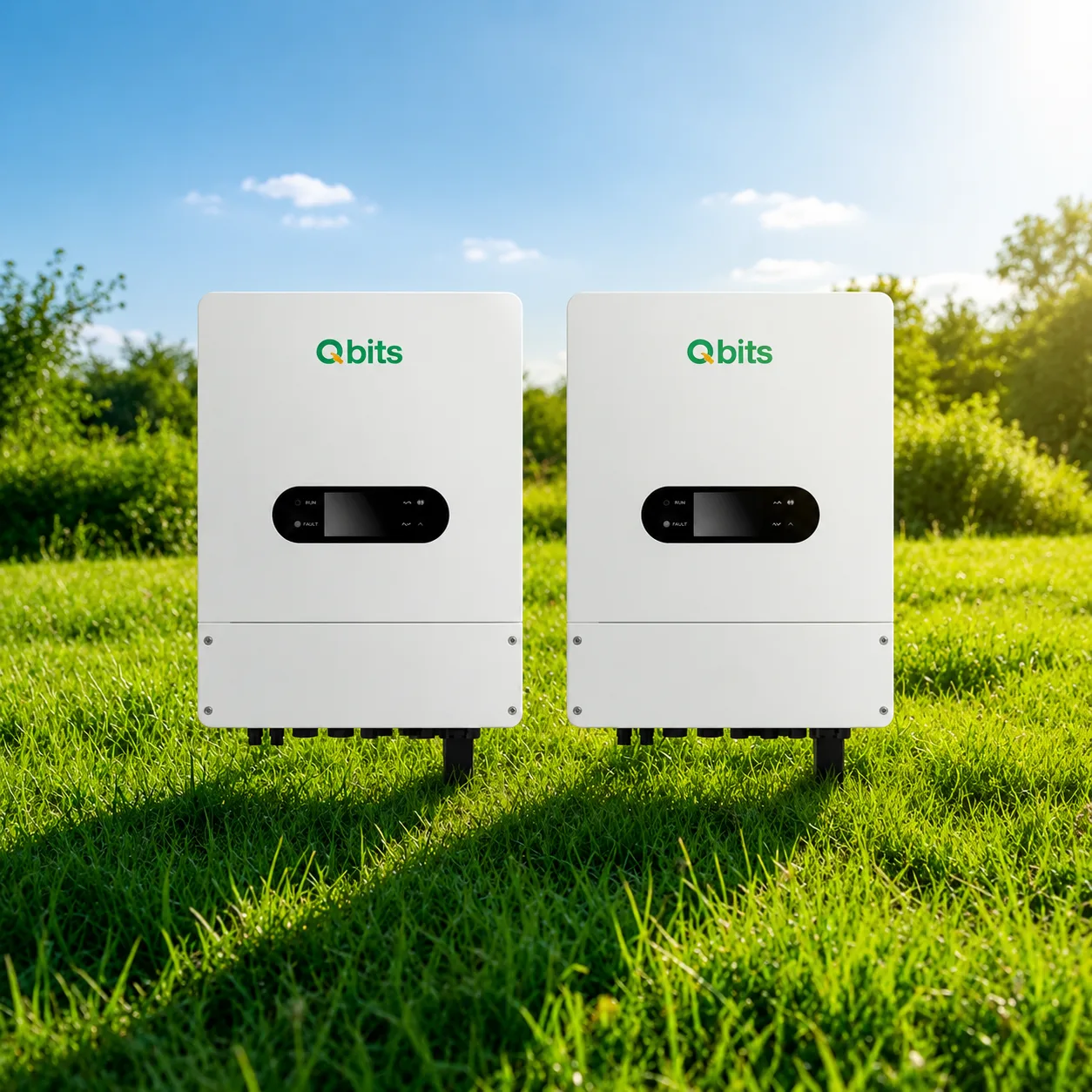
Specify the Inverter for Your Project
Match the inverter to your grid connection and array.
Qbits publishes three-phase inverter families for factories, warehouses, offices, and large-scale installations. Check the exact model limits, monitoring options and site assumptions before estimating return on investment.
Published three-phase families extend from 5 kW to 320 kW. Models with multiple MPPTs may support separately designed array groups when their voltage and current limits permit. Request the current BIS, IEC and project evidence for the exact SKU instead of treating a standard cited in a datasheet as a current certificate.
Prepare the inverter requirement before requesting a quote
Provide the project location, grid voltage and phase, proposed PV array, model or capacity shortlist, number of units and delivery schedule. Separate inverter AC capacity from array DC capacity and total project size.
Check model datasheets and the EPC supplier qualification checklist. If you are an EPC buying several units, you can send a bulk supply enquiry. The 225–320 kW EHV family specifies an 800 Vac connection; assess its transformer and grid requirements separately from low-voltage rooftop families.
Compare three-phase models
Each row is a three-phase on-grid family from the published product data. The kW figure is the range across the family, and MPPT count and efficiency are as listed for it, so confirm the exact figures on the datasheet for the model you shortlist. For the high-capacity 225–320 kW EHV family, check the grid connection voltage first.
| Model | Capacity | Phase | MPPT | Max efficiency | Details |
|---|---|---|---|---|---|
| QB 5/6/8/10/12/15/17KTLC | 5–17 kW | Three-phase | 2 MPPTs | 98.5–98.7% by model | Model page · Datasheet (PDF) · Enquire |
| QB 20/23/25/28/30KTLC | 20–30 kW | Three-phase | 2 MPPTs | 98.8% | Model page · Datasheet (PDF) · Enquire |
| QB 30/33/36/40KTLC-Pro | 30–40 kW | Three-phase | 3 MPPTs | 98.6–98.7% by model | Model page · Datasheet (PDF) · Enquire |
| QB 40/45/50KTLC-Plus | 40–50 kW | Three-phase | 4 MPPTs | 98.6–98.7% by model | Model page · Datasheet (PDF) · Enquire |
| QB 50/60KTLC | 50–60 kW | Three-phase | 3 MPPTs | 98.7–98.9% by model | Model page · Datasheet (PDF) · Enquire |
| QB 70/75/80/90/100/110KTLC-Pro | 70–110 kW | Three-phase | 6 or 8 MPPTs by model | 98.6–98.7% by model | Model page · Datasheet (PDF) · Enquire |
| QB 80/90/100/110/125KTLC | 80–125 kW | Three-phase | 8 to 10 MPPTs by model | 98.6–98.9% by model | Model page · Datasheet (PDF) · Enquire |
| QB 225/320K-EHV | 225–320 kW | Three-phase | 12 MPPTs; 14 or 16 optional on 320 kW | 99.02% | Model page · Datasheet (PDF) · Enquire |
How to choose a commercial or industrial inverter
Start from the connection
Note the supply voltage, sanctioned load or contract demand, and who approves the interconnection. Many DISCOMs limit solar capacity to the sanctioned load or contract demand. The three-phase inverter buyer guide covers what to check on a three-phase connection.
Separate AC and DC capacity
The inverter's AC rating, the array's DC size and the total project size are three different numbers. Choose the inverter count from the AC load and the connection, then check the array fits within each model's input limits. Solar inverters for factories walks through typical industrial loads.
Plan MPPTs around roof zones
Give each roof zone with a different tilt, orientation or shading its own MPPT where you can. A mid-size example is QB 30/33/36/40KTLC-Pro, a three-phase family listed with 3 MPPTs and a maximum efficiency of 98.6–98.7% by model. Larger roofs may suit families with more MPPTs, as the table shows.
Check strings and the business case
Check string voltage and current against each MPPT's limits using the string sizing calculator as a first screen. When you estimate returns, use your own tariff, load and installed cost, as in solar IRR and payback for C&I.
Installers and dealers who want to supply these models can apply to become a Qbits partner.
The Three-Phase Range at a Glance
5–320 kW
Published three-phase range
8
Three-phase model families
2–12
MPPTs, varies by model
Site
Model project ROI
Built for Commercial Scale
Three-Phase, 5 to 320 kW
Published three-phase models run from QB 5KTLC to QB 320K-EHV. Choose the exact model for your site, grid voltage and array.
Project Configuration
Confirm each inverter and its string and MPPT layout against the exact model documents.
Communication Options
The published three-phase models list Wi-Fi communication with optional RS485 or GPRS. Confirm the supported monitoring interface for your model.
Project Economics
Model savings from site load, tariff, generation and installed cost.
Multi-MPPT Technology
MPPT count depends on the model: 2 on the QB 5 to 30KTLC families, 8 to 10 on the QB 80 to 125KTLC family, and 12 as standard on QB 225/320K-EHV (14 or 16 optional on 320 kW).
Enclosure and DC Input
Every published three-phase model lists an IP66 enclosure and a maximum DC input of 1100 V (1500 V on QB 225/320K-EHV).
Where Three-Phase Inverters Are Used
Manufacturing
Check roof area, daytime load and the connection voltage before choosing the inverter capacity.
Warehousing
Check roof area, daytime load and connection constraints for the proposed system.
Commercial Buildings
Office complexes and retail spaces. Confirm phase, connection voltage and approvals with the local utility.
Educational Institutions
Schools and colleges with large rooftops and daytime consumption.
Ready to Shortlist Your Project’s Inverters?
Share your project requirements and request model-specific pricing, availability and documents. Pricing is quoted for the exact model.