



IP66 Inverters: India’s Climate Survival Guide 2026

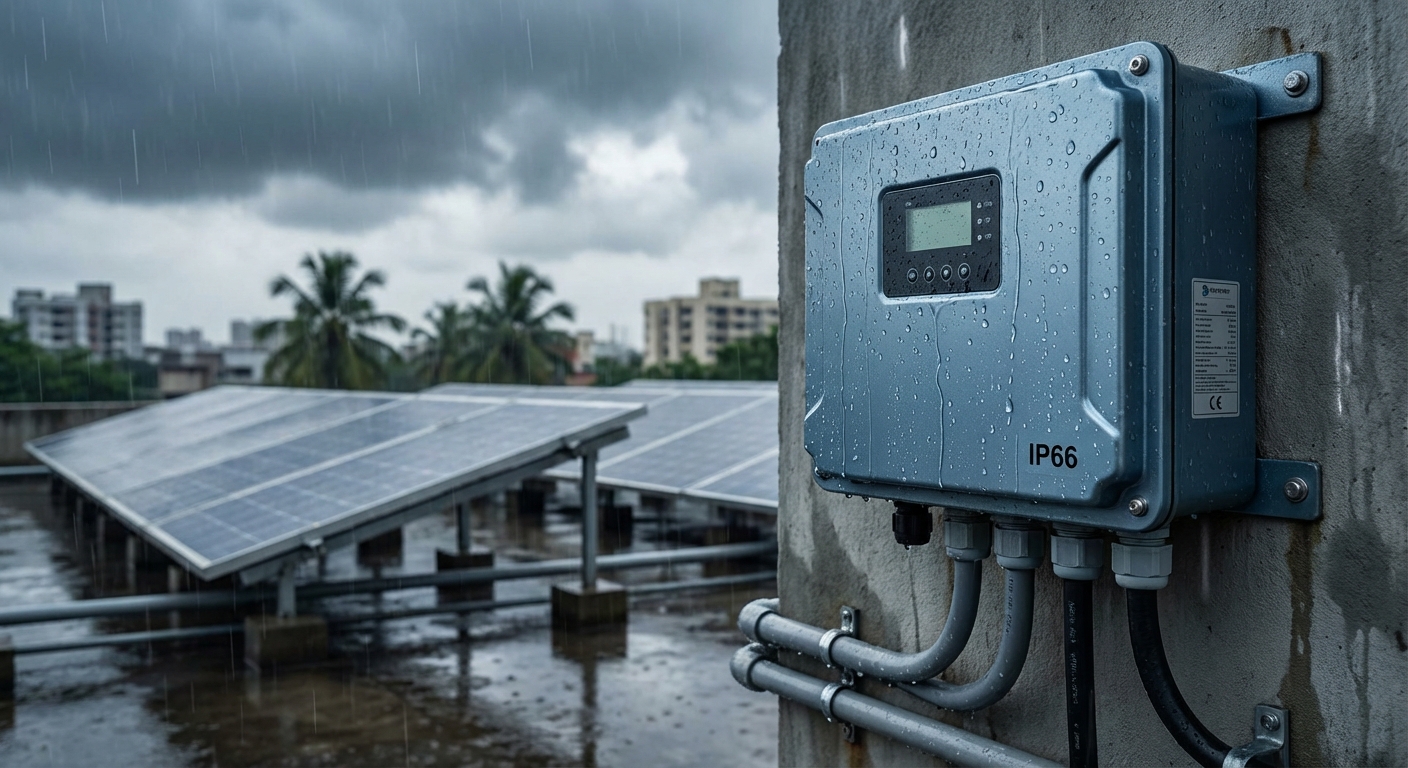
When a solar installation fails during India’s first monsoon downpour, the financial consequences extend far beyond a simple repair bill. For EPCs and solar installers across India, equipment durability isn’t just a technical specification—it’s the foundation of business reputation and long-term profitability. In 2026, as solar installations expand across India’s most challenging climate zones, IP66 inverters have emerged as the non-negotiable standard for weather protection in rooftop solar systems.
India’s climate presents a unique combination of extreme weather challenges that few other markets face simultaneously. From the relentless monsoons of Kerala to the scorching dust storms of Rajasthan, from the salt-laden coastal air of Tamil Nadu to the temperature extremes of Madhya Pradesh, solar inverters must withstand conditions that would quickly destroy inadequately protected equipment. This comprehensive guide examines how IP66 inverters provide the weather resistance necessary for reliable solar performance across India’s diverse climate zones, helping EPCs make informed decisions that protect both their installations and their bottom line.
Understanding IP66 Weather Protection: What It Means for Solar Inverters
The IP (Ingress Protection) rating system provides a standardized method for classifying the degree of protection electrical enclosures offer against solid objects and liquids. For solar professionals evaluating IP66 inverters, understanding this rating system is essential to making informed equipment selections.
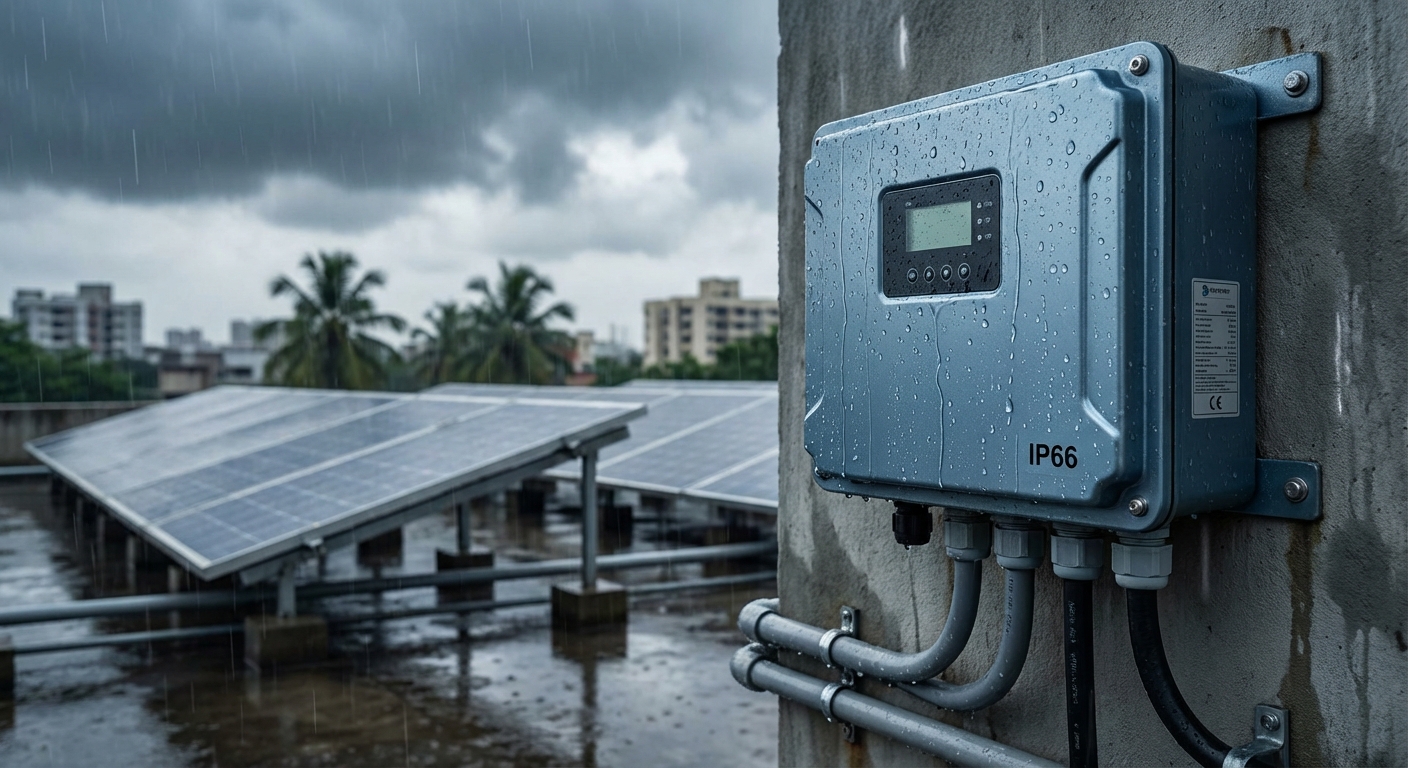
The IP rating consists of two digits, each representing a specific level of protection. The first digit (ranging from 0 to 6) indicates protection against solid particles, while the second digit (ranging from 0 to 9) indicates protection against liquids. In the case of IP66 inverters, both digits represent the highest practical protection levels for solar installations:
- First digit “6” (Dust-tight protection): Complete protection against dust ingress. No dust particles can enter the enclosure even under prolonged exposure to fine particulate matter. This is critical for Indian installations facing dust storms, construction site environments, and agricultural areas with high airborne particulate levels.
- Second digit “6” (Water jet protection): Protection against powerful water jets from any direction. The enclosure can withstand water projected by a 12.5mm nozzle at 100 liters per minute from any angle without harmful ingress. This protection level is essential for surviving India’s intense monsoon rainfall and rooftop cleaning operations.
Lower IP ratings such as IP54 or IP65 may seem adequate on paper, but they fall short in real-world Indian conditions. An IP54-rated inverter offers only “dust protected” (not dust-tight) status and protection against water splashing, which proves insufficient during heavy monsoons. Even IP65, while dust-tight, only protects against water jets from a specific direction—a limitation that becomes critical when wind-driven rain approaches from multiple angles during severe weather events.
The practical implications of inadequate weather protection manifest quickly in the field. Water ingress leads to component corrosion, short circuits, and complete system failure. Dust accumulation causes overheating, reduced efficiency, and accelerated component degradation. For EPCs, a single weather-related inverter failure can trigger warranty claims, emergency service calls, production losses, and damaged client relationships—costs that far exceed any initial savings from choosing lower-rated equipment.
India’s Climate Challenges: Why IP66 Inverters Are Non-Negotiable
India’s geographical diversity creates one of the world’s most demanding environments for solar equipment. Understanding these regional climate challenges explains why IP66 inverters have become the industry standard for reliable solar installations across the country.
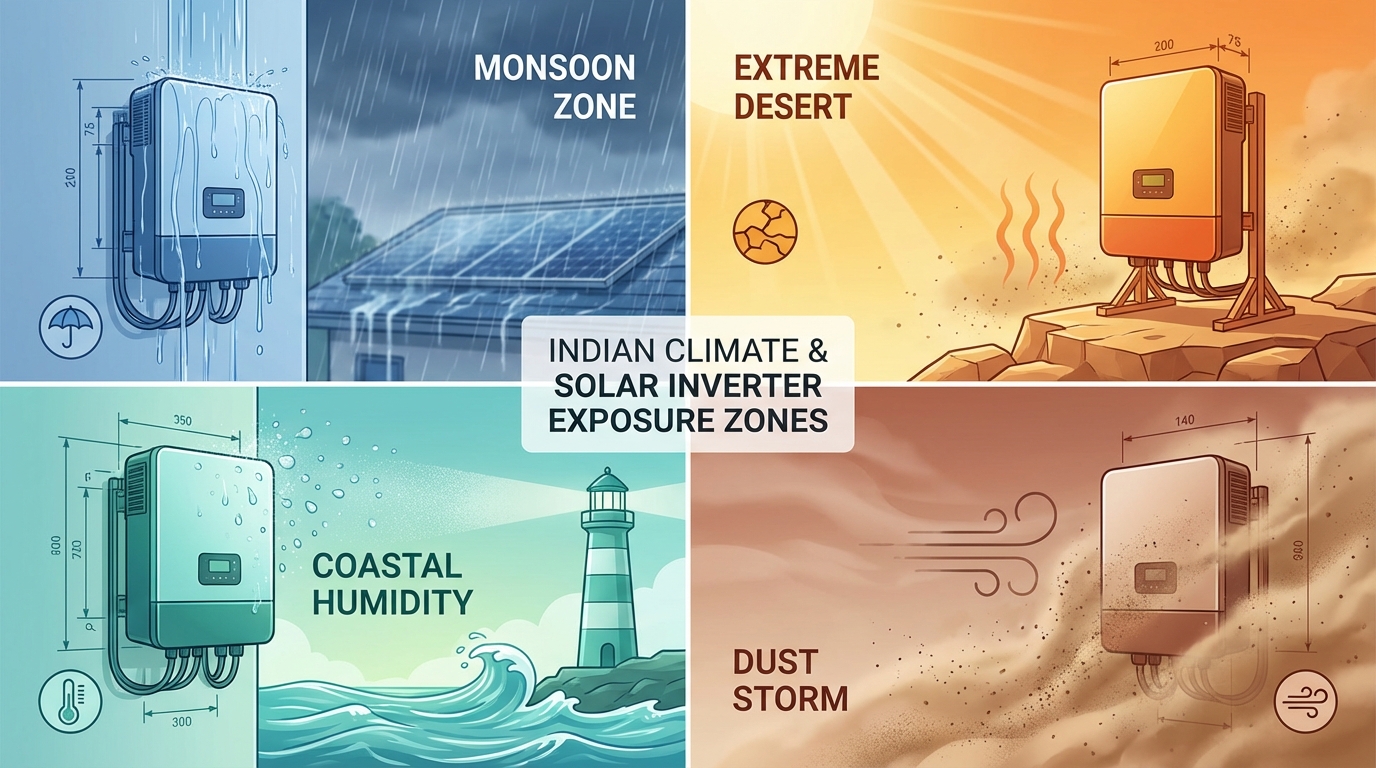
The monsoon season, spanning June through September across most of India, delivers rainfall intensities that test equipment protection to its limits. Mumbai receives over 2,400mm of annual rainfall, with individual storm events producing sustained heavy downpours. During these periods, rooftop-mounted inverters face not just vertical rainfall but wind-driven water jets approaching from all angles, precisely the scenario that IP66 inverters are engineered to withstand. Industry data from 2025 indicates that inverters with ratings below IP65 experienced failure rates exceeding 15% during their first monsoon season, compared to less than 2% for properly installed IP66 units.
Extreme heat presents equally severe challenges in India’s northern and central regions. Cities like Nagpur and Jaipur regularly experience summer temperatures exceeding 45°C, with rooftop surface temperatures climbing even higher. These conditions create thermal cycling stress as equipment heats during the day and cools at night, causing expansion and contraction that can compromise seals and gaskets in lower-quality enclosures. IP66 inverters designed for Indian conditions incorporate thermal management systems that maintain protection integrity across wide temperature ranges while preventing heat buildup that reduces component lifespan.
Coastal installations face the insidious challenge of salt-laden humidity. In cities like Chennai, Visakhapatnam, and Goa, the combination of high humidity and airborne salt particles creates a corrosive environment that accelerates metal degradation and electrical contact deterioration. Standard IP ratings don’t specifically address corrosion resistance, making it essential to select IP66 inverters manufactured with marine-grade materials and protective coatings specifically engineered for coastal environments.
Dust storms in arid regions like Rajasthan and Gujarat generate massive quantities of fine particulate matter that can penetrate even small gaps in equipment enclosures. Once inside, this dust accumulates on circuit boards and cooling components, creating insulation layers that cause overheating and eventual component failure. The dust-tight protection of IP66 inverters prevents this accumulation, maintaining optimal thermal performance and component longevity even in the dustiest environments.
How IP66 Inverters Withstand India’s Harshest Weather Conditions
The engineering behind IP66 inverters involves sophisticated design elements that work together to create comprehensive weather protection without compromising performance or thermal management.
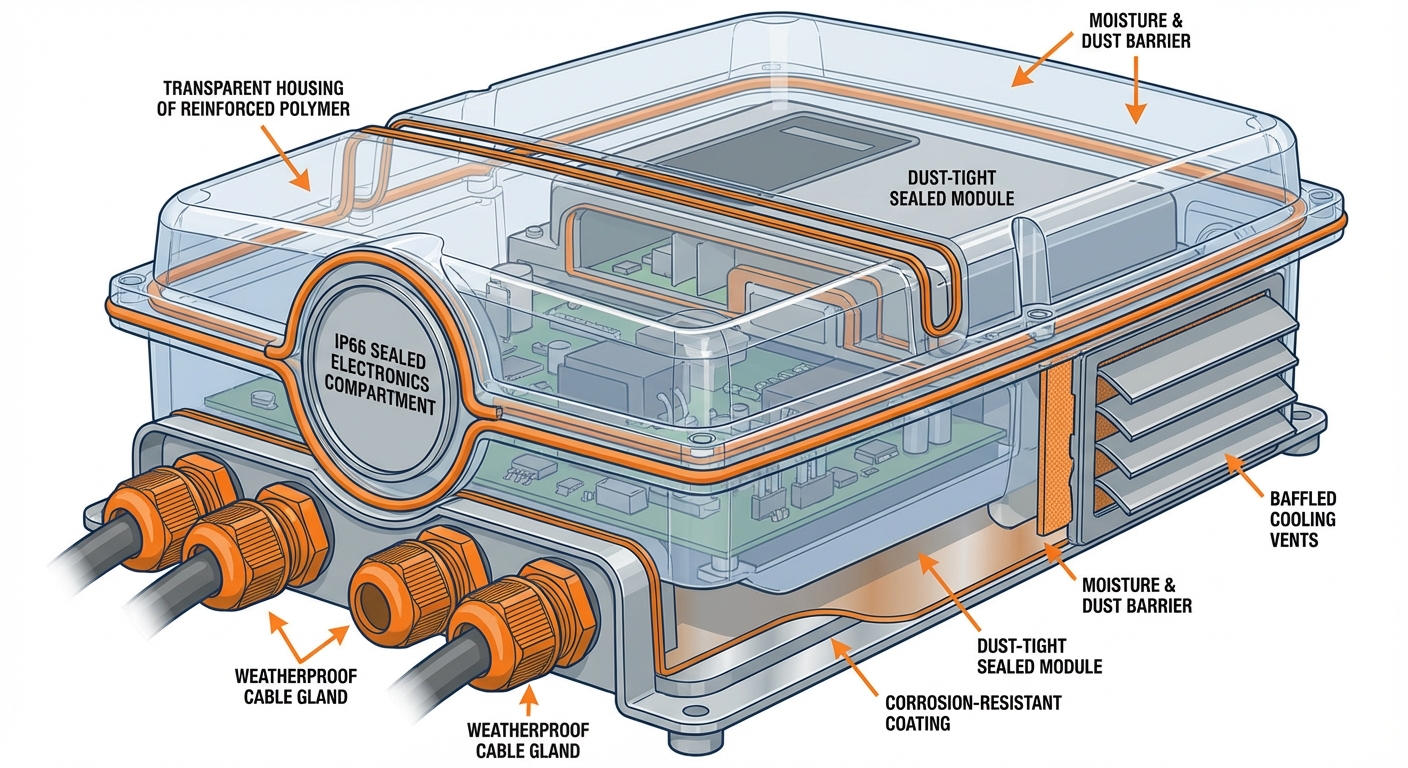
Sealed enclosures form the foundation of IP66 protection. High-quality inverters utilize precision-molded enclosures with continuous gasket seals around all access points. These gaskets, typically manufactured from silicone or EPDM rubber, maintain their sealing properties across wide temperature ranges and resist degradation from UV exposure and ozone. The enclosure design eliminates unnecessary seams and joints, with each potential entry point carefully engineered to maintain the IP66 rating.
Thermal management presents a unique challenge for sealed enclosures. While complete sealing protects against environmental ingress, it also traps heat generated by power conversion components. Advanced IP66 inverters address this through intelligent ventilation systems that incorporate labyrinth pathways and baffles. These designs allow air circulation for cooling while preventing direct water or dust ingress, maintaining both thermal performance and weather protection simultaneously.
Cable entry points represent critical vulnerability areas in any electrical enclosure. IP66 inverters employ specialized cable glands with multiple sealing layers that compress around incoming cables, creating watertight and dust-tight seals. These glands accommodate the thermal expansion and contraction of cables while maintaining seal integrity, and they’re designed to prevent loosening from vibration or physical stress over years of operation.
Corrosion-resistant materials and coatings extend protection beyond simple ingress prevention. Quality manufacturers apply powder coating or specialized protective finishes to metal enclosures, creating barriers against moisture and salt corrosion. Internal components receive conformal coating, a thin protective layer applied to circuit boards that provides additional moisture resistance even in the unlikely event of enclosure compromise.
Certification and testing verify that these design elements deliver real-world protection. Genuine IP66 inverters undergo rigorous testing according to IEC 60529 standards, including dust chamber exposure and water jet testing from multiple angles. Reputable manufacturers like Qbits Energy subject each unit to over 1000 automated quality tests, ensuring that IP66 protection isn’t just a specification on paper but a verified performance characteristic of every shipped unit.
Regional Weather Considerations Across India
Selecting and installing IP66 inverters requires understanding the specific weather challenges of different Indian regions. While IP66 protection provides a baseline standard, installation practices and additional considerations vary based on local climate conditions.
Monsoon-Heavy Regions: Kerala, Maharashtra, West Bengal
In regions experiencing intense monsoon rainfall, water ingress prevention becomes the primary concern. Cities like Mumbai, Kolkata, and Kochi face sustained periods of heavy rainfall with wind speeds that drive water horizontally and even upward into equipment enclosures. For these installations, IP66 inverters should be mounted with slight forward tilt to prevent water pooling on top surfaces, and all cable entries should approach from below to prevent water running down cables into glands.
Humidity management extends beyond the monsoon season in these regions. Year-round high humidity levels can lead to condensation inside enclosures during temperature fluctuations. Quality IP66 inverters incorporate internal humidity management through desiccant materials or active ventilation systems that prevent condensation buildup. EPCs should verify that selected inverters include these features for monsoon-region installations.
Installation timing matters significantly in these areas. Scheduling inverter installation during the dry season allows proper curing of sealants and adhesives before the first monsoon exposure. Post-monsoon inspections should verify that seals remain intact and no water ingress has occurred, establishing a baseline for long-term monitoring.
Extreme Heat Zones: Rajasthan, Gujarat, Madhya Pradesh
In India’s hottest regions, thermal management becomes as critical as weather protection. Summer temperatures regularly exceed 45°C, with rooftop surface temperatures climbing above 60°C. At these extremes, IP66 inverters must maintain both their weather sealing and their thermal performance to prevent component degradation.
Dust storm protection requires particular attention in these arid zones. The fine particulate matter generated during dust storms can penetrate surprisingly small gaps, making the dust-tight protection of IP66 inverters essential. Installation practices should include regular inspection of seal integrity, as the thermal cycling in these regions can accelerate gasket aging.
UV resistance becomes a long-term durability factor. Enclosure materials and coatings must resist degradation from intense solar radiation. Quality manufacturers use UV-stabilized materials and protective coatings that maintain their properties over 15-20 year equipment lifespans. When evaluating IP66 inverters for these regions, EPCs should verify UV resistance specifications and review long-term field performance data from similar climate zones.
Derating considerations affect system design in extreme heat zones. While IP66 inverters maintain protection at high temperatures, power conversion efficiency may decrease slightly as thermal management systems work harder. System designers should account for these factors when sizing inverters for installations in Rajasthan, Gujarat, and similar regions, ensuring adequate capacity even during peak summer conditions.
Coastal Areas: Tamil Nadu, Andhra Pradesh, Goa
Coastal installations face the most corrosive environment for solar equipment. The combination of salt spray, high humidity, and temperature fluctuations creates conditions that can rapidly degrade inadequately protected equipment. For these locations, IP66 inverters represent the minimum acceptable protection level, and additional material considerations become critical.
Salt spray corrosion affects both external enclosures and internal components if any ingress occurs. EPCs installing in coastal areas should specifically verify that selected IP66 inverters incorporate marine-grade materials, including stainless steel hardware, corrosion-resistant coatings, and conformal-coated circuit boards. Standard aluminum enclosures without proper protective coating will corrode in coastal environments regardless of IP rating.
Installation distance from the coastline affects exposure severity. Installations within 1 kilometer of the ocean face the most aggressive conditions, while those 5-10 kilometers inland experience significantly reduced salt exposure. This gradient should inform both equipment selection and maintenance scheduling, with closer installations requiring more frequent inspection and preventive maintenance.
Long-term durability in coastal climates depends heavily on installation quality. Even the best IP66 inverters will fail prematurely if cable glands are improperly installed or if mounting hardware creates galvanic corrosion pathways. EPCs should ensure installation teams receive specific training on coastal installation requirements and use only corrosion-resistant mounting hardware and sealants rated for marine environments.
The Financial Impact: How IP66 Inverters Reduce Total Cost of Ownership
The business case for IP66 inverters extends far beyond initial equipment cost. For EPCs and solar installers, total cost of ownership analysis reveals that weather-protected inverters deliver substantial financial advantages over their operational lifetime.
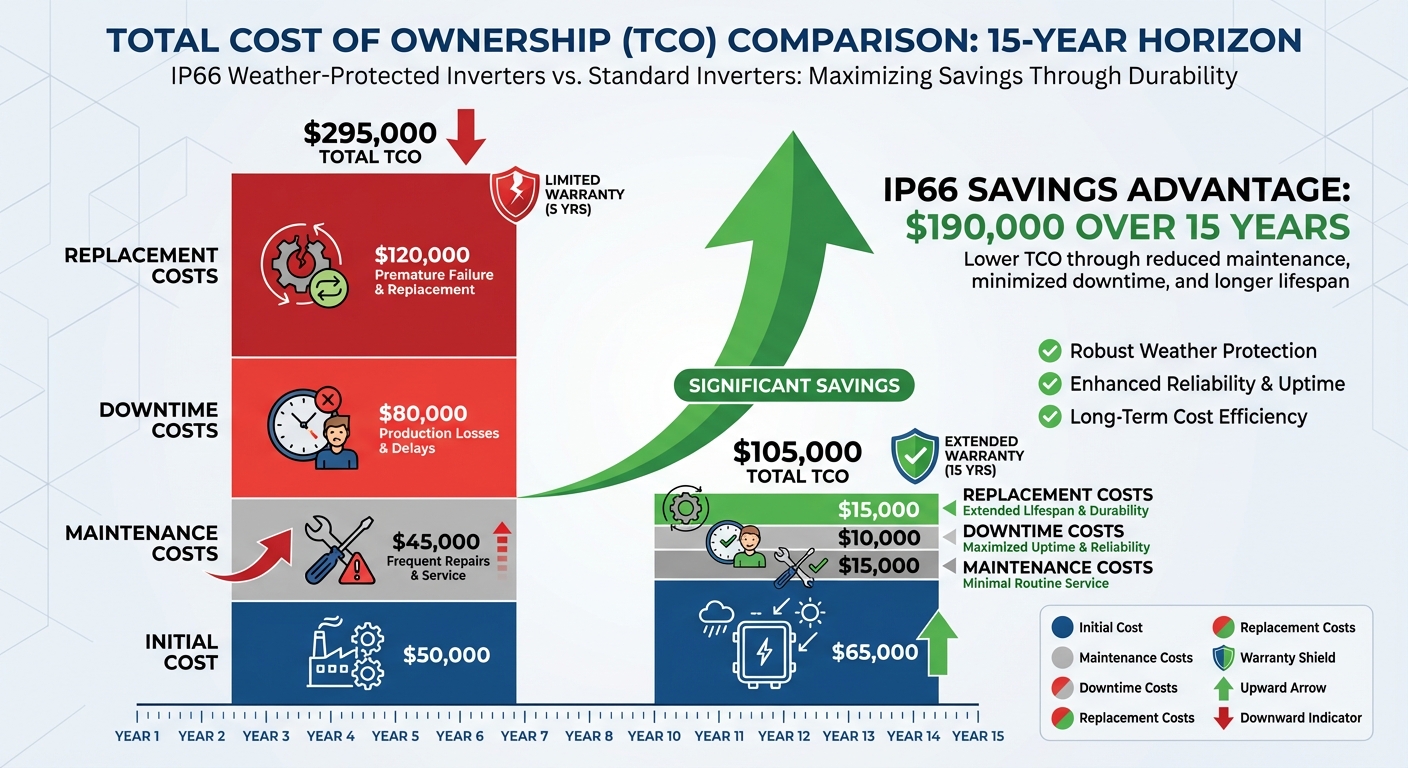
Maintenance cost reduction represents the most immediate financial benefit. Inverters without adequate weather protection require frequent service calls for cleaning, seal replacement, and component repair. Industry data from 2025 indicates that installations using lower-rated inverters averaged 3-4 service interventions per year, with each visit costing ₹5,000-15,000 in labor and parts. In contrast, properly installed IP66 inverters typically require only annual preventive maintenance, reducing service costs by 60-70% over a 10-year period.
Extended equipment lifespan directly impacts return on investment calculations. Standard inverters in harsh Indian conditions often fail within 5-7 years, requiring complete replacement. Quality IP66 inverters manufactured with German-grade components routinely operate for 12-15 years or longer, effectively doubling the equipment lifespan. For a commercial installation with ₹5 lakh in inverter costs, this extended lifespan eliminates a mid-life replacement expense that would otherwise erode project returns.
Downtime and production losses create hidden costs that many EPCs underestimate. When an inverter fails, the entire solar array stops producing power until repairs are completed. For a 100kW commercial installation, each day of downtime represents approximately ₹2,000-3,000 in lost production value. Weather-related failures often occur during monsoon season when access is difficult and replacement parts may be delayed, extending downtime to weeks rather than days. IP66 inverters dramatically reduce these failure incidents, protecting revenue streams and client satisfaction.
Warranty protection provides financial security but only when manufacturers stand behind their products. Qbits Energy’s 12-year full replacement warranty on IP66 inverters reflects confidence in weather protection engineering and component quality. This warranty coverage eliminates replacement costs during the critical first decade of operation, providing EPCs with predictable cost structures and reducing financial risk on long-term solar projects. When comparing inverter options, EPCs should carefully evaluate warranty terms specific to weather-related failures, as many manufacturers exclude environmental damage from coverage.
Insurance and risk mitigation benefits extend beyond direct equipment costs. Solar installations with documented use of high-quality, weather-protected equipment may qualify for reduced insurance premiums and more favorable financing terms. Additionally, EPCs building reputations for reliable installations using IP66 inverters gain competitive advantages in bidding processes, as sophisticated clients increasingly evaluate long-term reliability rather than just initial costs.
Comparative analysis over 15 years demonstrates the financial advantage clearly. A typical 100kW commercial installation using standard inverters might incur ₹8-12 lakh in total inverter-related costs (initial purchase, mid-life replacement, maintenance, downtime losses). The same installation using quality IP66 inverters typically sees total costs of ₹6-8 lakh, despite potentially higher initial equipment prices. This 25-35% reduction in total cost of ownership translates directly to improved project returns and enhanced client satisfaction.
IP66 Inverters Selection Criteria for EPCs and Installers
Selecting the right IP66 inverters requires looking beyond the IP rating specification to evaluate the complete package of quality, support, and long-term reliability that manufacturers provide.
Verifying genuine IP66 certification starts with documentation review. Reputable manufacturers provide IEC 60529 test reports from accredited laboratories, not just self-declared ratings. EPCs should request and review these test reports, verifying that testing covered the complete inverter assembly including all cable entry points and access panels, not just the base enclosure. Manufacturers who hesitate to provide detailed certification documentation should raise immediate concerns.
Component quality determines whether an inverter will maintain its IP66 protection over years of thermal cycling and environmental exposure. IP66 inverters manufactured with German-grade electronic components and industrial-quality gaskets maintain seal integrity far longer than units built with commodity components. Qbits Energy’s approach of subjecting each unit to over 1000 automated quality tests ensures that every component meets stringent standards before the inverter ships, providing confidence that IP66 protection will persist throughout the equipment’s operational life.
Warranty terms specific to weather-related failures reveal manufacturer confidence in their weather protection engineering. Standard warranties often include exclusions for “environmental damage” or “improper installation,” potentially leaving EPCs exposed to costs from weather-related failures. When evaluating IP66 inverters, look for comprehensive warranty coverage that explicitly includes protection against weather-related failures when proper installation procedures are followed. The 12-year full replacement warranty offered by manufacturers like Qbits Energy demonstrates genuine confidence in IP66 protection performance.
Installation requirements affect both initial costs and long-term protection maintenance. Some IP66 inverters require complex installation procedures or specialized tools to maintain weather protection, increasing labor costs and creating opportunities for installation errors. EPCs should evaluate installation complexity during the selection process, considering both initial installation and future maintenance access requirements. Comprehensive inverter selection criteria should include installation practicality alongside technical specifications.
Monitoring capabilities enable early detection of environmental stress before it causes equipment failure. Advanced IP66 inverters with integrated monitoring systems can detect temperature anomalies, humidity intrusion, or performance degradation that might indicate compromised weather protection. Qbits Energy’s AI-powered WhatsApp monitoring system provides real-time alerts when environmental conditions threaten equipment performance, allowing preventive intervention before failures occur. This intelligent monitoring transforms weather protection from a passive feature into an active system that protects both equipment and investment returns. Learn more about advanced monitoring capabilities that complement IP66 protection.
Manufacturer reputation and local support infrastructure matter significantly for long-term success. IP66 inverters from established manufacturers with strong Indian presence provide access to technical support, replacement parts, and warranty service when needed. Qbits Energy’s backing by the Heaven Group legacy combines manufacturing expertise with comprehensive support infrastructure, ensuring that EPCs have access to assistance throughout the equipment lifecycle. When evaluating manufacturers, consider not just the product specifications but the complete support ecosystem that ensures long-term success.
Installation Best Practices to Maintain IP66 Protection
Even the highest-quality IP66 inverters will fail prematurely if installation practices compromise their weather protection. EPCs must ensure installation teams follow proven procedures that maintain manufacturer-designed protection levels.
Proper mounting orientation significantly affects weather protection performance. IP66 inverters should be mounted vertically or with slight forward tilt (5-10 degrees) to prevent water pooling on top surfaces and to ensure that any condensation drains away from sensitive components. Avoid mounting inverters in recessed areas where water can accumulate or in locations exposed to direct water runoff from roof edges or gutters.
Cable gland installation represents the most common point of weather protection failure. Each cable entry must use appropriately sized glands with proper compression to create effective seals. Installation teams should follow these critical steps:
- Select cable glands matching the exact cable diameter, avoiding oversized glands that cannot compress adequately
- Remove only the minimum necessary cable jacket length, maintaining maximum insulation coverage
- Tighten gland compression nuts to manufacturer-specified torque values using calibrated tools
- Route cables with drip loops before entry points, preventing water from running along cables into glands
- Apply additional sealant around gland threads before installation in coastal or extreme weather locations
Common installation mistakes that compromise IP66 protection include over-tightening access panel fasteners (which can deform gaskets), using incompatible sealants that degrade gasket materials, mounting inverters in locations where they’ll be submerged during heavy rainfall, and failing to properly seal conduit entries. Installation teams should receive specific training on these failure modes and verification procedures to confirm proper installation.
Periodic inspection and maintenance protocols preserve long-term weather protection. EPCs should establish annual inspection schedules that include:
- Visual inspection of all gaskets and seals for degradation, compression set, or damage
- Verification that cable glands remain properly tightened and sealed
- Examination of enclosure surfaces for corrosion, coating damage, or physical impacts
- Testing of ventilation systems to ensure proper airflow without compromised protection
- Documentation of inspection findings with photographic records for trend analysis
Documentation and compliance verification create accountability and provide evidence of proper installation practices. Installation teams should photograph all cable entries, mounting details, and seal conditions before closing enclosures. These records serve multiple purposes: they provide baseline documentation for future inspections, they demonstrate compliance with manufacturer requirements for warranty purposes, and they create training materials for improving installation practices across the organization.
Training requirements for installation teams should include both theoretical understanding of IP protection principles and hands-on practice with actual equipment. Teams should understand why each installation step matters, not just follow rote procedures. This deeper understanding enables installers to adapt to field conditions while maintaining protection standards and to identify potential issues before they compromise equipment performance.
Future-Proofing Solar Installations with IP66 Inverters in 2026
As India’s solar industry matures and climate patterns evolve, the importance of weather-protected equipment continues to grow. Forward-thinking EPCs recognize that IP66 inverters represent not just current best practice but essential future-proofing for long-term solar installations.
Climate change is intensifying weather extremes across India. Meteorological data from 2024-2025 shows increasing frequency of severe weather events, including more intense monsoon rainfall, longer heat waves, and more frequent dust storms. These trends suggest that equipment adequate for yesterday’s climate may prove insufficient for tomorrow’s conditions. IP66 inverters provide margin for these increasing extremes, protecting installations against weather conditions that exceed historical norms.
Evolving industry standards and regulatory requirements increasingly emphasize equipment durability and long-term reliability. As the Indian solar market matures, procurement specifications are shifting from lowest-cost selection to total-value evaluation that includes lifecycle costs and reliability metrics. EPCs positioning themselves for this evolution by standardizing on IP66 inverters gain competitive advantages as clients become more sophisticated in their evaluation criteria.
Integration with smart monitoring systems transforms weather protection from a passive feature into an active risk management tool. Modern IP66 inverters equipped with AI-powered monitoring can detect environmental stress patterns and provide early warning of potential issues. Qbits Energy’s WhatsApp-based monitoring system delivers real-time alerts about temperature anomalies, humidity intrusion, or performance degradation directly to installation managers’ phones, enabling preventive action before weather-related failures occur. This integration of robust hardware protection with intelligent software monitoring represents the future of reliable solar installations.
Advanced features in 2026-generation IP66 inverters extend beyond basic weather protection to include remote diagnostics, predictive maintenance algorithms, and integration with broader energy management systems. These capabilities allow EPCs to offer value-added services to clients, transforming from equipment installers into long-term energy performance partners. The combination of IP66 weather protection with these advanced features creates installations that deliver reliable performance with minimal intervention over 15-20 year operational lifespans.
Long-term reliability has become a competitive advantage for EPCs in India’s increasingly sophisticated solar market. Installation companies building reputations for durable, trouble-free systems gain referrals, repeat business, and premium pricing power. This reputation advantage stems directly from equipment selection decisions made at the project design phase. By standardizing on quality IP66 inverters from manufacturers like Qbits Energy, EPCs differentiate themselves from competitors focused solely on initial cost minimization.
The solar industry’s evolution toward performance-based contracts and long-term service agreements makes equipment reliability financially critical. When EPCs guarantee production levels or commit to long-term maintenance contracts, weather-related equipment failures directly impact profitability. IP66 inverters reduce this risk, enabling EPCs to confidently offer performance guarantees that win competitive bids while protecting profit margins.
For solar professionals planning installations in 2026 and beyond, the choice is clear: IP66 inverters represent the foundation of reliable, profitable solar installations across India’s challenging climate zones. The combination of dust-tight and water jet protection, when delivered through quality manufacturing and proper installation, ensures that solar investments deliver promised returns over their full operational lifespans.
As you plan your next solar installation, consider the total value that weather-protected equipment delivers. The modest premium for quality IP66 inverters pays dividends through reduced maintenance costs, extended equipment life, minimized downtime, and enhanced client satisfaction. Qbits Energy’s IP66 inverters, engineered with German-grade components and backed by 12-year warranties, provide the weather protection and long-term reliability that India’s climate demands. Explore our complete range of weather-protected inverters designed specifically for Indian conditions, or connect with our technical team to discuss how IP66 protection can enhance your next solar project’s performance and profitability.
The future of solar in India belongs to installations built on foundations of quality, reliability, and intelligent engineering. Make IP66 inverters the standard for your projects, and build a reputation for solar installations that perform flawlessly regardless of what India’s climate delivers.
This blog post was written using thestacc.com