



Inverter Procurement India: Complete EPC Sourcing Guide 2026


For solar EPCs and installation companies operating in India, inverter procurement India is one of the most consequential decisions you make on every project. Get it right, and you protect your margins, your timelines, and your client relationships. Get it wrong, and you face delayed deliveries, warranty disputes, underperforming systems, and unhappy customers. In 2026, with India’s solar capacity additions accelerating past 20 GW annually, the pressure on procurement teams has never been higher.
This guide walks you through every stage of the inverter procurement process in India, from defining your technical requirements and evaluating vendors to managing bulk orders, verifying quality, and building supplier relationships that give your business a competitive edge. Whether you’re sourcing for residential rooftop projects or large commercial and industrial installations, the principles here apply directly to your operations.

Why Inverter Procurement India Demands a Strategic Approach
India’s solar market is not like any other. The combination of extreme weather conditions, diverse grid infrastructure, complex GST and import duty frameworks, and a rapidly evolving regulatory landscape makes inverter procurement India a discipline in its own right. EPCs that treat inverter sourcing as a simple purchasing task consistently run into problems that erode project profitability.
Consider the scale: a mid-sized EPC company handling 50 to 100 residential projects per month needs a reliable, repeatable procurement process. A single bad batch of inverters, a delayed shipment from an overseas supplier, or a vendor with poor after-sales support can cascade into project delays, client complaints, and costly replacements. The stakes are even higher on commercial and industrial projects where inverter failures translate directly into lost energy revenue for your clients.
Key Procurement Challenges Unique to India
- Lead times: Imported inverters can carry 8 to 16 week lead times, creating serious project scheduling risks.
- BIS certification: The Bureau of Indian Standards mandates BIS certification for solar inverters sold in India. Non-compliant products create legal and financial exposure for EPCs.
- Import duties and GST: Customs duties on imported inverter components and the GST input credit structure significantly affect total landed cost calculations.
- Weather compatibility: India’s rooftop environments, from coastal humidity to Rajasthan’s desert heat, demand inverters with robust weather protection ratings like IP66.
- After-sales infrastructure: A vendor with no India-based support team means your technicians are on their own when a unit fails in the field.
A structured procurement strategy addresses each of these challenges systematically. The sections that follow give you a practical framework to do exactly that.
Understanding the Indian Solar Inverter Market Landscape
Before you can build a smart procurement strategy, you need a clear picture of the market you’re operating in. The Indian solar inverter market in 2026 is a mix of domestic manufacturers, Chinese brands with Indian distribution networks, and European premium brands. Each segment has distinct trade-offs for EPCs.
Domestic vs Imported Inverters
Domestic manufacturers offer shorter lead times, easier warranty claim processes, India-specific technical support, and no import duty exposure. The best domestic manufacturers now match or exceed global brands on efficiency and reliability, with certifications like BIS and IEC already in place. Qbits, for example, manufactures on-grid and hybrid inverters in India using German-grade electronic components, with 98% efficiency ratings and 12-year full replacement warranties.
Imported inverters from global brands like Sungrow, Growatt, Fronius, and Solis carry strong brand recognition but come with longer lead times, higher landed costs due to import duties, and after-sales support that is often routed through third-party service networks rather than the manufacturer directly. For EPCs managing tight project timelines, these factors add procurement risk.
Inverter Categories for EPC Procurement
- On-grid string inverters (residential): The highest-volume category for most EPCs. Key metrics are efficiency, panel compatibility (including 750W+ modules), and monitoring capability.
- On-grid commercial and industrial inverters: Higher capacity units for rooftop and ground-mount C&I projects. Three-phase output, DC oversizing capability, and grid compliance are critical.
- Hybrid inverters: Growing rapidly as battery storage adoption increases. Procurement complexity is higher due to battery compatibility requirements. See our guide on Solar Inverter Selection: 10 Critical Criteria for EPCs for a detailed breakdown of selection factors.
According to the Ministry of New and Renewable Energy (MNRE), India’s installed solar capacity continues to grow at a record pace, making reliable inverter procurement India a foundational capability for any EPC that wants to scale.
1. Defining Your Inverter Requirements Before Sourcing
Effective inverter procurement India starts before you contact a single vendor. EPCs that skip the requirements definition stage end up with mismatched products, compatibility issues, and procurement decisions they have to reverse mid-project. Spend time here and you save time everywhere else.
Map Your Project Portfolio
Start by categorizing your typical project mix. What percentage of your projects are residential versus commercial versus industrial? What are the average system sizes? Do your clients typically want grid-tied systems, or is battery backup becoming a common requirement? The answers determine which inverter categories you need to standardize on and in what volumes.
Technical Specification Benchmarks
For each inverter category in your portfolio, define minimum acceptable specifications before you evaluate any vendor. Key benchmarks for the Indian market in 2026 include:
- Efficiency: Target 98% or higher. Even a 1% efficiency difference compounds significantly over a 25-year system life, directly affecting your client’s inverter ROI.
- Panel compatibility: Modern high-wattage panels (600W to 750W+) require inverters with high open-circuit voltage tolerance. Confirm compatibility before committing to a product range.
- DC oversizing: Look for inverters that support up to 100% DC oversizing. This gives your design team flexibility and improves energy yield in real-world conditions.
- Weather protection: IP66 rating is the minimum standard for Indian rooftop environments. Anything lower creates long-term reliability risk.
- Monitoring: AI-powered monitoring with Wi-Fi, 4G, and Bluetooth connectivity is now a baseline expectation. WhatsApp-based alerts are particularly valuable for Indian end-users who may not use dedicated apps. Learn more about monitoring options in our detailed post on Solar Inverter Monitoring Systems in India (2026).
- Surge protection: DC and AC surge protection devices (SPDs) are essential in India’s grid environment, where voltage fluctuations are common.
Warranty as a Procurement Criterion
Warranty terms directly affect your business risk. A 5-year warranty means you may be handling replacement costs on your own for the last 20 years of a system’s life. A 12-year full replacement warranty fundamentally changes the risk profile of your procurement decision. Factor warranty length and terms into your vendor shortlist criteria, not just as a nice-to-have but as a hard requirement. For a full analysis of how warranty terms affect financial planning, see our guide on Solar Inverter Lifespan: Complete Financial Planning Guide.
2. Evaluating and Shortlisting Inverter Vendors in India
With your requirements defined, you can evaluate vendors against objective criteria. This is where many EPCs make the mistake of letting price dominate the decision. Price matters, but it is one factor among many in a sound inverter procurement India evaluation.

Technical Evaluation Criteria
Request detailed technical datasheets from every vendor on your shortlist. Compare them against your specification benchmarks. Pay particular attention to:
- Efficiency curves across different load conditions, not just peak efficiency
- MPPT voltage range and number of MPPT channels
- Start-up voltage requirements (lower is better for morning and evening energy capture)
- Grid compliance certifications relevant to Indian grid standards
- BIS and IEC certification status and certificate validity dates
Manufacturing Quality and Process
Ask vendors about their quality assurance processes. A manufacturer that runs 1,000+ automated quality tests per unit before shipment is making a fundamentally different quality commitment than one that relies on sample-based inspection. Ask for quality process documentation and, where possible, arrange a factory visit or request a third-party audit report.
Component sourcing matters too. Inverters built with German-grade electronic components carry a different reliability profile than those built with the lowest-cost available components. Ask vendors specifically about their component sourcing standards and whether they can provide traceability documentation.
Financial Stability and Manufacturing Legacy
Your vendor needs to be around for the full warranty period. Evaluate the financial stability and business history of every vendor you consider. A manufacturer backed by an established industrial group, like Qbits’ backing by the Heaven Group legacy, provides a level of business continuity assurance that a standalone startup cannot match.
After-Sales Support Infrastructure
Test the support infrastructure before you commit. Submit a technical query through the vendor’s support channel and measure response time and quality. Ask about their helpdesk system, digital warranty registration process, and field service network. A vendor with a dedicated support portal, like Qbits’ support helpdesk, gives your team a structured escalation path when issues arise in the field.
For a comprehensive framework on evaluating manufacturers, refer to our post on Solar Inverter Manufacturers in India: Complete Evaluation Guide for EPCs & Distributors (2026).
Red Flags in Vendor Evaluation
- Inability to provide BIS certification documentation on request
- Warranty terms with excessive exclusion clauses or repair-only (not replacement) commitments
- No India-based technical support team
- Vague answers about component sourcing or quality testing processes
- No digital warranty registration or tracking system
3. Navigating Bulk Ordering and Procurement Logistics
Once you’ve shortlisted and selected your vendor, the operational side of inverter procurement India begins. Bulk ordering for EPC operations requires careful attention to order structuring, logistics, and documentation.
Structuring Bulk Purchase Orders
Work with your vendor to structure purchase orders that align with your project pipeline. A rolling forecast model, where you share 3 to 6 month project visibility with your vendor, allows them to plan production and reserve inventory for you. This reduces lead times and gives you priority allocation during periods of high market demand.
Negotiate volume-based pricing tiers, but be realistic about your actual volume commitments. Overcommitting to volume to secure a lower price, then failing to absorb the inventory, creates cash flow problems and strains the supplier relationship.
Lead Time Management
For domestic manufacturers, typical lead times range from 2 to 4 weeks for standard products. For imported inverters, factor in 8 to 16 weeks for ocean freight plus customs clearance. In a market where project timelines are tight, this difference is often decisive. Build lead time buffers into your project scheduling and maintain a safety stock of your most commonly used inverter models.
Packaging, Transportation, and Damage Prevention
Inverters are sensitive electronic equipment. Confirm with your vendor that packaging meets transportation standards for Indian road conditions, which can be rough. Request packaging specifications and inspect the first few shipments carefully for transit damage. Establish a clear process for reporting and claiming on damaged units before you place your first bulk order.
GST Documentation and Input Credits
Ensure every purchase order and invoice is structured correctly for GST input credit claims. Solar inverters attract GST, and for registered EPC businesses, input credits are a meaningful part of your cost management. Work with your accounts team to confirm that vendor invoicing meets all GST documentation requirements from day one.
4. Quality Verification and Incoming Inspection Protocols
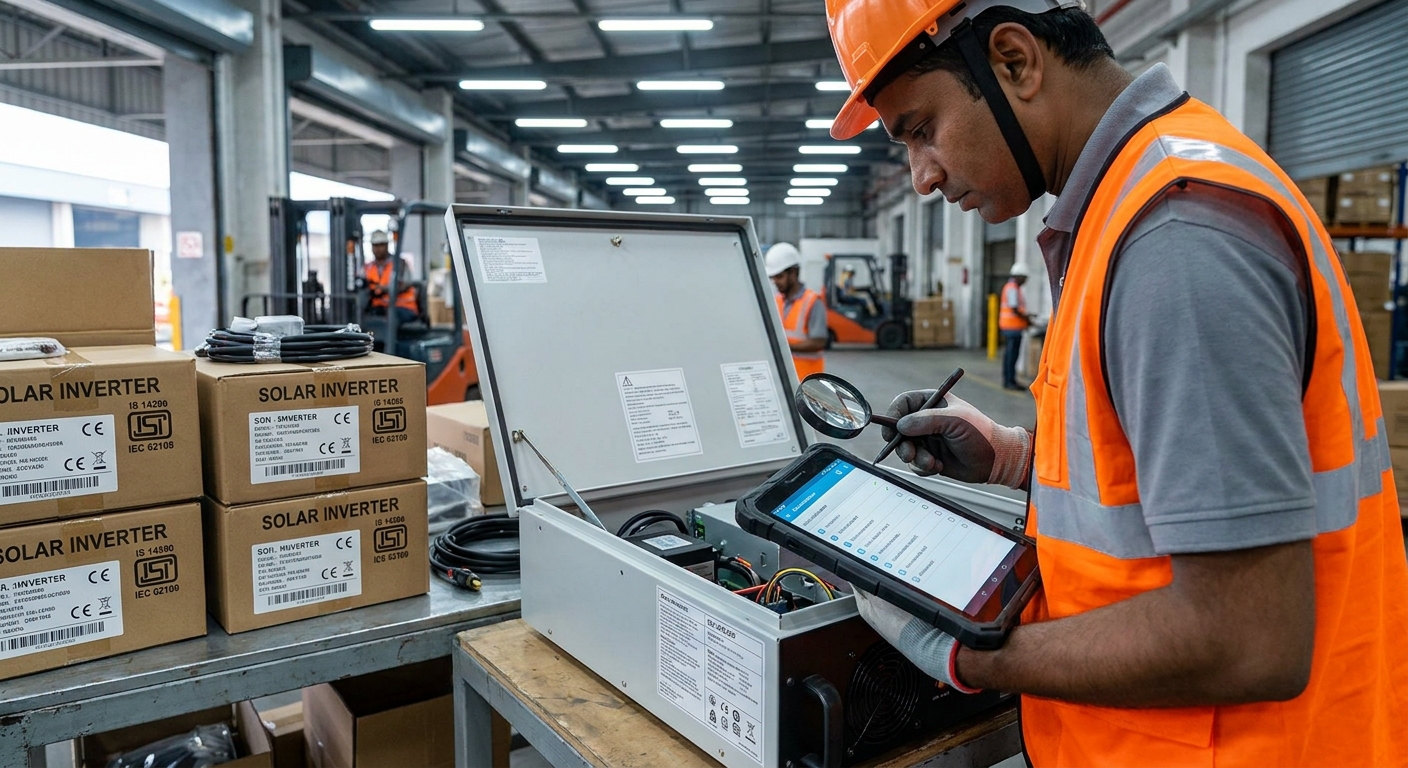
Even with a well-evaluated vendor, incoming inspection is a non-negotiable step in professional inverter procurement India operations. No manufacturer is perfect, and catching issues at the receiving dock is far less costly than discovering them after installation.
Pre-Shipment Inspection
For large orders, consider arranging pre-shipment inspection at the manufacturer’s facility. This is particularly valuable for new vendor relationships or unusually large orders. A pre-shipment inspection catches batch-level quality issues before the entire order ships, saving significant time and cost.
Incoming Inspection Checklist
Every inverter delivery should go through a structured incoming inspection. Your checklist should cover:
- Visual inspection: Check for physical damage to units and packaging. Inspect connectors, display screens, and enclosures for defects.
- Documentation verification: Confirm BIS/IEC certification labels, serial numbers, and warranty registration documentation are present and match the purchase order.
- Electrical verification: For a sample of units from each batch, conduct basic electrical tests to confirm the unit powers up correctly and displays expected parameters.
- Quantity and model verification: Confirm that delivered quantities and model numbers match the purchase order exactly.
Handling Non-Conforming Units
Establish a clear RMA (Return Merchandise Authorization) process with your vendor before you place your first order. Know exactly how to report a non-conforming unit, what documentation is required, and what the replacement timeline commitment is. A vendor with a digital warranty system, like Qbits’ digital warranty registration portal, makes this process significantly faster and more transparent.
Building a Quality Log
Maintain a running quality log for every vendor. Track defect rates by batch, model, and time period. This data gives you objective evidence for vendor performance reviews and strengthens your negotiating position when discussing quality issues or pricing.
5. Payment Terms, Pricing Strategies, and Cost Management
Payment terms in Indian inverter procurement vary widely. Understanding the standard structures and knowing how to negotiate favorable terms is an important part of managing your working capital effectively.
Common Payment Structures
Most domestic inverter manufacturers in India work on one of these structures:
- Advance payment: Full payment before shipment. Common for new relationships or small orders. Carries the highest working capital burden for the EPC.
- Partial advance with balance on delivery: Typically 30 to 50% advance with the remainder due on delivery or within 7 to 15 days. The most common structure for established relationships.
- Credit terms: 30 to 60 day credit terms for high-volume, long-standing partners. Requires a strong track record and often a credit limit agreement.
Total Cost of Ownership vs Unit Price
The most common procurement mistake is optimizing for unit price while ignoring total cost of ownership (TCO). A cheaper inverter with a 5-year warranty, lower efficiency, and no India-based support will cost you more over a 10-year project lifecycle than a premium unit with a 12-year warranty, 98% efficiency, and a responsive support team.
Calculate TCO by factoring in: unit price, freight and logistics costs, GST, expected replacement costs over the system life, efficiency-related energy yield differences, and the cost of your team’s time managing warranty claims and field service. For a detailed framework on pricing strategy, see our post on Solar Inverter Pricing Strategies for EPCs (2026).
Avoiding Hidden Costs
Watch for costs that don’t appear in the unit price but add up quickly at scale:
- Freight and insurance charges (especially for imported inverters)
- Customs clearance fees and import duties
- Accessories not included in the base price (DC connectors, mounting brackets, communication cables)
- Warranty registration fees or extended warranty upgrade costs
6. Building Long-Term Supplier Relationships for Inverter Procurement India
The most successful EPCs in India don’t just buy inverters. They build strategic supplier relationships that give them preferential access to inventory, better pricing, technical support, and co-marketing opportunities. This is where inverter procurement India transitions from a transactional activity to a genuine competitive advantage.

Single-Vendor vs Multi-Vendor Strategy
There are valid arguments on both sides. A single-vendor strategy gives you maximum volume leverage, simpler operations, and a deeper relationship with one manufacturer. A multi-vendor strategy reduces supply chain risk and gives you flexibility when one vendor has stock or quality issues.
For most mid-sized EPCs, a practical approach is to have one primary vendor for 70 to 80% of volume and one secondary vendor as a backup. This balances relationship depth with supply chain resilience.
Becoming a Certified Channel Partner
Most serious inverter manufacturers in India offer formal channel partner or distributor programs. These programs typically provide: priority inventory allocation, volume-based pricing tiers, co-branded marketing support, technical training for your installation teams, and dedicated account management. If you’re doing consistent volume with a manufacturer, formalizing the relationship through a partnership program is almost always worth it.
Qbits offers a structured partner program for EPCs and distributors. If you’re looking to add a high-quality, India-manufactured inverter brand to your portfolio, you can apply to become a Qbits partner and access the full range of partnership benefits.
Leveraging Digital Tools for Relationship Management
Modern inverter manufacturers are increasingly offering digital tools that strengthen the EPC-manufacturer relationship. AI-powered monitoring platforms that send real-time alerts via WhatsApp give your team visibility into installed system performance without manual site visits. Digital warranty portals let you register, track, and claim warranties without paperwork. These tools reduce your operational costs and make the manufacturer relationship more valuable over time.
SLA Agreements and Escalation Processes
For high-volume relationships, negotiate a formal Service Level Agreement (SLA) that defines response times for technical support queries, replacement timelines for warranty claims, and escalation paths for unresolved issues. An SLA transforms a vendor relationship into a business partnership with mutual accountability.
Inverter Procurement India: Common Mistakes EPCs Must Avoid
Even experienced EPCs make procurement mistakes that cost them time and money. Here are the most common ones to watch for in the Indian market:
- Choosing on price alone: The cheapest inverter is rarely the lowest-cost option over a project’s lifetime. Always calculate TCO before making a final decision.
- Ignoring BIS certification: Installing non-BIS-certified inverters in India creates legal liability for your business and can void your client’s net metering application. Verify certification documents on every order.
- Underestimating import lead times: If your project schedule assumes 4-week delivery and your imported inverter takes 14 weeks, you have a serious problem. Always build realistic lead time buffers for imported products.
- Neglecting after-sales support evaluation: A vendor’s support quality only becomes apparent when something goes wrong. Test it before you commit, not after.
- Failing to standardize: Using a different inverter model on every project creates a training and spares management nightmare. Standardize on a small number of models across your project portfolio wherever possible.
- Skipping incoming inspection: Even trusted vendors occasionally ship defective units. A systematic incoming inspection process catches problems before they become installed problems.
- Not formalizing the supplier relationship: Operating on informal agreements leaves you exposed when disputes arise. Get key terms in writing, including warranty commitments, lead time guarantees, and pricing validity periods.
Frequently Asked Questions on Inverter Procurement in India
What certifications should a solar inverter have in India?
At minimum, solar inverters sold and installed in India should carry BIS (Bureau of Indian Standards) certification under IS 16221 and IEC 62109 certification for safety. For grid-connected systems, compliance with Central Electricity Authority (CEA) technical standards is also required. Always verify that certification documents are current and match the specific model you are procuring.
How long are typical lead times for inverter procurement in India?
Domestic manufacturers typically deliver within 2 to 4 weeks for standard models. Imported inverters from global brands carry 8 to 16 week lead times when accounting for production, ocean freight, and customs clearance. For project planning purposes, always use the longer end of the range as your baseline assumption.
What is the difference between on-grid and hybrid inverters for procurement purposes?
On-grid inverters are simpler to procure and install, with a more straightforward specification set. Hybrid inverters add battery management complexity, requiring you to verify compatibility with specific battery chemistries and capacities. Hybrid inverter procurement also typically involves higher unit costs and more complex commissioning requirements. If your project pipeline includes battery storage, build hybrid inverter expertise into your procurement and installation teams early.
How do I verify inverter quality before placing a bulk order?
Request sample units before committing to bulk quantities. Test samples against your specification benchmarks. Ask the manufacturer for their quality assurance process documentation, including details of automated testing protocols. For new vendor relationships, consider a third-party factory audit. Check online forums and industry networks for feedback from other EPCs who have used the same products.
What payment terms are standard in Indian inverter procurement?
For new relationships, expect to pay 50 to 100% in advance. As the relationship matures and your volume grows, most domestic manufacturers will extend 30 to 60 day credit terms. Always get payment terms confirmed in writing as part of your purchase order or supply agreement, not just verbally.
How important is the inverter manufacturer’s monitoring system for EPCs?
Increasingly important. A manufacturer with a robust AI-powered monitoring platform reduces your post-installation service burden significantly. Real-time alerts via WhatsApp or app notifications mean your clients can self-report issues, and your team can diagnose problems remotely before dispatching a technician. This directly reduces your after-sales service costs and improves client satisfaction.
Take the Next Step in Your Inverter Procurement India Strategy
Effective inverter procurement India is not a one-time task. It is an ongoing capability that your business builds over time through better vendor relationships, smarter processes, and deeper technical knowledge. The EPCs that get this right consistently outperform their competitors on project margins, client satisfaction, and business scalability.
If you’re evaluating inverter vendors for your next project or looking to upgrade your procurement strategy, Qbits offers India-manufactured on-grid and hybrid inverters with 98% efficiency, IP66 weather protection, AI-powered WhatsApp monitoring, and a 12-year full replacement warranty backed by 1,000+ automated quality tests per unit. These are the specifications that protect your business and your clients’ investments over the long term.
Explore the full Qbits product range at qbitsenergy.com/our-products, or reach out directly to discuss your procurement requirements and volume pricing. If you’re ready to formalize a partnership, apply to become a Qbits channel partner today. For immediate procurement inquiries, send us a WhatsApp message and our team will respond promptly. You can also follow Qbits on LinkedIn for the latest product updates and industry insights relevant to inverter procurement India.
This blog post was written using thestacc.com