



How to Read Solar Inverter Datasheets: 11 Critical Specs


Every solar EPC in India has faced this situation: two inverter datasheets side by side, both claiming “98% efficiency” and “best-in-class performance,” yet one product fails within three monsoon seasons while the other runs flawlessly for a decade. The difference almost always comes down to how carefully you read the inverter datasheet before placing the purchase order. In 2026, with panel wattages climbing past 750W and Indian grid regulations tightening, the ability to decode a technical datasheet is no longer optional for procurement teams. It is a core competency.
This guide walks you through the 11 critical specifications every EPC and solar installation company must verify on any inverter datasheet before committing to a purchase. We also cover the red flags that signal misleading claims, and we close with a practical comparison checklist you can use immediately on your next project.

Why Inverter Datasheet Analysis Is Non-Negotiable for EPCs
The inverter is the most technically complex component in any solar system. Unlike panels, which degrade predictably, an inverter can fail suddenly due to a single overlooked specification mismatch. In India’s demanding environment, with ambient temperatures regularly exceeding 45°C, frequent grid voltage fluctuations, and monsoon humidity, the gap between a well-specified inverter and a poorly specified one translates directly into project downtime, warranty disputes, and lost client trust.
For EPCs, the stakes are even higher. You are not just buying one unit. You are standardizing a product across dozens or hundreds of installations. A procurement decision made on incomplete inverter datasheet analysis can cascade into systemic failures across your entire project portfolio. Conversely, EPCs who master datasheet verification gain a competitive edge: they deliver systems that perform as promised, generate fewer service calls, and build the kind of client relationships that drive referrals.
The 11 specifications covered in this guide address the most common sources of inverter underperformance and failure in Indian solar projects. Each section explains what the spec means, how to find it on a datasheet, and what numbers to look for.
1. Peak Efficiency vs. Weighted (Euro/CEC) Efficiency
The first number most EPCs look at on an inverter datasheet is the peak efficiency figure. It is also the most misunderstood. Peak efficiency tells you the best-case conversion rate the inverter achieves under ideal laboratory conditions, typically at a specific load percentage and temperature. In real-world operation, an inverter rarely runs at that exact condition.
Weighted efficiency (reported as Euro Efficiency or CEC Efficiency) is far more useful. It calculates a weighted average of the inverter’s efficiency across multiple load levels, reflecting how the unit actually performs across a typical day’s generation profile. An inverter with 98% peak efficiency but only 94% Euro efficiency will consistently underperform compared to one with 97.5% peak and 97% Euro efficiency.
When reviewing any inverter datasheet, always locate both figures. If a datasheet only shows peak efficiency and omits weighted efficiency, treat that as a yellow flag. Reputable manufacturers publish both. For Indian conditions, where morning and evening generation at partial load is significant, weighted efficiency is the number that actually predicts your system’s annual energy yield.
2. MPPT Voltage Range and Number of MPPT Trackers
Maximum Power Point Tracking (MPPT) is the mechanism by which an inverter extracts the maximum available power from your solar array. The MPPT voltage range on an inverter datasheet defines the window within which the inverter can operate at full rated power. Strings designed outside this window will result in clipping or reduced output.
For Indian rooftop projects, where string lengths vary due to space constraints and panel orientations differ across complex roof geometries, a wide MPPT range gives your design team more flexibility. Look for a minimum MPPT voltage that allows operation even on cold winter mornings (when Voc is highest) and a maximum that accommodates your longest practical string.
The number of MPPT trackers is equally important. A single-MPPT inverter forces all strings to operate at the same voltage point. If one string is shaded or oriented differently, it drags down the entire array. Dual or multi-MPPT inverters allow independent optimization of each string, which is critical for commercial rooftops with multiple orientations or partial shading from water tanks and AC units.
Red flag on an inverter datasheet: an MPPT range that looks suspiciously wide (e.g., 100V to 1000V) without a corresponding “full power range” specification. Always check the voltage range within which the inverter delivers its rated output power, not just the absolute operating range.
3. Temperature Derating and Operating Temperature Range
This is the specification most frequently overlooked by EPCs in India, and it is arguably the most consequential for actual energy production. Temperature derating refers to the reduction in an inverter’s output power as ambient temperature rises above a threshold, typically 40°C or 45°C for most products.
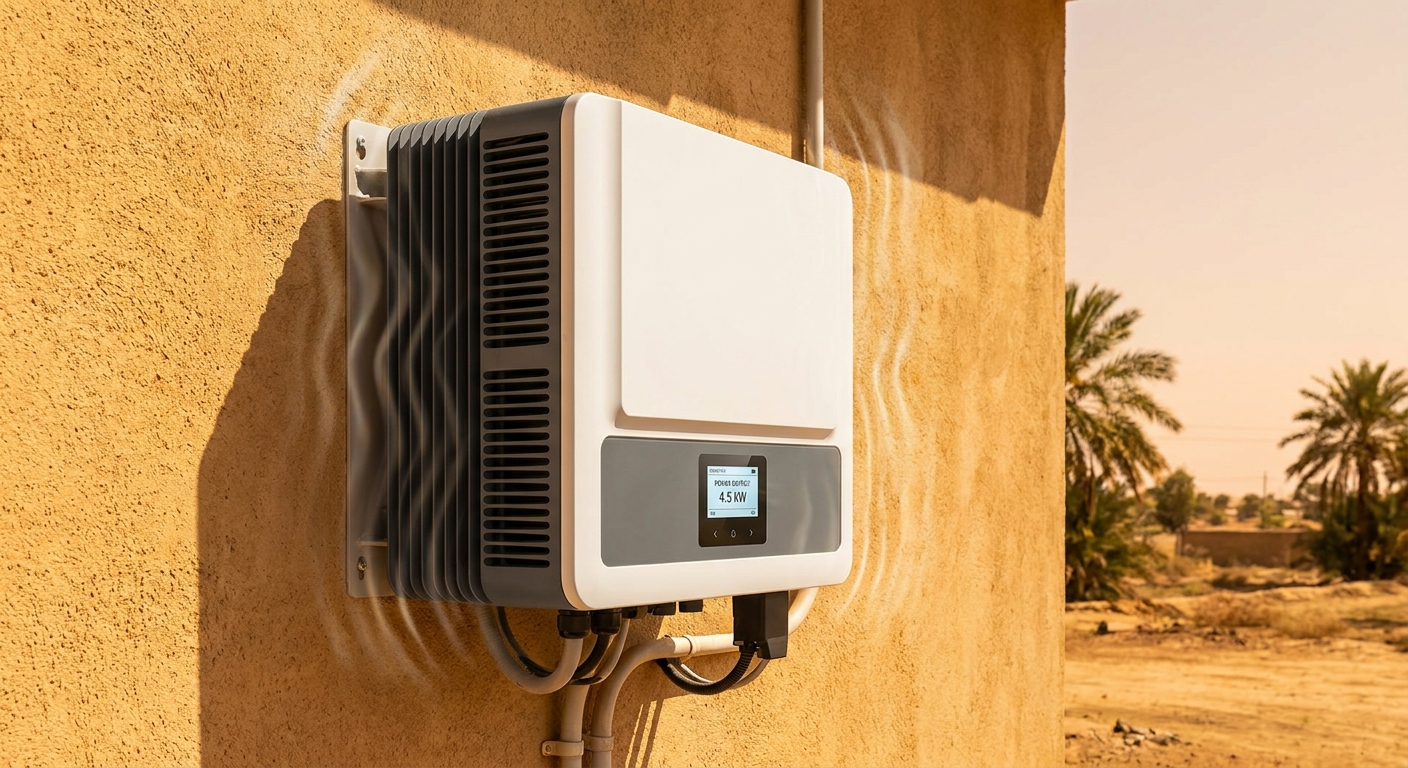
On an inverter datasheet, look for a derating curve or a derating table. This will show you, for example, that at 50°C ambient temperature, the inverter operates at 85% of its rated output. In Indian summers, rooftop temperatures regularly exceed 55°C. An inverter rated at 10 kW that derate to 7.5 kW at your site’s operating temperature is effectively a 7.5 kW inverter for several peak hours each day.
When comparing inverters for Indian projects, calculate the effective output at your site’s expected maximum ambient temperature, not the nameplate rating. This single calculation can change your inverter sizing decisions significantly.
Also check the operating temperature range listed on the datasheet. The lower limit matters for high-altitude sites in Himachal Pradesh, Uttarakhand, or Ladakh. The upper limit tells you the absolute maximum the inverter can tolerate before shutting down for self-protection.
Weather protection ratings go hand-in-hand with temperature performance. An IP66-rated enclosure protects the inverter’s internal components from dust ingress and water jets, which is essential for rooftop installations exposed to Indian monsoons and dusty environments. Always verify the IP rating on the inverter datasheet and confirm it applies to the entire unit, not just the enclosure.
4. DC Input Specifications: Voltage, Current, and Oversizing
The DC input section of an inverter datasheet contains several critical parameters that directly affect system safety and energy yield. The three most important are maximum DC input voltage, maximum input current per MPPT, and the allowable DC oversizing ratio.
Maximum DC input voltage is a hard safety limit. Exceeding it, even momentarily during cold weather when panel Voc is at its highest, can permanently damage the inverter and void the warranty. Always calculate your string’s maximum open-circuit voltage at the lowest expected temperature for your site and verify it stays below the inverter’s maximum DC input voltage with a safety margin.
Maximum input current per MPPT determines how many parallel strings you can connect to each tracker. With modern high-wattage panels now exceeding 750W, the short-circuit current (Isc) per string is higher than ever. Verify that the inverter’s maximum input current comfortably accommodates your string configuration, including the Isc of the panels you are using.
DC oversizing (also called DC-to-AC ratio or clipping ratio) is the practice of connecting more panel capacity than the inverter’s rated AC output. A datasheet that specifies up to 100% DC oversizing means you can connect up to twice the inverter’s rated AC power in panels. This is a valuable feature for maximizing energy harvest during morning and evening hours when irradiance is below peak, without significantly increasing clipping losses at midday. Verify the maximum allowable DC oversizing ratio on the datasheet and confirm it aligns with your project’s design.
5. AC Output Specifications and Grid Compliance
The AC output section of an inverter datasheet tells you how the inverter interfaces with the grid. For Indian EPCs, grid compliance is not just a technical matter. It is a regulatory requirement for DISCOM approvals and net metering applications.
Key AC output parameters to verify include rated AC output power, maximum AC output power, output voltage range, frequency range, and power factor. The rated power is what the inverter delivers continuously under standard conditions. The maximum power is the short-term peak it can sustain, which matters for systems with variable loads.
Total Harmonic Distortion (THD) is a measure of the quality of the AC waveform the inverter produces. Lower THD means cleaner power, which is important for sensitive commercial and industrial loads. Look for THD below 3% on the datasheet. Higher THD can cause issues with equipment connected to the same circuit and may complicate DISCOM approvals.
For Indian projects, verify that the inverter datasheet lists compliance with BIS certification and relevant IEC standards. BIS certification is mandatory for inverters sold in India under the Bureau of Indian Standards framework. An inverter without BIS certification cannot legally be installed in India, and its absence on a datasheet is an immediate disqualifier. For more on evaluating manufacturers against Indian regulatory requirements, see our guide on Solar Inverter Manufacturers in India: Complete Evaluation Guide for EPCs and Distributors (2026).
6. Surge Protection and Safety Ratings
India’s grid environment is characterized by frequent voltage spikes, lightning-induced surges, and switching transients. For EPCs designing systems in this environment, the surge protection specifications on an inverter datasheet are critical safety parameters, not optional extras.
Look for both DC-side and AC-side Surge Protection Device (SPD) ratings. The datasheet should specify the SPD type (Type I, Type II, or Type III) and the maximum surge current the protection can handle. Type II SPDs on both DC and AC sides are the minimum standard for Indian rooftop installations. Some premium inverters integrate SPDs directly into the unit, which simplifies installation and ensures the protection is always present.
Beyond surge protection, review the full list of built-in protections on the datasheet. A well-specified inverter should include overvoltage protection, undervoltage protection, overcurrent protection, short-circuit protection, reverse polarity protection, and anti-islanding protection. Anti-islanding is particularly important for grid-tied systems: it ensures the inverter shuts down immediately during a grid outage, protecting utility workers from backfed power.
7. Start-Up Voltage and Low-Light Performance
The start-up voltage listed on an inverter datasheet is the minimum DC input voltage at which the inverter begins operating. A lower start-up voltage means the inverter begins generating power earlier in the morning and continues later in the evening, capturing more energy from low-irradiance periods.
In India, where diffuse radiation during monsoon months and hazy winter mornings can significantly reduce irradiance, low start-up voltage is a meaningful performance differentiator. Compare start-up voltage figures across the inverters you are evaluating. A difference of even 30-50V in start-up voltage can translate into 15-30 additional minutes of generation per day, which adds up to measurable kWh gains over a year.
Also check the self-consumption and standby power figures on the datasheet. These tell you how much power the inverter consumes for its own operation when the system is running and when it is in standby mode at night. Lower self-consumption improves the system’s net energy output, particularly for smaller residential systems where inverter self-consumption represents a larger percentage of total generation.
8. Monitoring Capabilities and Communication Interfaces
Modern solar projects demand real-time visibility into system performance. The monitoring and communication section of an inverter datasheet tells you what connectivity options are available and what data the inverter can report.
Look for the communication interfaces listed: RS485, Wi-Fi, 4G, Bluetooth, or Ethernet. Each has different implications for installation complexity and monitoring reliability. Wi-Fi is convenient for residential installations with good router coverage. 4G connectivity is essential for remote commercial sites without reliable broadband. RS485 is the standard for multi-inverter commercial systems connected to a central monitoring platform.
Beyond connectivity, evaluate what the monitoring platform actually delivers. Basic platforms show generation data. Advanced platforms provide fault alerts, performance ratio analysis, and predictive maintenance insights. For EPCs managing large portfolios of installations, the quality of the monitoring system directly affects your after-sales service efficiency and your ability to respond to issues before clients notice them.
AI-powered monitoring that delivers alerts via WhatsApp is a particularly practical feature for the Indian market, where WhatsApp is the dominant business communication channel. When an inverter’s monitoring system can push real-time fault alerts directly to your service team’s WhatsApp, response times drop dramatically. For a deeper look at monitoring system capabilities and what to look for, read our detailed guide on Solar Inverter Monitoring Systems in India (2026).
9. Warranty Terms and What the Fine Print Reveals
The warranty section of an inverter datasheet (or the accompanying warranty document) is where the manufacturer’s confidence in their product is most clearly expressed. A long warranty period is meaningless if the terms are riddled with exclusions that make claims practically impossible to process.
The critical distinction is between a parts warranty and a full replacement warranty. A parts warranty covers the cost of replacement components but not labor, shipping, or the cost of the replacement unit itself. A full replacement warranty covers the entire unit. For EPCs, the difference in total cost of a warranty claim between these two types can be substantial, especially for commercial inverters installed on rooftops.
Read the exclusions carefully. Common exclusions that can effectively void coverage include damage from grid surges (particularly relevant in India), installation by uncertified personnel, use of non-approved accessories, and failure to register the warranty within a specified period. A 12-year full replacement warranty with a straightforward digital registration process is the benchmark to measure other products against.
Digital warranty systems that allow online registration and claim tracking are a significant operational advantage for EPCs managing multiple installations. They eliminate paperwork, create a verifiable record of each installation, and speed up the claims process. You can explore how digital warranty registration works at Qbits’ warranty download portal.
10. Certifications and Quality Testing Standards
Certifications listed on an inverter datasheet are the manufacturer’s documented proof that the product has been independently tested against defined standards. For Indian EPCs, certain certifications are non-negotiable, while others indicate a higher level of quality commitment.
BIS certification under the Bureau of Indian Standards is mandatory for inverters sold in India. Verify the BIS registration number on the datasheet and cross-check it on the BIS website. An inverter without a valid BIS registration cannot be legally installed in India and will create problems during DISCOM inspections and net metering applications.
IEC 62109 (Safety of Power Converters for Use in Photovoltaic Power Systems) is the primary international safety standard for solar inverters. IEC 61727 covers the characteristics of the utility interface. Both should be listed on the datasheet of any inverter you consider for professional installation.
Beyond certifications, look for information about the manufacturer’s quality testing process. A claim of “1000+ automated quality tests per unit” is meaningful when it is backed by a documented testing protocol. This level of testing, combined with the use of premium electronic components, is what separates inverters that perform reliably for 12+ years from those that fail within the first three. For a comprehensive framework for evaluating inverter quality beyond the datasheet, see our guide on Solar Inverter Selection: 10 Critical Criteria for EPCs.
11. Dimensions, Weight, and Installation Requirements
The physical specifications on an inverter datasheet are often reviewed last, but they can determine whether a product is practical for your specific installation context. Dimensions and weight affect where the inverter can be mounted, what structural support is needed, and how easy it is to handle during installation and replacement.
Check the cooling method specified on the datasheet. Natural convection cooling (no fan) means the inverter is silent and has no moving parts to fail. Forced air cooling (fan-cooled) can handle higher power densities but introduces a component that can fail and requires periodic cleaning in dusty Indian environments. For rooftop installations near occupied spaces, noise level specifications are also worth checking.
For projects at higher altitudes, look for altitude derating information. At elevations above 2000m, reduced air density affects cooling efficiency, and some inverters require derating above certain altitudes. This is relevant for projects in hill stations and high-altitude industrial sites across India.
Finally, verify the minimum clearance distances required around the inverter for adequate ventilation. Insufficient clearance is a common installation error that leads to overheating and premature failure, and it is a detail that is clearly specified on every reputable inverter datasheet.
Red Flags: How to Spot a Misleading Inverter Datasheet

Not all inverter datasheets are created with equal transparency. Some manufacturers use selective data presentation to make their products appear more capable than they are. Knowing the red flags protects your projects and your reputation.
- Only peak efficiency is listed, with no weighted efficiency figure. This is the most common form of selective data presentation. Always ask for Euro or CEC efficiency data.
- No derating curves or temperature performance data. A datasheet that only shows rated power without explaining how that power changes with temperature is hiding important information about real-world performance in Indian conditions.
- Vague or missing certification details. “Complies with international standards” without specific standard numbers and certification body names is not a certification claim. Require specific standard numbers and verify them.
- Warranty terms that require reading a separate document not provided with the datasheet. Warranty conditions should be clearly summarized on the datasheet or in an easily accessible accompanying document. Hidden exclusions are a common source of disputes.
- MPPT range listed without a “full power range” specification. The absolute operating range and the range within which full rated power is delivered are different numbers. Ensure the datasheet distinguishes between them.
- No information about surge protection or safety features. A datasheet that lists output power and efficiency but omits protection features is incomplete. This omission often indicates the product lacks adequate protection.
- Suspiciously round numbers throughout. Real engineering measurements rarely produce perfectly round numbers. A datasheet showing exactly 98.0% efficiency, exactly 1000V max input, and exactly 40A max current across every model in a range may be presenting marketing targets rather than measured values.
Inverter Datasheet Comparison Checklist for EPCs

Use this structured checklist when comparing multiple inverters for a project. Score each inverter on each criterion to create an objective comparison.
- Weighted efficiency (Euro/CEC): Is it above 96%? Is it clearly stated on the datasheet?
- MPPT range: Does it cover your string design’s voltage range at both temperature extremes? How many MPPT trackers are available?
- Temperature derating: What is the output at your site’s maximum expected ambient temperature? Is a derating curve provided?
- DC input specs: Does the maximum input voltage accommodate your string’s Voc at minimum temperature? Is the maximum input current sufficient for your panel configuration?
- DC oversizing: What is the maximum allowable DC-to-AC ratio? Does it support your design’s oversizing strategy?
- AC output and grid compliance: Is THD below 3%? Are BIS and IEC certifications listed with verifiable numbers?
- Surge protection: Are DC and AC SPDs included? What type and rating?
- Start-up voltage: Is it low enough to capture early morning and late evening generation at your site?
- Monitoring: What communication interfaces are available? Does the platform provide real-time alerts and performance analytics?
- Warranty: Is it a full replacement warranty? What are the exclusions? Is there a digital registration system?
- Certifications: Are BIS and IEC certifications listed with verifiable registration numbers?
When you apply this checklist to Qbits inverter datasheets, you will find that each of these 11 criteria is addressed with specific, verifiable data. The 98% efficiency figure is backed by weighted efficiency data. The IP66 rating covers the full enclosure. The 12-year warranty is a full replacement warranty with digital registration. The BIS and IEC certifications are listed with registration numbers. This level of datasheet transparency is what you should expect from any inverter manufacturer you consider for your projects.
For a broader perspective on how inverter selection decisions affect project economics, our guide on Solar Inverter Lifespan: Complete Financial Planning Guide provides a detailed framework for calculating the true cost of ownership across different inverter options.
Understanding inverter datasheet specifications also directly informs your pricing strategy. EPCs who can articulate why a higher-quality inverter justifies its cost are better positioned to win projects on value rather than competing purely on price. Our guide on Solar Inverter Pricing Strategies for EPCs (2026) covers this in detail.
Frequently Asked Questions About Inverter Datasheets
What is the most important specification on an inverter datasheet?
For Indian EPCs, temperature derating is arguably the most critical and most overlooked specification. An inverter that derate significantly at 45-50°C ambient temperature will underperform for several peak hours every summer day, directly reducing your client’s energy yield and ROI. Always calculate effective output at your site’s operating temperature, not just the nameplate rating.
How do I verify if inverter datasheet claims are accurate?
Start by checking certifications against official databases. BIS registration numbers can be verified on the BIS website. IEC test reports should be available from the manufacturer on request. For efficiency claims, ask for third-party test reports from accredited laboratories. Reputable manufacturers provide these without hesitation. You can also cross-reference specifications against independent reviews and field performance data from other EPCs who have installed the same product.
What certifications should an inverter have for installation in India?
BIS certification is mandatory under Indian law. IEC 62109 (safety) and IEC 61727 (grid interface) are the primary international standards. For grid-connected systems, the inverter must also comply with the relevant CERC/SERC grid connectivity standards and your state DISCOM’s technical requirements. Always verify that the certifications listed on the inverter datasheet are current and applicable to the specific model you are purchasing, not just the product family.
How does temperature affect inverter output in Indian summers?
Most inverters begin derating output above 40-45°C ambient temperature. In Indian summers, rooftop ambient temperatures can reach 55-60°C during peak afternoon hours. Depending on the inverter’s derating curve, this can reduce output by 10-25% during the hottest part of the day. This is why IP66 weather protection and effective thermal management design are important features to verify on the datasheet, not just the nameplate efficiency figure.
What does “full replacement warranty” mean compared to a standard warranty?
A standard or “parts only” warranty covers the cost of replacement components but typically excludes labor, transportation, and the cost of the replacement unit itself. A full replacement warranty covers the entire inverter unit, including all associated costs of replacement. For EPCs, the practical difference is significant: a full replacement warranty eliminates the risk of unexpected service costs during the warranty period and provides a clear, predictable cost structure for your maintenance contracts.
Make Your Next Inverter Procurement Decision with Confidence
Reading an inverter datasheet with the depth and rigor this guide describes takes practice, but it is the single most effective way to protect your projects from underperformance, premature failure, and warranty disputes. The 11 specifications covered here, from weighted efficiency and MPPT range to temperature derating, surge protection, and warranty terms, give you a complete framework for evaluating any inverter product against the real demands of Indian solar installations.
Qbits inverters are engineered specifically for India’s demanding conditions, with IP66 weather protection, AI-powered WhatsApp monitoring, German-grade electronic components, and a 12-year full replacement warranty. Every specification on a Qbits datasheet is backed by BIS and IEC certifications and verified through 1000+ automated quality tests per unit. If you are ready to evaluate Qbits inverters against the checklist in this guide, explore our complete product range or send us a WhatsApp inquiry today and our technical team will walk you through the datasheet specifications for your specific project requirements.
EPCs and distributors looking to add a reliable, India-focused inverter brand to their portfolio can also apply to become a Qbits partner. For technical support on existing installations, visit our support portal or contact our team directly.
This blog post was written using thestacc.com