



Solar Inverter Certifications: 9 Essential Standards EPCs Must Verify (2026)

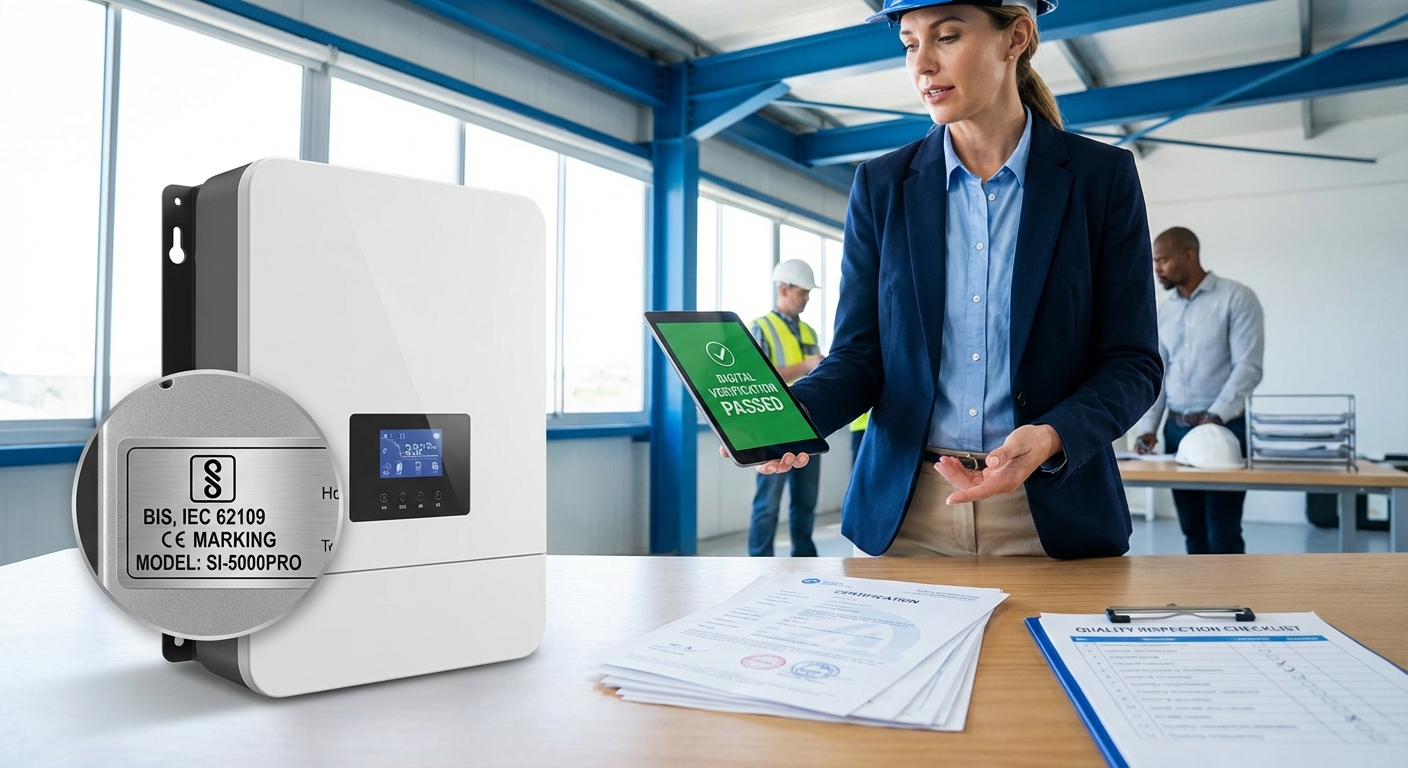
Every year, solar EPCs and distributors in India lose millions of rupees to project delays, warranty disputes, and legal complications—all stemming from a single oversight: failing to properly verify inverter certifications. In 2026, as India’s solar market continues its rapid expansion with increasingly stringent regulatory requirements, the stakes have never been higher. A single uncertified or improperly certified inverter can derail an entire project, void insurance coverage, and expose your business to significant liability.
For solar installation companies and distributors operating in India’s competitive market, understanding and verifying inverter certifications isn’t just about regulatory compliance—it’s about protecting your business reputation, ensuring project profitability, and building long-term customer trust. This comprehensive guide walks you through the nine essential certification standards you must verify before purchasing solar inverters, complete with practical verification methods and red flags that signal potential problems.
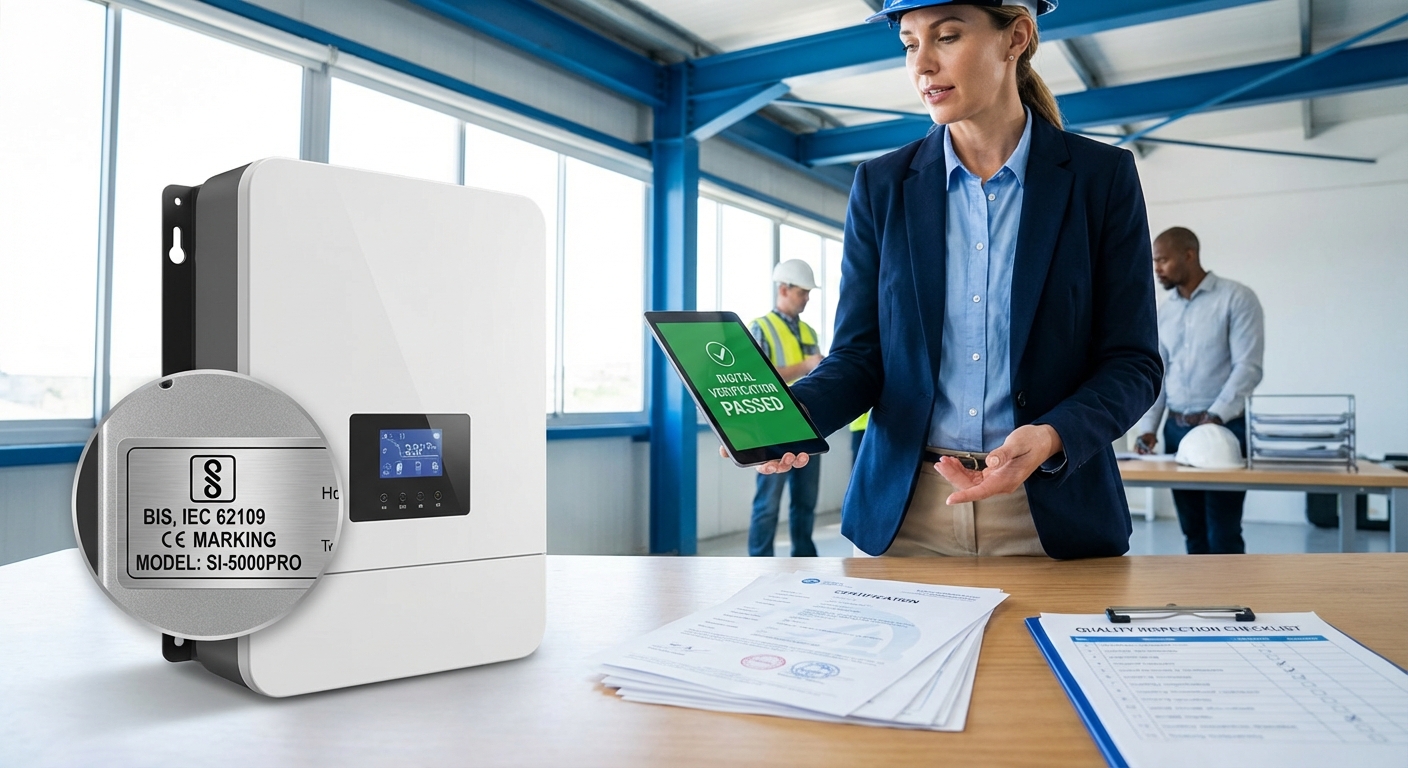
Why Inverter Certifications Matter for Solar EPCs in India
The Indian solar industry operates under a complex regulatory framework that mandates specific certifications for grid-connected equipment. Inverter certifications serve as your first line of defense against substandard equipment, but their importance extends far beyond simple compliance checkboxes.
When you install an uncertified or improperly certified inverter, you expose your business to multiple risk vectors. First, there’s the immediate regulatory risk: the Bureau of Indian Standards (BIS) has made certification mandatory for solar inverters, and using non-compliant equipment can result in penalties ranging from ₹1 lakh to ₹10 lakhs, plus potential criminal liability under the BIS Act 2016. State electricity boards and DISCOMs routinely reject grid connection applications for projects using uncertified equipment, causing costly project delays.
Beyond regulatory compliance, inverter certifications directly impact your financial exposure. Insurance companies increasingly scrutinize equipment certifications when processing claims. If a fire or equipment failure occurs and investigators discover uncertified components, your insurance claim may be denied entirely. Similarly, warranty disputes become nearly impossible to resolve when manufacturers can point to the use of uncertified equipment as grounds for voiding coverage.
For projects seeking government subsidies or participating in tender processes, proper certification documentation is non-negotiable. The Ministry of New and Renewable Energy (MNRE) and state nodal agencies require comprehensive certification proof for subsidy disbursement. Missing or invalid certifications can disqualify your project entirely, leaving you to absorb costs that were budgeted as subsidized.
Perhaps most importantly, your reputation as a solar EPC depends on delivering reliable, compliant installations. When you source properly certified equipment, you demonstrate professional due diligence to your clients. This builds the trust necessary for repeat business and referrals in India’s relationship-driven solar market. As detailed in our guide on solar inverter selection criteria for EPCs, certification verification should be a foundational element of your procurement process.
1. BIS Certification: The Non-Negotiable Standard for Inverter Certifications in India
The Bureau of Indian Standards (BIS) certification stands as the absolute baseline requirement for solar inverters sold and installed in India. Since 2017, BIS certification has been mandatory for grid-connected solar inverters under the Compulsory Registration Scheme (CRS). This isn’t optional—it’s a legal requirement backed by significant penalties for non-compliance.
BIS certification for solar inverters primarily covers two critical Indian Standards: IS 61683 (Photovoltaic systems – Power conditioners – Procedure for measuring efficiency) and IS 62109 (Safety of power converters for use in photovoltaic power systems). These standards ensure that inverters meet minimum safety requirements, perform as specified, and integrate safely with India’s electrical grid infrastructure.
The IS 62109 standard is particularly comprehensive, covering protection against electric shock, fire hazards, mechanical hazards, and environmental stress. It mandates specific requirements for insulation, grounding, temperature limits, and protective devices. When an inverter carries valid BIS certification under IS 62109, you have assurance that it has undergone rigorous testing for these safety parameters.
Verifying authentic BIS certification requires a systematic approach. Every BIS-certified inverter must display the BIS standard mark (the ISI mark) along with a unique registration number (R-XXXXXXXX format) on the product nameplate. This registration number is your key to verification. Visit the BIS website (bis.gov.in) and navigate to the “Check Product Certification” portal. Enter the registration number and manufacturer details to confirm the certification is valid, current, and covers the specific inverter model you’re purchasing.
Pay close attention to the scope of certification. BIS certification is model-specific, not manufacturer-wide. A manufacturer may have BIS certification for their 5kW model but not for their 10kW model. Always verify that the exact model number, capacity rating, and specifications match the certification documentation. Manufacturers like Qbits Energy ensure all their inverter models carry proper BIS certification, providing EPCs with the compliance assurance needed for smooth project execution.
The penalties for using non-BIS certified inverters are severe and getting stricter. Under the BIS Act 2016, manufacturers face fines up to ₹10 lakhs, and installers can be held liable for using non-compliant equipment. More importantly, DISCOMs across India now routinely inspect inverter certifications during commissioning inspections, and projects with uncertified equipment face connection refusal until compliant equipment is installed—a costly and time-consuming remediation.
2. IEC Standards: International Quality Benchmarks for Inverter Certifications
While BIS certification is mandatory for the Indian market, International Electrotechnical Commission (IEC) standards represent the global benchmark for inverter quality and safety. Understanding IEC standards helps you evaluate inverter quality beyond minimum compliance requirements, especially when comparing manufacturers or assessing imported equipment.
The most critical IEC standards for solar inverters are IEC 62109-1 (Safety of power converters for use in photovoltaic power systems – Part 1: General requirements) and IEC 62109-2 (Part 2: Particular requirements for inverters). These standards form the foundation for many national certification schemes, including India’s IS 62109 standard, which is harmonized with the IEC version.
IEC 62109 establishes comprehensive safety requirements covering electrical, mechanical, thermal, and fire hazards. It specifies testing protocols for insulation resistance, dielectric strength, protective grounding, temperature rise, and abnormal operation conditions. When an inverter meets IEC 62109 standards, it has demonstrated resilience under extreme conditions that might occur during real-world operation.
IEC 61683 addresses inverter performance testing, establishing standardized procedures for measuring efficiency, power quality, and operational characteristics. This standard ensures that manufacturer efficiency claims are measured consistently, allowing meaningful comparisons between different inverter models. When evaluating inverter efficiency claims—a critical factor in system ROI—always verify that efficiency ratings are based on IEC 61683 testing protocols.
Another crucial standard is IEC 62116, which covers anti-islanding protection. Islanding occurs when an inverter continues to energize the grid during a power outage, creating serious safety hazards for utility workers. IEC 62116 specifies testing procedures to ensure inverters reliably detect grid disconnection and shut down within specified timeframes. This protection is mandatory for grid-connected systems and is a key component of DISCOM approval processes.
To verify IEC compliance, request complete test reports from the manufacturer, not just certificates. Authentic IEC test reports should identify the accredited testing laboratory (look for ILAC or equivalent accreditation), specify the exact inverter model tested, detail the test procedures followed, and present comprehensive results. Be wary of generic “IEC compliant” claims without supporting documentation. Reputable manufacturers maintain detailed test reports for all their product lines and readily share them with EPCs during the procurement process.
IEC certification also serves as a quality indicator for the manufacturer’s engineering capabilities. Achieving IEC compliance requires sophisticated design, quality components, and rigorous testing infrastructure. Manufacturers who invest in IEC certification typically demonstrate higher overall quality standards across their product lines, as explored in our comprehensive guide on evaluating solar inverter manufacturers in India.
3. ISO Quality Management Certifications
While product-specific certifications like BIS and IEC verify individual inverter models, ISO certifications assess the manufacturer’s overall quality management systems and operational processes. These certifications provide insight into the consistency, reliability, and long-term viability of your inverter supplier, factors that directly impact your business relationship and product support over the inverter’s lifespan.
ISO 9001 certification for quality management systems is the most relevant ISO standard for inverter procurement decisions. ISO 9001 certification indicates that a manufacturer has implemented systematic processes for quality control, continuous improvement, customer satisfaction, and risk management. For EPCs, this translates to more consistent product quality, better documentation, more reliable delivery schedules, and more responsive customer support.
When a manufacturer holds ISO 9001 certification, they’ve committed to documented procedures for design control, supplier management, production processes, testing protocols, and corrective action systems. This systematic approach reduces the likelihood of quality variations between production batches, a critical consideration when you’re sourcing inverters for large projects or establishing long-term supply relationships.
ISO 14001 certification for environmental management systems indicates a manufacturer’s commitment to sustainable operations and environmental responsibility. While not directly related to inverter performance, ISO 14001 certification suggests organizational maturity and forward-thinking management, qualities that correlate with better long-term business stability and support.
Verifying ISO certifications requires checking several key elements. First, confirm the certification is issued by an accredited certification body, look for accreditation from national bodies like NABCB (National Accreditation Board for Certification Bodies) in India or international equivalents like UKAS or ANAB. Second, verify the scope of certification covers inverter manufacturing specifically, not just general electronics or unrelated activities. Third, check the validity dates, as ISO certifications require annual surveillance audits and three-year recertification.
You can verify ISO certifications through the issuing certification body’s website or through the International Accreditation Forum (IAF) database. Request a copy of the current ISO certificate from your supplier and cross-reference the certificate number with the certification body’s records. Legitimate manufacturers have no hesitation providing current ISO certificates and audit reports.
Red flags in ISO documentation include certificates from unaccredited certification bodies, vague scope statements that don’t specifically mention inverter manufacturing, expired certificates, or reluctance to provide verification details. These warning signs suggest either fraudulent certification or a manufacturer who doesn’t take quality management seriously, both scenarios you want to avoid.
4. CE Marking and International Safety Standards
For EPCs working with imported inverters or evaluating international brands operating in India, understanding CE marking and other international safety standards provides additional quality assurance layers beyond mandatory Indian certifications. While CE marking itself isn’t required for the Indian market, its presence indicates compliance with European safety standards and can serve as a valuable quality indicator.
The CE mark indicates that a product meets European Union safety, health, and environmental protection requirements. For solar inverters, CE marking typically covers two key directives: the Electromagnetic Compatibility (EMC) Directive and the Low Voltage Directive (LVD). EMC compliance ensures the inverter doesn’t generate excessive electromagnetic interference that could disrupt other equipment, while LVD compliance addresses electrical safety requirements.
EMC compliance is particularly important in commercial and industrial installations where inverters operate alongside sensitive electronic equipment. Inverters with poor EMC characteristics can cause interference with communication systems, control equipment, and other electronics. The EMC Directive requires testing for both emissions (interference the inverter generates) and immunity (the inverter’s resistance to external interference).
UL certification from Underwriters Laboratories represents North American safety standards and is another valuable quality indicator. UL 1741 specifically addresses inverter safety requirements and includes comprehensive testing for fire safety, electrical safety, and grid interaction. While not required for Indian installations, UL certification indicates a manufacturer has invested in meeting multiple international standards, a sign of quality commitment and global market capability.
TÜV certification from German technical inspection associations (TÜV Rheinland, TÜV SÜD, etc.) represents some of the most rigorous testing standards in the industry. TÜV certification often goes beyond minimum standard requirements, incorporating additional safety margins and long-term reliability testing. Inverters with TÜV certification have typically undergone extended environmental stress testing, including temperature cycling, humidity exposure, and accelerated aging tests.
When verifying CE marking, understand that it’s a self-declaration system, manufacturers affix the CE mark based on their own conformity assessment. However, reputable manufacturers back their CE marking with complete technical documentation, including test reports from accredited laboratories and a Declaration of Conformity. Request these supporting documents and verify the testing laboratory’s accreditation status.
International certifications become particularly valuable when assessing new manufacturers or lesser-known brands. A manufacturer who has successfully obtained certifications from multiple international bodies (BIS, IEC, CE, UL, TÜV) demonstrates both technical capability and commitment to quality that transcends any single market’s minimum requirements. This multi-certification approach is characteristic of premium manufacturers who compete on quality rather than price alone.
5. IP Rating Certifications for Weather Protection
India’s diverse and often harsh climate conditions, from the intense heat and dust of Rajasthan to the high humidity and monsoon rains of coastal regions, make weather protection certifications critically important for inverter longevity and reliability. The Ingress Protection (IP) rating system provides standardized measurement of an inverter’s resistance to dust and water intrusion, directly impacting performance and lifespan in real-world installations.
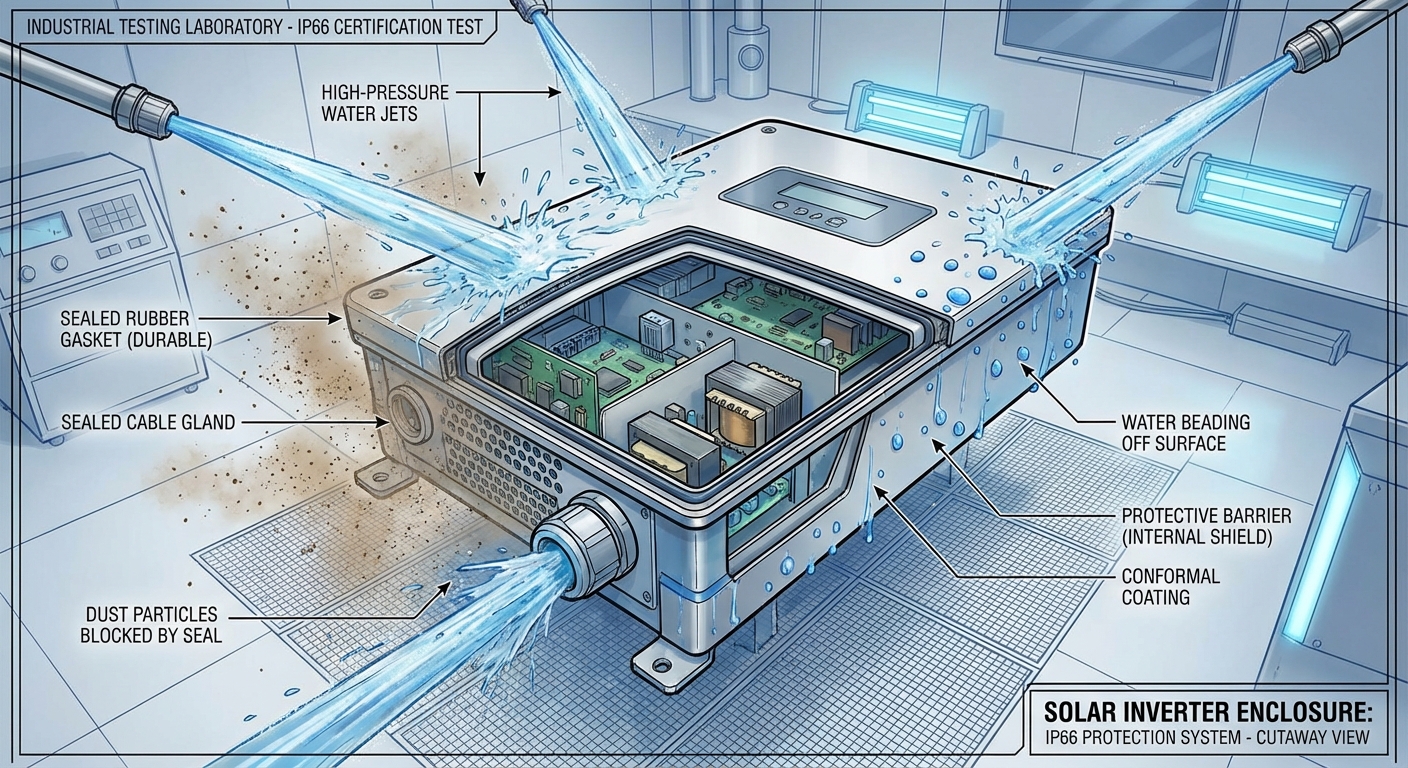
The IP rating consists of two digits: the first indicates dust protection (0-6 scale), and the second indicates water protection (0-9 scale). For rooftop solar installations in India, IP65 or IP66 ratings represent the minimum acceptable protection levels. IP65 provides protection against dust ingress and water jets from any direction, while IP66 offers protection against powerful water jets and heavy seas, important for coastal installations or areas with severe monsoon conditions.
Understanding what these ratings mean in practical terms helps you match inverter specifications to installation environments. An IP65-rated inverter can withstand direct water spray from cleaning operations or rain-driven wind, but may not survive sustained exposure to high-pressure water. An IP66-rated inverter provides an additional safety margin for the most demanding environments. For commercial rooftop installations where inverters may be exposed to industrial dust, cleaning operations, or extreme weather, IP66 certification provides essential protection.
The correlation between IP ratings and inverter lifespan is significant. Moisture and dust intrusion are leading causes of inverter failure in India. When contaminants penetrate the inverter enclosure, they cause corrosion of electronic components, degradation of insulation, and eventual component failure. An inverter with inadequate IP rating may function initially but experience accelerated degradation, leading to premature failure and costly replacements. Our detailed analysis of solar inverter lifespan and financial planning demonstrates how weather protection directly impacts total cost of ownership.
Verifying IP rating certifications requires examining test reports from accredited laboratories. The IP rating test must follow IEC 60529 standards, which specify exact testing procedures for each protection level. Authentic IP rating certificates should identify the testing laboratory, specify the test standard followed (IEC 60529), detail the test conditions, and clearly state the achieved IP rating for the specific inverter model.
Be cautious of manufacturers who claim IP ratings without supporting test documentation. IP rating testing requires specialized equipment and controlled conditions, it’s not something that can be self-certified or estimated. Request complete test reports and verify the testing laboratory’s accreditation through NABL (National Accreditation Board for Testing and Calibration Laboratories) or equivalent international accreditation bodies.
For EPCs operating across different regions of India, consider IP ratings as part of your inverter selection criteria for specific project locations. Coastal projects, industrial environments, and high-dust regions warrant IP66 protection, while more benign environments might accept IP65. Premium manufacturers like Qbits Energy engineer their inverters with IP66 protection as standard, recognizing that Indian rooftop conditions demand robust weather resistance for reliable long-term operation.
6. Grid Connectivity and Anti-Islanding Certifications
Grid connectivity certifications ensure that solar inverters interact safely and reliably with India’s electrical distribution network. These certifications address critical safety functions, power quality requirements, and grid support capabilities that DISCOMs require for approving grid connections. Understanding these certifications helps you avoid project delays and ensures your installations meet utility interconnection requirements.
The Central Electricity Authority (CEA) has established technical standards for grid connectivity of distributed generation systems, including solar installations. The CEA (Technical Standards for Connectivity to the Grid) Regulations specify requirements for voltage and frequency operating ranges, power quality parameters, protection systems, and grid support functions. Inverters must demonstrate compliance with these regulations to receive DISCOM approval for grid connection.
Anti-islanding protection represents one of the most critical safety functions covered by grid connectivity certifications. Islanding occurs when a section of the grid loses utility power but continues to be energized by distributed generation sources like solar inverters. This creates severe safety hazards for utility workers who may be working on lines they assume are de-energized. Anti-islanding protection ensures inverters detect loss of grid power and disconnect within specified timeframes, typically within 2 seconds of grid failure.
Testing for anti-islanding protection follows standardized protocols defined in IEC 62116 and IEEE 1547 standards. These tests simulate various grid failure scenarios and verify that the inverter reliably detects each condition and disconnects appropriately. Authentic anti-islanding certification should include detailed test reports showing the inverter’s response time under different load conditions and grid impedance scenarios.
Voltage and frequency ride-through capabilities have become increasingly important as solar penetration increases on distribution networks. Modern grid codes require inverters to remain connected during minor grid disturbances rather than immediately disconnecting, which could destabilize the grid. Low Voltage Ride Through (LVRT) and High Voltage Ride Through (HVRT) certifications verify that inverters can continue operating or gracefully disconnect during voltage fluctuations without causing grid instability.
Different DISCOMs across India may have specific additional requirements beyond the national CEA standards. Before finalizing inverter procurement for a project, verify the specific requirements of the local DISCOM where the system will be installed. Some utilities require additional testing or certification documentation, and having these requirements clarified upfront prevents delays during the interconnection approval process.
Power quality certifications address harmonic distortion, power factor, and voltage regulation. The CEA regulations specify maximum Total Harmonic Distortion (THD) limits for current injected into the grid. Inverters must maintain THD below 5% to avoid degrading grid power quality. Request test reports showing harmonic performance across the inverter’s operating range, not just at rated power.
When verifying grid connectivity certifications, ensure the test reports cover all relevant parameters: anti-islanding response time, voltage and frequency operating ranges, harmonic distortion, power factor, and any DISCOM-specific requirements. These certifications directly impact your ability to commission projects and receive grid connection approval, making them as critical as basic safety certifications for project success.
7. How to Verify Inverter Certifications: Step-by-Step Process
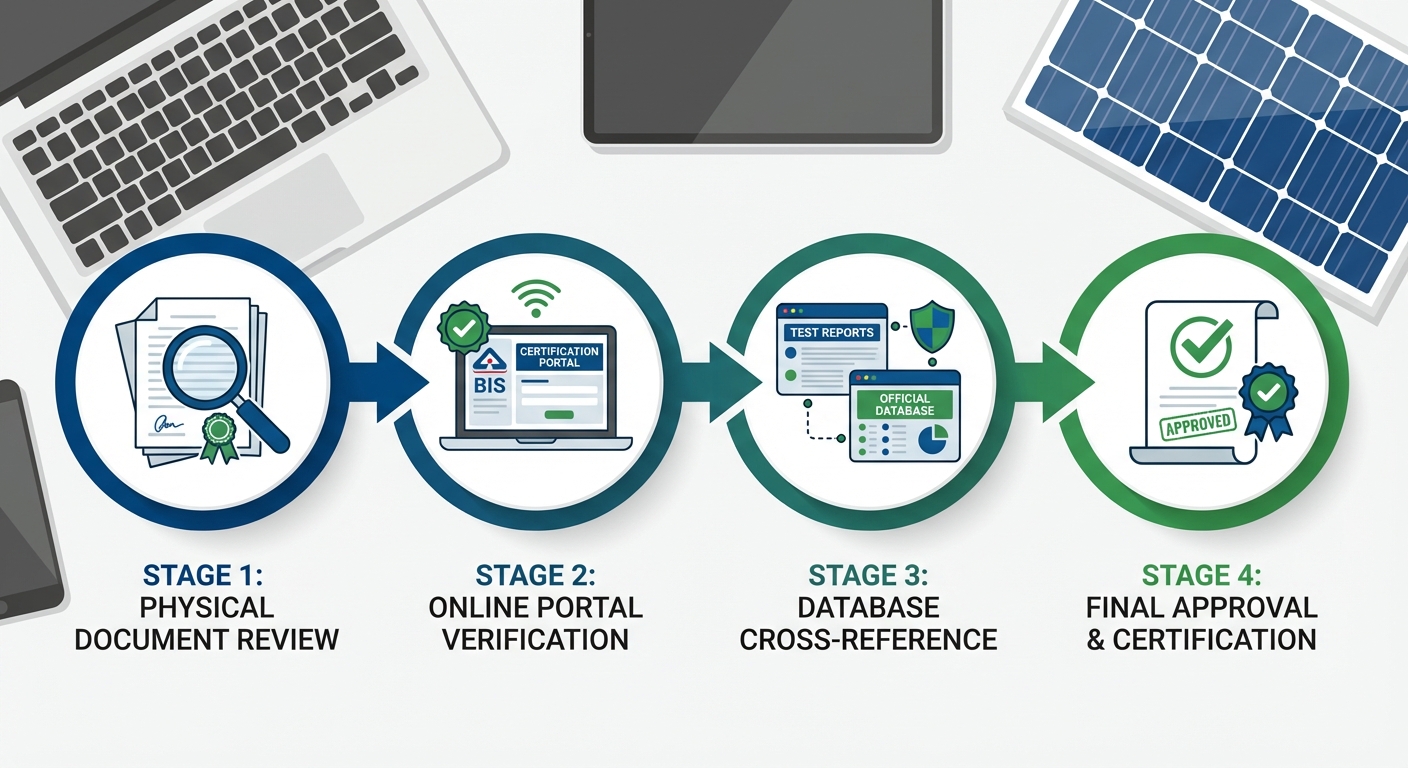
Establishing a systematic verification process for inverter certifications protects your business from costly mistakes and ensures consistent quality across your supply chain. This step-by-step approach provides a practical framework for certification verification that you can implement immediately in your procurement workflow.
Step 1: Request Complete Certification Documentation
Begin by requesting comprehensive certification documentation from the manufacturer or supplier. This should include original certificates (not just photocopies), complete test reports from accredited laboratories, and a Declaration of Conformity. Specify that you need documentation for the exact model number, capacity rating, and specifications you’re purchasing. Generic or model-family certifications are insufficient, certifications must match the specific product.
Step 2: Verify Certificate Authenticity and Validity
Examine each certificate for basic authenticity indicators. Check for security features like holograms, watermarks, or embossed seals. Verify that the certificate includes essential information: issuing authority name and logo, certificate number, issue date and expiry date, manufacturer name and address, specific product model and specifications, applicable standards, and authorized signatory. Missing or incomplete information suggests questionable documentation.
Step 3: Cross-Check Certification Numbers with Issuing Authorities
Use online verification portals to confirm certification validity. For BIS certification, visit the BIS website (bis.gov.in) and use the “Check Product Certification” tool to verify the registration number. For ISO certifications, contact the issuing certification body directly or check their online certificate database. Many certification bodies provide online verification tools where you can enter the certificate number and confirm its validity status.
Step 4: Verify Testing Laboratory Accreditation
Confirm that test reports come from accredited laboratories. In India, look for NABL (National Accreditation Board for Testing and Calibration Laboratories) accreditation. Internationally, verify ILAC (International Laboratory Accreditation Cooperation) recognition. Visit the NABL website (nabl-india.org) and search their directory of accredited laboratories to confirm the testing lab’s accreditation status and scope. Test reports from unaccredited laboratories have no credibility and should be rejected.
Step 5: Examine Test Report Details
Review test reports thoroughly, not just certificates. Authentic test reports should specify the exact inverter model tested (including serial number of the test sample), detail the test procedures followed with reference to specific standard clauses, present comprehensive test results with measured values, identify the testing equipment used with calibration dates, and include the test engineer’s signature and laboratory seal. Generic or summary reports without detailed test data suggest incomplete or questionable testing.
Step 6: Verify Scope and Applicability
Ensure certifications cover the specific application and configuration you’re implementing. For example, if you’re installing a hybrid inverter with battery integration, verify that certifications cover hybrid operation, not just grid-tied mode. Check that power ratings, voltage ranges, and other specifications in the certification documentation match the product specifications you’re purchasing.
Step 7: Check Validity Dates and Renewal Status
Certifications have expiry dates and require periodic renewal. Verify that all certifications are current and haven’t expired. For ongoing supplier relationships, establish a system to track certification expiry dates and request updated documentation before certifications lapse. Using inverters with expired certifications carries the same risks as using uncertified equipment.
Step 8: Consider Third-Party Verification Services
For high-value projects or when working with new suppliers, consider engaging third-party verification services. Several organizations specialize in technical due diligence for solar equipment, including certification verification, factory audits, and product testing. While this adds cost to your procurement process, it provides additional assurance for major investments and can prevent far more expensive problems later.
Implementing this systematic verification process as standard practice in your procurement workflow ensures consistency across your supply chain. Train your procurement team on these verification steps and create a standardized checklist that must be completed before any inverter purchase order is approved. This systematic approach to inverter certifications verification becomes a competitive advantage, reducing your risk exposure and building your reputation for quality installations.
8. Red Flags: Spotting Fake or Invalid Inverter Certifications
The unfortunate reality of India’s solar market is that fake or fraudulent certifications exist, and they’re becoming increasingly sophisticated. Recognizing red flags that indicate questionable certifications protects your business from costly mistakes and potential legal liability. Developing a critical eye for certification authenticity should be a core competency for every EPC procurement professional.
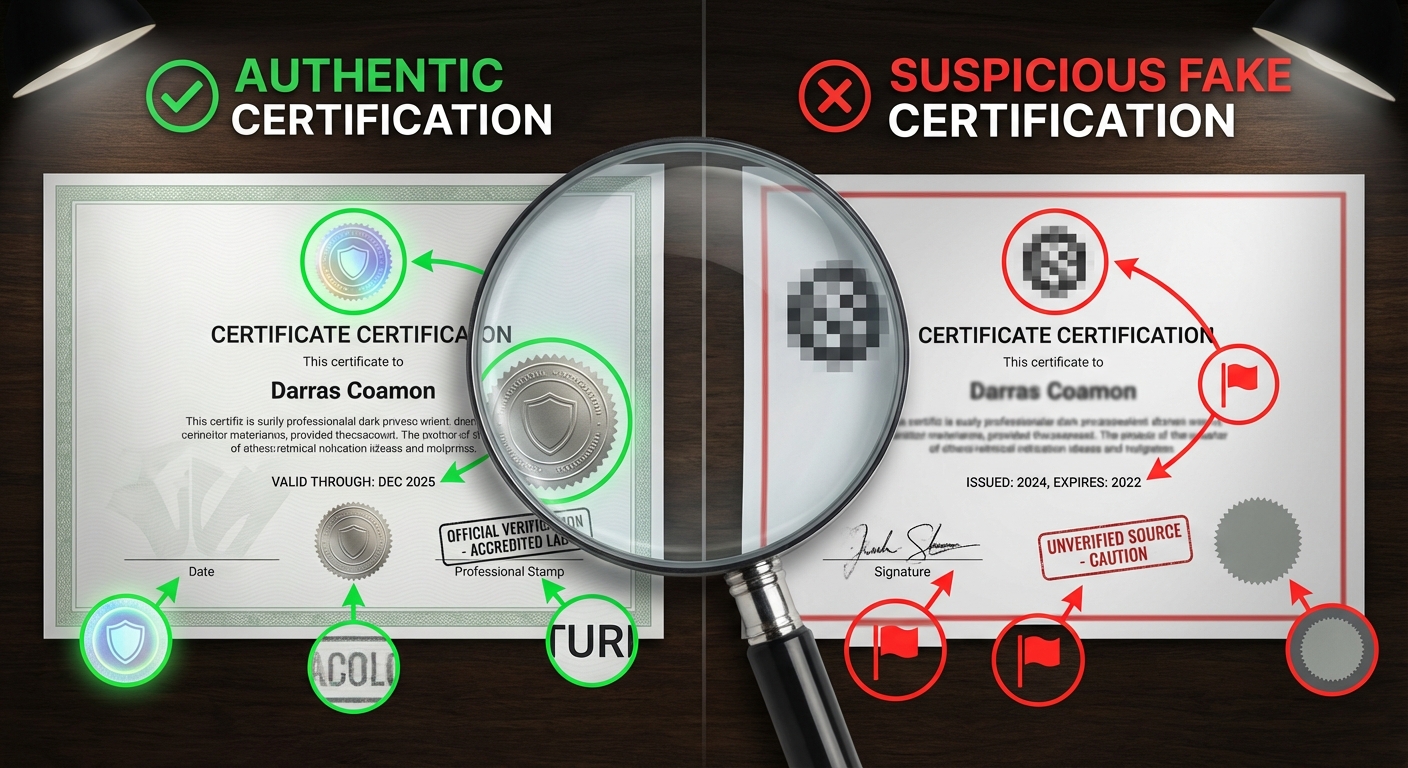
Red Flag 1: Poor Document Quality and Obvious Forgeries
Examine the physical quality of certification documents. Authentic certificates from recognized certification bodies are printed on high-quality paper with security features like watermarks, holograms, or special inks. Blurry logos, pixelated text, obvious photocopy artifacts, or low-resolution printing suggest forged documents. Professional certification bodies invest in secure document production, poor quality documents are immediate red flags.
Red Flag 2: Mismatched or Vague Product Specifications
Authentic certifications specify exact product details: complete model numbers, precise power ratings, voltage ranges, and other technical specifications. Be suspicious of certificates with vague descriptions like “solar inverter” without specific model information, or certificates where the product description doesn’t exactly match the inverter you’re purchasing. Legitimate certifications are model-specific and technically precise.
Red Flag 3: Unverifiable Certification Numbers
Every legitimate certification has a unique identification number that can be verified with the issuing authority. If a supplier provides certificates but the certification numbers don’t appear in the issuing authority’s database, or if the supplier makes excuses about why verification isn’t possible, treat this as a major red flag. Legitimate manufacturers have no hesitation providing verifiable certification numbers and actively encourage verification.
Red Flag 4: Expired or Suspended Certifications
Check certification validity dates carefully. Some suppliers present expired certifications hoping buyers won’t notice the dates. Others may have had certifications suspended or revoked due to quality issues or non-compliance. Always verify current validity status with the issuing authority, not just the dates printed on the certificate. Certification databases often indicate suspension or revocation status.
Red Flag 5: Unaccredited or Unknown Testing Laboratories
Test reports should come from recognized, accredited laboratories. Be suspicious of test reports from laboratories you can’t verify through NABL or international accreditation databases. Some fraudulent suppliers create fictitious laboratory names or use real laboratory names without authorization. Always verify the testing laboratory’s accreditation status independently before accepting test reports.
Red Flag 6: Generic “Compliant” Claims Without Documentation
Marketing materials that claim “BIS compliant,” “IEC compliant,” or “ISO certified” without providing actual certification numbers and documentation should raise immediate suspicion. Legitimate manufacturers prominently display certification numbers on product datasheets, nameplates, and marketing materials, and readily provide complete documentation. Vague compliance claims without supporting evidence suggest the certifications don’t actually exist.
Red Flag 7: Certification Scope Doesn’t Match Product
Sometimes suppliers present legitimate certifications, but for different products or models. Carefully verify that the model number, specifications, and product description on the certification exactly match the inverter you’re purchasing. A certificate for a 5kW model doesn’t validate a 10kW model, even from the same manufacturer. This mismatch is a common deceptive practice, using real certifications for one product to sell uncertified variants.
Red Flag 8: Missing Security Features on Certificates
Legitimate certification documents include security features to prevent forgery: holograms, embossed seals, security printing, watermarks, or unique serial numbers. Certificates that lack these security features or have obviously fake security elements (like printed images of holograms) are likely fraudulent. Compare the security features on certificates from known legitimate sources to develop familiarity with authentic documents.
Red Flag 9: Reluctance to Provide Verification Details
Legitimate suppliers welcome certification verification and proactively provide all necessary information for independent verification. Be suspicious of suppliers who are evasive about providing certification numbers, resist sharing complete documentation, make excuses about why verification isn’t possible, or become defensive when asked for verification details. This behavior strongly suggests the certifications are questionable.
Red Flag 10: Prices Too Good to Be True
While not directly related to certification documentation, pricing significantly below market rates often correlates with certification fraud. Achieving legitimate certifications requires investment in testing, quality systems, and compliance infrastructure. Manufacturers offering prices substantially below competitors while claiming equivalent certifications may be cutting corners on compliance. Unusually low pricing should trigger enhanced certification verification.
When you encounter these red flags, don’t proceed with the purchase hoping for the best. The risks of using uncertified or improperly certified equipment far outweigh any potential cost savings. Instead, work with established manufacturers who have verifiable track records and transparent certification documentation. Companies like Qbits Energy maintain complete, verifiable certification documentation for all their products and actively support EPC verification processes, recognizing that certification transparency builds the trust necessary for long-term business relationships.
9. Building a Certification Verification Checklist for Your Procurement Process
Transforming certification verification from an ad-hoc activity into a systematic process requires developing a standardized checklist and integrating it into your procurement workflow. This systematic approach ensures consistency across your organization, reduces the risk of oversights, and creates documentation that protects your business in case of disputes or audits.
Creating Your Certification Verification Checklist
Develop a comprehensive checklist that covers all critical certification categories and verification steps. Your checklist should include mandatory certifications (BIS, IEC safety standards), quality indicators (ISO certifications, international standards), application-specific requirements (IP ratings, grid connectivity), and verification procedures (online verification, laboratory accreditation checks). Customize the checklist based on your typical project types and customer requirements.
Structure your checklist with clear pass/fail criteria for each item. Avoid subjective assessments, define specific requirements that can be objectively verified. For example, instead of “check BIS certification,” specify “BIS registration number verified on BIS website and matches product model number exactly.” This specificity ensures consistent application across different procurement personnel and creates clear documentation.
Documentation Requirements for Vendor Onboarding
Establish clear documentation requirements for new vendors entering your supply chain. Before approving any new inverter supplier, require a complete certification package including original certificates for all mandatory certifications, complete test reports from accredited laboratories, Declaration of Conformity documents, product datasheets with certification numbers clearly marked, and contact information for verification with issuing authorities. Make these requirements explicit in your vendor onboarding process and don’t make exceptions.
Create a vendor certification file for each approved supplier, maintaining copies of all certification documentation, verification records showing when and how certifications were verified, expiry date tracking for time-limited certifications, and contact information for the supplier’s quality or compliance department. This centralized documentation proves invaluable during audits, customer inquiries, or if certification questions arise during project execution.
Periodic Re-Verification Schedules
Certifications expire and require renewal. Establish a system to track certification expiry dates for your approved suppliers and schedule re-verification before certifications lapse. Set calendar reminders 90 days before certification expiry dates to request updated documentation from suppliers. This proactive approach prevents situations where you discover expired certifications after equipment has been purchased or installed.
For ongoing supplier relationships, conduct annual certification audits even if certifications haven’t expired. Request updated certification documentation annually and verify that all certifications remain valid and in good standing. This regular verification catches situations where certifications may have been suspended or revoked between renewal periods.
Training Your Procurement Team
Certification verification requires knowledge and attention to detail. Invest in training your procurement team on certification requirements, verification procedures, and red flags. Conduct regular training sessions covering updates to certification standards, changes in regulatory requirements, and lessons learned from certification issues encountered in your projects. Consider this training an investment in risk management, well-trained procurement personnel prevent costly mistakes.
Develop internal expertise by designating a certification compliance specialist or quality assurance lead who becomes the go-to resource for certification questions. This person should maintain current knowledge of certification requirements, build relationships with certification bodies and testing laboratories, and serve as the final reviewer for certification verification on major purchases.
Integrating Certification Checks into Quality Management Systems
If your organization maintains ISO 9001 certification or other quality management systems, integrate certification verification into your documented procedures. Make certification verification a mandatory step in your procurement process with defined responsibilities, verification methods, and documentation requirements. This integration ensures certification verification happens consistently and creates audit trails that demonstrate due diligence.
Link certification verification to your supplier evaluation and approval processes. Make valid, verified certifications a prerequisite for approved supplier status. Establish procedures for handling situations where certification issues are discovered, including stop-work procedures if uncertified equipment is identified before installation, and corrective action processes if certification problems are discovered after installation.
Leveraging Technology for Certification Management
Consider implementing digital tools to streamline certification management. Simple solutions include spreadsheet-based tracking systems with automated expiry date alerts, or more sophisticated options like procurement software with built-in certification tracking modules. Some EPCs develop custom databases that link supplier information, product models, certification details, and verification records in a searchable system.
Digital certification management provides several advantages: centralized access to certification documentation for all team members, automated alerts for expiring certifications, searchable records for quick verification during project planning, and comprehensive audit trails demonstrating compliance due diligence. Even basic digital systems significantly improve certification management compared to paper-based filing systems.
By building systematic certification verification into your procurement process, you transform it from a compliance burden into a competitive advantage. Your reputation for quality installations, your reduced risk exposure, and your ability to confidently guarantee compliance to customers all stem from rigorous certification verification. This systematic approach to inverter certifications distinguishes professional EPCs from those who treat certification as an afterthought.
The Business Case: How Proper Certification Verification Protects Your Bottom Line
Understanding the financial impact of certification verification helps justify the time and resources required for thorough due diligence. The costs of proper verification are minimal compared to the potential losses from certification failures, making this one of the highest-return risk management investments you can make.
Avoiding Project Delays and Rework Costs
Project delays represent one of the most immediate financial impacts of certification problems. When DISCOMs discover uncertified equipment during commissioning inspections, they refuse grid connection approval until compliant equipment is installed. This triggers a cascade of costs: equipment replacement expenses, labor costs for removal and reinstallation, project timeline delays with associated carrying costs, and potential penalty payments to customers for late completion. A single certification failure can easily cost ₹2-5 lakhs in direct expenses, plus the opportunity cost of delayed payment and tied-up working capital.
Consider a typical 100kW commercial rooftop project. If certification issues delay commissioning by 30 days, you’re absorbing the cost of equipment sitting idle, labor crews waiting or reassigned to other projects, project management overhead continuing without revenue, and customer dissatisfaction that may impact future business. Proper certification verification upfront prevents these entirely avoidable costs.
Reducing Warranty Claim Disputes
Warranty disputes become significantly more complex when certification questions exist. If an inverter fails and the manufacturer discovers certification irregularities or evidence of counterfeit products, they may deny warranty coverage entirely. You’re then left absorbing replacement costs that should have been covered under warranty, plus the labor costs of replacement installation, and customer relationship damage from extended downtime.
Proper certification verification protects your warranty rights. When you can demonstrate that you purchased equipment with valid certifications from authorized channels, manufacturers have no grounds to deny legitimate warranty claims. This protection becomes increasingly valuable as inverter warranties extend, Qbits Energy’s 12-year warranty, for example, represents substantial long-term value, but only if your warranty rights are protected through proper certification verification and authorized purchasing channels.
Protecting Against Legal Liability
The legal liability exposure from uncertified equipment is substantial and often underestimated. If an equipment failure causes property damage, injury, or fire, and investigators discover uncertified equipment was installed, your liability insurance may not provide coverage. You could face direct liability for damages, legal defense costs, and potential criminal charges under the BIS Act for using non-compliant equipment.
Even without catastrophic failures, regulatory penalties for non-compliant installations are increasing. State electricity boards and regulatory authorities are conducting more frequent compliance audits, and penalties for violations are substantial. The cost of proper certification verification is negligible compared to potential legal liability and regulatory penalties.
Maintaining Subsidy and Incentive Eligibility
Government subsidy programs and incentive schemes require comprehensive compliance documentation, including equipment certifications. Projects with certification deficiencies may be disqualified from subsidy programs entirely, or face delays in subsidy disbursement that impact project cash flow. For projects where subsidies represent significant portions of project economics, certification compliance is essential for financial viability.
The MNRE and state nodal agencies increasingly scrutinize equipment certifications during subsidy application reviews. Projects with questionable certifications face extended review periods, requests for additional documentation, or outright rejection. Proper certification verification ensures smooth subsidy processing and protects the project economics you’ve promised to customers.
Building Long-Term Customer Trust and Repeat Business
Perhaps the most valuable long-term benefit of rigorous certification verification is the customer trust and reputation you build. When customers know you source only properly certified, compliant equipment, they have confidence in your installations’ quality, safety, and longevity. This trust translates into repeat business, referrals, and the ability to command premium pricing based on your quality reputation.
In India’s relationship-driven solar market, reputation is everything. EPCs known for quality installations and attention to compliance details win the best projects and build sustainable businesses. Those who cut corners on certification verification may save small amounts on individual purchases but sacrifice long-term business viability. The business case for proper certification verification is ultimately about building a sustainable, reputable business rather than maximizing short-term margins.
When you factor in all these financial considerations, avoided delays, protected warranty rights, reduced liability exposure, maintained subsidy eligibility, and enhanced reputation, the return on investment for systematic certification verification is substantial. The time and resources required for thorough verification represent a small fraction of the potential costs of certification failures, making this one of the most cost-effective risk management practices you can implement.
Frequently Asked Questions About Inverter Certifications
Can I use inverters with only IEC certification in India without BIS certification?
No, BIS certification is legally mandatory for solar inverters sold and installed in India under the Compulsory Registration Scheme. IEC certification alone, while valuable as a quality indicator, does not satisfy Indian regulatory requirements. Using inverters without valid BIS certification violates the BIS Act 2016 and can result in penalties, project approval delays, and legal liability. Always ensure inverters carry both BIS certification for legal compliance and IEC certification for quality assurance.
How often do inverter certifications need renewal?
Certification renewal requirements vary by certification type. BIS certification requires annual renewal with surveillance audits to maintain validity. ISO certifications require annual surveillance audits and full recertification every three years. Product-specific certifications like IEC test reports don’t technically expire, but certification bodies may require retesting if standards are updated or if significant product design changes occur. Always verify the validity dates on specific certificates and establish tracking systems to ensure certifications remain current throughout your supplier relationships.
What happens if I install non-certified inverters?
Installing non-certified inverters carries multiple serious consequences. Legally, you may face penalties under the BIS Act ranging from ₹1 lakh to ₹10 lakhs, plus potential criminal liability. DISCOMs will refuse grid connection approval, preventing project commissioning. Your insurance coverage may be voided if equipment failures occur. Warranty claims will likely be denied. Government subsidies will be withheld or revoked. Most importantly, you expose your business to significant legal liability if equipment failures cause property damage or injury. The risks far outweigh any potential cost savings from using uncertified equipment.
Are all BIS-certified inverters of equal quality?
No, BIS certification establishes minimum safety and performance standards, but doesn’t guarantee equal quality across all certified products. BIS certification verifies that an inverter meets baseline requirements for safety, basic performance, and grid compatibility. However, factors like component quality, manufacturing processes, design sophistication, efficiency levels, monitoring capabilities, and warranty support vary significantly among BIS-certified inverters. Use BIS certification as a mandatory baseline requirement, then evaluate additional factors like ISO certifications, international standards compliance, manufacturer reputation, and specific features to differentiate quality levels among certified products. Our comprehensive guide on solar inverter selection criteria provides a framework for evaluating quality beyond basic certification requirements.
How do I handle certification verification for imported inverter brands?
For imported brands, verify both international certifications from the country of origin and mandatory Indian certifications. Imported inverters must still carry valid BIS certification to be legally sold in India, the manufacturer or their Indian distributor must obtain BIS certification even if the product is manufactured abroad. Request complete certification documentation including BIS registration for the Indian market, original IEC or other international test reports, CE marking documentation if applicable, and import documentation showing the equipment entered India through authorized channels. Verify that the Indian distributor or importer is authorized by the manufacturer and maintains proper certification records. Be especially vigilant about certification verification for imported brands, as some unauthorized importers may present questionable certification documentation.
Partner with Certified Excellence: Qbits Energy’s Commitment to Compliance
Navigating the complex landscape of inverter certifications requires more than just knowledge, it requires partnering with manufacturers who prioritize compliance, transparency, and quality as foundational business principles. Qbits Energy’s comprehensive approach to certification and quality assurance provides EPCs and distributors with the confidence and documentation needed for successful project execution across India’s diverse solar market.
Every Qbits inverter carries complete BIS and IEC certifications, with full documentation readily available for verification. Our manufacturing processes follow ISO 9001 quality management standards, ensuring consistent quality across every unit produced. With IP66 weather protection, our inverters meet the demanding requirements of India’s harshest rooftop environments, backed by comprehensive test reports from NABL-accredited laboratories.
Beyond basic compliance, Qbits Energy’s 12-year full replacement warranty demonstrates our confidence in our products’ long-term reliability, a warranty that’s only meaningful when backed by proper certifications and quality manufacturing. Our AI-powered monitoring systems provide real-time performance visibility, helping you identify and address issues before they impact system performance or customer satisfaction. For EPCs and distributors, this combination of certified quality, advanced features, and comprehensive support translates into smoother project execution, reduced risk exposure, and satisfied customers who become sources of repeat business and referrals.
When you’re ready to partner with a manufacturer who understands that inverter certifications represent more than compliance checkboxes, they represent your business reputation and customer trust, explore Qbits Energy’s complete product line. Our team provides comprehensive certification documentation, technical support, and the transparency you need to confidently specify and install quality solar inverters across your projects.
For immediate assistance with certification verification, technical specifications, or project-specific requirements, connect with our technical team. We’re committed to supporting EPCs and distributors with the information, documentation, and expertise needed to navigate India’s solar market successfully. If you’re interested in building a long-term partnership with a manufacturer who prioritizes quality and compliance, explore our channel partner program and discover how Qbits Energy can strengthen your competitive position in India’s growing solar industry.
In 2026’s competitive solar market, proper inverter certifications verification isn’t optional, it’s the foundation of sustainable business success. By implementing the systematic verification processes outlined in this guide, you protect your business from costly risks while building the reputation for quality and compliance that drives long-term growth. Start strengthening your certification verification processes today, and transform compliance from a burden into a competitive advantage that sets your business apart in India’s dynamic solar industry.
This blog post was written using thestacc.com