



Inverter Distributors India: Complete Partnership Guide


For solar EPCs and installation companies operating in India’s rapidly expanding renewable energy market, selecting the right inverter distributors India can make the difference between profitable growth and operational headaches. The solar inverter distribution landscape has evolved significantly in 2026, with sophisticated channel networks, digital warranty systems, and specialized technical support infrastructure becoming standard expectations rather than premium offerings.
Whether you’re a growing solar EPC looking to establish reliable supply chains or an established installer seeking to optimize your distributor partnerships, understanding how to evaluate and select inverter distributors India is critical to your business success. This comprehensive guide walks you through the complete evaluation framework, regional mapping, partnership terms, and relationship-building strategies that will help you build a robust, profitable inverter supply network across India.
Understanding the Inverter Distribution Landscape in India
The solar inverter distribution ecosystem in India has matured considerably over the past few years. In 2026, the market features a complex network of national distributors, regional channel partners, and state-level stockists, each serving different segments of the solar installation industry. Understanding this landscape is the first step toward making informed partnership decisions.

National distributors typically maintain presence across 15-20 states with centralized warehousing in major metros like Mumbai, Delhi, Bangalore, and Chennai. These partners offer broad geographic coverage but may lack the local market intimacy that regional distributors provide. Regional distributors, conversely, focus on 3-5 states within a specific zone (North, South, East, or West India) and often deliver superior last-mile logistics and personalized technical support.
The third tier consists of state-level stockists who serve specific markets with deep local relationships and rapid delivery capabilities. For EPCs operating in multiple states, a hybrid approach—combining national distributors for standardized products with regional partners for specialized requirements—often yields the best results.
Market dynamics in 2026 have shifted toward distributor consolidation, with larger channel partners acquiring smaller regional players to expand coverage. This consolidation brings advantages like improved logistics infrastructure and stronger financial backing, but EPCs must carefully assess whether these larger entities maintain the responsiveness and technical expertise that smaller, specialized distributors traditionally offered.
Why does your choice of inverter distributors India matter so profoundly? Consider that distributor-related issues—stock unavailability, delayed deliveries, poor warranty support, or inadequate technical assistance—directly impact your project timelines, customer satisfaction, and ultimately, your profit margins. A distributor who can deliver inverters to a remote Rajasthan site within 48 hours versus one requiring 10-12 days can mean the difference between meeting project deadlines and incurring penalty clauses.
Critical Evaluation Criteria for Inverter Distributors India
Evaluating potential inverter distributors India requires a systematic framework that goes beyond basic pricing comparisons. The most successful EPC-distributor partnerships are built on six foundational pillars that ensure operational excellence and business growth.
Regional Coverage and State-Wise Availability
Begin by mapping your current and projected project locations against the distributor’s coverage footprint. A distributor claiming “pan-India presence” may actually have warehouses in only four cities with limited reach into tier 2 and tier 3 markets where solar adoption is accelerating rapidly. Request specific details about warehouse locations, service territories, and delivery capabilities to cities beyond major metros.
For EPCs working on commercial and industrial projects in manufacturing hubs like Pune, Coimbatore, or Ahmedabad, proximity to distributor warehouses significantly reduces logistics costs and delivery times. Similarly, if you’re targeting the growing residential solar market in tier 2 cities across Uttar Pradesh or Madhya Pradesh, ensure your distributor partner has established last-mile delivery networks in these regions.
Inventory Management and Stock Availability
Nothing disrupts project schedules more severely than inverter stock unavailability. During your evaluation, investigate the distributor’s inventory holding patterns, reorder cycles, and buffer stock policies. Leading inverter distributors India maintain 30-45 days of inventory for fast-moving SKUs and have established protocols for emergency procurement when unexpected demand surges occur.
Ask potential partners about their inventory management systems. Do they use real-time stock tracking? Can you access inventory availability through a distributor portal or API integration? Advanced distributors now offer EPCs direct visibility into stock levels, enabling better project planning and reducing the risk of last-minute surprises.
Logistics Infrastructure and Delivery Timelines
Logistics capabilities separate exceptional distributors from mediocre ones. Evaluate the distributor’s transportation network, delivery timelines to different regions, and track record of on-time deliveries. Request specific delivery SLAs (Service Level Agreements) for different geographic zones—metro cities should typically see 24-48 hour delivery, while remote locations might require 5-7 days.
Transit damage is another critical consideration. Quality inverter distributors India invest in proper packaging, use dedicated solar equipment logistics partners, and carry comprehensive transit insurance. Verify their policies on damaged goods, replacement timelines, and who bears the cost of transit-related losses.
Technical Support and Pre-Sales Engineering
The best distributor relationships extend beyond transactional product supply to include genuine technical partnership. Assess the distributor’s technical support infrastructure, do they employ qualified electrical engineers who can assist with system design, inverter sizing, and configuration recommendations?
For EPCs handling complex commercial installations or hybrid systems with battery integration, access to pre-sales engineering support can accelerate project design and reduce costly specification errors. Distributors who offer regular product training sessions, commissioning assistance, and troubleshooting support add substantial value beyond the product itself. This technical backing becomes especially valuable when you’re working with advanced features like AI-powered monitoring systems or configuring inverters for specific grid conditions.
After-Sales Service and Warranty Claim Processing
Warranty claim efficiency directly impacts your customer relationships and cash flow. During distributor evaluation, investigate their warranty claim process, average resolution timelines, and replacement unit availability. The best inverter distributors India have streamlined digital warranty systems that enable quick claim registration, transparent status tracking, and rapid resolution.
Request data on the distributor’s warranty claim statistics, what percentage of claims are resolved within 7 days? Within 15 days? What’s their process for providing temporary replacement units while warranty claims are processed? These metrics reveal the distributor’s operational efficiency and commitment to customer satisfaction.
Financial Stability and Credit Terms
A distributor’s financial health affects your business continuity. Financially unstable distributors may struggle with inventory investment, face supply disruptions, or even exit the market unexpectedly. While you may not access complete financial statements, you can assess stability through market reputation, years in business, manufacturer relationships, and credit rating if available.
Credit terms significantly impact your working capital requirements. Compare payment terms across potential partners, some offer 30-day credit for established EPCs, while others require advance payment or shorter cycles. Balance attractive credit terms against other evaluation criteria; the cheapest pricing with poor service often costs more in the long run than slightly higher prices with exceptional support.
Regional Availability: State-Wise Distributor Mapping
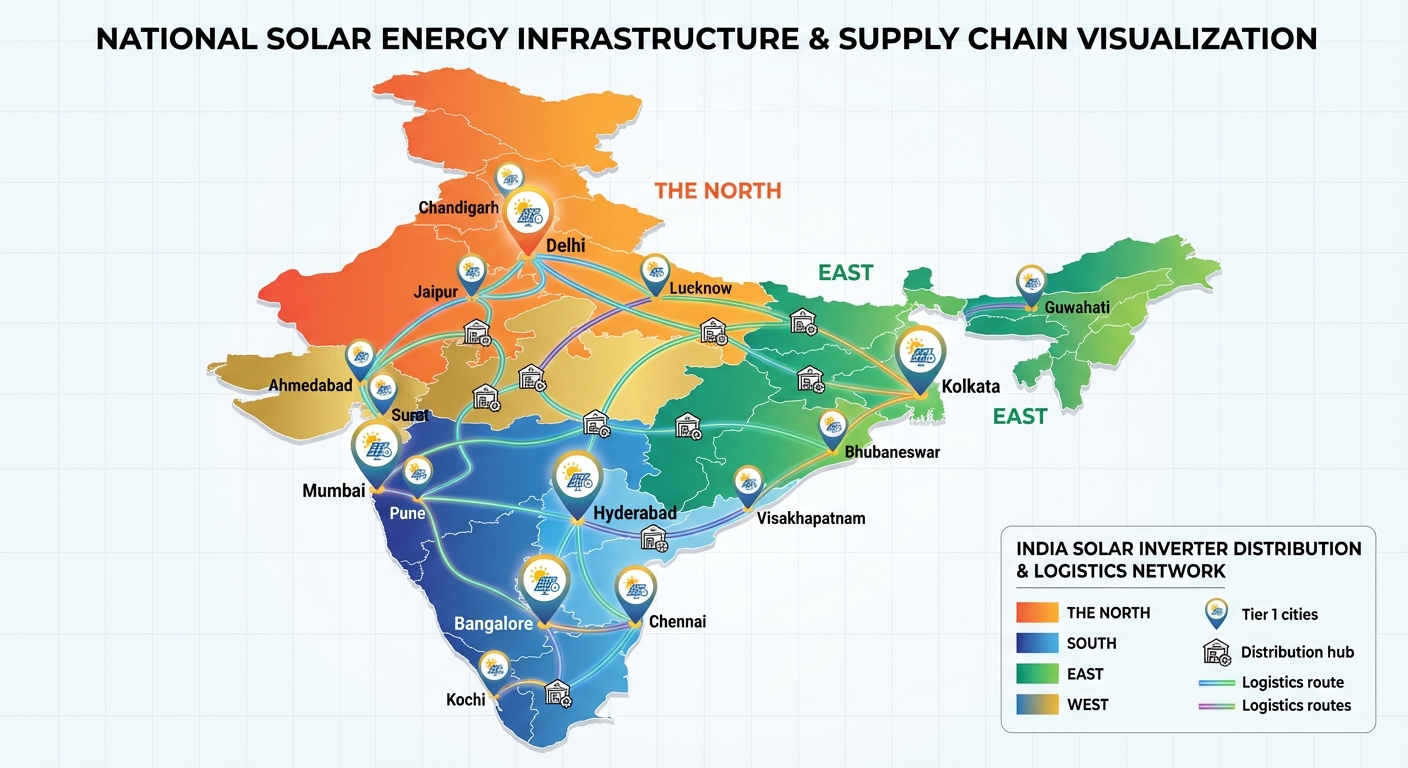
India’s geographic diversity demands a nuanced approach to distributor selection. The inverter distributors India landscape varies significantly across regions, with different strengths, coverage patterns, and market dynamics in each zone.
North India Distribution Networks
North India, encompassing Delhi NCR, Punjab, Haryana, Rajasthan, Uttar Pradesh, and Uttarakhand, represents one of the most competitive markets for solar inverter distribution. The region benefits from strong logistics infrastructure, particularly around the Delhi NCR hub, which serves as a distribution gateway for the entire northern zone.
For EPCs operating in this region, look for distributors with warehouses in both Delhi and secondary hubs like Jaipur or Lucknow. The vast geographic spread of Uttar Pradesh and Rajasthan requires distributors with robust last-mile delivery capabilities to reach tier 2 and tier 3 cities where residential and agricultural solar installations are growing rapidly.
Punjab and Haryana, with their strong agricultural economies, present unique opportunities for solar pumping and agricultural applications. Distributors serving these markets should understand the specific requirements of agricultural inverter installations and provide appropriate technical support.
West India Coverage
Maharashtra and Gujarat dominate West India’s solar market, with Mumbai and Ahmedabad serving as major distribution hubs. The region’s strong industrial base drives significant demand for commercial and industrial solar installations, requiring inverter distributors India who can handle large-volume orders and provide sophisticated technical support for complex C&I projects.
Gujarat’s position as India’s solar manufacturing hub means many inverter manufacturers and distributors maintain significant presence in Ahmedabad and Vadodara. This concentration offers EPCs excellent access to products, competitive pricing, and strong technical ecosystems. Maharashtra’s diverse market, from Mumbai’s commercial sector to Pune’s industrial belt and rural agricultural areas, requires distributors with versatile capabilities across different installation types.
South India Presence
South India, particularly Karnataka, Tamil Nadu, Andhra Pradesh, and Telangana, has emerged as a solar powerhouse with sophisticated markets and high-quality installation standards. Bangalore and Chennai serve as primary distribution centers, with secondary hubs in Hyderabad, Coimbatore, and Visakhapatnam.
The region’s tech-savvy customer base and emphasis on quality make it ideal for advanced inverter technologies with features like smart monitoring systems and high-efficiency performance. Distributors serving South India typically maintain higher technical competency and offer more sophisticated pre-sales support compared to other regions.
Kerala’s unique geographic challenges, hilly terrain, high rainfall, and dispersed population, require distributors with specialized logistics capabilities and products suited to high-humidity coastal environments. When evaluating inverter distributors India for Kerala operations, prioritize those with experience in weather-resistant installations and IP66-rated equipment.
East India Availability
East India, including West Bengal, Odisha, Bihar, and Jharkhand, represents an emerging solar market with growing potential but less developed distribution infrastructure compared to other regions. Kolkata serves as the primary hub, with limited secondary distribution centers in cities like Bhubaneswar or Patna.
EPCs operating in this region often face longer delivery timelines and may need to work with distributors who ship from other regional hubs. However, the market’s growth trajectory makes it increasingly attractive, and several national distributors are expanding their East India presence with dedicated warehousing and technical teams.
Tier 2 and Tier 3 City Penetration
While metro city coverage is standard among most inverter distributors India, the real differentiator lies in tier 2 and tier 3 city reach. Cities like Indore, Nagpur, Surat, Kochi, Vijayawada, Chandigarh, and Bhopal are experiencing rapid solar adoption, yet many distributors struggle with consistent service in these markets.
For EPCs targeting these high-growth markets, prioritize distributors who have established local partnerships, maintain regional stock points, or have proven last-mile delivery capabilities. The ability to deliver inverters to a project site in Nashik or Madurai within 3-4 days rather than 10-12 days provides significant competitive advantage.
Logistics and Supply Chain Capabilities
Superior logistics infrastructure transforms good distributor relationships into great ones. When evaluating inverter distributors India, dig deep into their supply chain capabilities to ensure they can support your operational requirements consistently.
Warehouse Locations and Inventory Capacity
Strategic warehouse placement reduces delivery times and logistics costs. Leading distributors maintain multi-location warehousing with primary hubs in major metros and secondary stock points in regional centers. Request a detailed map of warehouse locations and understand the inventory allocation across these facilities.
Warehouse capacity matters during peak season (typically October through March when solar installations accelerate). Distributors with limited warehouse space may struggle to maintain adequate inventory during high-demand periods, leading to stock-outs precisely when you need products most urgently.
Last-Mile Delivery to Project Sites
Metro-to-metro logistics are relatively straightforward; the challenge lies in last-mile delivery to actual project sites, which may be rooftop locations in congested urban areas or remote rural installations. Evaluate the distributor’s capabilities for site-level delivery, including their network of local logistics partners and experience with challenging delivery scenarios.
Some advanced distributors offer GPS-tracked deliveries, real-time shipment visibility, and dedicated account managers who coordinate complex multi-site deliveries for large EPC projects. These capabilities become invaluable when you’re managing multiple concurrent installations across different locations.
Transit Insurance and Damage Protection
Solar inverters are sensitive electronic equipment requiring careful handling during transport. Verify that your distributor carries comprehensive transit insurance and has clear policies on damage claims. Who inspects damaged goods? What’s the timeline for replacement? Are you charged for damaged units while claims are processed?
The best inverter distributors India use specialized solar equipment packaging, conduct quality checks before dispatch, and maintain photographic documentation of packaging condition. These practices minimize transit damage and streamline resolution when issues occur.
Emergency Stock and Urgent Requirements
Project emergencies happen, a failed inverter needs immediate replacement, or a client accelerates their timeline unexpectedly. How does your distributor handle urgent requirements? Do they maintain emergency stock? Can they arrange same-day or next-day delivery for critical situations?
While you shouldn’t rely on emergency services routinely, knowing your distributor can support you during genuine crises provides valuable peace of mind and protects your customer relationships when unexpected situations arise.
Technical Support Infrastructure Assessment
The technical competency of your inverter distributors India directly impacts your installation quality, project timelines, and ability to handle complex requirements. A distributor who views themselves as a technical partner rather than merely a product supplier adds substantial value to your business.
Pre-Sales Technical Consultation
Quality distributors employ qualified electrical engineers who can assist with system design, inverter selection, and configuration planning. This pre-sales support helps you specify the right products for each project, avoiding costly mistakes like undersized inverters, incorrect voltage configurations, or incompatible battery integration.
When evaluating distributors, request a technical consultation on a sample project. Assess the depth of their knowledge, responsiveness to technical queries, and ability to provide documentation and specifications. Distributors who can discuss topics like inverter selection criteria, DC oversizing capabilities, or grid compatibility demonstrate the technical partnership you need.
Product Training Programs
Your installation team’s competency with specific inverter products affects installation quality and speed. Leading distributors offer regular training programs covering product features, installation best practices, commissioning procedures, and troubleshooting techniques.
Ask potential partners about their training infrastructure. Do they conduct hands-on workshops? Provide online training resources? Offer certification programs for installers? Access to quality training reduces installation errors, speeds up commissioning, and improves your team’s confidence with new products or advanced features.
Commissioning Assistance and On-Site Support
For complex commercial installations or when your team is learning new products, on-site commissioning support can be invaluable. Some distributors provide field engineers who assist with initial installations, verify configurations, and ensure proper system setup.
While you may not need this support for every installation, having access to commissioning assistance for challenging projects or new product lines reduces risk and accelerates your learning curve. Verify the distributor’s policies on commissioning support, is it complimentary for certain order volumes? Available on a paid basis? Limited to specific product lines?
Troubleshooting Response and Escalation
When technical issues arise during installation or operation, rapid troubleshooting support minimizes downtime and customer dissatisfaction. Evaluate the distributor’s technical support responsiveness, what are their support hours? Do they offer phone, email, and WhatsApp support channels? What’s their typical response time for technical queries?
Advanced distributors now provide tiered support with escalation paths to manufacturer engineering teams for complex issues. This direct connection to manufacturer resources can resolve challenging technical problems that distributor-level support cannot address independently.
Access to Technical Documentation
Comprehensive technical documentation, installation manuals, wiring diagrams, configuration guides, troubleshooting flowcharts, is essential for quality installations. Verify that your distributor provides complete documentation in formats your team can easily access and reference during installations.
Some progressive inverter distributors India now offer digital resource libraries with video tutorials, installation guides, and technical bulletins accessible through mobile apps or web portals. These resources improve your team’s efficiency and reduce dependency on direct support for routine questions.
Warranty and After-Sales Service Evaluation
Warranty support quality directly impacts your customer satisfaction and business reputation. A distributor who processes warranty claims efficiently protects your customer relationships, while one with slow, bureaucratic processes creates ongoing headaches that damage your brand.
Warranty Claim Process Efficiency
Map out the complete warranty claim journey with potential distributors. How do you register a claim? What documentation is required? Who conducts the initial assessment? What are the typical resolution timelines for different claim types?
The best inverter distributors India have digitized warranty processes with online claim registration, automated status tracking, and transparent communication throughout the resolution cycle. Digital warranty systems eliminate paperwork delays, reduce processing times, and provide you and your customers with real-time visibility into claim status.
Companies like Qbits have pioneered digital warranty systems that streamline the entire process, enabling EPCs to register claims, track status, and receive resolutions efficiently. When evaluating distributors, prioritize those representing manufacturers with robust warranty infrastructure and proven claim resolution track records.
Replacement Unit Availability
During warranty claim processing, is the customer’s system offline? Or does the distributor provide temporary replacement units while claims are evaluated? The availability of replacement inverters during warranty processing significantly impacts customer satisfaction and your reputation.
Leading distributors maintain dedicated warranty replacement stock and can provide temporary units within 48-72 hours for valid claims. This service level transforms warranty situations from customer frustrations into demonstrations of your commitment to service excellence.
Service Center Network
Beyond the distributor’s own capabilities, assess the manufacturer’s service center network and authorized technician presence across your operating regions. A manufacturer with service centers in 20+ cities provides better warranty support than one with limited service infrastructure, regardless of distributor quality.
When considering inverter distributors India, verify the manufacturer’s service network, authorized service partner locations, and technician availability in your key markets. This infrastructure determines how quickly warranty issues can be diagnosed and resolved, especially for on-site assessments.
Manufacturer Backing and Track Record
The distributor’s warranty support is only as strong as the manufacturer’s commitment to honoring warranties. Research the manufacturer’s reputation for warranty fulfillment, their financial stability, and their track record in the Indian market.
Manufacturers offering extended warranties like 12-year full replacement warranties demonstrate confidence in their product quality and commitment to long-term customer support. These extended warranty periods, when backed by financially stable manufacturers with established Indian presence, provide genuine value to your customers and differentiate your offerings in competitive markets. Understanding inverter lifespan and warranty implications helps you make informed decisions about which brands and distributors to partner with.
Partnership Terms and Commercial Considerations
While technical capabilities and service quality form the foundation of distributor relationships, commercial terms determine the partnership’s financial viability and long-term sustainability. Negotiate partnership agreements that balance competitive pricing with the service levels your business requires.
Pricing Structures and Volume Incentives
Inverter distributors India typically offer tiered pricing based on order volumes, with better rates for larger commitments. Understand the pricing structure completely, what are the volume thresholds for different price tiers? Are prices locked for specific periods, or do they fluctuate with manufacturer pricing changes?
Volume incentive programs can significantly impact your margins, but ensure you can realistically achieve the required volumes without overstocking. Some distributors offer quarterly rebates based on cumulative purchases, while others provide upfront discounts for committed volumes. Choose structures that align with your sales patterns and cash flow capabilities.
Credit Terms and Payment Cycles
Payment terms directly affect your working capital requirements. Standard terms in the solar industry range from advance payment for new relationships to 30-45 day credit for established EPCs with proven track records.
Negotiate credit terms that match your project payment cycles. If your customers pay on 30-day terms, but your distributor requires advance payment, you’re financing the inventory gap from your working capital. Conversely, 45-day credit terms when your customers pay within 15 days improves your cash flow position.
Be realistic about credit terms, distributors extend credit based on your business stability, order history, and financial strength. Build the relationship with smaller orders and reliable payments before requesting extended credit terms.
Minimum Order Quantities
Some distributors impose minimum order quantities (MOQs) that may not align with your project-based purchasing patterns. If you typically need 2-3 inverters per residential project, but the distributor requires minimum orders of 10 units, you’ll carry excess inventory or face frequent stock-outs.
Clarify MOQ requirements during evaluation and negotiate terms that match your operational reality. Some distributors waive MOQs for established partners or offer mixed-SKU orders that meet value thresholds rather than unit counts.
Marketing Support and Co-Branding
Progressive inverter distributors India invest in partner success through marketing support programs. These might include co-branded marketing materials, joint customer events, lead generation support, or digital marketing assistance.
While marketing support shouldn’t be the primary selection criterion, it adds value when choosing between otherwise comparable distributors. Partners who actively support your business growth through marketing initiatives demonstrate commitment beyond transactional relationships.
Territory Rights and Exclusivity
Some distributors offer exclusive territory rights, meaning they won’t supply other EPCs in your designated area. Exclusivity can provide competitive advantage but typically requires volume commitments and may limit your flexibility to work with alternative suppliers.
Most inverter distributors India operate non-exclusive models, supplying multiple EPCs within the same region. This approach offers you flexibility but means you’re competing with other installers who access the same products and pricing. Evaluate which model suits your business strategy and competitive positioning.
Performance Metrics and Reviews
Establish clear performance expectations and review mechanisms from the partnership’s beginning. What metrics will define success, on-time delivery rates, warranty claim resolution times, technical support responsiveness? How frequently will you conduct business reviews?
Formal performance tracking creates accountability and provides data-driven foundations for partnership discussions. Quarterly business reviews allow both parties to address issues, optimize processes, and align on growth strategies.
20 Essential Questions to Ask Potential Inverter Distributors India
Structured evaluation requires asking the right questions. Use this comprehensive checklist when assessing potential inverter distributors India to ensure you gather all critical information for informed decision-making.

Regional Coverage and Delivery
- Which states and cities do you actively serve with warehousing and inventory? Request specific warehouse locations and coverage maps.
- What are your standard delivery timelines to our key project locations? Get specific SLAs for different geographic zones.
- Do you offer last-mile delivery to project sites, or only to city hubs? Understand logistics capabilities beyond major cities.
- How do you handle deliveries to remote or difficult-to-access locations? Assess their experience with challenging logistics scenarios.
Inventory and Stock Management
- What inventory levels do you maintain for different inverter models? Verify they stock the products you commonly specify.
- How can we check real-time stock availability? Determine if they offer distributor portals or API access.
- What’s your process for handling urgent or emergency orders? Understand their capabilities for time-sensitive requirements.
- How far in advance should we place orders for guaranteed availability? Plan your procurement timelines accordingly.
Technical Support and Training
- What technical support do you provide during pre-sales and system design? Assess the depth of engineering expertise available.
- Do you offer product training for our installation teams? Understand training formats, frequency, and costs.
- Can you provide on-site commissioning support for complex installations? Clarify availability and terms for field support.
- What are your technical support hours and response time commitments? Verify they match your operational requirements.
Warranty and Service
- Walk us through your complete warranty claim process. Map the entire journey from claim registration to resolution.
- What are typical warranty claim resolution timelines? Request data on average resolution times for different claim types.
- Do you provide replacement units during warranty claim processing? Understand policies on temporary replacements.
- Where are the nearest manufacturer service centers for our operating regions? Verify service infrastructure in your key markets.
Commercial Terms and Partnership
- What pricing tiers and volume incentives do you offer? Understand the complete pricing structure and qualification criteria.
- What credit terms can you extend, and what are the qualification requirements? Clarify payment terms and credit application processes.
- Are there minimum order quantities or stocking requirements? Ensure MOQs align with your purchasing patterns.
- How do you handle price changes and what notice period do you provide? Understand pricing stability and change notification processes.
Document responses systematically and use them to create a comparative scorecard across multiple potential distributors. This structured approach ensures you evaluate all candidates against consistent criteria rather than making decisions based on incomplete information or subjective impressions.
Building Long-Term Profitable Distributor Relationships
Selecting the right inverter distributors India is just the beginning; building mutually profitable long-term relationships requires ongoing effort, clear communication, and collaborative approaches to business growth.

Communication Protocols and Regular Reviews
Establish clear communication channels and regular touchpoints from the partnership’s start. Designate primary contacts on both sides, set expectations for response times, and schedule regular business review meetings, quarterly reviews work well for most partnerships.
These reviews should cover performance metrics (delivery times, warranty claim resolution, technical support responsiveness), upcoming projects and demand forecasts, market feedback, and opportunities for process improvement. Formal reviews create accountability and ensure small issues are addressed before they become relationship-threatening problems.
Demand Forecasting and Inventory Planning
Help your distributor serve you better by sharing demand forecasts and project pipelines. When distributors understand your upcoming requirements, they can optimize inventory levels, ensure product availability, and potentially offer better pricing for committed volumes.
Collaborative planning benefits both parties, you gain supply certainty, while distributors reduce inventory risk and improve cash flow management. Share project timelines, expected volumes, and any seasonal patterns in your business to enable effective planning.
Joint Marketing and Lead Generation
Explore opportunities for joint marketing initiatives that benefit both parties. Co-hosted webinars, joint participation in solar exhibitions, collaborative content marketing, or shared customer events can generate leads while strengthening the partnership.
Some manufacturers and distributors offer marketing development funds (MDF) or co-marketing budgets for qualified partners. These programs can offset your marketing costs while increasing brand visibility for both organizations.
Feedback Loops for Continuous Improvement
Create structured feedback mechanisms that flow in both directions. Share customer feedback about product performance, installation experiences, and warranty issues with your distributor. This market intelligence helps manufacturers improve products and distributors enhance services.
Conversely, be receptive to distributor feedback about your ordering patterns, payment reliability, or communication effectiveness. Strong partnerships involve mutual improvement, not one-sided demands.
Scaling Partnerships as Your Business Grows
As your EPC business expands into new regions or market segments, involve your distributor in growth planning. Can they support your expansion with inventory in new territories? Do they have technical resources for new product lines you’re considering?
Growing together strengthens partnerships and often unlocks better commercial terms, priority support, and collaborative investment in shared success. Distributors who view you as a growth partner rather than merely a customer provide superior long-term value.
Red Flags: Warning Signs of Problematic Distributors
While evaluating positive attributes is important, recognizing warning signs of problematic inverter distributors India can save you from costly mistakes. Watch for these red flags during your assessment process.
Inconsistent Stock Availability
Frequent stock-outs or inability to commit to delivery timelines indicates poor inventory management or financial constraints. If a distributor consistently responds to inquiries with “we’ll check and get back to you” rather than providing immediate stock status, their inventory systems are inadequate for professional EPC operations.
Poor Communication and Responsiveness
Distributors who are slow to respond during the sales process will be even less responsive after you become a customer. If you’re experiencing delayed responses, unreturned calls, or vague answers to specific questions during evaluation, expect worse service after the sale.
Delayed or Complicated Warranty Processing
Ask for references from existing customers and specifically inquire about warranty claim experiences. Distributors with bureaucratic, slow warranty processes create ongoing customer service nightmares that damage your reputation regardless of the product quality.
Limited Technical Knowledge
If the distributor’s sales team cannot answer basic technical questions about the products they sell, they lack the expertise to support your business effectively. Technical competency should be evident from initial conversations, not something you hope develops over time.
Unclear Pricing or Hidden Charges
Transparent pricing is fundamental to professional relationships. Be wary of distributors who are vague about pricing, mention “additional charges” without specifics, or change quoted prices without clear explanation. Hidden charges for delivery, packaging, or documentation indicate problematic business practices.
Weak Manufacturer Relationships
Distributors should have formal authorization from manufacturers, not gray-market or unauthorized supply arrangements. Request proof of authorized distributor status and verify directly with manufacturers when possible. Unauthorized channels may offer lower prices but provide no warranty support or manufacturer backing.
If a distributor represents dozens of brands with minimal depth in any, they’re likely order-takers rather than technical partners. Focused distributors with deep expertise in 3-5 quality brands typically provide better support than those with superficial relationships across 20+ manufacturers.
The Qbits Advantage: Next-Generation Distribution Support
As you evaluate inverter distributors India, consider partners who represent manufacturers committed to channel excellence and EPC success. Qbits Energy has built its distribution strategy around comprehensive partner support, recognizing that distributor and EPC success drives mutual growth.
The Qbits channel partner program provides EPCs and installers with access to next-generation solar inverters backed by robust distribution support. Partners benefit from a growing network of authorized distributors across India, each selected for their technical competency, logistics capabilities, and commitment to service excellence. If you’re interested in exploring distribution opportunities or becoming a channel partner, you can become a partner through Qbits’ structured onboarding process.
What sets Qbits apart in the inverter distributors India landscape is the company’s digital warranty system, which streamlines claim registration, processing, and resolution. EPCs working with Qbits distributors can register warranty claims digitally, track status in real-time, and receive rapid resolutions backed by the company’s 12-year full replacement warranty. This digital infrastructure eliminates the paperwork delays and communication gaps that plague traditional warranty processes. You can access warranty services through the digital warranty portal for seamless claim management.
Technical training and EPC support infrastructure form another pillar of the Qbits distribution approach. The company provides comprehensive product training covering installation best practices, commissioning procedures, and advanced features like AI-powered WhatsApp monitoring. This training ensures your installation teams can confidently deploy Qbits inverters with full understanding of features like IP66 weather protection, DC surge protection, and smart connectivity options.
The 12-year warranty backing reflects Qbits’ confidence in product quality and long-term commitment to the Indian market. Backed by the Heaven Group’s established legacy in renewable energy, Qbits provides the manufacturer stability and financial strength that ensure warranty commitments will be honored throughout the product lifecycle. This long-term backing gives EPCs confidence when making multi-year commitments to Qbits products and distributors.
Perhaps most importantly for end-customer satisfaction, Qbits’ AI-powered monitoring support enables EPCs to offer differentiated value to clients. The WhatsApp-based monitoring system provides customers with real-time performance visibility, instant alerts, and remote troubleshooting capabilities that reduce service calls and improve system uptime. When your customers experience this level of intelligent monitoring, they become advocates for your installation services. Learn more about these advanced capabilities in our detailed guide on solar inverter monitoring systems.
For EPCs seeking to differentiate their offerings with premium products backed by exceptional distribution support, exploring the Qbits partner network represents a strategic opportunity. You can learn more about Qbits products and their technical specifications to assess fit with your project requirements and customer expectations.
Taking the Next Step: Optimizing Your Inverter Distribution Strategy
Selecting and managing inverter distributors India effectively requires systematic evaluation, clear communication, and ongoing relationship management. The distributor partnerships you build directly impact your project success, customer satisfaction, and business profitability in India’s competitive solar market.
Start by mapping your current and projected geographic footprint against distributor coverage areas. Evaluate potential partners using the comprehensive criteria outlined in this guide, regional availability, logistics capabilities, technical support infrastructure, warranty processes, and commercial terms. Ask the 20 essential questions to gather comparable data across multiple candidates, and watch for red flags that indicate problematic relationships.
Once you’ve selected partners, invest in building strong relationships through regular communication, collaborative planning, and mutual feedback. The most successful EPCs view distributors as strategic partners rather than transactional suppliers, creating win-win relationships that support mutual growth.
As you refine your inverter distribution strategy, consider how manufacturer selection influences distributor quality and support. Partnering with manufacturers committed to channel excellence, like Qbits Energy with its digital warranty systems, comprehensive training programs, and 12-year warranty backing, provides competitive advantages that translate directly to customer satisfaction and business growth.
The Indian solar market in 2026 offers tremendous opportunities for EPCs who build robust, reliable supply chains with quality inverter distributors India. By applying the evaluation frameworks, asking the right questions, and building collaborative partnerships, you position your business for sustainable growth in one of the world’s fastest-growing renewable energy markets.
Ready to optimize your inverter supply chain with next-generation products and distribution support? Connect with Qbits Energy to explore partnership opportunities, discuss your specific requirements, and discover how advanced inverter technology combined with exceptional distribution support can differentiate your EPC business in competitive markets. For technical support or additional information, visit the Qbits support portal or contact the team directly.
This blog post was written using thestacc.com