



On-Grid vs Hybrid Solar Inverters: ROI Guide for India 2026

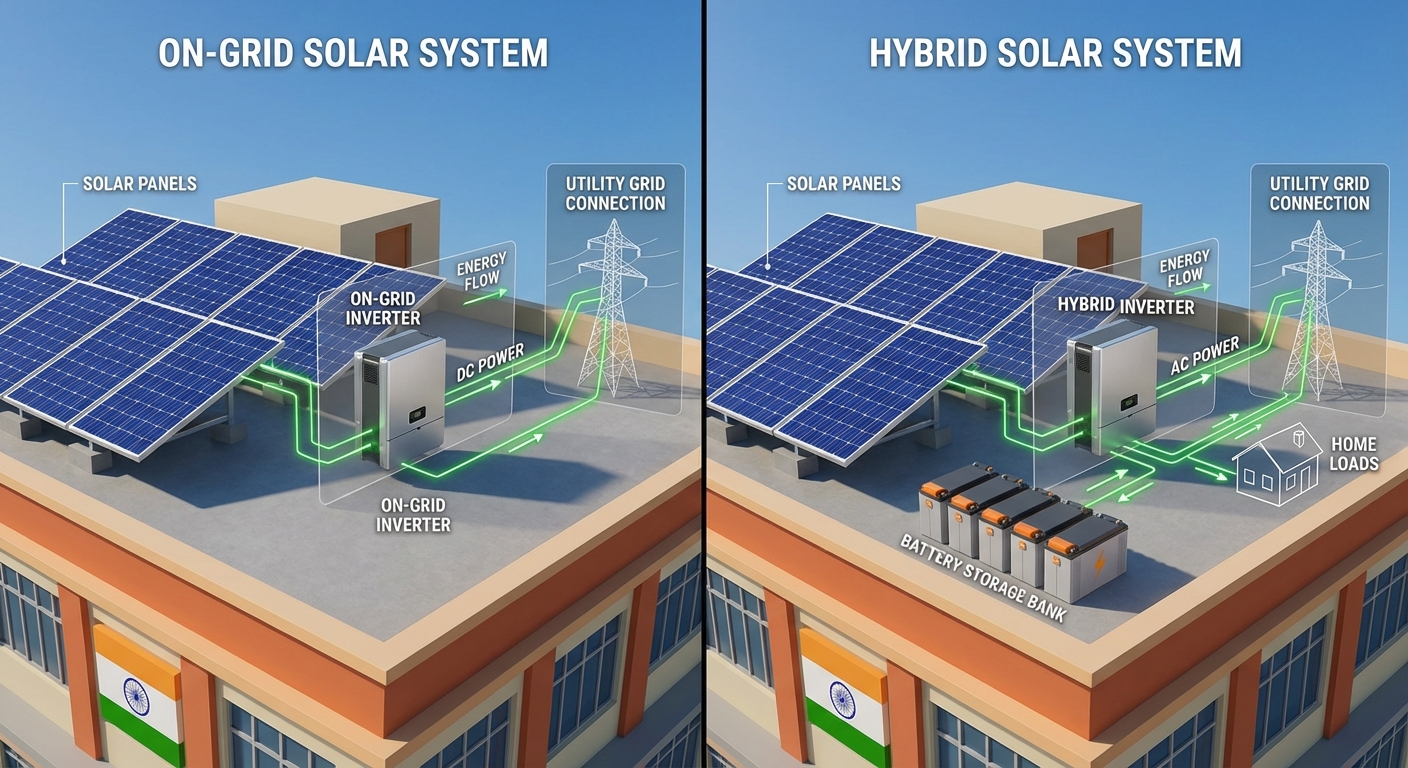
Choosing between on-grid and hybrid solar inverters represents one of the most critical decisions for solar EPCs and distributors serving the Indian market in 2026. This choice directly impacts your client’s return on investment, system reliability, and long-term satisfaction. With electricity tariffs varying significantly across states and grid stability differing by region, understanding the nuanced differences between on-grid hybrid inverter technologies is essential for recommending the right solution.
This comprehensive comparison analyzes upfront costs, long-term ROI, battery integration benefits, grid dependency factors, and ideal use cases for both residential and commercial installations across India. Whether you’re specifying inverters for a 5kW rooftop system in Mumbai or a 500kW commercial project in Rajasthan, this guide provides the financial and technical framework to make data-driven recommendations.
Understanding On-Grid and Hybrid Solar Inverter Technologies
Before diving into cost comparisons and ROI calculations, it’s crucial to understand the fundamental architectural differences between on-grid and hybrid solar inverters. These differences determine not just pricing, but also functionality, application suitability, and long-term value.
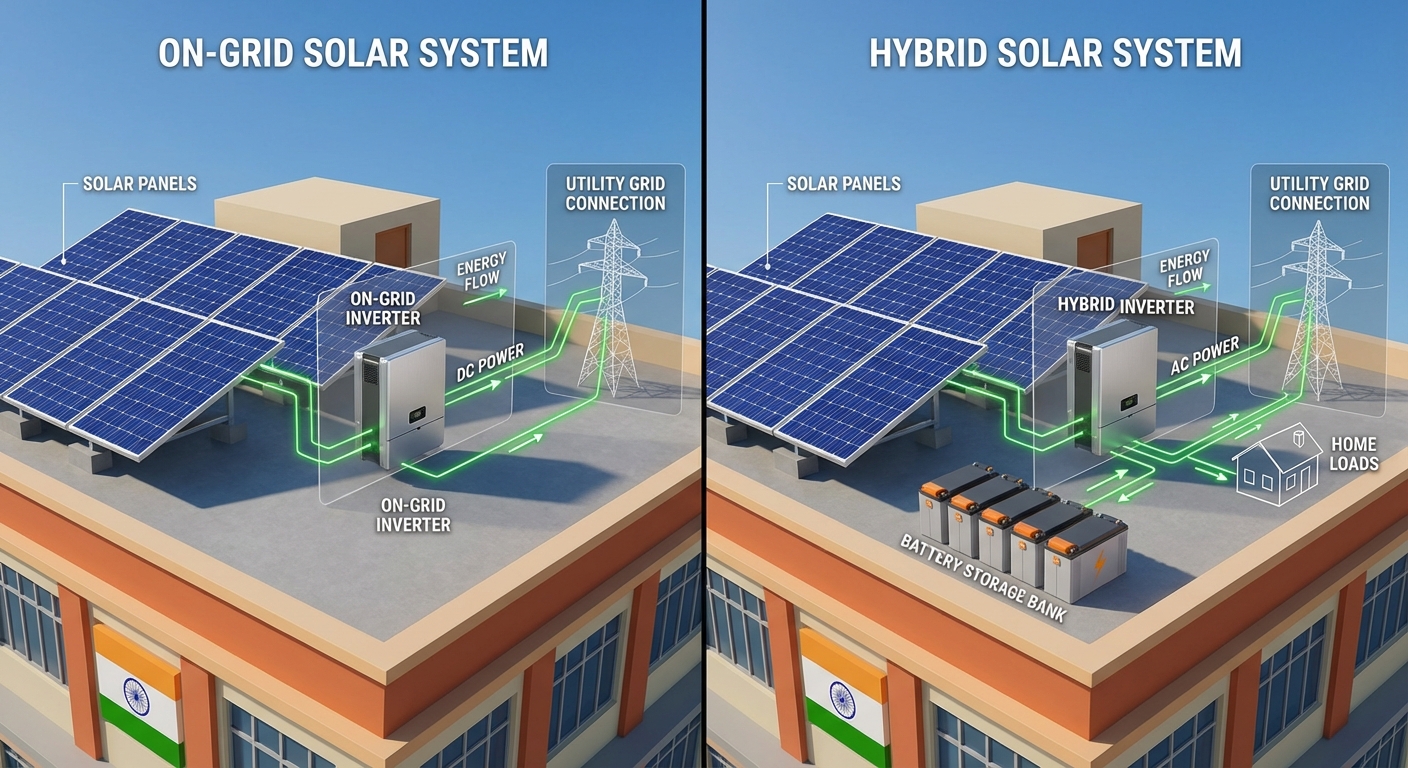
On-grid solar inverters, also called grid-tied inverters, convert DC electricity from solar panels into AC electricity that synchronizes with the utility grid. These systems operate only when the grid is active, feeding excess solar generation back to the grid through net metering arrangements. When solar production exceeds consumption, the surplus energy flows to the grid, effectively running your electricity meter backward in states with favorable net metering policies.
The core advantage of on-grid systems lies in their simplicity and cost-effectiveness. Without battery storage requirements, these inverters focus exclusively on efficient DC-to-AC conversion and grid synchronization. Modern on-grid inverters from manufacturers like Qbits achieve up to 98% efficiency with advanced maximum power point tracking (MPPT) algorithms that extract maximum energy from solar panels even under partial shading conditions.
Hybrid inverters represent the next evolution in solar technology, combining grid-tied functionality with integrated battery management systems. These sophisticated devices can simultaneously manage solar input, battery charging and discharging, grid interaction, and load supply. A hybrid inverter intelligently routes power based on programmed priorities—typically charging batteries first, then powering loads, and finally exporting surplus to the grid.
The technical complexity of hybrid systems is significantly higher. These inverters incorporate bidirectional conversion capabilities, battery charge controllers, sophisticated energy management algorithms, and multiple protection circuits. This complexity translates to higher component costs but delivers unmatched flexibility in energy management and backup power capabilities.
Key Technical Differences in Architecture
On-grid inverters feature a single-stage conversion process optimized for grid synchronization. They monitor grid voltage and frequency continuously, shutting down automatically during outages for safety—a feature called anti-islanding protection. This safety mechanism prevents the inverter from energizing grid lines during maintenance, protecting utility workers.
Hybrid inverters incorporate dual conversion stages: one for solar-to-battery charging (DC-DC conversion) and another for battery/solar-to-grid output (DC-AC conversion). This dual-stage architecture enables the inverter to operate in multiple modes: grid-tied mode, battery backup mode, and off-grid mode. Advanced models can seamlessly transition between modes in milliseconds, ensuring uninterrupted power supply during grid failures.
Component-wise, hybrid inverters require additional hardware including battery charge controllers, battery management systems (BMS) integration, and more robust power electronics to handle bidirectional power flow. These components increase both the initial cost and the potential points of failure, though quality manufacturers implement extensive protection mechanisms to ensure reliability.
Upfront Cost Analysis: On-Grid vs Hybrid Inverters in India
Understanding the upfront investment required for on-grid versus hybrid solar inverters is fundamental to ROI calculations and client recommendations. In the Indian market of 2026, pricing varies significantly based on capacity, brand positioning, component quality, and feature sets.
On-grid inverter pricing in India typically ranges from ₹6,000 to ₹12,000 per kW for residential systems (1kW to 10kW capacity). For a standard 5kW residential installation, expect to invest between ₹30,000 and ₹60,000 for the inverter alone. Commercial and industrial on-grid inverters (10kW to 100kW+) benefit from economies of scale, with per-kW costs dropping to ₹5,000 to ₹9,000 per kW.
Premium on-grid inverters with advanced features—such as AI-powered monitoring, IP66 weather protection, and extended warranties—command higher prices but deliver superior long-term value. For instance, inverters with 12-year full replacement warranties and German-grade components may cost 15-20% more upfront but eliminate replacement costs and downtime over the system’s lifespan.
Hybrid inverter costs are substantially higher, ranging from ₹15,000 to ₹30,000 per kW for the inverter unit alone, not including battery storage. A 5kW hybrid inverter typically costs between ₹75,000 and ₹1,50,000. However, this is only part of the total system cost, battery storage adds significant expense.
Battery costs vary by chemistry and capacity. Lithium-ion batteries, the preferred choice for hybrid systems due to their efficiency and lifespan, cost approximately ₹12,000 to ₹18,000 per kWh of storage capacity. A typical residential hybrid system with 10kWh of battery storage adds ₹1,20,000 to ₹1,80,000 to the total system cost. Lead-acid batteries offer lower upfront costs (₹8,000 to ₹12,000 per kWh) but require replacement every 3-5 years, making them less economical over the system’s lifetime.
Total System Cost Comparison
For a 5kW residential installation, the complete cost breakdown looks like this:
- On-grid system: ₹2,50,000 to ₹3,00,000 (including panels, inverter, mounting, installation)
- Hybrid system without batteries: ₹2,90,000 to ₹3,50,000 (inverter premium adds ₹40,000-₹50,000)
- Hybrid system with 10kWh lithium batteries: ₹4,10,000 to ₹5,30,000 (battery storage adds ₹1,20,000-₹1,80,000)
For a 50kW commercial installation, the economics shift due to scale:
- On-grid system: ₹22,00,000 to ₹28,00,000
- Hybrid system with 50kWh storage: ₹32,00,000 to ₹42,00,000
These cost differences form the foundation for ROI analysis, but the complete financial picture requires examining long-term savings, maintenance costs, and operational benefits over the system’s 25-year lifespan. For deeper insights into inverter selection criteria beyond just cost, explore our guide on solar inverter selection for EPCs.
Long-Term ROI Comparison for Indian Solar Projects
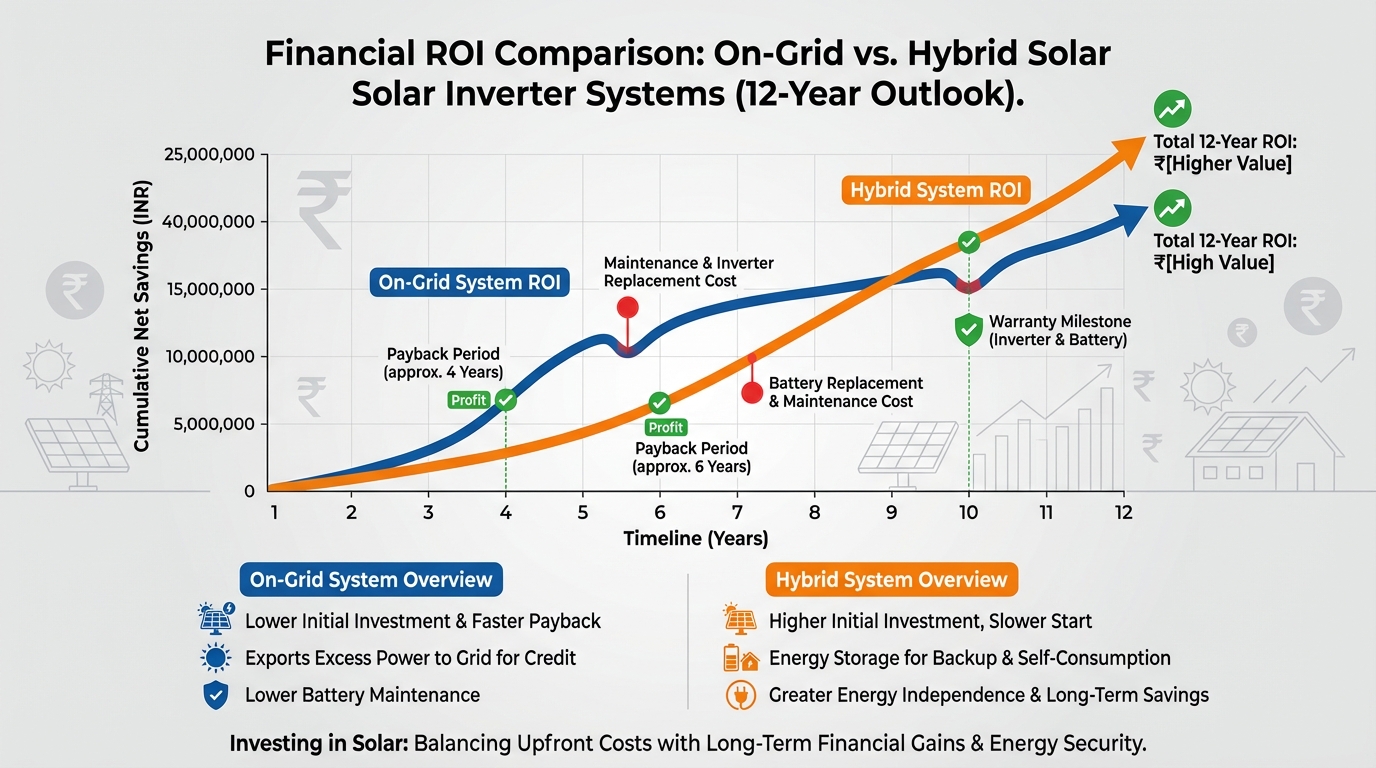
While upfront costs favor on-grid systems, the true measure of value lies in long-term return on investment. ROI calculations must account for electricity savings, net metering benefits, battery storage value, maintenance costs, warranty coverage, and system lifespan.
On-grid system ROI is relatively straightforward to calculate. These systems generate electricity that either reduces grid consumption or earns credits through net metering. In states with favorable net metering policies like Gujarat, Karnataka, and Andhra Pradesh, excess generation receives credits at retail electricity rates, maximizing savings.
For a typical 5kW residential on-grid system in India generating 20 units per day (7,300 units annually), the financial benefits are substantial. At an average electricity tariff of ₹7 per unit, annual savings reach ₹51,100. With a system cost of ₹2,75,000, the simple payback period is approximately 5.4 years. Over the system’s 25-year lifespan, total savings exceed ₹12,75,000, delivering an ROI of over 360%.
However, this calculation assumes stable grid connectivity and favorable net metering policies. In regions with frequent power cuts or unfavorable net metering terms, on-grid systems lose significant value. When the grid fails, on-grid inverters shut down completely, rendering your solar investment temporarily useless despite abundant sunshine.
Hybrid system ROI is more complex but potentially more valuable in the right circumstances. The additional investment in battery storage delivers three key financial benefits: backup power during outages, time-of-use optimization, and reduced grid dependency.
Consider the same 5kW system configured as a hybrid with 10kWh battery storage, costing ₹4,60,000. The system generates the same 7,300 units annually, but battery storage enables strategic energy management. During off-peak hours, the system charges batteries with solar energy. During peak hours when electricity rates are highest, the system powers loads from batteries, avoiding expensive grid consumption.
In commercial settings with time-of-use tariffs, this optimization is particularly valuable. Industrial electricity rates in India can vary from ₹5 per unit during off-peak hours to ₹12 per unit during peak demand periods. A hybrid system that shifts 30% of consumption from peak to off-peak hours delivers additional savings of ₹1,50,000 to ₹2,00,000 annually for a 50kW installation.
Impact of Electricity Tariffs and Regional Variations
Electricity tariffs across Indian states vary dramatically, directly impacting solar ROI. States like Maharashtra, Tamil Nadu, and Rajasthan have higher average tariffs (₹8-₹10 per unit for commercial consumers), making solar investments more attractive. States with lower tariffs see longer payback periods but still deliver positive ROI over the system’s lifespan.
Net metering policies also vary significantly. Some states offer 1:1 net metering with indefinite credit rollover, while others impose restrictions on system size, credit validity periods, or compensation rates for exported energy. In states with unfavorable net metering terms, hybrid systems with battery storage become more economically attractive by maximizing self-consumption rather than grid export.
Maintenance costs for on-grid systems are minimal, typically ₹3,000 to ₹5,000 annually for cleaning and inspection. Hybrid systems incur slightly higher maintenance costs (₹5,000 to ₹8,000 annually) due to battery monitoring and management requirements. However, quality inverters with comprehensive warranties significantly reduce these concerns. A 12-year full replacement warranty eliminates inverter replacement costs that would otherwise occur around year 10-12, saving ₹50,000 to ₹1,50,000 depending on system size.
Battery replacement represents the most significant long-term cost for hybrid systems. Lithium-ion batteries typically last 10-15 years, requiring one replacement over a 25-year system lifespan. This adds ₹1,20,000 to ₹1,80,000 to the total cost of ownership for a residential system. However, declining battery costs, expected to drop 30-40% by 2030, will reduce this burden for systems installed today.
For comprehensive analysis of inverter lifespan and its financial implications, refer to our detailed solar inverter lifespan financial planning guide.
Grid Dependency and Power Backup Capabilities
One of the most significant differentiators between on-grid and hybrid inverters is their behavior during grid outages, a critical consideration in India where power reliability varies dramatically by region and season.
On-grid inverter limitations during grid failures are absolute. When the grid goes down, on-grid inverters immediately shut down due to anti-islanding protection requirements. This safety feature prevents the inverter from energizing grid lines during maintenance or repairs, protecting utility workers from electrocution.
For homeowners and businesses in areas with stable grid connectivity, this limitation is minor. However, in regions experiencing frequent power cuts, common in rural areas and during summer peak demand periods, this represents a significant drawback. Your solar panels may be generating abundant electricity, but you cannot use it during outages. This paradox frustrates many solar system owners who expected energy independence.
The economic impact of grid dependency extends beyond inconvenience. Businesses experiencing power cuts often rely on diesel generators for backup power, incurring fuel costs of ₹15-₹20 per unit generated. A commercial establishment running generators for 2-3 hours daily during outages spends ₹50,000 to ₹1,00,000 annually on backup power, costs that could be eliminated with hybrid inverter technology.
Hybrid inverter backup capabilities transform the value proposition in grid-unstable regions. When the grid fails, hybrid inverters seamlessly switch to battery backup mode, continuing to power critical loads without interruption. Advanced hybrid inverters complete this transition in under 10 milliseconds, fast enough that computers and sensitive electronics experience no disruption.
The backup capacity depends on battery size and load requirements. A 10kWh battery system can power essential loads (lights, fans, refrigerator, computers) for 4-6 hours, or run critical loads only (refrigerator, internet, lighting) for 8-12 hours. For businesses with critical operations, this backup capability is invaluable, preventing revenue loss and maintaining productivity during outages.
Grid Stability Requirements Across Indian Regions
Grid stability varies significantly across India’s diverse geography. Metropolitan areas like Mumbai, Delhi, and Bangalore enjoy relatively stable grid connectivity with minimal outages. In these regions, on-grid inverters deliver excellent value without the added complexity and cost of battery storage.
Tier-2 and tier-3 cities, along with rural areas, experience more frequent and prolonged outages. States like Uttar Pradesh, Bihar, and parts of Madhya Pradesh see regular power cuts, particularly during summer months when demand peaks. In these regions, hybrid inverters with battery backup deliver substantially higher value by ensuring continuous power availability.
Coastal regions face unique challenges from extreme weather events. Cyclones and storms can cause multi-day grid outages, making battery backup essential for maintaining basic services. Inverters with IP66 weather protection, designed to withstand heavy rain, salt spray, and extreme temperatures, are critical in these environments to ensure long-term reliability.
Industrial areas often experience voltage fluctuations and power quality issues that can damage sensitive equipment. Quality inverters incorporate DC and AC surge protection devices (SPDs) that safeguard both the inverter and connected loads from voltage spikes. This protection is particularly valuable in regions with unstable grid infrastructure.
Battery Integration Benefits and Considerations
Battery integration represents the defining feature of hybrid inverters, enabling energy storage, backup power, and sophisticated energy management strategies. Understanding battery technologies, sizing requirements, and economic implications is essential for making informed recommendations.
Lithium-ion batteries have become the preferred choice for hybrid solar systems due to their superior performance characteristics. These batteries offer 90-95% round-trip efficiency (compared to 70-80% for lead-acid), deeper discharge capabilities (80-90% depth of discharge vs. 50% for lead-acid), and longer lifespans (10-15 years vs. 3-5 years). While upfront costs are higher, the total cost of ownership over the system’s lifetime strongly favors lithium-ion technology.
Modern lithium iron phosphate (LiFePO4) batteries offer enhanced safety and thermal stability, critical factors in India’s hot climate. These batteries can operate reliably in temperatures up to 45-50°C, making them suitable for rooftop installations where ambient temperatures can exceed 60°C during summer months.
Lead-acid batteries remain relevant for budget-conscious installations, particularly in residential applications where upfront cost is the primary constraint. However, EPCs should clearly communicate the total cost implications to clients. A lead-acid battery system requiring replacement every 4 years will need 5-6 replacements over a 25-year period, potentially costing more than a single lithium-ion installation while delivering inferior performance.
Battery Capacity Planning and Sizing
Proper battery sizing requires analyzing daily consumption patterns, critical load requirements, and desired backup duration. A common mistake is oversizing batteries based on total connected load rather than actual usage patterns, leading to unnecessary expense and reduced ROI.
For residential applications, a typical approach is to size batteries for 4-6 hours of backup for essential loads. A household with 2kW of critical loads (refrigerator, fans, lights, internet) requires 8-12kWh of battery capacity. This provides adequate backup for evening peak consumption and overnight requirements while remaining economically viable.
Commercial installations require more sophisticated analysis. Businesses should identify critical loads that must remain operational during outages versus non-essential loads that can be shed. A retail store might prioritize point-of-sale systems, lighting, and refrigeration while accepting that air conditioning will be unavailable during extended outages. This selective approach minimizes battery requirements and system costs.
Self-consumption optimization represents another key benefit of battery integration. Rather than exporting excess solar generation to the grid at potentially unfavorable rates, hybrid systems store this energy for later use. In states with poor net metering terms or time-of-use tariffs, this capability significantly enhances ROI.
Consider a commercial facility that generates peak solar output during midday when consumption is moderate, but experiences peak consumption in the evening when solar generation has ceased. Without batteries, this facility must export midday surplus at low rates and purchase evening power at high rates. With battery storage, the system stores midday surplus and discharges it during evening peak hours, maximizing self-consumption and minimizing grid dependence.
Ideal Use Cases: Residential Installations
Recommending the right inverter type for residential clients requires understanding their specific circumstances, priorities, and local conditions. Both on-grid and hybrid inverters have clear sweet spots in the residential market.
On-grid inverters excel for residential clients in the following scenarios:
- Stable grid areas: Homes in metropolitan areas with reliable grid connectivity and minimal outages gain little value from battery backup, making on-grid systems the cost-effective choice
- Favorable net metering: States offering 1:1 net metering with retail rate compensation make grid export economically attractive, eliminating the need for battery storage
- Budget constraints: Homeowners prioritizing lowest upfront cost and fastest payback period benefit from on-grid simplicity
- High daytime consumption: Households with significant daytime electricity usage (work-from-home professionals, daytime air conditioning) consume most solar generation directly, reducing the value of battery storage
A typical recommendation might be a 5kW on-grid system for a Mumbai apartment with stable grid connectivity, high daytime consumption, and access to favorable net metering. The system costs ₹2,75,000, delivers a 5-6 year payback period, and requires minimal maintenance over its 25-year lifespan.
Hybrid inverters deliver superior value for residential clients when:
- Frequent power cuts: Homes experiencing regular grid outages benefit enormously from battery backup, maintaining comfort and productivity during failures
- Critical backup needs: Households with medical equipment, home offices, or security systems requiring uninterrupted power justify the hybrid premium
- Poor net metering terms: States with unfavorable export rates or restrictions make self-consumption through battery storage more economical than grid export
- Evening peak consumption: Families with high evening electricity usage (air conditioning, cooking, entertainment) benefit from storing daytime solar generation for evening use
- Future-proofing: Homeowners planning long-term residence who want maximum energy independence and resilience against future grid instability or tariff increases
A recommended configuration might be a 5kW hybrid system with 10kWh lithium battery storage for a Bangalore villa experiencing 1-2 hours of daily power cuts. Despite the higher upfront cost of ₹4,60,000, the system eliminates generator dependency (saving ₹20,000 annually on fuel), provides seamless backup, and optimizes self-consumption for superior long-term ROI.
Electricity Consumption Patterns and Tariff Structures
Understanding client consumption patterns is critical for accurate ROI projections and system sizing. Request 12 months of electricity bills to analyze seasonal variations, peak consumption periods, and average daily usage. This data reveals whether solar generation will align with consumption or require storage for time-shifting.
Residential tariff structures in India typically feature slab-based pricing where per-unit costs increase with consumption. Solar systems reduce consumption into lower tariff slabs, amplifying savings. A household consuming 800 units monthly might pay ₹8 per unit for consumption above 500 units. Solar generation that reduces consumption to 400 units eliminates the highest-cost consumption, delivering disproportionate savings.
Some states have introduced time-of-use tariffs for residential consumers, charging higher rates during evening peak hours (6 PM to 10 PM). In these markets, hybrid systems with battery storage deliver exceptional value by storing cheap midday solar generation for use during expensive evening hours.
Ideal Use Cases: Commercial and Industrial Projects
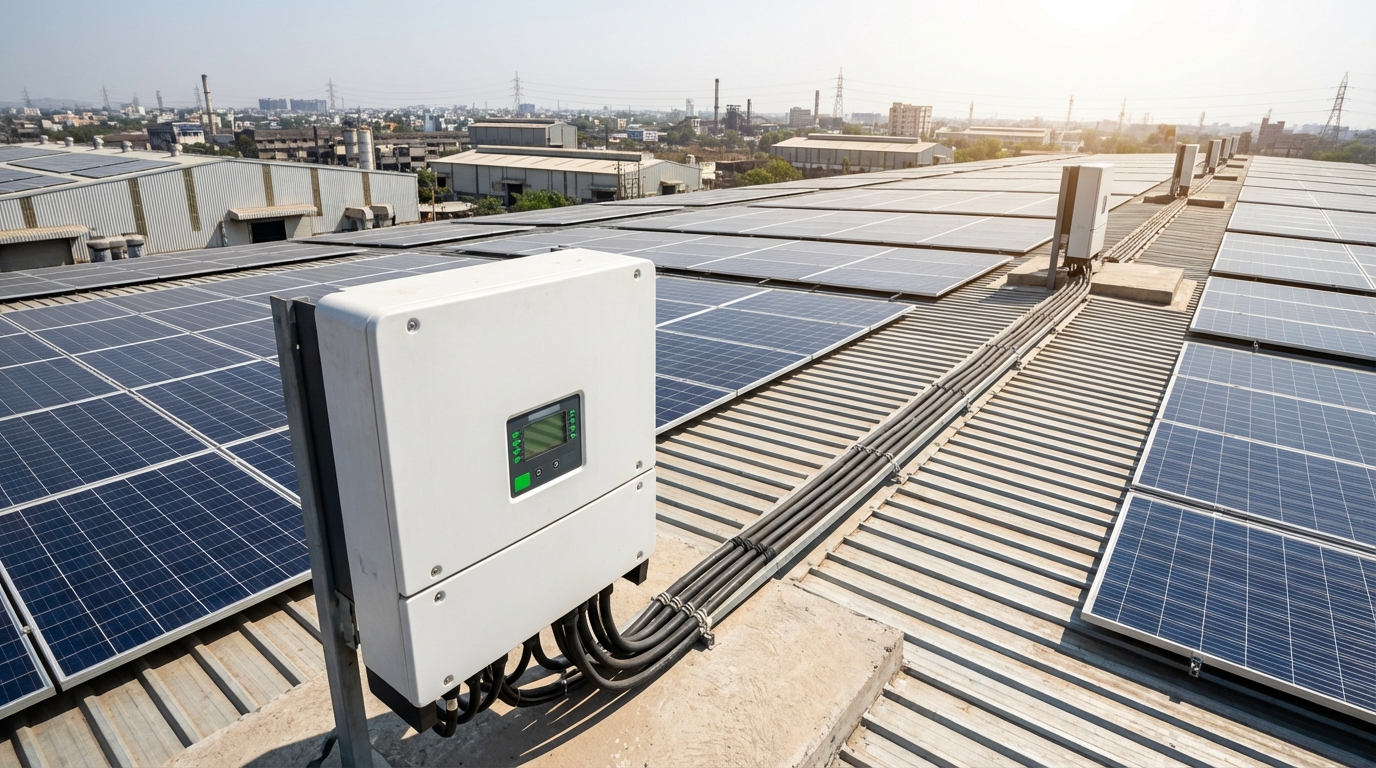
Commercial and industrial solar installations represent the largest market segment for solar EPCs, with project sizes ranging from 10kW rooftop systems to multi-megawatt ground-mount installations. The on-grid versus hybrid decision in this segment is driven primarily by operational requirements and financial optimization.
On-grid systems dominate commercial installations in scenarios including:
- Stable grid connectivity: Commercial facilities in industrial parks and metropolitan areas with reliable power supply gain minimal value from backup capabilities
- Daytime operations: Businesses operating primarily during daylight hours (9 AM to 6 PM) consume solar generation directly, maximizing self-consumption without storage
- Large-scale installations: Projects above 100kW benefit from economies of scale in on-grid technology, where battery storage costs become prohibitively expensive
- Open access agreements: Large consumers with open access to cheaper power sources use solar primarily for demand charge reduction and sustainability goals rather than backup
A typical recommendation might be a 100kW on-grid system for a manufacturing facility operating single-shift daytime production. The system costs ₹45,00,000, generates 1,50,000 units annually, saves ₹12,00,000 per year at ₹8 per unit, and delivers a 3.75-year payback period. With minimal maintenance requirements and a 12-year warranty, the system provides excellent ROI without the complexity of battery integration.
Hybrid systems prove valuable for commercial clients when:
- Critical operations: Facilities with processes that cannot tolerate power interruptions (data centers, hospitals, cold storage) require seamless backup power
- Demand charge optimization: Commercial consumers facing high demand charges can use battery storage to shave peak demand, reducing monthly demand charges by 20-30%
- Grid instability: Businesses in regions with frequent outages or poor power quality benefit from battery backup and power conditioning
- 24/7 operations: Facilities operating round-the-clock can store daytime solar generation for nighttime consumption, maximizing self-sufficiency
- Diesel generator replacement: Businesses currently relying on expensive diesel backup can replace generators with cleaner, cheaper battery storage
Consider a 50kW hybrid system with 100kWh battery storage for a hospital requiring uninterrupted power. The system costs ₹42,00,000 but eliminates diesel generator dependency (saving ₹3,00,000 annually on fuel and maintenance), provides clean backup power, and reduces demand charges by ₹1,50,000 annually. The combined savings of ₹4,50,000 per year deliver a payback period under 10 years while ensuring critical patient care systems never experience interruption.
Demand Charge Management with Battery Storage
Demand charges represent a significant portion of commercial electricity bills in India, often 30-50% of total costs. These charges are based on the highest 15-minute average power demand during the billing period, regardless of total consumption. A single demand spike can result in elevated charges for the entire month.
Hybrid inverters with battery storage enable sophisticated demand charge management strategies. The system monitors real-time power consumption and automatically discharges batteries when demand approaches the target threshold, preventing spikes. This “peak shaving” capability can reduce demand charges by 20-30%, delivering substantial savings for large commercial consumers.
For a facility with 200kW contracted demand paying ₹400 per kVA monthly, reducing peak demand by 50kW through battery storage saves ₹20,000 per month or ₹2,40,000 annually. This saving alone can justify the battery investment, with energy savings and backup capabilities providing additional value.
Technical Performance Comparison
Beyond cost and functionality, technical performance characteristics significantly impact long-term value and system reliability. Understanding efficiency ratings, monitoring capabilities, and durability factors helps EPCs specify the right equipment for each application.
Efficiency ratings directly impact energy yield and financial returns. Modern on-grid inverters achieve 97-98% peak efficiency, meaning only 2-3% of solar generation is lost during conversion. Over a 25-year lifespan, a 1% efficiency difference on a 5kW system generating 7,300 units annually represents 1,825 units of lost generation, worth approximately ₹12,775 at ₹7 per unit.
Hybrid inverters typically achieve slightly lower efficiency (95-97%) due to the additional conversion stages required for battery charging and discharging. However, this efficiency penalty is offset by the value of energy storage and backup capabilities in appropriate applications. Quality hybrid inverters minimize these losses through advanced power electronics and intelligent energy management algorithms.
DC oversizing capabilities have become increasingly important as solar panel wattages have increased. Modern panels now reach 650-750W per module, requiring inverters that can handle higher DC input voltages and currents. Inverters supporting 100% DC oversizing allow EPCs to install more panel capacity than the inverter’s rated AC output, maximizing energy harvest during optimal conditions while maintaining safe operation.
For example, a 5kW inverter with 100% oversizing capability can handle up to 10kW of panel capacity. During peak sun hours, the inverter operates at maximum capacity, but during morning, evening, and cloudy conditions, the additional panel capacity ensures the inverter reaches rated output more frequently, increasing total energy generation by 10-15% annually.
Monitoring and Smart Features
Advanced monitoring capabilities have evolved from luxury features to essential requirements for professional solar installations. Real-time monitoring enables proactive maintenance, rapid fault detection, and performance optimization, all critical for maximizing ROI and client satisfaction.
Modern inverters incorporate multiple connectivity options including Wi-Fi, 4G, and Bluetooth, ensuring reliable data transmission even in areas with poor internet connectivity. Cloud-based monitoring platforms provide EPCs and system owners with comprehensive performance data, including real-time generation, historical trends, fault alerts, and component-level diagnostics.
AI-powered monitoring systems represent the cutting edge of inverter technology. These systems analyze performance patterns, detect anomalies indicating potential failures, and provide predictive maintenance alerts. For EPCs managing large installation portfolios, this capability dramatically reduces service costs and improves customer satisfaction by addressing issues before they cause system downtime.
WhatsApp-based monitoring has emerged as a particularly valuable feature for the Indian market, where WhatsApp enjoys near-universal adoption. System owners receive daily performance summaries, instant fault alerts, and can query system status through simple text commands, all without installing separate apps or learning complex interfaces. This accessibility ensures clients remain engaged with their solar investment and quickly report any performance issues.
For deeper insights into monitoring system capabilities and selection criteria, explore our comprehensive guide on solar inverter monitoring systems in India.
Weather Protection and Durability
Indian rooftop installations face extreme environmental conditions including temperatures exceeding 60°C, monsoon rains, coastal salt spray, and dust accumulation. Inverter durability in these conditions directly impacts system reliability and long-term ROI.
IP66 weather protection represents the gold standard for rooftop inverter installations. This rating certifies complete dust ingress protection and protection against powerful water jets from any direction, essential for surviving monsoon conditions and regular cleaning. Inverters with lower IP ratings (IP65 or IP54) may fail prematurely when exposed to heavy rain or high-pressure cleaning.
Component quality determines inverter lifespan and reliability. German-grade electronic components, industrial-grade capacitors, and robust thermal management systems ensure consistent performance over 12+ years of operation. While these premium components increase upfront costs, they eliminate the need for inverter replacement during the system’s lifespan, a replacement that would otherwise cost ₹50,000 to ₹1,50,000 depending on system size.
Surge protection is critical in regions with unstable grid infrastructure. Integrated DC and AC surge protection devices (SPDs) safeguard the inverter and connected equipment from voltage spikes caused by lightning strikes, grid switching events, or equipment failures. This protection is particularly valuable for hybrid systems where battery banks represent significant investments requiring protection from electrical transients.
Making the Right Choice: Decision Framework for EPCs
Recommending the optimal inverter type requires a systematic evaluation of client needs, site conditions, financial constraints, and long-term objectives. This decision framework helps EPCs navigate the on-grid versus hybrid choice with confidence.
Step 1: Assess Grid Reliability
Begin by evaluating grid stability in the installation location. Request data on outage frequency and duration from the client or local utility. Areas experiencing less than 10 hours of outages monthly generally favor on-grid systems, while locations with more frequent or prolonged outages justify hybrid investment.
Step 2: Identify Critical Loads
Work with the client to identify loads requiring uninterrupted power. Residential clients may prioritize refrigeration, internet connectivity, and basic lighting. Commercial clients might identify point-of-sale systems, servers, or critical manufacturing equipment. If critical loads exceed 30% of total consumption or backup requirements exceed 4 hours daily, hybrid systems deliver clear value.
Step 3: Analyze Consumption Patterns
Review 12 months of electricity bills to understand consumption patterns, seasonal variations, and peak demand periods. Calculate the overlap between solar generation hours and consumption. High daytime consumption (>60% of total) favors on-grid systems, while evening-heavy consumption benefits from battery storage.
Step 4: Evaluate Tariff Structure
Examine the applicable electricity tariff structure, including net metering terms, time-of-use rates, and demand charges. Favorable net metering (1:1 compensation at retail rates) reduces the value of battery storage, while poor net metering terms or high demand charges increase hybrid system value.
Step 5: Calculate Financial Scenarios
Develop detailed financial models for both on-grid and hybrid configurations, including upfront costs, annual savings, maintenance expenses, battery replacement costs, and warranty coverage. Calculate payback periods, net present value (NPV), and internal rate of return (IRR) for each option. Present both scenarios to clients with clear recommendations based on their priorities.
Step 6: Consider Future-Proofing
Discuss the client’s long-term plans and potential changes in circumstances. Clients planning long-term ownership, anticipating grid instability, or concerned about future tariff increases may value the flexibility and resilience of hybrid systems despite higher upfront costs. Some hybrid inverters allow battery addition later, providing a future-proofing option without immediate battery investment.
Regional Considerations Across Indian States
Solar policies, net metering regulations, and grid conditions vary significantly across Indian states, requiring region-specific recommendations:
- Gujarat, Karnataka, Andhra Pradesh: Excellent net metering policies favor on-grid systems for most applications
- Maharashtra, Tamil Nadu: High electricity tariffs and good net metering make both options attractive; choose based on backup requirements
- Uttar Pradesh, Bihar, Madhya Pradesh: Frequent outages and grid instability strongly favor hybrid systems with battery backup
- Coastal states (Kerala, Goa, Odisha): Extreme weather and cyclone risk require IP66-rated inverters; hybrid systems provide resilience during multi-day grid outages
- Rajasthan, Haryana: Excellent solar resources and agricultural/industrial demand make large on-grid systems economically attractive
For comprehensive evaluation of inverter manufacturers and their regional presence, refer to our detailed guide on solar inverter manufacturers in India.
Conclusion: Optimizing On-Grid Hybrid Inverter Selection for Maximum ROI
The choice between on-grid and hybrid solar inverters fundamentally shapes the value proposition of solar installations across India in 2026. On-grid systems deliver unmatched simplicity, lowest upfront costs, and fastest payback periods in areas with stable grid connectivity and favorable net metering policies. These systems excel for residential and commercial clients prioritizing cost-effectiveness and operating in reliable grid environments.
Hybrid inverters with battery integration command premium pricing but deliver superior value in grid-unstable regions, for clients with critical backup requirements, and in applications where demand charge management or time-of-use optimization justify the investment. The ability to provide seamless backup power, optimize self-consumption, and future-proof against grid instability makes hybrid systems the intelligent choice for clients prioritizing energy independence and operational resilience.
As an EPC or distributor, your recommendation should be driven by systematic analysis of grid reliability, consumption patterns, tariff structures, and client priorities rather than a one-size-fits-all approach. Both on-grid and hybrid inverters have clear sweet spots in the Indian market, success lies in matching the right technology to each client’s specific circumstances.
Quality matters enormously in both categories. Inverters with 12-year warranties, IP66 weather protection, AI-powered monitoring, and German-grade components deliver superior long-term value despite higher upfront costs. These features eliminate replacement expenses, minimize downtime, and ensure consistent performance over the system’s 25-year lifespan, critical factors for maximizing ROI and client satisfaction.
Whether you’re specifying a 5kW residential on-grid system for a Mumbai apartment or a 50kW hybrid installation for a hospital in Uttar Pradesh, the framework outlined in this guide provides the analytical foundation for confident, data-driven recommendations. The on-grid hybrid inverter decision represents one of the most impactful choices in solar system design, make it count.
Ready to specify the right inverter technology for your next project? Explore Qbits’ comprehensive range of on-grid and hybrid solar inverters engineered with AI-powered monitoring, 12-year warranties, and IP66 weather protection. Know more about our products or connect with our technical team to discuss your specific project requirements and receive customized recommendations for optimal ROI.
This blog post was written using thestacc.com