



Inverter Voltage: String vs MPPT in Solar Inverters India 2026

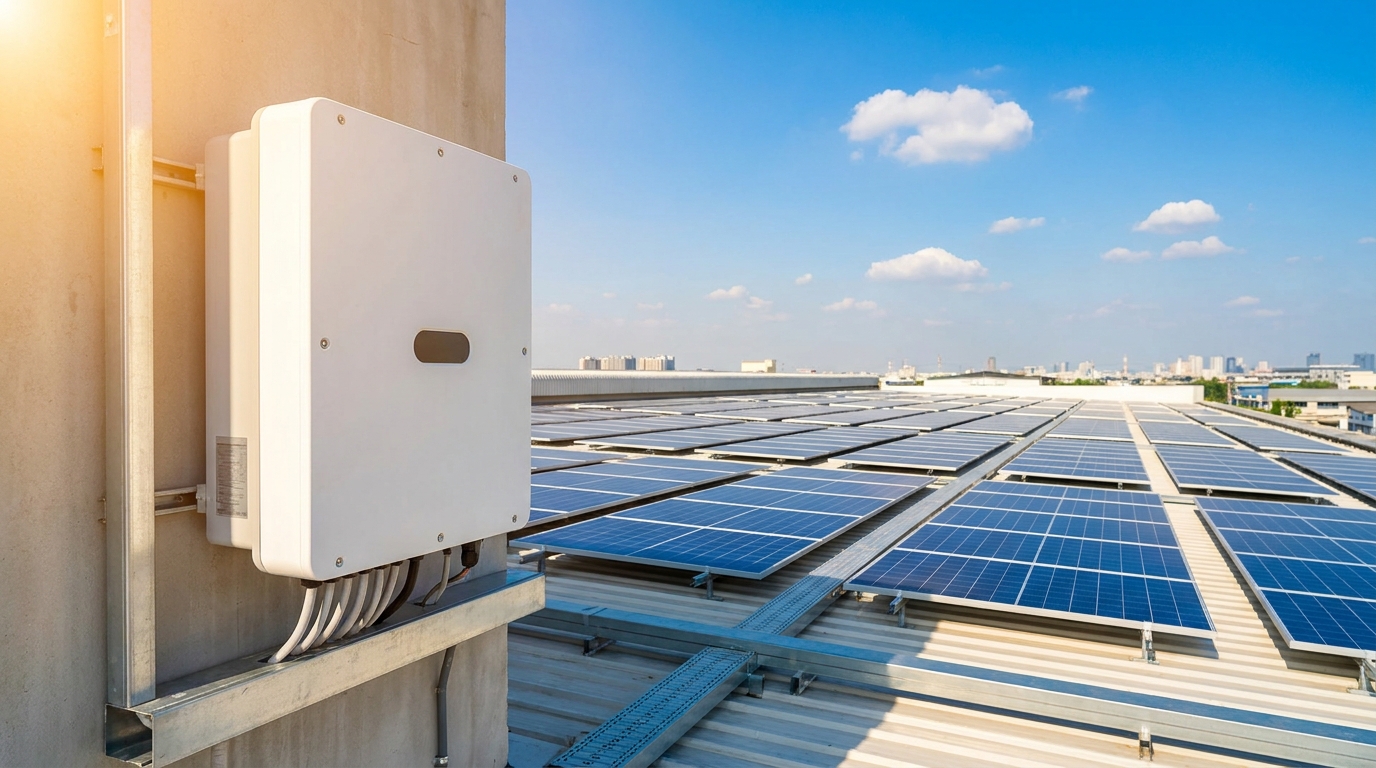
Getting inverter voltage configuration right is one of the most consequential decisions an EPC or solar installer makes on any project in India. A miscalculated string voltage can trip protection circuits, void warranties, and permanently damage expensive inverter hardware. An MPPT voltage window that is too narrow for your site’s temperature range silently bleeds energy yield every single day. In 2026, as panel wattages climb past 600W and India’s solar capacity continues its rapid expansion, understanding the difference between string voltage and MPPT voltage in solar inverters is no longer optional — it is foundational engineering knowledge.
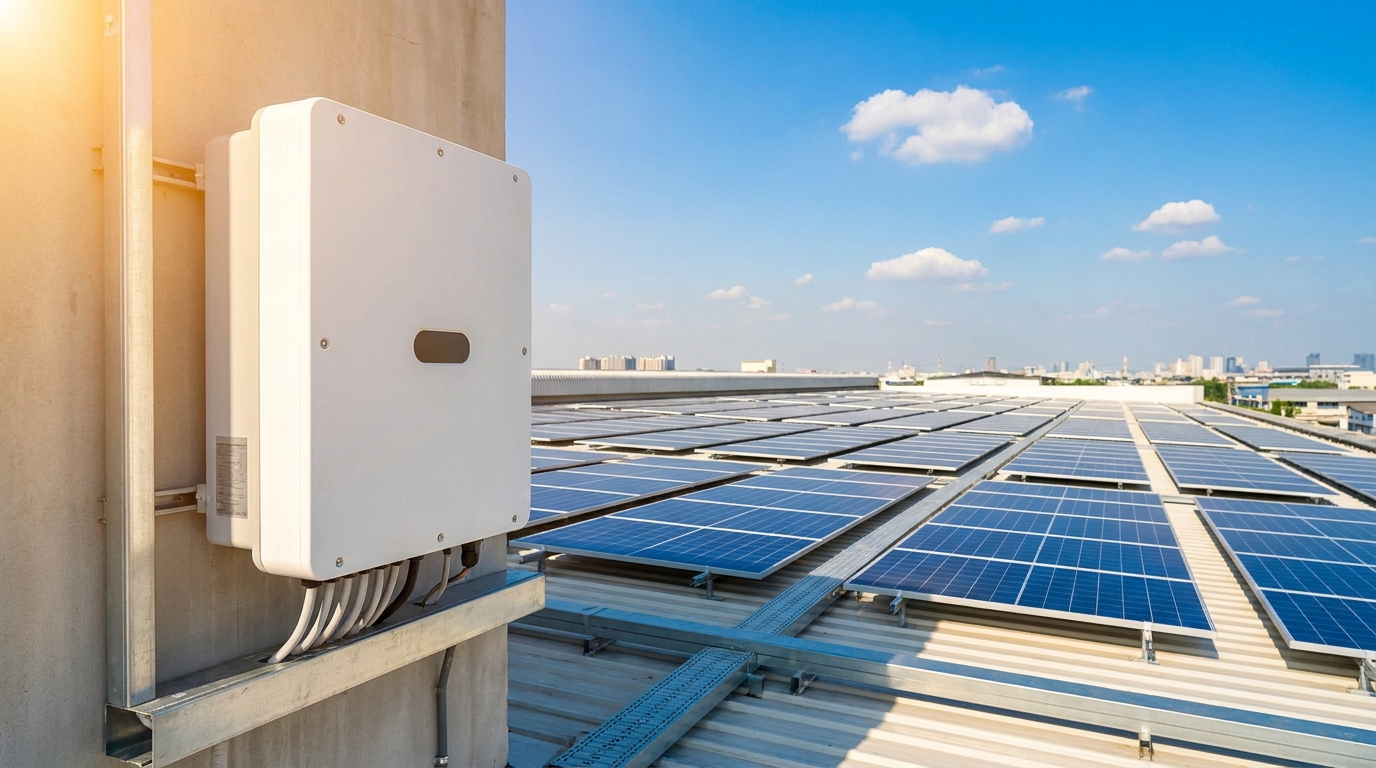
Why Inverter Voltage Configuration Matters for Indian Solar Installations
India’s solar market is not a single environment. A rooftop project in Jodhpur faces peak ambient temperatures above 45°C, while a ground-mount installation in Ladakh can see winter lows of minus 20°C. A coastal plant in Kerala deals with persistent humidity and salt-laden air. Each of these conditions directly affects the inverter voltage behavior of your PV array, and each demands a different design approach.
The financial stakes are real. An inverter that trips due to overvoltage on a cold January morning in Shimla loses generation during peak irradiance hours. An inverter whose MPPT window is too narrow for a hot Rajasthan summer operates outside its optimal tracking range for hours each day, reducing annual energy harvest by measurable percentages. Over a 25-year project life, these losses compound into significant revenue shortfalls for C&I facility owners and damaged reputations for EPCs.
This guide breaks down two core inverter voltage concepts — string voltage and MPPT voltage — and shows you exactly how to apply them across India’s diverse installation scenarios. Whether you are sizing a 10 kW residential system in Pune or a 500 kW commercial rooftop in Ahmedabad, the principles here will help you design with confidence.
Understanding String Voltage in Solar Inverters
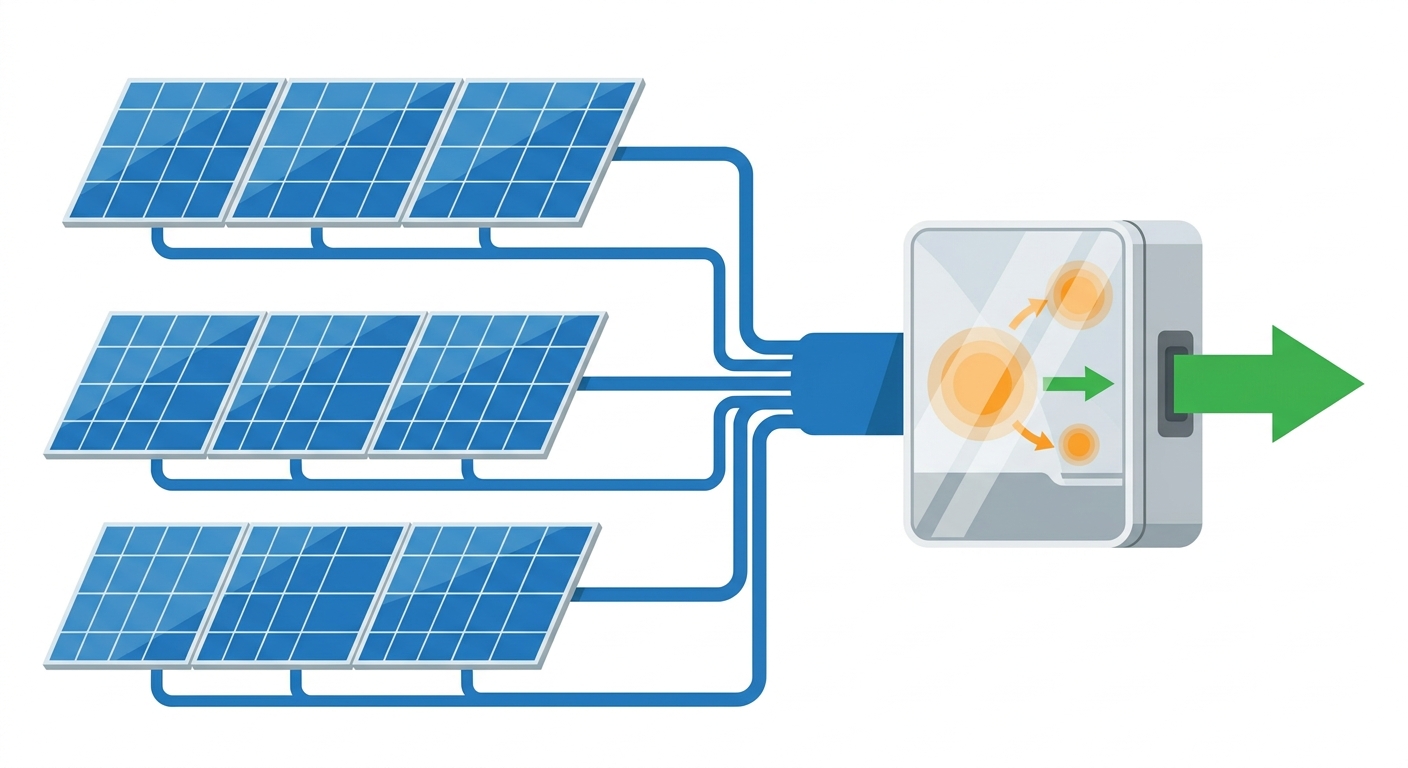
String voltage refers to the combined DC voltage produced by a series-connected group of solar panels, called a string. When panels are wired in series, their voltages add together. A string of 20 panels, each with an open-circuit voltage (Voc) of 49V, produces a string Voc of 980V. This is the voltage the inverter’s DC input terminals must safely handle.
How String Voltage Is Calculated
Every solar panel has two key voltage ratings on its datasheet: Voc (open-circuit voltage) and Vmp (maximum power point voltage). Voc is the highest voltage a panel produces with no load connected, typically under cold, bright conditions. Vmp is the voltage at which the panel delivers maximum power under standard test conditions (STC: 25°C, 1000 W/m²).
String Voc = Voc per panel × number of panels in series. This figure must stay below the inverter’s maximum DC input voltage under all temperature conditions. Most modern solar inverters for the Indian market support maximum input voltages of 600V, 800V, or 1000V. Exceeding this limit, even momentarily, can destroy the inverter’s input stage and will void the manufacturer’s warranty.
Temperature Effects on String Voltage in India
Here is where many EPCs make costly errors. Panel Voc is not fixed, it rises as temperature drops and falls as temperature rises. The rate of change is defined by the panel’s temperature coefficient of Voc, typically around -0.28% to -0.35% per °C for monocrystalline panels.
In practical terms: a panel rated at 49V Voc at 25°C will produce approximately 53, 54V on a cold Himalayan morning at 0°C. Scale that across a 20-panel string and your string voltage jumps from 980V to over 1060V, well above a 1000V inverter’s maximum. This is not a theoretical risk. It is a documented failure mode that destroys inverters and creates safety hazards on Indian rooftops every winter season.
Understanding MPPT Voltage in Solar Inverters
While string voltage defines the safety boundary, MPPT voltage defines the performance window. MPPT stands for Maximum Power Point Tracking, the algorithm inside the inverter that continuously adjusts its operating point to extract the maximum available power from the solar array.
The MPPT Operating Window
Every inverter specifies an MPPT voltage range, for example 200V to 800V. This is the window within which the inverter can actively track and extract maximum power. If the array’s operating voltage (Vmp) falls below the MPPT minimum, which can happen on very hot days or at low irradiance, the inverter either stops tracking efficiently or shuts down entirely. If Vmp rises above the MPPT maximum, the inverter clips power to protect itself.
The MPPT range is always narrower than the absolute maximum input voltage. An inverter might accept up to 1000V DC input but only track optimally between 200V and 850V. Designing your string so that Vmp stays within this window across all operating temperatures is the key to maximizing annual energy yield.
Single MPPT vs Multiple MPPT Channels
Modern solar inverters offer either a single MPPT input or multiple independent MPPT channels. Multiple MPPT channels allow you to connect strings with different orientations, tilt angles, or shading profiles to the same inverter without one string dragging down the performance of another. For Indian commercial rooftops, which often have east-west split orientations, obstructions from water tanks and AC units, and irregular roof shapes, multi-MPPT inverters are frequently the right choice.
A single-MPPT inverter forces all connected strings to operate at the same voltage point. If one string is partially shaded while another is in full sun, the MPPT algorithm compromises between the two, reducing total harvest. Multi-MPPT architecture eliminates this compromise by tracking each string independently.
Start-Up Voltage and Low-Light Performance
A parameter that deserves more attention in inverter selection is start-up voltage, the minimum DC voltage at which the inverter begins operating. Inverters with low start-up voltages begin generating power earlier in the morning and continue later in the evening, capturing additional energy during the shoulder hours of the day. In India’s tropical latitudes, where diffuse irradiance during monsoon months is significant, a low start-up voltage can meaningfully improve annual yield. Qbits inverters are engineered with low start-up voltage thresholds specifically to capture this early-morning and late-evening generation that other inverters miss.
String Voltage vs MPPT Voltage: Head-to-Head Comparison
Understanding each concept individually is useful. Seeing them compared side by side is where the practical design insight emerges. The table below summarizes the key differences between string voltage and MPPT voltage parameters in solar inverters.
| Parameter | String Voltage (Voc-based) | MPPT Voltage (Vmp-based) |
|---|---|---|
| Primary Role | Safety boundary, defines maximum allowable DC input | Performance window, defines optimal power extraction range |
| Key Panel Parameter | Voc (open-circuit voltage) | Vmp (maximum power point voltage) |
| Temperature Behavior | Rises in cold weather, overvoltage risk | Falls in hot weather, may exit MPPT window |
| Design Consequence | Limits maximum number of panels per string | Determines minimum number of panels per string |
| Failure Mode | Inverter damage, warranty void, fire risk | Reduced energy yield, inverter shutdown at low irradiance |
| Monitoring Indicator | DC overvoltage fault alarm | Low yield, MPPT out-of-range warning |
| Inverter Spec to Check | Max DC input voltage (e.g., 1000V) | MPPT voltage range (e.g., 200V, 850V) |
Impact on Annual Energy Yield
Both parameters affect energy yield, but in different ways. String voltage violations cause discrete, catastrophic events, an inverter trips or fails, and generation stops entirely until the fault is cleared or the unit is replaced. MPPT voltage mismatches cause chronic, silent losses. An array operating at the edge of the MPPT window loses 2, 5% of potential yield daily, which accumulates to hundreds of kilowatt-hours per year on a commercial system.
For EPCs focused on long-term inverter ROI and financial planning, both types of losses must be accounted for in project economics. The good news is that both are entirely preventable with correct design methodology.
Cost Implications of Getting Inverter Voltage Wrong
An inverter damaged by overvoltage is rarely covered under warranty, manufacturers explicitly exclude damage caused by incorrect installation. Replacing a commercial-scale inverter in India costs anywhere from ₹40,000 to several lakhs depending on capacity, plus lost generation revenue during downtime. MPPT mismatch losses, while less dramatic, reduce the project’s lifetime energy output and extend payback periods. Neither outcome is acceptable for professional EPCs building a reputation in India’s competitive solar market.

Inverter Voltage Design Scenarios for India’s Climate Zones
India’s geographic diversity means that inverter voltage design cannot follow a single national template. The correct approach varies significantly by climate zone. Here is how to think about string and MPPT voltage across India’s major installation environments.

Hot-Dry Zones: Rajasthan, Gujarat, Madhya Pradesh
In India’s hottest regions, panel temperatures regularly reach 65, 75°C during summer afternoons. At these temperatures, Vmp drops significantly below the STC value. A panel with a Vmp of 40V at 25°C may operate at 36, 37V at 70°C. For a 20-panel string, this means operating Vmp falls from 800V to around 720, 740V. Your inverter’s MPPT window must comfortably accommodate this lower operating voltage to avoid efficiency losses during peak summer hours.
The practical implication: in hot-dry zones, design your strings toward the higher end of the MPPT window at STC, leaving room for the voltage to drop in summer heat without falling below the MPPT minimum. Inverters with wide MPPT windows (e.g., 150V to 850V) provide the most design flexibility in these conditions.
Cold High-Altitude Zones: Himachal Pradesh, Ladakh, Uttarakhand
Cold-climate installations present the opposite challenge. Winter temperatures below 0°C push panel Voc well above STC values. This is where overvoltage failures occur. For a site in Leh with a recorded minimum temperature of -20°C, the temperature correction factor for a panel with a -0.30%/°C Voc coefficient adds approximately 13.5% to the STC Voc. A string designed to 950V at STC could reach 1078V on a cold clear morning, exceeding a 1000V inverter’s maximum input voltage.
In cold-climate zones, always calculate worst-case Voc using the site’s recorded minimum temperature, not just the average winter temperature. Use the IMD (India Meteorological Department) historical data for your specific district. Leave a safety margin of at least 5, 10% below the inverter’s maximum input voltage.
Coastal and Humid Zones: Kerala, Tamil Nadu, Maharashtra Coast, Odisha
Coastal installations face moderate temperature ranges but high humidity and salt-laden air. While the inverter voltage calculations are less extreme than in desert or mountain zones, the operating environment demands inverters with robust weather protection. Humidity affects panel performance through soiling and potential-induced degradation (PID), which can alter the effective string voltage over time. Inverters with IP66 weather protection, like those in the Qbits range, are essential for coastal deployments where moisture ingress is a persistent threat.
Mixed-Climate Commercial Rooftops: Multi-MPPT Solutions
Large commercial rooftops in cities like Mumbai, Bengaluru, Chennai, and Hyderabad often have multiple roof sections with different orientations, partial shading from parapets and equipment, and varying tilt angles. These installations benefit most from multi-MPPT inverters that can independently track each string or group of strings. A 3-MPPT inverter on a complex commercial rooftop can recover 8, 15% more energy compared to a single-MPPT unit forced to compromise between mismatched strings.
For guidance on selecting the right inverter architecture for complex commercial projects, see our detailed resource on solar inverter selection criteria for EPCs.
Common Inverter Voltage Mistakes EPCs Make in India
Even experienced installers make inverter voltage design errors. Here are the most common mistakes seen on Indian solar projects, and how to avoid them.
- Ignoring temperature coefficient for cold-climate sites: Using STC Voc values without cold-temperature correction is the single most common cause of overvoltage inverter failures in North India. Always apply the temperature correction formula: Voc(T) = Voc(STC) × [1 + (Tmin, 25) × TempCoeff].
- Designing strings at the edge of the MPPT window: Strings designed to operate at exactly the MPPT minimum or maximum voltage leave no margin for temperature variation. A 5, 10% buffer inside the MPPT window is standard engineering practice.
- Mixing panel wattages or Vmp values in one string: Panels with different Vmp values in series force the MPPT algorithm to compromise, reducing the output of the higher-performing panels to match the lowest. Always use identical panels within a string.
- Overlooking DC cable voltage drop: Long DC cable runs between panels and the inverter cause voltage drop that reduces the effective string voltage reaching the inverter. This can push the operating point below the MPPT minimum, especially at low irradiance. Size DC cables to keep voltage drop below 1%.
- Not accounting for panel degradation: Panels lose approximately 0.5, 0.7% of output per year. Over 10 years, Vmp can drop by 5, 7%. Strings designed with no margin for degradation may fall below the MPPT minimum in the later years of the project.
- Using narrow-MPPT inverters with high-wattage bifacial panels: Modern bifacial panels with higher Vmp values can push string voltages higher than older panel generations. Inverters designed for legacy panel specifications may have MPPT windows that are too narrow for today’s 600W+ bifacial modules.
For a broader view of inverter selection pitfalls and best practices, the complete evaluation guide for EPCs and distributors covers manufacturer-level quality indicators alongside technical specifications.
How to Select the Right Inverter Voltage Range for Your Project
Selecting the correct inverter voltage range is a six-step process that combines site data, panel datasheets, and inverter specifications. Here is the methodology used by professional EPCs across India.
Step 1: Determine Site Temperature Extremes
Obtain the historical minimum and maximum ambient temperatures for your installation site from IMD records or a reliable weather database. For rooftop installations, add 25, 30°C to the ambient maximum to estimate panel operating temperature (panels run significantly hotter than ambient air). For the minimum temperature calculation, use the lowest recorded ambient temperature, panels can approach ambient temperature on cold, clear nights and early mornings.
Step 2: Calculate Worst-Case Voc (Cold Temperature)
Apply the temperature correction to the panel’s STC Voc using the manufacturer’s temperature coefficient. Multiply the corrected Voc by the number of panels in your proposed string. This is your worst-case string voltage. It must be lower than the inverter’s maximum DC input voltage, with a safety margin of at least 5%.
Formula: String Voc(cold) = Voc(STC) × [1 + (Tmin, 25) × TempCoeff_Voc] × N panels
Step 3: Calculate Worst-Case Vmp (Hot Temperature)
Apply the temperature correction to the panel’s STC Vmp using the temperature coefficient of Vmp (typically -0.35% to -0.45%/°C). Multiply by the number of panels. This is your worst-case operating voltage during peak summer heat. It must remain above the inverter’s MPPT minimum voltage.
Formula: String Vmp(hot) = Vmp(STC) × [1 + (Tmax_panel, 25) × TempCoeff_Vmp] × N panels
Step 4: Match to Inverter Specifications
Your string design is valid when: MPPT minimum < String Vmp(hot) < String Vmp(STC) < String Voc(cold) < Max DC input voltage. If any of these conditions are violated, adjust the number of panels per string up or down until all conditions are satisfied.
Step 5: Verify Start-Up Voltage
Confirm that your string’s Vmp under low-irradiance conditions (e.g., 200 W/m² at dawn) exceeds the inverter’s start-up voltage. Inverters with low start-up voltages, a key feature of Qbits’ inverter range, begin generating power earlier in the day, improving overall system performance ratio.
Step 6: Consider DC Oversizing and Its Voltage Implications
DC oversizing (connecting more panel capacity than the inverter’s rated AC output) is a common and economically sound practice in India, where high irradiance hours justify clipping losses. However, oversizing increases the number of strings connected to each MPPT input, which can affect the voltage distribution across the MPPT window. Qbits inverters support up to 100% DC oversizing, giving EPCs the flexibility to maximize energy harvest without compromising inverter voltage safety. For a detailed analysis of how oversizing affects project economics, see our guide on solar inverter pricing strategies for EPCs in 2026.
Once your string design is validated, verify that your inverter’s monitoring system can track voltage performance in real time. Qbits’ AI-powered WhatsApp monitoring system provides live DC voltage readings, MPPT performance data, and instant alerts for voltage anomalies, giving EPCs and facility owners the visibility they need to catch problems before they become failures. Learn more about what to look for in solar inverter monitoring systems in India.
“The best inverter voltage design is one that works safely on the coldest day of the year and harvests maximum energy on the hottest. In India’s climate diversity, achieving both requires deliberate engineering, not default settings.”
Frequently Asked Questions About Inverter Voltage in India
What is the ideal MPPT voltage range for Indian rooftop solar?
For most Indian rooftop installations using monocrystalline panels in the 400, 600W range, an MPPT window of 200V to 800V or wider provides good design flexibility. Wider MPPT ranges accommodate more panel configurations and provide better performance across India’s temperature extremes. Always verify that your specific string design keeps Vmp within the MPPT window at both maximum and minimum operating temperatures for your site.
Can I mix different panel brands in one string?
Technically possible but strongly discouraged. Panels from different manufacturers, even with similar wattage ratings, often have different Vmp values. Mixing them in a series string forces the MPPT algorithm to operate at a compromised voltage point, reducing the output of the higher-performing panels. For optimal inverter voltage performance, always use identical panels within a string.
What happens if string voltage exceeds the inverter’s maximum input voltage?
The inverter’s input protection circuits will trip, shutting down the unit to prevent damage. In severe cases, the overvoltage can permanently damage the inverter’s DC input stage, capacitors, and IGBT components. This type of damage is classified as installation error and is excluded from manufacturer warranties. The inverter will need to be repaired or replaced at the installer’s cost.
How does DC oversizing affect inverter voltage?
DC oversizing increases the total panel capacity connected to the inverter but does not change the string voltage, voltage is determined by the number of panels in series, not the number of parallel strings. Adding parallel strings increases current, not voltage. However, oversizing does increase the likelihood of clipping during peak irradiance, which is a separate performance consideration from inverter voltage management.
Does inverter voltage design affect the 12-year warranty?
Yes, directly. Warranty coverage from manufacturers like Qbits is contingent on correct installation within specified parameters. An inverter damaged by string voltages exceeding the maximum DC input specification will not be covered under warranty. Correct inverter voltage design is therefore not just a performance issue, it is a warranty protection issue. Qbits’ digital warranty system makes it easy to register and manage warranty claims, but the foundation of warranty protection is correct installation.
How many MPPT channels do I need for a commercial rooftop?
The number of MPPT channels needed depends on the roof’s complexity. A simple, unobstructed south-facing rooftop can work well with a single or dual MPPT inverter. Rooftops with multiple orientations, partial shading, or irregular shapes benefit from 3 or more MPPT channels. As a general rule, each distinct string group with a different orientation or shading profile should have its own MPPT channel to prevent inter-string losses.
Choosing an Inverter Built for India’s Voltage Challenges
Understanding inverter voltage, both string voltage limits and MPPT operating windows, is the technical foundation of every successful solar installation in India. The country’s climate diversity, from Ladakh’s freezing winters to Rajasthan’s scorching summers, demands inverters engineered with wide MPPT ranges, robust maximum input voltage ratings, and intelligent monitoring that flags voltage anomalies before they become costly failures.
Qbits solar inverters are designed specifically for these conditions. With German-grade electronic components, IP66 weather protection, support for up to 750W+ panels, 100% DC oversizing capability, and AI-powered WhatsApp monitoring that delivers real-time inverter voltage data to your phone, Qbits gives EPCs and C&I facility owners the technical confidence to design and operate solar systems that perform across India’s full range of environments. The 12-year full replacement warranty backs every unit, because correct inverter voltage design, combined with precision-engineered hardware, is how long-term solar ROI is protected.
If you are designing a project and want to verify that your string voltage and MPPT configuration is optimized for your specific site, our technical team is ready to help. Inquire now via WhatsApp for a direct conversation with a Qbits application engineer, or explore the full Qbits inverter range to find the right voltage specifications for your next project. EPCs and distributors looking to add a technically superior, India-focused inverter brand to their portfolio are welcome to become a Qbits partner. For ongoing technical support, visit the Qbits support portal.
This blog post was written using thestacc.com