



Inverter Financing Options in India: Complete Guide 2026

Solar inverter investments represent a significant portion of any solar installation budget, often accounting for 15-20% of total project costs. For solar EPCs, distributors, and commercial & industrial facility owners across India, understanding inverter financing options is critical to optimizing cash flow, maximizing returns, and maintaining competitive advantage in 2026’s dynamic solar market.
The right inverter financing strategy can transform a capital-intensive purchase into a manageable investment that aligns with your business objectives. Whether you’re an EPC managing multiple projects simultaneously, a distributor building inventory, or a C&I facility owner planning a large-scale installation, the financing model you choose directly impacts your project’s profitability, tax benefits, and long-term ROI.
This comprehensive guide explores all available inverter financing options in India, from traditional upfront payments to sophisticated CAPEX and OPEX models, helping you make informed decisions that balance immediate cash requirements with long-term financial performance.
Understanding Inverter Financing in India’s Solar Market
India’s solar market has matured significantly, with installed capacity exceeding 80 GW in 2026. This growth has brought sophisticated financing mechanisms specifically designed for solar equipment procurement. Inverter financing has evolved from simple vendor credit arrangements to comprehensive financial products offered by banks, NBFCs, and specialized green energy financing institutions.
For solar EPCs and installation companies, inverter costs create a working capital challenge. Projects often require bulk inverter purchases before client payments are received, creating cash flow gaps that can limit growth. Distributors face similar challenges when stocking inventory to meet market demand. Meanwhile, C&I facility owners must balance the desire for solar energy independence against competing capital allocation priorities.
The inverter financing landscape in 2026 offers multiple pathways to address these challenges. Understanding each option’s mechanics, benefits, and limitations is essential for making strategic procurement decisions that support business growth while maintaining financial flexibility.
Key considerations when evaluating inverter financing include interest costs, tax implications, balance sheet impact, warranty alignment, and how the financing structure affects overall project economics. High-quality inverters with extended warranties—such as those offering 12-year full replacement coverage—often receive more favorable financing terms due to reduced risk profiles.
1. Upfront Payment: Full Cash Purchase Model
The upfront payment model remains the most straightforward approach to inverter financing, where buyers pay the full inverter cost at the time of purchase. This traditional method offers distinct advantages for businesses with strong cash positions and those seeking to maximize long-term cost efficiency.
Primary benefits of upfront inverter financing include elimination of interest charges, simplified accounting, and immediate ownership with full asset control. For EPCs working on projects with advance client payments or distributors with healthy working capital, this model avoids the cumulative interest burden that can add 15-25% to total inverter costs over typical loan tenures.
Tax advantages make upfront purchases particularly attractive. Under the Income Tax Act, solar equipment including inverters qualifies for accelerated depreciation at 40% in the first year. Businesses can claim this substantial depreciation benefit immediately, reducing taxable income significantly in the year of purchase. This tax shield often provides effective returns that partially offset the opportunity cost of deploying capital.
The upfront model works best for established EPCs with predictable project pipelines, distributors with strong balance sheets, and C&I facility owners prioritizing total cost of ownership over cash preservation. When combined with high-efficiency inverters featuring extended warranties, the upfront purchase delivers maximum lifetime value with minimal ongoing financial obligations.
However, this approach does tie up working capital that could otherwise fund business expansion, additional projects, or operational needs. Businesses must carefully assess their cash flow cycles and growth plans before committing significant capital to inverter purchases.
2. EMI Schemes and Loan-Based Inverter Financing
Equated Monthly Installment (EMI) schemes have become increasingly popular for inverter financing, allowing buyers to spread costs over 12 to 60 months while preserving working capital. Banks and Non-Banking Financial Companies (NBFCs) now offer specialized solar equipment loans with competitive terms tailored to the industry’s unique characteristics.
In 2026, typical interest rates for inverter financing range from 9.5% to 14% annually, depending on the borrower’s credit profile, loan amount, and tenure. Public sector banks often provide lower rates for solar projects, particularly those aligned with government renewable energy initiatives. NBFCs may offer faster approval processes with slightly higher rates, making them attractive for time-sensitive projects.
The EMI model for inverter financing works particularly well for EPCs managing multiple concurrent projects. By financing inverter purchases, companies can maintain liquidity for labor costs, other equipment, and operational expenses while still securing quality components. Monthly payments become predictable operational expenses that can be factored into project pricing and cash flow projections.
Documentation requirements typically include business registration certificates, GST returns, income tax returns for the past two years, bank statements, project contracts or purchase orders, and inverter quotations. Lenders increasingly recognize established inverter brands with strong warranties as lower-risk assets, potentially improving loan terms and approval rates.
When calculating EMI impact on project profitability, businesses must factor the total interest outlay against the benefits of preserved working capital. For a ₹10 lakh inverter purchase financed at 12% over 36 months, total interest paid would be approximately ₹1.98 lakh. This cost must be weighed against the value generated by deploying that capital elsewhere in the business or the opportunity cost of delayed projects due to capital constraints.
Many financial institutions now offer bulk financing arrangements for distributors and large EPCs, providing pre-approved credit lines for inverter purchases. These arrangements streamline procurement, reduce per-transaction documentation, and often secure better interest rates through volume commitments.
3. CAPEX vs OPEX Models for Inverter Financing
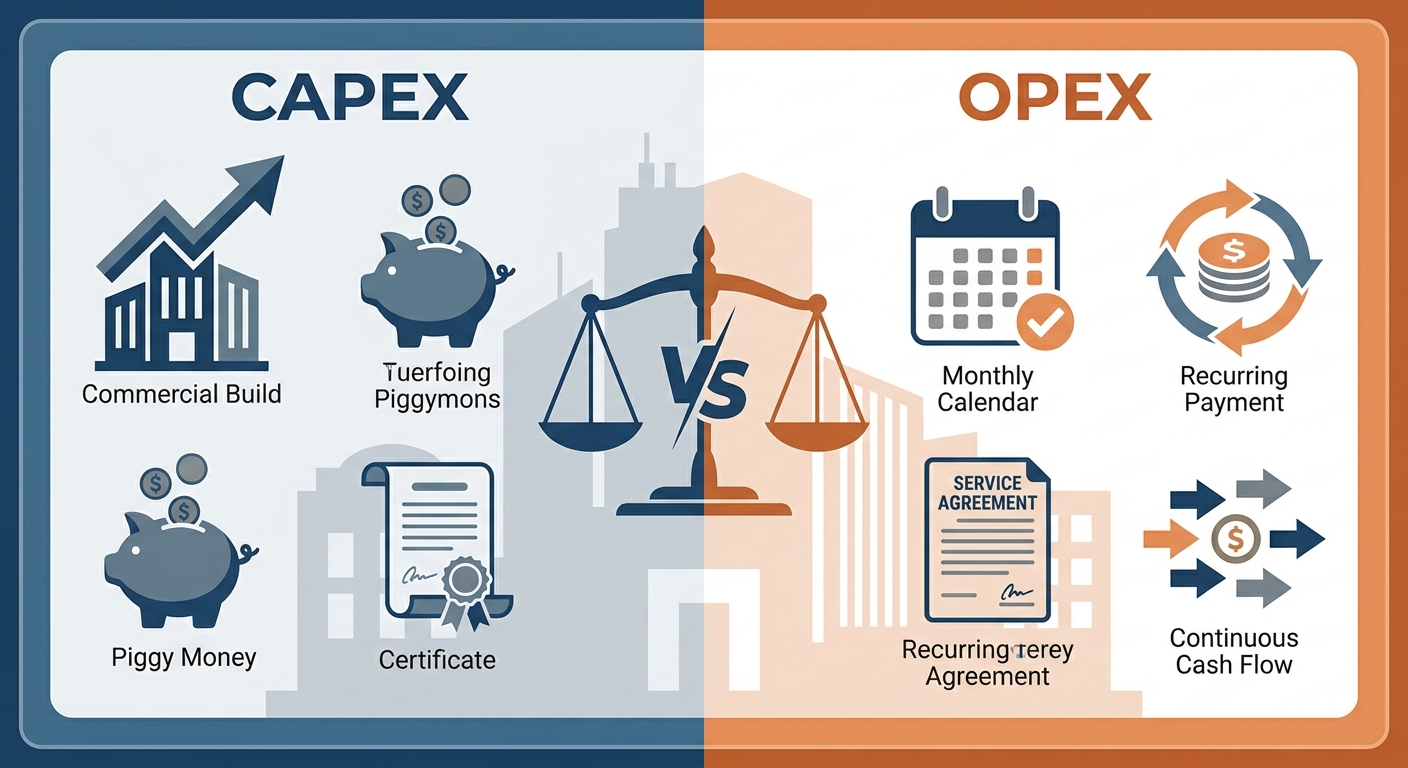
The choice between Capital Expenditure (CAPEX) and Operational Expenditure (OPEX) models represents one of the most strategic decisions in inverter financing, particularly for commercial and industrial facility owners. Each model carries distinct financial, accounting, and operational implications that align differently with various business objectives.
CAPEX Model: Ownership and Asset Benefits
Under the CAPEX model for inverter financing, the buyer purchases and owns the inverter outright, recording it as a capital asset on the balance sheet. This traditional ownership approach provides maximum control and long-term cost advantages, making it the preferred choice for businesses with strong balance sheets and long-term facility ownership plans.
Key advantages of CAPEX inverter financing include full asset ownership, eligibility for accelerated depreciation benefits, no ongoing rental or lease payments after the initial purchase, and complete control over equipment selection and maintenance. For C&I facilities planning to occupy their premises for 10+ years, CAPEX models typically deliver the lowest total cost of ownership.
The depreciation benefit is substantial. Solar inverters qualify for 40% accelerated depreciation in year one, with the remaining 60% depreciated over subsequent years. For a business in the 30% tax bracket purchasing a ₹20 lakh inverter, the first-year depreciation of ₹8 lakh provides a tax saving of ₹2.4 lakh—a significant immediate return on investment.
CAPEX models work exceptionally well when paired with high-quality inverters offering extended warranties. A 12-year warranty inverter provides cost certainty throughout the critical payback period, eliminating replacement risks that could undermine project economics. This warranty coverage becomes a balance sheet asset, reducing long-term maintenance reserves required.
OPEX Model: Pay-as-You-Go Solutions
The OPEX model for inverter financing treats solar equipment as an operational expense rather than a capital asset. Under this structure, a third-party developer or financing company owns the inverter, while the facility owner pays for the electricity generated or a monthly service fee. This approach has gained traction among businesses prioritizing cash preservation and off-balance-sheet financing.
OPEX advantages include zero or minimal upfront investment, no balance sheet impact, predictable monthly expenses, and typically bundled maintenance and monitoring services. For businesses with limited capital budgets or those preferring to deploy resources into core operations rather than energy infrastructure, OPEX models remove the barrier to solar adoption.
In OPEX arrangements, the equipment owner claims depreciation and other tax benefits, but passes some of these savings to the facility owner through competitive per-unit electricity rates. The facility owner benefits from reduced energy costs without the capital commitment, while the financing entity generates returns through long-term service contracts.
However, OPEX models for inverter financing typically result in higher total costs over the equipment’s lifetime compared to CAPEX ownership. The financing entity’s profit margin, administrative costs, and risk premium are embedded in the monthly charges. For businesses with 15-20 year facility ownership horizons, CAPEX often delivers superior financial outcomes despite the higher initial investment.
The choice between CAPEX and OPEX for inverter financing should align with broader business strategy, capital availability, tax position, and facility ownership timeline. EPCs and distributors typically operate under CAPEX models for their own operations, while offering both options to C&I clients based on their specific financial preferences.
4. Leasing Options for Solar Inverter Financing
Leasing represents a middle ground in inverter financing, combining elements of both ownership and rental models. Two primary lease structures dominate the solar inverter market: operating leases and finance leases, each with distinct accounting treatments and end-of-term implications.
Operating leases for inverter financing function similarly to rental arrangements. The lessor retains ownership, and the lessee makes periodic payments for equipment use. At lease end, the inverter returns to the lessor, or the lessee may have an option to purchase at fair market value. Operating leases keep the asset off the lessee’s balance sheet, preserving debt capacity and maintaining favorable financial ratios.
Finance leases (also called capital leases) are structured as purchase arrangements with deferred payment. The lessee records the inverter as an asset and the lease obligation as a liability on the balance sheet. At lease end, ownership typically transfers to the lessee automatically or through a nominal buyout payment. Finance leases provide ownership benefits while spreading payments over time.
Lease terms for inverter financing typically range from 5 to 10 years, aligning with equipment payback periods and warranty coverage. Monthly lease payments are calculated based on the inverter’s cost, lease duration, interest rate (implicit in the lease), and residual value assumptions. For a ₹15 lakh inverter on a 7-year finance lease at an effective 11% rate, monthly payments would approximate ₹25,000-28,000.
Leasing preserves working capital more effectively than upfront purchases while providing more control than OPEX models. EPCs can lease inverters for specific projects, matching payment obligations to client payment schedules. Distributors can lease inventory, reducing the capital required to maintain stock levels. C&I facility owners can access quality equipment without depleting capital reserves.
Lease-to-own arrangements have become particularly popular in the solar industry, offering flexibility for businesses uncertain about long-term equipment needs. These structures allow lessees to test equipment performance and business model viability before committing to full ownership, with lease payments typically credited toward the purchase price if the buyout option is exercised.
When evaluating leasing for inverter financing, businesses should carefully review end-of-term options, maintenance responsibilities, insurance requirements, and early termination provisions. Leases for high-quality inverters with comprehensive warranties often carry better terms, as the equipment’s residual value and reliability reduce lessor risk.
5. Government Subsidies and Incentive Programs
Government support mechanisms significantly enhance the economics of inverter financing across India. Multiple central and state-level programs provide direct subsidies, tax incentives, and preferential financing terms that reduce the effective cost of solar inverter investments.
The PM-KUSUM (Pradhan Mantri Kisan Urja Suraksha evam Utthaan Mahabhiyan) scheme, while primarily focused on agricultural solar applications, includes provisions for inverter subsidies in qualifying installations. Component-C of PM-KUSUM supports solarization of agricultural feeders, with subsidies covering up to 30% of project costs, including inverters. EPCs working on agricultural projects can leverage these subsidies to improve project economics and client affordability.
State-level solar policies vary significantly but often include inverter-specific incentives. Several states offer capital subsidies ranging from 20-40% for rooftop solar installations, with inverters explicitly included in eligible equipment. Maharashtra, Gujarat, Rajasthan, and Tamil Nadu have particularly robust state-level programs that can be combined with central schemes for maximum benefit.
The Ministry of New and Renewable Energy (MNRE) maintains a list of approved models and manufacturers for subsidy eligibility. Inverters must meet BIS/IEC certification standards and performance specifications to qualify. When planning inverter financing, EPCs and facility owners should verify equipment eligibility early in the procurement process to ensure subsidy access.
Accelerated depreciation under Section 32 of the Income Tax Act remains one of the most valuable incentives for inverter financing. Solar power systems, including inverters, qualify for 40% depreciation in the first year of operation. This benefit applies to CAPEX purchases and finance lease arrangements where the asset appears on the buyer’s balance sheet. For profitable businesses, this depreciation significantly improves after-tax returns and shortens effective payback periods.
Some financial institutions offer preferential interest rates for solar equipment loans when projects qualify for government subsidies or meet specific green energy criteria. These concessional rates, sometimes 1-2 percentage points below standard commercial rates, can substantially reduce the total cost of EMI-based inverter financing.
Navigating subsidy programs requires careful documentation and compliance with program guidelines. EPCs and distributors should develop expertise in subsidy application processes, as this capability adds significant value for clients and improves project competitiveness. When combined with strategic inverter financing, subsidies can reduce effective inverter costs by 30-50%, dramatically improving project ROI.
6. Choosing the Right Inverter Financing Model
Selecting the optimal inverter financing approach requires systematic evaluation of multiple factors specific to your business type, financial position, and project characteristics. A structured decision framework helps identify the model that best balances immediate cash requirements with long-term financial performance.

Key Factors Affecting Inverter Financing Decisions
Cash flow position and working capital availability represent the primary consideration. Businesses with strong cash reserves and minimal competing capital needs can benefit from upfront purchases that eliminate interest costs and maximize tax benefits. Conversely, companies experiencing rapid growth or managing multiple concurrent projects often benefit from EMI or lease arrangements that preserve liquidity for operational needs.
Project size and volume significantly influence financing choices. Large EPCs managing portfolios of installations may negotiate bulk financing arrangements with preferential terms, making loan-based inverter financing more attractive. Smaller installers working on individual projects might prefer project-specific financing or vendor credit arrangements that align payment obligations with client receipts.
Tax position and depreciation capacity affect the value of ownership-based models. Profitable businesses in higher tax brackets gain maximum benefit from accelerated depreciation, making CAPEX purchases or finance leases financially superior. Companies with lower current profitability or those in tax-exempt categories may find OPEX models more suitable, as they cannot fully utilize depreciation benefits.
The quality and warranty coverage of inverters directly impacts financing decisions and available terms. High-quality inverters with extended warranties reduce replacement risk and maintenance costs, improving project economics regardless of financing model. Financial institutions recognize this reduced risk, often offering better terms for premium equipment with comprehensive warranty coverage.
For instance, inverters with 12-year full replacement warranties eliminate the risk of major equipment failure during the critical payback period. This warranty coverage makes longer-term financing more viable, as lenders and lessors face minimal risk of equipment obsolescence or failure requiring premature replacement. The warranty effectively serves as collateral, supporting more favorable financing terms.
Balance sheet considerations matter particularly for C&I facility owners and publicly traded companies. CAPEX purchases increase asset values but also debt levels if financed through loans. OPEX models and operating leases keep obligations off-balance-sheet, preserving debt capacity and maintaining financial ratios important to investors and lenders. Finance leases fall between these extremes, recording both assets and liabilities.
Risk tolerance and maintenance preferences also influence inverter financing choices. Ownership models (CAPEX, finance lease) provide control but require the owner to manage maintenance and performance risk. OPEX models typically bundle maintenance and monitoring services, transferring performance risk to the service provider. For businesses preferring predictable costs and minimal operational involvement, OPEX arrangements offer peace of mind despite higher total costs.
EPCs should develop capability to offer multiple financing options to clients, as this flexibility improves competitiveness and expands addressable market. Understanding how to structure and present different inverter financing models allows EPCs to serve diverse client needs, from cash-rich facility owners seeking maximum ROI to capital-constrained businesses prioritizing cash preservation.
7. Tax Benefits and Financial Incentives
Tax optimization represents a critical dimension of inverter financing strategy, often delivering returns that rival or exceed the equipment’s direct energy savings. Understanding and maximizing available tax benefits can reduce the effective cost of inverter investments by 25-40% for eligible businesses.
Accelerated depreciation under Section 32 of the Income Tax Act provides the most substantial tax benefit for solar inverter financing. Solar power generating systems qualify for 40% depreciation in the first year, significantly higher than the standard 15% rate for most electrical equipment. This accelerated schedule allows businesses to recover a large portion of their investment through tax savings in the early years of operation.
For a ₹30 lakh inverter purchase, a business in the 30% tax bracket would claim ₹12 lakh depreciation in year one, generating ₹3.6 lakh in tax savings. The remaining ₹18 lakh depreciates over subsequent years, continuing to provide tax shields that improve overall project returns. This benefit applies to outright purchases and finance lease arrangements where the asset appears on the buyer’s balance sheet.
Section 80-IA deductions apply to businesses engaged in power generation, including solar installations. Qualifying entities can claim deductions on profits from power generation for 10 consecutive years within the first 15 years of operation. While this benefit primarily targets power producers rather than equipment purchasers, EPCs developing projects under build-own-operate models can leverage this substantial incentive.
Goods and Services Tax (GST) implications affect the net cost of inverter financing. Solar inverters currently fall under the 5% GST category for solar power generating systems, significantly lower than the standard 18% rate for electrical equipment. Businesses registered for GST can claim input tax credit on inverter purchases, effectively recovering the GST paid and reducing the net investment required.
The interaction between financing structure and GST treatment requires careful planning. For outright purchases, the full GST amount can be claimed as input credit immediately. Under lease arrangements, GST applies to each lease payment, with input credit claimed periodically. OPEX models may have different GST treatment depending on whether the arrangement is structured as an equipment lease or a power purchase agreement.
Interest deduction on business loans provides additional tax benefits for EMI-based inverter financing. Interest paid on loans for business purposes is fully deductible as a business expense, reducing taxable income. For a loan with ₹2 lakh annual interest, a business in the 30% bracket saves ₹60,000 in taxes, partially offsetting the interest cost.
State-level incentives vary but can include electricity duty exemptions, wheeling and banking charge waivers, and preferential tariffs for solar power. These benefits don’t directly affect inverter financing but improve overall project economics, making more aggressive financing strategies viable by enhancing revenue projections and shortening payback periods.
Maximizing tax benefits requires coordination between financing structure, accounting treatment, and tax planning. Businesses should consult with tax advisors to ensure inverter financing arrangements are structured to optimize available incentives while maintaining compliance with applicable regulations. The right structure can transform a marginal investment into a highly attractive opportunity through effective tax optimization.
8. Maximizing ROI Through Strategic Inverter Financing
Return on investment calculations must account for both the direct costs of inverter financing and the broader financial implications of different payment structures. A comprehensive ROI framework considers interest costs, tax benefits, opportunity costs, and how inverter quality affects long-term performance and replacement requirements.

Payback period analysis provides the foundation for comparing inverter financing options. For a typical commercial installation, the solar system payback period ranges from 4-7 years depending on electricity rates, system size, and financing costs. The inverter financing model directly impacts this timeline through its effect on total project costs and cash flow patterns.
Consider a ₹25 lakh inverter purchase under three scenarios: (1) upfront payment with 40% first-year depreciation, (2) 5-year loan at 11% interest, and (3) 7-year operating lease. The upfront purchase delivers the shortest payback and highest lifetime returns but requires immediate capital deployment. The loan extends payback by 6-12 months due to interest costs but preserves working capital. The lease offers the longest payback but minimal upfront investment.
Inverter efficiency and reliability dramatically affect ROI calculations. A high-efficiency inverter operating at 98% conversion efficiency generates approximately 3-5% more electricity annually than a 95% efficiency unit. Over a 12-year period, this efficiency advantage compounds significantly, often justifying premium pricing and influencing optimal financing choices.
Total cost of ownership (TCO) analysis must extend beyond the initial purchase to include maintenance, monitoring, and potential replacement costs. Advanced monitoring systems reduce maintenance costs through predictive diagnostics and rapid fault identification, improving overall ROI regardless of financing model.
Inverters with extended warranties provide superior ROI certainty. A 12-year full replacement warranty eliminates the risk of major equipment failure during the payback period, ensuring projected returns materialize as planned. This warranty coverage is particularly valuable under longer-term financing arrangements, as it guarantees equipment performance throughout the loan or lease tenure.
For EPCs, inverter financing strategy affects competitive positioning and project margins. Offering flexible payment terms to clients—enabled by the EPC’s own access to favorable financing, can win projects that might otherwise go to competitors. The ability to structure attractive client financing while maintaining healthy margins requires sophisticated understanding of inverter financing options and their cost implications.
Scenario modeling helps identify the optimal financing approach for specific situations. Variables to model include electricity price escalation, inverter degradation rates, maintenance costs, tax rate changes, and interest rate fluctuations. Sensitivity analysis reveals which financing models perform best under different future scenarios, supporting more robust decision-making.
For C&I facility owners, inverter financing should align with broader energy strategy and corporate financial objectives. Facilities with aggressive carbon reduction targets may prioritize rapid solar deployment, making OPEX models attractive despite higher total costs. Companies focused on maximizing shareholder returns typically favor CAPEX approaches that deliver superior long-term economics.
Distributors must balance inventory financing costs against market opportunity. Maintaining adequate inverter stock requires capital, but stockouts result in lost sales and damaged customer relationships. Strategic use of inventory financing, whether through supplier credit, bank loans, or consignment arrangements, enables distributors to capture market demand while managing working capital efficiently.
The highest ROI typically comes from combining quality equipment with optimal financing. Selecting reliable inverter manufacturers with strong warranty support, then financing that equipment through the most tax-efficient and cash-flow-appropriate mechanism, creates a powerful combination that maximizes both immediate and long-term returns.
Frequently Asked Questions About Inverter Financing
What is the typical interest rate for solar inverter loans in India in 2026?
Interest rates for inverter financing in India currently range from 9.5% to 14% annually, depending on the lender, borrower credit profile, loan amount, and tenure. Public sector banks typically offer rates at the lower end of this range, particularly for projects aligned with government renewable energy initiatives. NBFCs may charge slightly higher rates but often provide faster approval and more flexible terms. Businesses with strong credit histories and those purchasing high-quality equipment with comprehensive warranties often secure more favorable rates.
Can I combine government subsidies with EMI financing for inverter purchases?
Yes, government subsidies and EMI financing can typically be combined, though the subsidy amount may reduce the loan principal required. Under most programs, subsidies are disbursed after installation and inspection, so buyers initially finance the full inverter cost. Once the subsidy is received, it can be used to prepay a portion of the loan, reducing subsequent EMI amounts or loan tenure. Some specialized lenders offer bridge financing that accounts for expected subsidies, reducing initial loan amounts. Always verify specific program requirements, as some subsidies may have restrictions on financed purchases.
Which inverter financing model is best for small EPCs with limited working capital?
Small EPCs with limited working capital typically benefit most from project-specific financing or vendor credit arrangements that align inverter payment obligations with client payment schedules. EMI schemes with 12-24 month tenures provide a good balance between preserving cash flow and minimizing total interest costs. Some EPCs successfully use a hybrid approach: maintaining a small inventory of commonly used inverters purchased through vendor credit or short-term loans, while arranging project-specific financing for larger or specialized equipment. Building relationships with financial institutions that understand solar project cash flows can unlock credit lines that support business growth without excessive capital requirements.
How does inverter warranty coverage affect financing approval and terms?
Inverter warranty coverage significantly influences financing approval and terms. Lenders and lessors view extended warranties as risk mitigation, as they reduce the likelihood of equipment failure requiring replacement during the loan or lease period. Inverters with 12-year comprehensive warranties typically receive more favorable financing terms, lower interest rates, higher loan-to-value ratios, and longer tenures, compared to equipment with standard 5-year warranties. The warranty effectively serves as additional collateral, demonstrating equipment quality and manufacturer commitment. When applying for inverter financing, providing detailed warranty documentation can improve approval odds and negotiating leverage for better terms.
What documentation is typically needed for inverter financing applications?
Standard documentation for inverter financing includes business registration certificates (partnership deed, incorporation certificate, or proprietorship proof), GST registration and recent returns, income tax returns for the past 2-3 years, bank statements for the past 6-12 months, and detailed inverter quotations or proforma invoices. For project-based financing, lenders also require client contracts or purchase orders, project feasibility reports, and sometimes technical specifications. C&I facility owners may need to provide property ownership documents if the loan is secured against real estate. Maintaining organized financial records and working with established inverter manufacturers can streamline the documentation process and accelerate approval timelines.
Making Your Inverter Financing Decision
Strategic inverter financing transforms a significant capital requirement into a manageable investment that supports business growth and project profitability. Whether you’re an EPC managing multiple installations, a distributor building market presence, or a C&I facility owner pursuing energy independence, the right financing model aligns payment obligations with cash flow realities while maximizing tax benefits and long-term returns.
The optimal approach balances immediate cash preservation against total cost of ownership, considers tax position and balance sheet implications, and accounts for equipment quality and warranty coverage. High-efficiency inverters with comprehensive warranties not only deliver superior performance but also unlock better financing terms through reduced lender risk.
As India’s solar market continues its rapid expansion in 2026, access to flexible, cost-effective inverter financing will increasingly differentiate successful businesses from those constrained by capital limitations. By understanding the full spectrum of financing options, from upfront purchases and EMI schemes to CAPEX/OPEX models and leasing arrangements, you can structure investments that support both immediate project needs and long-term strategic objectives.
For solar professionals seeking to optimize their inverter investments, partnering with manufacturers who understand financing challenges and offer solutions tailored to the Indian market provides a significant competitive advantage. Quality equipment, comprehensive warranty protection, and financing flexibility combine to create winning project economics that satisfy all stakeholders.
Ready to explore inverter financing options that align with your specific business needs? Discover Qbits Energy’s range of high-efficiency inverters engineered with 12-year warranties and German-grade components designed for long-term reliability. Our team understands the financing challenges facing EPCs, distributors, and C&I buyers, and can help you structure investments that maximize ROI while preserving working capital. Contact us today to discuss how our inverter solutions and financing guidance can support your solar projects in 2026 and beyond.
Whether you’re planning your first solar installation or managing a portfolio of projects, understanding inverter financing options empowers you to make decisions that balance immediate cash requirements with long-term profitability. The right financing strategy, combined with quality equipment and comprehensive support, creates a foundation for sustainable growth in India’s dynamic solar market.
This blog post was written using thestacc.com