



How to Find Reliable Inverter Dealers India: 2026 Guide


For solar EPCs and installation companies operating in India’s rapidly expanding renewable energy market, selecting the right inverter dealers can make the difference between profitable projects and costly operational headaches. With India’s solar capacity projected to reach 500 GW by 2030, the demand for reliable inverter dealers India has never been more critical. Yet many EPCs struggle to identify partners who can deliver consistent quality, responsive support, and transparent business practices across diverse regional markets.
This comprehensive guide walks you through the systematic process of evaluating, vetting, and partnering with trustworthy solar inverter dealers across India. Whether you’re scaling operations in Rajasthan’s solar belt or expanding into emerging markets in the Northeast, these proven criteria will help you build a resilient supply chain that supports your growth and protects your reputation.
Why Choosing the Right Inverter Dealers India Matters for Your Solar Business
The inverter represents 15-20% of total solar project costs and serves as the critical conversion point between DC generation and AC power delivery. When you partner with unreliable inverter dealers India, you expose your business to multiple risk factors that extend far beyond initial procurement.

Poor dealer selection impacts your operations in several measurable ways. First, warranty claim processing delays can leave your clients without functioning systems for weeks, damaging your reputation and triggering penalty clauses in installation contracts. Second, inconsistent inventory availability forces you to delay project timelines or source emergency replacements at premium prices, eroding profit margins. Third, inadequate technical support from dealers means your installation teams waste valuable time troubleshooting issues that should be resolved through proper dealer guidance.
Regional availability presents another critical consideration across India’s diverse geography. A dealer with strong presence in Gujarat may have limited reach in Tamil Nadu or Uttar Pradesh. For EPCs operating across multiple states, you need partners who understand local market dynamics, regulatory requirements, and installation challenges specific to each region. The right dealer network provides consistent support whether you’re installing rooftop systems in Mumbai’s humid coastal climate or ground-mount arrays in Rajasthan’s desert conditions.
Supply chain reliability has become increasingly important as solar inverter technology evolves rapidly. Dealers who maintain strong relationships with manufacturers like Qbits gain early access to advanced features such as AI-powered monitoring systems, higher DC oversizing capabilities, and improved weather protection ratings. These technological advantages translate directly into competitive differentiation for your EPC business.
1. Evaluate Technical Expertise and Product Knowledge
Technical competency separates professional inverter dealers India from mere product resellers. Your dealer should function as an extension of your technical team, providing expert guidance on product selection, system design considerations, and troubleshooting support throughout the project lifecycle.
Start by assessing their understanding of BIS and IEC certification requirements that govern solar inverter installations in India. A knowledgeable dealer should explain how these standards impact product selection for different project types and help you navigate compliance documentation. They should be familiar with the latest amendments to Indian solar standards and how they affect inverter specifications.
Evaluate their grasp of technology distinctions between on-grid and hybrid inverter systems. Ask specific questions about inverter efficiency ratings, DC oversizing capabilities, and how different models handle voltage fluctuations common in Indian grid conditions. For example, dealers representing manufacturers like Qbits should articulate how 98% efficiency ratings and low start-up voltage features benefit specific installation scenarios.
Technical training capabilities indicate a dealer’s commitment to long-term partnership. The best dealers offer regular training sessions for your installation teams covering:
- Proper inverter installation procedures and mounting requirements
- Commissioning protocols and system testing methodologies
- Common troubleshooting scenarios and resolution steps
- New product features and technology updates
- Safety procedures and electrical protection systems
Ask potential dealers about their technical support structure. Do they employ qualified electrical engineers who can provide phone or video support during installations? What are their response times for technical queries? Can they provide on-site support for complex commercial and industrial projects? These capabilities become invaluable when you encounter unexpected challenges during critical project phases.
Request information about their familiarity with advanced inverter features that differentiate premium products in the market. For instance, dealers should understand how IP66 weather protection ratings enable reliable operation in harsh rooftop conditions, or how AI-powered WhatsApp monitoring systems simplify remote system management for clients. This knowledge helps them recommend appropriate solutions for your specific project requirements rather than simply pushing whatever inventory they need to move.
2. Assess Warranty Support and After-Sales Service Infrastructure
Warranty support quality directly impacts your long-term relationship with solar clients and your business reputation. When evaluating inverter dealers India, dig deep into their warranty claim processing procedures and after-sales service capabilities.
Examine the warranty claim processing workflow in detail. How quickly do they acknowledge warranty claims? What documentation do they require? What is the average turnaround time from claim submission to resolution? Request specific data on their claim resolution rates and timelines over the past year. The best dealers maintain digital warranty systems that streamline documentation and provide transparent tracking throughout the claim process.
Service center network coverage determines how effectively dealers can support your installations across different regions. Map their service locations against your target markets. A dealer with service centers in major metros but no presence in Tier 2 and Tier 3 cities may leave your rural and semi-urban projects without adequate support. Ask about their service radius from each location and whether they offer on-site service for commercial installations.
Response time commitments separate professional dealers from unreliable partners. Establish clear expectations for different support scenarios:
- Emergency support: System-down situations requiring immediate response
- Technical troubleshooting: Performance issues needing diagnostic support
- Routine maintenance: Scheduled service and inspection requests
- Warranty claims: Product replacement or repair processing
Replacement part availability often determines actual system downtime during warranty claims. Even with fast claim approval, if the dealer lacks replacement inventory, your client’s system remains non-functional. Ask about their replacement part stocking policies, backup inventory levels, and expedited shipping options for urgent situations.
Digital warranty systems represent a significant advantage in managing multiple installations. Dealers offering online warranty registration, digital claim submission, and real-time status tracking reduce administrative burden on your team. For example, manufacturers like Qbits provide digital warranty platforms that enable instant warranty activation and transparent claim management, eliminating paperwork delays that plague traditional warranty processes.
For more insights on maximizing inverter longevity and warranty value, review our detailed analysis in Solar Inverter Lifespan: Complete Financial Planning Guide.
3. Verify Inventory Management and Supply Chain Reliability
Supply chain disruptions can derail project timelines and damage client relationships. Robust inventory management practices distinguish reliable inverter dealers India from those who leave you scrambling for last-minute alternatives.

Assess stock availability across the full range of inverter models you typically specify. A dealer who only stocks residential units but lacks commercial and industrial inventory forces you to work with multiple suppliers, complicating logistics and vendor management. Request their current inventory levels for key product lines and their restocking frequency.
Lead time commitments for bulk orders reveal their supply chain strength. For large EPC projects requiring 50+ inverters, you need confidence that dealers can fulfill orders within your project schedule. Ask about their ordering process, manufacturing lead times from their suppliers, and any minimum order quantities that might affect your procurement flexibility.
Backup inventory for urgent requirements provides crucial insurance against unexpected needs. Equipment failures during warranty periods, project scope changes, or emergency replacements all require rapid access to additional units. The best dealers maintain safety stock specifically for such scenarios, ensuring you’re never left waiting weeks for critical components.
Logistics capabilities matter especially for EPCs managing installations across multiple locations. Can the dealer coordinate deliveries to different project sites? Do they offer consolidated shipping for multi-location projects? What are their packaging standards to prevent transit damage? For remote or difficult-to-access sites, do they have experience with specialized logistics arrangements?
Seasonal demand management strategies indicate sophisticated supply chain planning. India’s solar installation activity peaks during certain months due to weather patterns and fiscal year cycles. Dealers who anticipate these demand fluctuations and adjust inventory accordingly help you avoid shortages during critical periods. Ask how they manage inventory during peak seasons and whether they offer pre-booking options for major projects.
Transparency in inventory visibility builds trust and enables better project planning. Some advanced dealers provide online portals where you can check real-time stock availability, place orders, and track shipments. This visibility eliminates the frustration of placing orders only to discover items are backordered.
4. Check Manufacturer Relationships and Authorization Status
The distinction between authorized and unauthorized dealers carries significant implications for product authenticity, warranty validity, and support quality. When selecting inverter dealers India, verification of manufacturer relationships should be a non-negotiable step.
Authorized dealers maintain direct partnerships with inverter manufacturers, receiving official appointment letters, dealer agreements, and inclusion in manufacturer directories. This authorization ensures they source genuine products through official channels, receive manufacturer training, and can process warranty claims directly. Unauthorized dealers may offer lower prices but often supply gray market products with questionable warranty coverage and no manufacturer support.
Request proof of authorization directly from dealers. Legitimate dealers readily provide copies of their authorization certificates, dealer agreements, and inclusion in manufacturer partner lists. Cross-verify this information by contacting manufacturers directly or checking their official websites for authorized dealer directories. For instance, manufacturers like Qbits maintain updated partner networks that EPCs can reference when vetting potential dealers.
Direct manufacturer partnerships provide dealers with several advantages that benefit your EPC business:
- Priority access to new product launches: Early availability of latest inverter models with advanced features
- Technical training programs: Regular manufacturer-led training on installation, commissioning, and troubleshooting
- Marketing support: Co-branded materials, product demonstrations, and client presentation resources
- Warranty backing: Direct manufacturer support for warranty claims and technical issues
- Product roadmap visibility: Advance notice of upcoming features and technology developments
Access to latest product launches and updates gives you competitive advantages in the market. When manufacturers introduce innovations like enhanced AI-powered monitoring systems, higher DC oversizing capabilities, or improved weather protection ratings, authorized dealers receive these products first. This early access allows you to offer cutting-edge solutions to clients before competitors.
Training programs from manufacturers ensure dealers maintain current technical knowledge. Manufacturers invest in educating their authorized partners about proper installation procedures, optimal system design, and effective troubleshooting methods. This training translates into better support for your installation teams and fewer project complications.
Verification of dealer credentials should include checking their standing with manufacturers. How long have they been authorized partners? Have they received any performance recognition or awards from manufacturers? Are they in good standing with no history of authorization suspension? These indicators reveal the dealer’s track record and reliability.
For comprehensive guidance on evaluating inverter manufacturers and their dealer networks, see our detailed resource: Solar Inverter Manufacturers in India: Complete Evaluation Guide for EPCs & Distributors.
5. Analyze Pricing Structure and Payment Terms for Inverter Dealers India
Pricing transparency and favorable payment terms significantly impact your project economics and cash flow management. Sophisticated evaluation of dealer pricing goes beyond simply comparing unit costs.
Competitive pricing evaluation requires understanding the full cost structure. Request detailed quotations that break down unit prices, shipping costs, insurance, taxes, and any additional charges. Compare these comprehensive costs across multiple inverter dealers India rather than focusing solely on base unit prices. Sometimes apparently lower prices hide expensive shipping fees or mandatory service packages.
Volume discount structures for EPCs should reflect your purchasing power and ongoing business potential. Dealers should offer tiered pricing based on order quantities, with clear thresholds for each discount level. For example, pricing might decrease at 10 units, 25 units, 50 units, and 100+ units. Negotiate annual volume commitments that provide consistent pricing across multiple projects rather than renegotiating for each order.
Payment terms and credit facilities affect your working capital requirements. Standard payment terms in the solar industry range from advance payment to 30-60 day credit periods. Established dealers with confidence in long-term partnerships often extend credit facilities to reliable EPC partners, easing cash flow pressure during project execution. Discuss payment options including:
- Advance payment discounts for immediate payment
- Partial advance with balance on delivery
- Credit terms for established partners with payment history
- Project-based payment schedules aligned with your client payment milestones
- Letter of credit arrangements for large orders
Hidden costs and additional charges require careful scrutiny. Watch for mandatory annual maintenance contracts, restocking fees for returns, expedited shipping surcharges, or packaging deposits that inflate total costs. Clarify all potential additional charges upfront and get comprehensive quotations that include all costs.
Price stability and transparency protect you from unexpected cost increases mid-project. Request price validity periods on quotations, typically 30-90 days. For large projects with extended timelines, negotiate price lock-in agreements that protect you from market fluctuations. The best dealers maintain transparent pricing policies and communicate any necessary price adjustments well in advance.
Be cautious of pricing that seems significantly below market rates. Unusually low prices may indicate counterfeit products, gray market sourcing, or dealers in financial distress who may not survive to honor warranties. Sustainable pricing that provides fair margins for dealers ensures they remain viable partners capable of delivering long-term support.
For strategic insights on inverter pricing and cost optimization, explore our guide: Solar Inverter Pricing Strategies for EPCs.
6. Review Regional Availability and Local Market Presence
India’s vast geography and diverse regional markets demand inverter dealers India with appropriate local presence and market understanding. A dealer’s regional footprint should align with your current operations and expansion plans.
State-wise dealer network coverage determines their ability to support your projects across different regions. Map their physical locations, service centers, and warehouse facilities against your target markets. For EPCs operating nationally, you may need multiple regional dealers or a single dealer with truly pan-India capabilities. For regionally focused EPCs, deep local presence matters more than national coverage.
Urban versus rural service capabilities vary significantly among dealers. Metro-focused dealers may lack the logistics infrastructure and service networks to support rural and semi-urban installations effectively. If your project portfolio includes agricultural solar pumping, rural electrification, or small-town commercial installations, verify that dealers can provide equivalent support in these markets as they do in major cities.
Local language support and communication facilitate smoother operations, especially in regional markets. Dealers with staff fluent in regional languages can communicate more effectively with local installation teams, site supervisors, and end clients. This linguistic capability reduces miscommunication and speeds up problem resolution.
Understanding of regional installation challenges demonstrates market-specific expertise. Solar installations in Kerala’s high-rainfall coastal areas face different challenges than installations in Rajasthan’s arid desert climate or Himachal Pradesh’s mountainous terrain. Dealers with regional experience understand these nuances and can recommend appropriate product specifications and installation practices.
Proximity to major solar markets provides logistical and support advantages. India’s leading solar markets include:
- Rajasthan: Largest solar capacity with extensive ground-mount and rooftop installations
- Gujarat: Strong commercial and industrial solar adoption with supportive policies
- Maharashtra: Growing rooftop solar market driven by Mumbai and Pune metros
- Tamil Nadu: Established solar market with diverse residential and commercial projects
- Uttar Pradesh: Emerging market with significant growth potential
- Karnataka: Technology hub with strong commercial solar demand
Dealers with established presence in your primary markets provide faster delivery, lower shipping costs, and more responsive service. They understand local regulatory requirements, grid connection procedures, and relationships with state electricity boards that can smooth project execution.
7. Examine Digital Capabilities and Modern Business Practices
Digital transformation has reached the solar supply chain, and progressive inverter dealers India leverage technology to improve service quality and operational efficiency. Modern digital capabilities indicate a dealer’s commitment to professional business practices.
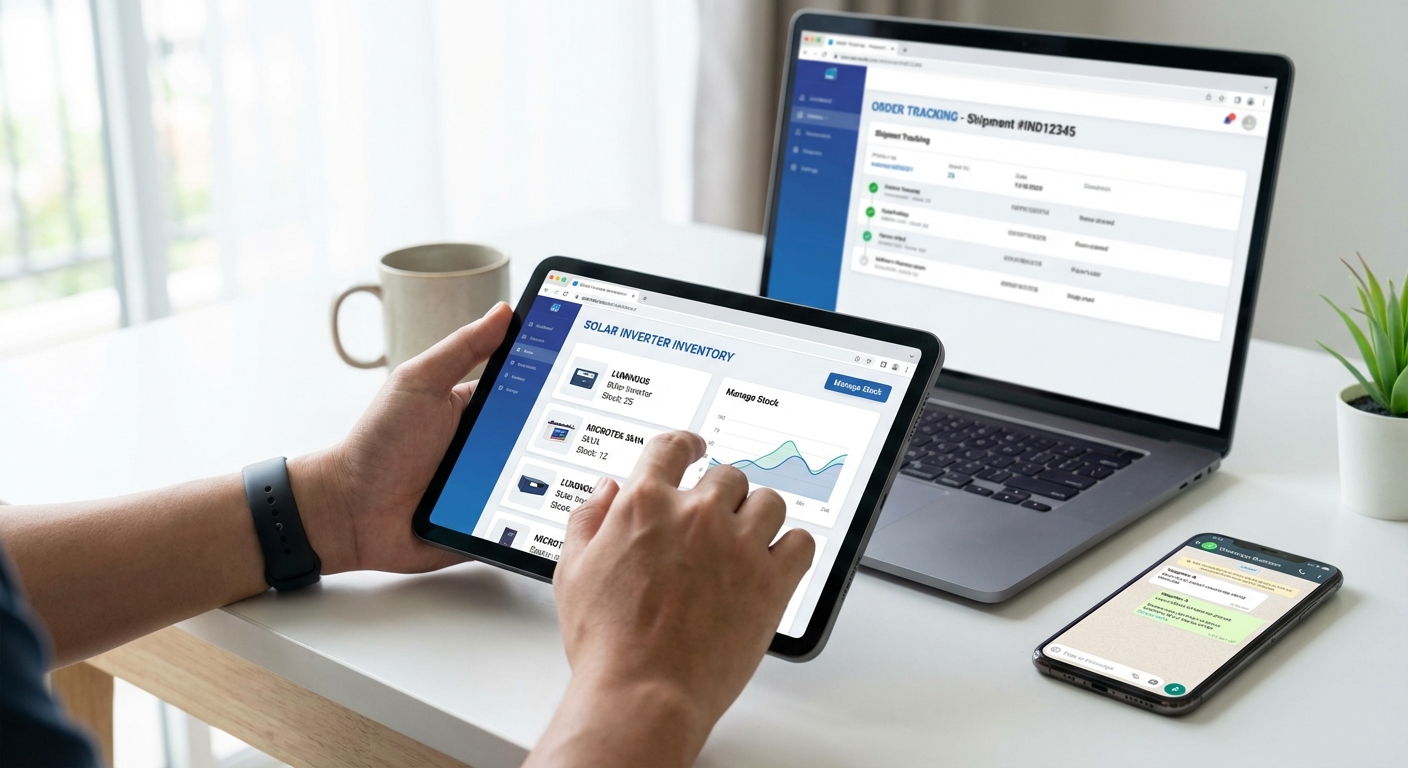
Online ordering and tracking systems streamline procurement processes. Dealers offering web portals or mobile apps enable you to browse inventory, check real-time availability, place orders, and track shipments without phone calls or email exchanges. This self-service capability saves time and provides transparency throughout the ordering process.
Digital documentation and invoicing reduce paperwork and speed up administrative processes. Electronic purchase orders, digital invoices with GST compliance, and automated payment receipts simplify accounting and record-keeping. Digital documentation also facilitates easier warranty registration and claim processing.
Real-time inventory visibility helps you plan projects with confidence. Advanced dealers provide online dashboards showing current stock levels for different inverter models, incoming shipments, and expected availability dates. This transparency enables better project scheduling and reduces the risk of procurement delays.
Integration with EPC project management tools represents the cutting edge of dealer digital capabilities. Some sophisticated dealers offer API integrations or data exports that connect with your project management software, enabling automated procurement workflows and centralized project tracking.
Communication channels diversity ensures you can reach dealers through your preferred methods. Modern dealers maintain multiple communication channels including:
- WhatsApp Business: Quick queries and order updates via familiar messaging platform
- Email support: Formal communications and documentation
- Phone support: Urgent technical issues and complex discussions
- Online portal: Self-service ordering and account management
- Video calls: Remote technical support and product demonstrations
Digital warranty systems deserve special attention given their impact on long-term service quality. Dealers partnering with manufacturers like Qbits that offer digital warranty platforms provide significant advantages. These systems enable instant warranty activation at installation, online claim submission with photo documentation, real-time claim status tracking, and digital warranty certificates that eliminate lost paperwork.
To understand how advanced monitoring systems enhance inverter performance and dealer support capabilities, read our comprehensive guide: Solar Inverter Monitoring Systems in India.
Complete Dealer Vetting Checklist for Solar EPCs
Systematic vetting processes ensure you thoroughly evaluate inverter dealers India before committing to partnerships. Use this comprehensive checklist to standardize your dealer evaluation across all potential partners.

Documentation Requirements
Request and verify the following documents from every potential dealer:
- Business registration certificates (GST registration, company incorporation documents)
- Manufacturer authorization letters and dealer agreements
- BIS/IEC certification documentation for products they supply
- Insurance certificates (product liability, business insurance)
- Bank references and financial stability indicators
- Physical address verification for offices and warehouses
- Tax compliance certificates and financial statements
Reference Checks and Past Client Verification
Contact existing clients to validate dealer performance claims:
- Request references from at least three current EPC clients
- Ask specific questions about delivery reliability, product quality, and support responsiveness
- Inquire about warranty claim experiences and resolution satisfaction
- Verify claimed project volumes and market presence
- Check online reviews and industry reputation through solar industry forums
Financial Stability Indicators
Assess the dealer’s financial health to ensure long-term viability:
- Review financial statements for the past 2-3 years
- Check credit ratings from business information services
- Verify they maintain adequate working capital for inventory investment
- Assess their payment history with manufacturers and suppliers
- Look for signs of financial distress (frequent ownership changes, office relocations, staff turnover)
Compliance and Legal Verification
Ensure dealers meet all regulatory and legal requirements:
- Verify GST registration and tax compliance status
- Check for any pending legal disputes or litigation history
- Confirm compliance with environmental and safety regulations
- Review their standard terms and conditions for fairness and clarity
- Verify they maintain required business licenses for their operating locations
Trial Order Recommendations
Start with limited engagement to validate dealer capabilities before major commitments:
- Place a small initial order (5-10 units) to test delivery and product quality
- Evaluate their order processing efficiency and communication quality
- Assess packaging quality and product condition upon delivery
- Test their technical support responsiveness with installation questions
- Verify warranty registration process and documentation quality
- Gradually increase order volumes as they demonstrate reliability
Document your evaluation findings systematically, using a scoring matrix that weights different criteria according to your business priorities. This structured approach enables objective comparison across multiple dealer candidates and provides a clear rationale for your final selection.
Red Flags to Avoid When Selecting Inverter Dealers India
Recognizing warning signs early prevents costly partnerships with unreliable dealers. Watch for these red flags when evaluating inverter dealers India.
Warning Signs of Unreliable Dealers
Several behavioral patterns indicate potential problems:
- Reluctance to provide documentation: Legitimate dealers readily share authorization certificates, business registrations, and references
- Vague or evasive answers: Professional dealers provide specific, detailed responses to technical and business questions
- Pressure tactics: Aggressive sales approaches pushing immediate decisions suggest desperation rather than confidence
- Inconsistent information: Contradictory statements about inventory, pricing, or capabilities indicate disorganization or dishonesty
- Poor communication: Slow response times, unreturned calls, or difficulty reaching key personnel signal operational problems
Common Dealer Malpractices in Solar Industry
Be alert to these unethical practices that plague the solar supply chain:
- Bait-and-switch tactics: Advertising premium brands but delivering inferior substitutes
- Warranty manipulation: Promising extended warranties not backed by manufacturers
- Inventory misrepresentation: Claiming stock availability then delaying delivery due to “unexpected shortages”
- Price manipulation: Quoting low prices then adding numerous hidden charges at delivery
- Technical incompetence: Providing incorrect technical specifications or installation guidance
Counterfeit Product Risks
Counterfeit and gray market inverters represent serious risks to your business and clients:
- Products lacking genuine manufacturer warranties despite dealer promises
- Inferior components that fail prematurely or perform below specifications
- Safety risks from substandard electrical protection and build quality
- Inability to access manufacturer technical support or software updates
- Legal liability exposure if counterfeit products cause property damage or injuries
Verify product authenticity through manufacturer serial number verification systems, holographic labels, and direct manufacturer confirmation of dealer authorization.
Overpromising on Delivery and Support
Unrealistic commitments often lead to project delays and disappointment:
- Guaranteed delivery timelines significantly faster than industry norms
- Claims of 24/7 technical support without adequate staff to deliver it
- Promises of on-site service in remote locations without local infrastructure
- Warranty terms exceeding manufacturer specifications
- Inventory availability claims that don’t match their actual warehouse capacity
Lack of Transparency in Operations
Opacity in business practices suggests potential problems:
- Unwillingness to allow warehouse or facility visits
- Refusal to provide detailed quotations with cost breakdowns
- Unclear or constantly changing terms and conditions
- No written agreements or contracts for business terms
- Absence of clear escalation procedures for disputes or issues
Trust your instincts when something feels wrong. The solar industry has many reputable dealers who operate transparently and professionally. Don’t compromise on dealer quality to save a few percentage points on pricing.
Building Long-Term Partnerships with Trusted Inverter Dealers
Once you’ve identified reliable inverter dealers India, focus on developing strategic partnerships that create mutual value beyond transactional relationships.
Moving from Transactional to Strategic Partnerships
Transform vendor relationships into strategic alliances through:
- Regular business reviews discussing performance, challenges, and improvement opportunities
- Sharing your project pipeline and growth plans to help dealers anticipate your needs
- Collaborative problem-solving when issues arise rather than adversarial blame
- Recognizing and rewarding excellent dealer performance through increased business
- Involving dealers early in project planning for large or complex installations
Collaborative Planning for Project Pipelines
Share visibility into your upcoming projects to enable better dealer support:
- Provide quarterly forecasts of expected inverter requirements by model and quantity
- Alert dealers to large upcoming projects requiring special inventory preparation
- Discuss new market segments you’re entering that may require different product mixes
- Coordinate on seasonal demand patterns to ensure adequate inventory during peak periods
- Plan joint client presentations or demonstrations for major opportunities
Joint Technical Training Opportunities
Invest in continuous learning together:
- Participate in manufacturer training programs offered through dealers
- Arrange dealer-led training sessions for your installation teams on new products
- Share field learnings and installation best practices that benefit both parties
- Collaborate on troubleshooting complex technical issues to build collective expertise
- Attend industry conferences and trade shows together to stay current on market trends
Feedback Loops and Continuous Improvement
Establish structured feedback mechanisms:
- Provide regular feedback on dealer performance across delivery, quality, and support dimensions
- Request dealer feedback on your ordering processes and communication
- Conduct post-project reviews to identify improvement opportunities
- Share client feedback about inverter performance and satisfaction
- Jointly develop solutions to recurring challenges or inefficiencies
Scaling Your Dealer Network as Business Grows
Expand your dealer partnerships strategically as your EPC business scales:
- Add regional dealers as you enter new geographic markets
- Develop specialized dealer relationships for different market segments (residential vs. C&I)
- Maintain multiple dealer relationships to ensure supply chain resilience
- Balance loyalty to proven partners with openness to new dealers offering unique capabilities
- Formalize preferred dealer programs with tiered benefits based on performance and volume
Strong dealer partnerships become competitive advantages that differentiate your EPC business. Dealers who understand your standards, anticipate your needs, and prioritize your success enable you to deliver superior client experiences and execute projects more efficiently than competitors working with less reliable supply chains.
For deeper insights into selecting the right inverter technology for your projects, explore our comprehensive resource: Solar Inverter Selection: 10 Critical Criteria for EPCs.
Partner with Qbits: Next-Generation Inverter Solutions for Forward-Thinking EPCs
Finding reliable inverter dealers India starts with partnering with manufacturers committed to dealer excellence and EPC success. Qbits combines German-grade engineering with India-focused innovation to deliver solar inverters that perform reliably across diverse installation environments.
Our authorized dealer network spans major solar markets across India, providing EPCs with consistent access to advanced inverter technology backed by comprehensive support. With 12-year full replacement warranties, AI-powered WhatsApp monitoring, and 98% efficiency ratings, Qbits inverters deliver the performance and reliability your projects demand.
Whether you’re installing residential rooftop systems or large-scale commercial and industrial projects, our dealer partners provide the technical expertise, inventory availability, and responsive service that keep your installations on schedule and your clients satisfied. Our digital warranty system eliminates paperwork delays, while our IP66 weather protection ensures reliable operation in India’s challenging climate conditions.
Ready to build your supply chain with trusted inverter dealers backed by next-generation technology? Contact our team today to discuss your project requirements and connect with authorized Qbits dealers in your region. For EPCs interested in becoming authorized partners, explore our partnership program and join India’s fastest-growing solar inverter network.
Discover how Qbits’ advanced features and comprehensive dealer support can differentiate your EPC business in India’s competitive solar market. Explore our complete product range and experience the difference that reliable inverter dealers India can make for your solar installations.
This blog post was written using thestacc.com