



Solar Inverter Depreciation in India: Tax Benefits Guide 2026


For commercial and industrial businesses investing in solar power systems across India, understanding inverter depreciation is crucial for maximizing financial returns and optimizing tax benefits. Solar inverters represent a significant portion of your total system investment—typically 15-20% of capital expenditure—and the way you account for their depreciation can dramatically impact your project’s return on investment, tax liability, and long-term financial planning.
In 2026, India’s accelerated depreciation policies continue to offer substantial tax advantages for businesses deploying solar energy systems. However, many facility owners, EPCs, and solar distributors overlook the nuanced strategies around inverter depreciation that can unlock additional value. This comprehensive guide explores depreciation rates, calculation methods, tax optimization strategies, and how to align your depreciation planning with actual equipment replacement cycles to ensure your solar investment delivers maximum financial performance.

Understanding Solar Inverter Depreciation in India
Inverter depreciation refers to the systematic allocation of an inverter’s cost over its useful life for accounting and tax purposes. Unlike physical wear and tear, depreciation is a non-cash expense that reduces your taxable income while the asset continues to generate value through solar power production.
For businesses investing in solar installations, depreciation serves two critical functions. First, it provides a realistic accounting representation of asset value decline over time. Second, and more importantly for most commercial entities, it creates significant tax shields that improve cash flow and accelerate payback periods.
The distinction between book depreciation and actual equipment degradation is essential to understand. Book depreciation follows prescribed tax schedules—currently 40% accelerated depreciation for solar systems in India—while actual inverter performance typically degrades much more gradually. A high-quality solar inverter with German-grade components and robust engineering may maintain 95% or higher efficiency even after 10-12 years of operation, yet its book value will have depreciated to a fraction of the original cost.
This gap between accounting value and real-world performance creates strategic opportunities. Businesses can claim substantial tax deductions in early years while the equipment continues delivering near-original performance throughout its operational life. For commercial and industrial solar installations, this means improved cash flow precisely when it matters most, during the initial investment recovery phase.
Why Inverter Depreciation Matters for Solar ROI
The financial impact of inverter depreciation extends far beyond simple accounting entries. For a typical 100 kW commercial solar installation with an inverter cost of ₹6-8 lakhs, accelerated depreciation can reduce first-year tax liability by ₹2.4-3.2 lakhs (assuming a 30% corporate tax rate). This immediate tax benefit effectively reduces your net capital outlay and shortens payback periods by 6-12 months.
When evaluating solar inverter selection criteria, depreciation benefits should factor prominently alongside technical specifications. Premium inverters with extended warranties and superior component quality may carry higher upfront costs, but their depreciation benefits combined with longer operational life often deliver superior total cost of ownership.
Accelerated Depreciation Rates for Solar Inverters Under Indian Tax Law
India’s Income Tax Act provides accelerated depreciation for solar power generating systems under Section 32 of the Act. As of 2026, the applicable depreciation rate for solar installations, including inverters, stands at 40% per annum under the Written Down Value (WDV) method.
This represents a significant tax incentive, though it’s worth noting the historical context. Prior to April 2017, solar systems qualified for an 80% accelerated depreciation rate in the first year, a provision that made solar investments extraordinarily attractive from a tax perspective. The reduction to 40% was implemented to balance fiscal considerations while maintaining meaningful incentives for renewable energy adoption.
Eligibility Criteria for Claiming Accelerated Depreciation
To qualify for accelerated inverter depreciation benefits, your solar installation must meet specific criteria:
- Business use requirement: The solar system must be used for business purposes. Residential installations do not qualify for accelerated depreciation benefits.
- Ownership structure: The claiming entity must own the solar assets. Third-party ownership models (like PPAs where a developer owns the system) transfer depreciation benefits to the system owner, not the electricity consumer.
- Operational status: The asset must be put to use during the financial year to claim depreciation. Purchased but uninstalled equipment doesn’t qualify.
- Minimum usage period: If the asset is used for less than 180 days in the year of purchase, only 50% of the applicable depreciation rate can be claimed in that year.
- Documentation: Proper invoicing, installation certificates, and commissioning reports must be maintained to substantiate depreciation claims.
The accelerated depreciation applies to the entire solar power system as an integrated unit. However, for financial planning and replacement cycle management, it’s valuable to track inverter costs separately since inverters typically require replacement before solar panels reach end-of-life.
How Inverter Depreciation Fits Within Overall Solar System Depreciation
While tax authorities treat the solar installation as a single asset class, prudent financial management requires separating component costs for internal planning. In a typical commercial solar installation, cost distribution breaks down approximately as follows:
- Solar panels: 50-55% of total system cost
- Inverters: 15-20% of total system cost
- Mounting structures: 10-12% of total system cost
- Balance of system (cables, connectors, protection devices): 8-10% of total system cost
- Installation and commissioning: 8-12% of total system cost
For depreciation calculation purposes, the entire capital expenditure qualifies for the 40% rate. However, understanding the inverter’s proportional contribution helps with long-term financial modeling, especially when planning for mid-life inverter replacement in year 10-12 of a 25-year solar project.
Calculating Inverter Depreciation: Methods and Formulas
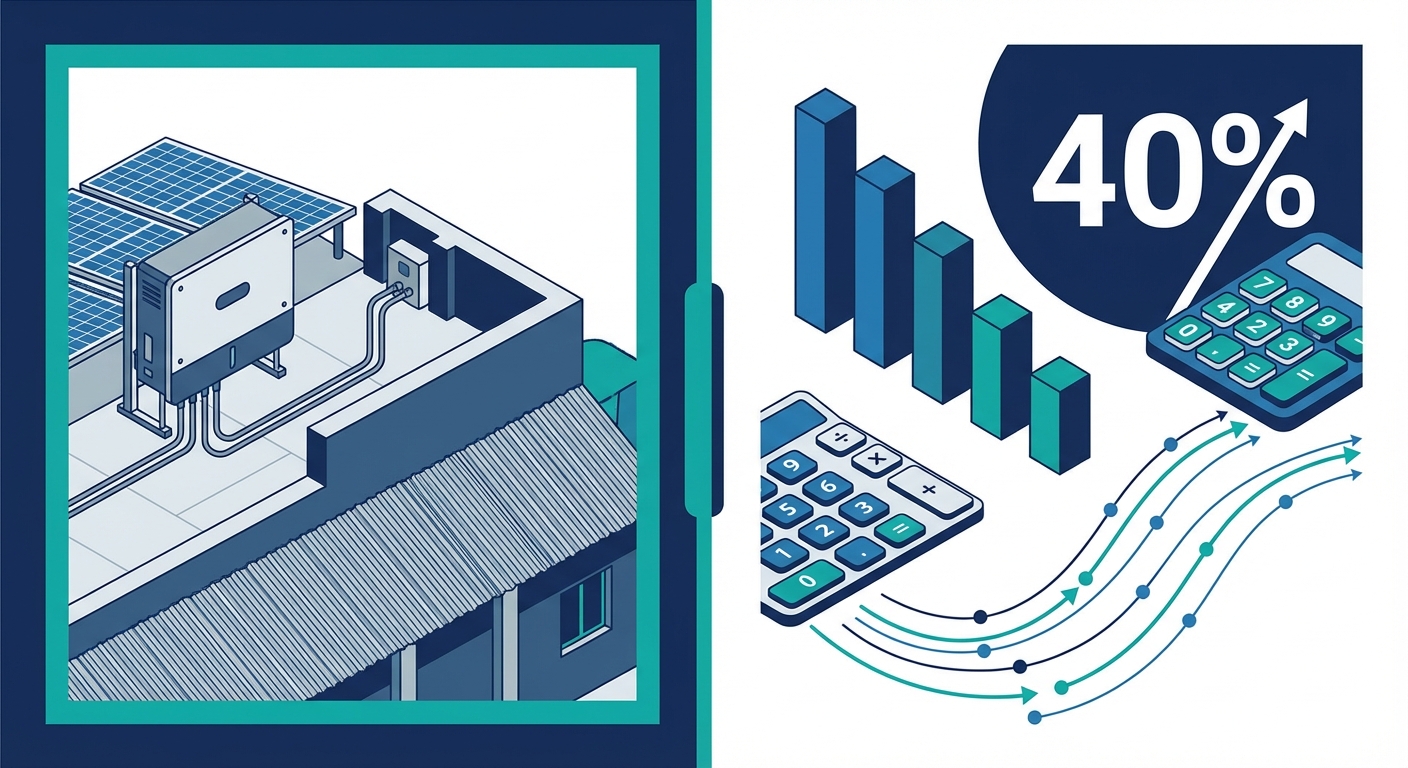
Indian tax law permits two depreciation methods: the Written Down Value (WDV) method and the Straight Line Method (SLM). For solar installations, the WDV method with accelerated depreciation offers superior tax benefits and is the preferred approach for most commercial entities.
Written Down Value Method for Inverter Depreciation
Under the WDV method, depreciation is calculated on the reducing balance each year. The formula is:
Depreciation = Opening WDV × Depreciation Rate
Let’s walk through a practical example for a commercial solar installation:
Example: 100 kW Commercial Solar Installation
- Total system cost: ₹40,00,000
- Inverter cost (component): ₹7,00,000
- Depreciation rate: 40% per annum
- Corporate tax rate: 30%
Year 1 Calculation:
- Opening value: ₹40,00,000
- Depreciation claimed: ₹40,00,000 × 40% = ₹16,00,000
- Tax benefit: ₹16,00,000 × 30% = ₹4,80,000
- Closing WDV: ₹40,00,000 – ₹16,00,000 = ₹24,00,000
Year 2 Calculation:
- Opening value: ₹24,00,000
- Depreciation claimed: ₹24,00,000 × 40% = ₹9,60,000
- Tax benefit: ₹9,60,000 × 30% = ₹2,88,000
- Closing WDV: ₹24,00,000 – ₹9,60,000 = ₹14,40,000
Year 3 Calculation:
- Opening value: ₹14,40,000
- Depreciation claimed: ₹14,40,000 × 40% = ₹5,76,000
- Tax benefit: ₹5,76,000 × 30% = ₹1,72,800
- Closing WDV: ₹14,40,000 – ₹5,76,000 = ₹8,64,000
This pattern continues throughout the asset’s life. Notice how the WDV method front-loads depreciation benefits, creating maximum tax shields in the early years when cash flow impact is most valuable for investment recovery.
Impact of Mid-Year Purchases on Depreciation Claims
The timing of your inverter purchase and installation significantly affects first-year depreciation benefits. If your solar system is commissioned and operational for less than 180 days in the financial year, you can only claim 50% of the normal depreciation rate.
For a system installed in January 2026 (assuming April-March financial year), you would claim:
- Full depreciation: ₹40,00,000 × 40% = ₹16,00,000
But for a system installed in December 2025 (operational for only 4 months in FY 2025-26):
- Half depreciation: ₹40,00,000 × 20% = ₹8,00,000 (Year 1)
- The remaining benefit is deferred to subsequent years
This timing consideration makes early-year installations (April-September) more tax-efficient, allowing you to capture full first-year depreciation benefits.
Separating Inverter Cost for Replacement Planning
While tax calculations treat the solar system as a unified asset, internal financial planning should track inverter costs separately. This becomes critical when planning for inverter replacement in years 10-15 of your solar project.
Using our example, the inverter component (₹7,00,000) depreciates alongside the full system. By year 10, the entire system’s book value will be approximately ₹1,54,000 (after 40% annual depreciation). However, when you need to replace the inverter, you’ll incur a fresh capital expenditure of ₹6-8 lakhs (accounting for technology improvements and price changes).
This replacement inverter becomes a new depreciable asset, eligible for the prevailing depreciation rate at that time. Strategic financial planning accounts for this mid-life capital requirement and its associated depreciation benefits when calculating true lifetime project economics.
Maximizing Tax Benefits Through Strategic Inverter Depreciation
Understanding inverter depreciation mechanics is just the starting point. Sophisticated solar investors employ several strategies to optimize tax benefits and improve overall project returns.
Timing Your Inverter Purchase for Optimal Tax Benefits
As discussed, ensuring your solar installation is operational for at least 180 days in the financial year allows you to claim full first-year depreciation. For businesses with strong profitability in a particular year, accelerating solar installation to capture maximum depreciation can significantly reduce tax liability.
Consider a business expecting ₹50 lakh taxable income in FY 2026-27. Installing a ₹40 lakh solar system in April-May 2026 would allow ₹16 lakh depreciation, reducing taxable income to ₹34 lakh and saving ₹4.8 lakh in taxes (at 30% rate). This immediate cash benefit improves project IRR substantially.
Combining Depreciation with Other Solar Incentives
Accelerated depreciation can be combined with other benefits to maximize returns:
- Capital subsidies: Some state governments and programs offer capital subsidies for solar installations. These subsidies reduce your depreciable base but don’t eliminate depreciation benefits entirely.
- Renewable energy certificates (RECs): While not directly related to depreciation, RECs provide additional revenue that improves overall project economics.
- Reduced electricity costs: The primary benefit, lower energy bills, combines with depreciation tax shields to accelerate payback.
- Carbon credits: For larger installations, carbon credit revenue adds another income stream alongside depreciation benefits.
When evaluating inverter pricing and project economics, model all these benefits together rather than viewing depreciation in isolation.
Documentation Requirements for Claiming Depreciation
To successfully claim inverter depreciation benefits, maintain comprehensive documentation:
- Purchase invoices: Detailed invoices showing inverter costs, GST, and other charges
- Installation certificates: Documentation proving the system was installed and commissioned
- Commissioning reports: Technical reports confirming the system is operational
- Ownership proof: Clear documentation that your business owns the assets
- BIS/IEC certifications: Quality certifications for equipment (particularly important for inverters)
- Warranty documentation: Warranty certificates that establish equipment quality and expected lifespan
For businesses working with premium inverter manufacturers offering 12-year warranties and comprehensive quality documentation, this requirement is straightforward. The digital warranty systems and automated quality test reports provided by leading manufacturers create an audit trail that satisfies tax authority requirements while also supporting long-term performance monitoring.
Common Mistakes That Reduce Depreciation Benefits
Avoid these frequent errors that diminish your tax advantages:
- Delayed commissioning: Purchasing equipment but delaying installation past the 180-day threshold reduces first-year benefits by half
- Inadequate documentation: Poor record-keeping can lead to disallowed depreciation claims during audits
- Incorrect asset classification: Misclassifying solar equipment under wrong asset categories may result in lower depreciation rates
- Ignoring replacement planning: Failing to account for mid-life inverter replacement in financial models creates unexpected capital requirements
- Choosing low-quality equipment: While cheaper inverters reduce initial capital, premature failures and replacements complicate depreciation accounting and reduce overall returns
Inverter Depreciation Impact on ROI and Payback Period
The true value of inverter depreciation becomes clear when analyzing its impact on return on investment and payback calculations. Depreciation benefits don’t just improve accounting metrics, they generate real cash flow improvements that accelerate investment recovery.
ROI Calculation With and Without Depreciation Benefits
Let’s compare two scenarios for a 100 kW commercial solar installation (₹40 lakh total cost, ₹7 lakh inverter component):
Scenario A: Without Considering Depreciation Tax Benefits
- Annual electricity savings: ₹6,00,000
- Annual O&M costs: ₹40,000
- Net annual benefit: ₹5,60,000
- Simple payback: ₹40,00,000 ÷ ₹5,60,000 = 7.1 years
Scenario B: Including Depreciation Tax Benefits
- Annual electricity savings: ₹6,00,000
- Annual O&M costs: ₹40,000
- Year 1 depreciation tax benefit: ₹4,80,000
- Year 2 depreciation tax benefit: ₹2,88,000
- Year 3 depreciation tax benefit: ₹1,72,800
- Cumulative 3-year benefit: ₹5,60,000 × 3 + ₹9,40,800 = ₹26,20,800
- Effective payback: Approximately 5.2 years (accounting for time value of money)
The depreciation benefits reduce payback period by nearly 2 years, a 27% improvement in investment recovery speed. This dramatic impact explains why accelerated depreciation remains one of the most valuable incentives for commercial solar adoption in India.
How Inverter Quality and Warranty Affect Long-Term Value
While depreciation schedules follow fixed rates regardless of equipment quality, the actual value retention and performance of your inverter significantly impacts true ROI. A premium inverter with German-grade components, comprehensive surge protection, and a 12-year warranty delivers several advantages:
- Extended operational life: High-quality inverters often operate effectively for 15+ years, well beyond the typical 10-year lifespan of budget alternatives
- Maintained efficiency: Premium inverters sustain 98% efficiency throughout their life, while lower-quality units may degrade to 92-94% efficiency
- Reduced replacement costs: Avoiding premature inverter replacement saves capital expenditure and operational disruption
- Higher resale value: If you sell the solar installation, quality equipment with remaining warranty commands premium pricing
When evaluating inverter manufacturers and equipment options, consider that the depreciation benefit is identical whether you purchase a ₹6 lakh budget inverter or a ₹8 lakh premium unit. However, the ₹2 lakh price difference is often recovered through superior performance, extended lifespan, and avoided replacement costs.
Factoring Replacement Costs Into Depreciation Planning
For 25-year solar projects, inverter replacement is virtually certain. Most inverters require replacement between years 10-15, while solar panels continue producing for 25+ years. This creates a secondary depreciation opportunity that should be factored into lifetime financial modeling.
When you replace an inverter in year 12, the new equipment becomes a fresh depreciable asset. If you invest ₹7 lakh in a replacement inverter, you can claim depreciation on this new capital expenditure, generating additional tax benefits in the project’s second decade.
This creates an interesting strategic consideration: investing in the highest-quality inverter initially may delay or eliminate the need for replacement, but it also means you forgo the second round of depreciation benefits. Financial modeling should account for both scenarios to determine the optimal equipment quality level for your specific tax situation and operational priorities.
Book Value vs Actual Value: Planning for Inverter Replacement
One of the most important concepts in inverter depreciation planning is understanding the divergence between book value (accounting value) and actual market or functional value. This gap creates both opportunities and planning requirements for long-term solar project management.
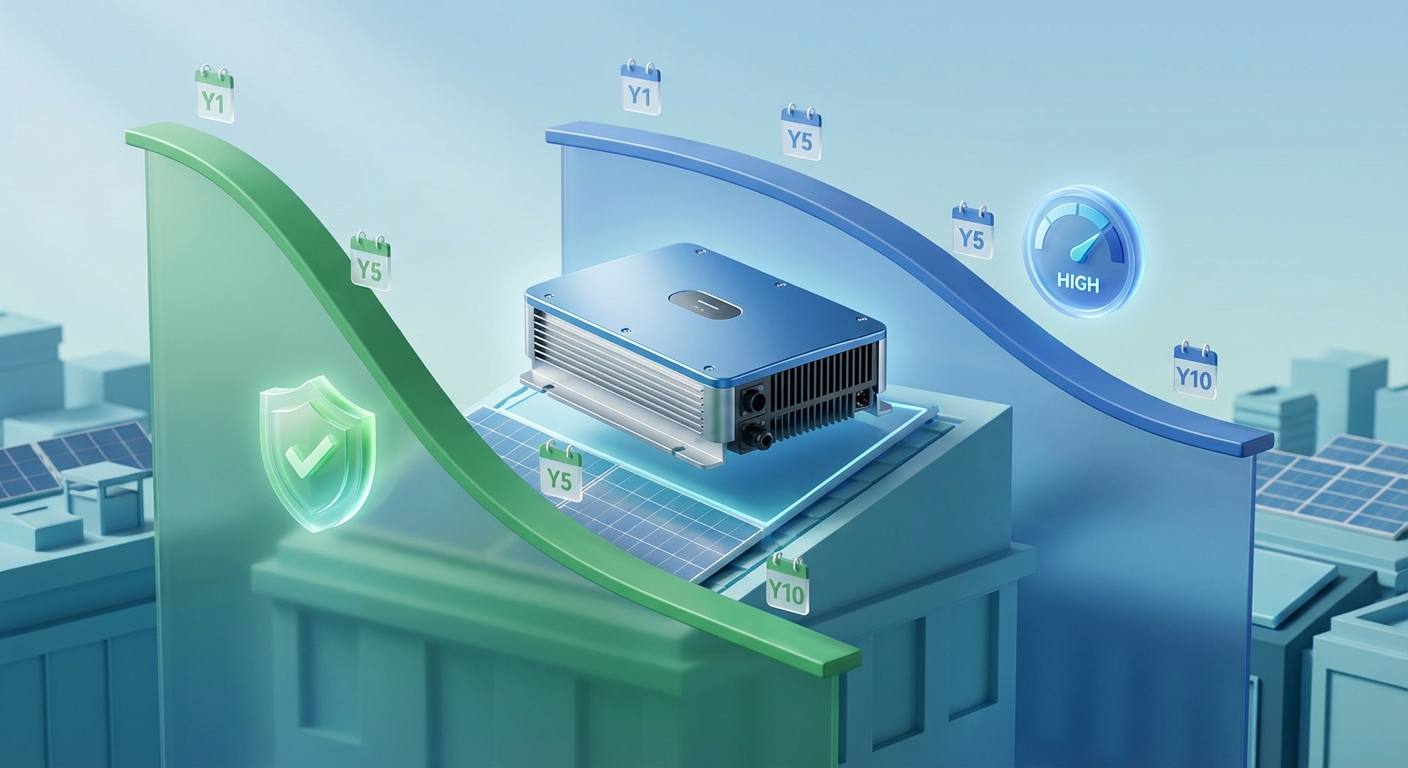
The Book Value Depreciation Curve
Under the 40% WDV method, an inverter’s book value declines rapidly:
- Year 0: ₹7,00,000 (original cost)
- Year 1: ₹4,20,000 (60% of original)
- Year 2: ₹2,52,000 (36% of original)
- Year 3: ₹1,51,200 (21.6% of original)
- Year 5: ₹54,432 (7.8% of original)
- Year 10: ₹4,239 (0.6% of original)
By year 10, the inverter’s book value is essentially zero from an accounting perspective. However, this bears little relationship to the equipment’s actual functional value or remaining useful life.
Actual Inverter Performance Degradation
In contrast to the steep book value decline, actual inverter performance degrades much more gradually. A high-quality inverter with robust engineering typically experiences:
- Years 1-5: 98-99% of original efficiency, essentially no performance degradation
- Years 6-10: 96-98% efficiency, minimal degradation with proper maintenance
- Years 11-15: 94-97% efficiency, gradual component aging but still highly functional
- Years 16+: Variable performance depending on component quality and operating conditions
This means that in year 10, when your inverter has a book value of near zero, it may still be operating at 96-97% of original capacity and have 5-8 years of remaining useful life. This gap between accounting value and real value is where strategic planning becomes crucial.
Planning Replacement Cycles Based on Actual Performance
Rather than replacing inverters based on depreciation schedules, base replacement decisions on actual performance metrics and lifecycle economics:
- Performance monitoring: Track actual efficiency, output, and degradation rates through AI-powered monitoring systems
- Warranty coverage: With 12-year warranties, replacement decisions can be deferred until warranty expiration approaches
- Technology advancement: Consider whether newer inverter technology offers sufficient efficiency gains to justify early replacement
- Failure risk assessment: Evaluate component condition and failure probability versus replacement costs
- Financial optimization: Time replacements to align with tax planning and capital availability
For businesses using inverters with comprehensive warranties and advanced monitoring capabilities, data-driven replacement decisions typically extend equipment life 2-4 years beyond industry averages, significantly improving lifetime project economics.
Residual Value Considerations for High-Quality Inverters
When solar installations are sold or refinanced, inverter quality dramatically affects asset valuation. A 10-year-old solar system with a premium inverter still under warranty commands substantially higher pricing than an identical system with a budget inverter approaching end-of-life.
This residual value consideration is particularly important for:
- Real estate transactions: Commercial properties with solar installations transfer at higher values when equipment quality is documented
- Project financing: Lenders assign higher valuations to solar assets with quality equipment and remaining warranties
- Portfolio sales: Solar developers selling operational projects receive premium pricing for installations with quality inverters
- Insurance claims: In the event of damage, quality equipment with proper documentation receives better claim settlements
While book value may be negligible after 10 years, the actual market value of a well-maintained, high-quality inverter can be 30-50% of replacement cost, a significant asset value that doesn’t appear on depreciation schedules.
Depreciation Strategies for Different Business Structures
The approach to inverter depreciation varies depending on your business structure and tax situation. Understanding these nuances helps optimize benefits for your specific circumstances.
Private Limited Companies and Corporations
Private limited companies and corporations represent the most straightforward scenario for claiming accelerated depreciation. These entities:
- Can claim full 40% depreciation under WDV method
- Benefit most when corporate tax rates are high (25-30%)
- Can carry forward depreciation losses to offset future profits
- Must maintain detailed asset registers and depreciation schedules
- Can optimize timing of solar investments based on annual profitability
For corporations with consistent profitability, accelerated depreciation provides immediate cash flow benefits that significantly improve solar project IRR.
Partnership Firms and LLPs
Partnership firms and Limited Liability Partnerships can claim depreciation, but the benefits flow through to individual partners based on their profit-sharing ratios. Key considerations include:
- Depreciation is claimed at the firm level, not by individual partners
- Partners benefit based on their share of firm profits/losses
- Tax rates vary based on individual partner tax situations
- Depreciation benefits may be less valuable if partners are in lower tax brackets
Sole Proprietorships
Sole proprietors can claim depreciation as part of business expenses. The value depends on the proprietor’s overall tax situation:
- Depreciation reduces business income, which flows to personal tax returns
- Benefits depend on individual tax slab (which may be lower than corporate rates)
- Simpler documentation requirements compared to corporations
- Must clearly demonstrate business use of solar installation
Special Considerations for Captive vs Third-Party Installations
The ownership structure of your solar installation determines who claims depreciation benefits:
Captive installations (you own the system):
- You claim all depreciation benefits
- You bear all capital costs and maintenance responsibilities
- You retain all electricity cost savings
- Optimal when you have tax liability to offset and capital availability
Third-party ownership (PPA/lease model):
- The system owner (developer) claims depreciation benefits
- You pay for electricity at contracted rates without capital investment
- You don’t receive direct depreciation benefits, but benefit indirectly through lower PPA rates
- Optimal when capital is constrained or tax liability is limited
Advanced Depreciation Planning: Multi-Year Strategies
Sophisticated solar investors employ long-term depreciation strategies that optimize tax benefits across the entire project lifecycle.
Long-Term Depreciation Planning for 25-Year Solar Projects
A comprehensive depreciation strategy for a 25-year solar project should account for:
- Initial system depreciation: Years 1-10, capturing accelerated benefits on original investment
- Inverter replacement depreciation: Years 10-15, new depreciation cycle on replacement equipment
- Potential panel replacement: Years 20-25, if partial panel replacement becomes necessary
- System upgrades: Monitoring equipment, protection devices, and other component upgrades throughout project life
Each capital expenditure creates a new depreciable asset, generating tax benefits that improve lifetime project economics. Financial models should incorporate these multiple depreciation cycles rather than treating the initial installation as the only depreciation opportunity.
Phased Installation Strategies to Optimize Tax Benefits
For businesses with large rooftop capacity or land availability, phased installations can optimize depreciation benefits:
Strategy 1: Annual Capacity Additions
Instead of installing 500 kW in year 1, consider:
- Year 1: 200 kW installation, ₹16 lakh depreciation
- Year 2: 150 kW installation, ₹6 lakh depreciation on new + ₹9.6 lakh on year 1 system
- Year 3: 150 kW installation, ₹6 lakh depreciation on new + continuing depreciation on prior systems
This approach spreads capital requirements and creates sustained depreciation benefits across multiple years, which can be valuable for businesses with consistent but moderate profitability.
Depreciation Recapture Considerations
If you sell solar assets before the end of their useful life, depreciation recapture rules may apply. When an asset is sold for more than its book value, the difference may be treated as income and taxed accordingly.
For example, if you sell a solar installation in year 10 when book value is ₹1.5 lakh but receive ₹8 lakh (due to well-maintained equipment and remaining useful life), the ₹6.5 lakh difference may be subject to taxation as short-term or long-term capital gains depending on holding period.
This consideration is particularly relevant for solar developers who build and sell projects, or businesses that may sell properties with solar installations.
Impact of Inverter Upgrades on Depreciation
Technology advancement in solar inverters creates opportunities for strategic upgrades that generate both performance improvements and depreciation benefits. When upgrading from an older inverter to a newer model with enhanced features, such as AI-powered monitoring, improved efficiency, or hybrid capabilities, the new equipment cost becomes a depreciable asset.
This creates a strategic decision point: continue operating a functional but older inverter with minimal book value, or upgrade to newer technology that provides both performance benefits and renewed depreciation advantages. The optimal choice depends on the performance gap, capital availability, and current tax situation.
Frequently Asked Questions About Inverter Depreciation
Can I claim separate depreciation for inverters and solar panels?
For tax purposes, the solar power system is treated as an integrated asset, and you claim depreciation on the total system cost at the 40% rate. However, for internal financial planning and replacement cycle management, you should track inverter costs separately since inverters typically require replacement before panels. The tax benefit applies to the entire system cost, but separating components helps with long-term capital planning.
What happens to depreciation if I replace the inverter mid-project?
When you replace an inverter during the project lifetime, the new inverter becomes a fresh depreciable asset. You can claim depreciation on the replacement cost at the prevailing rate (currently 40% under WDV method). The original system continues its depreciation schedule on the remaining book value. This creates a second depreciation cycle that provides additional tax benefits in the project’s second decade.
How does inverter warranty affect depreciation claims?
Warranty coverage doesn’t directly affect depreciation calculations, you claim the same 40% rate regardless of warranty length. However, extended warranties (such as 12-year coverage) provide important documentation for tax authorities and support higher residual value assessments. Quality warranties also reduce the likelihood of premature replacement, allowing you to optimize the timing of replacement-related depreciation benefits.
Can residential solar installations claim inverter depreciation?
No, accelerated depreciation benefits are only available for solar systems used for business purposes. Residential installations don’t qualify for depreciation deductions. However, residential users benefit from reduced electricity bills and may qualify for other incentives like net metering or state-specific subsidies. The depreciation benefit is specifically designed to incentivize commercial and industrial solar adoption.
What documentation is needed to claim inverter depreciation?
To successfully claim depreciation, maintain comprehensive documentation including: detailed purchase invoices showing equipment costs, installation and commissioning certificates, ownership proof, BIS/IEC quality certifications, warranty documentation, and evidence that the system is used for business purposes. Digital warranty systems and automated quality test reports from manufacturers create a strong audit trail. Keep all documentation for at least 7 years to satisfy potential tax authority inquiries.
Does the depreciation rate differ for hybrid vs on-grid inverters?
No, both hybrid and on-grid inverters qualify for the same 40% accelerated depreciation rate under current tax law. The depreciation rate applies to solar power generating systems as a category, regardless of specific inverter type. However, hybrid inverters with battery storage may have different considerations if the battery is classified separately, so consult with your tax advisor on the specific treatment of battery storage components.
How do I calculate depreciation if I install the system mid-year?
If your solar system is operational for less than 180 days in the financial year, you can only claim 50% of the normal depreciation rate in that year. For example, if you install in December and the financial year ends in March (only 4 months of operation), you would claim 20% depreciation instead of 40% in year one. The remaining benefit isn’t lost, it’s simply deferred to subsequent years. To maximize first-year benefits, aim to commission your system in the first half of the financial year.
Can I switch from WDV to Straight Line Method for better benefits?
Once you choose a depreciation method for an asset class, you must continue using that method for all assets in that class. You cannot switch between WDV and SLM for the same asset. For solar installations, the WDV method with 40% accelerated depreciation almost always provides superior tax benefits compared to the Straight Line Method, so most businesses opt for WDV from the outset.
Maximizing Your Solar Investment Through Strategic Depreciation Planning
Understanding and optimizing inverter depreciation represents one of the most powerful financial levers available to commercial and industrial solar investors in India. The 40% accelerated depreciation rate creates substantial tax shields that improve cash flow, accelerate payback periods, and enhance overall return on investment by 20-30% compared to scenarios that ignore these benefits.
The key to maximizing depreciation value lies in strategic planning across multiple dimensions. Timing your installation to capture full first-year benefits, maintaining comprehensive documentation, selecting quality equipment that balances upfront cost with long-term value, and planning for mid-life inverter replacement all contribute to optimal financial outcomes.
Perhaps most importantly, recognize that book depreciation and actual equipment value follow very different trajectories. While your inverter’s accounting value approaches zero within 10 years, a high-quality unit with German-grade components, comprehensive surge protection, and extended warranty coverage continues delivering near-original performance for 15+ years. This gap between book value and real value creates opportunities for sophisticated investors who understand how to leverage both accounting benefits and actual equipment longevity.
For businesses evaluating solar investments in 2026, inverter depreciation should be a central consideration in your financial modeling, not an afterthought. The difference between a well-planned depreciation strategy and a haphazard approach can mean the difference between a 7-year payback and a 5-year payback, or between a 12% IRR and a 16% IRR.
When selecting inverters for your commercial or industrial solar installation, look beyond just the technical specifications and upfront price. Consider the total value equation: depreciation benefits, warranty coverage, expected lifespan, monitoring capabilities, and manufacturer support. Premium inverters with AI-powered monitoring systems, 12-year warranties, and proven quality through 1000+ automated tests per unit may carry slightly higher initial costs, but they deliver superior total cost of ownership when depreciation benefits, extended operational life, and avoided replacement costs are properly accounted for.
Ready to optimize your solar investment with equipment that maximizes both depreciation benefits and long-term performance? Explore Qbits’ range of on-grid and hybrid inverters engineered with German-grade components and backed by comprehensive 12-year warranties. Our AI-powered monitoring systems provide the documentation and performance tracking you need for both tax compliance and operational optimization. Contact our team today to discuss how our inverter solutions can enhance your solar project’s financial performance through the complete lifecycle, from initial depreciation benefits through long-term value retention and strategic replacement planning.
For EPCs and distributors looking to offer clients the best combination of technical performance and financial optimization, explore partnership opportunities with a manufacturer that understands the complete value equation of solar inverter investments in the Indian market.
This blog post was written using thestacc.com