



IP65 vs IP66 Solar Inverters: Weather Protection Guide

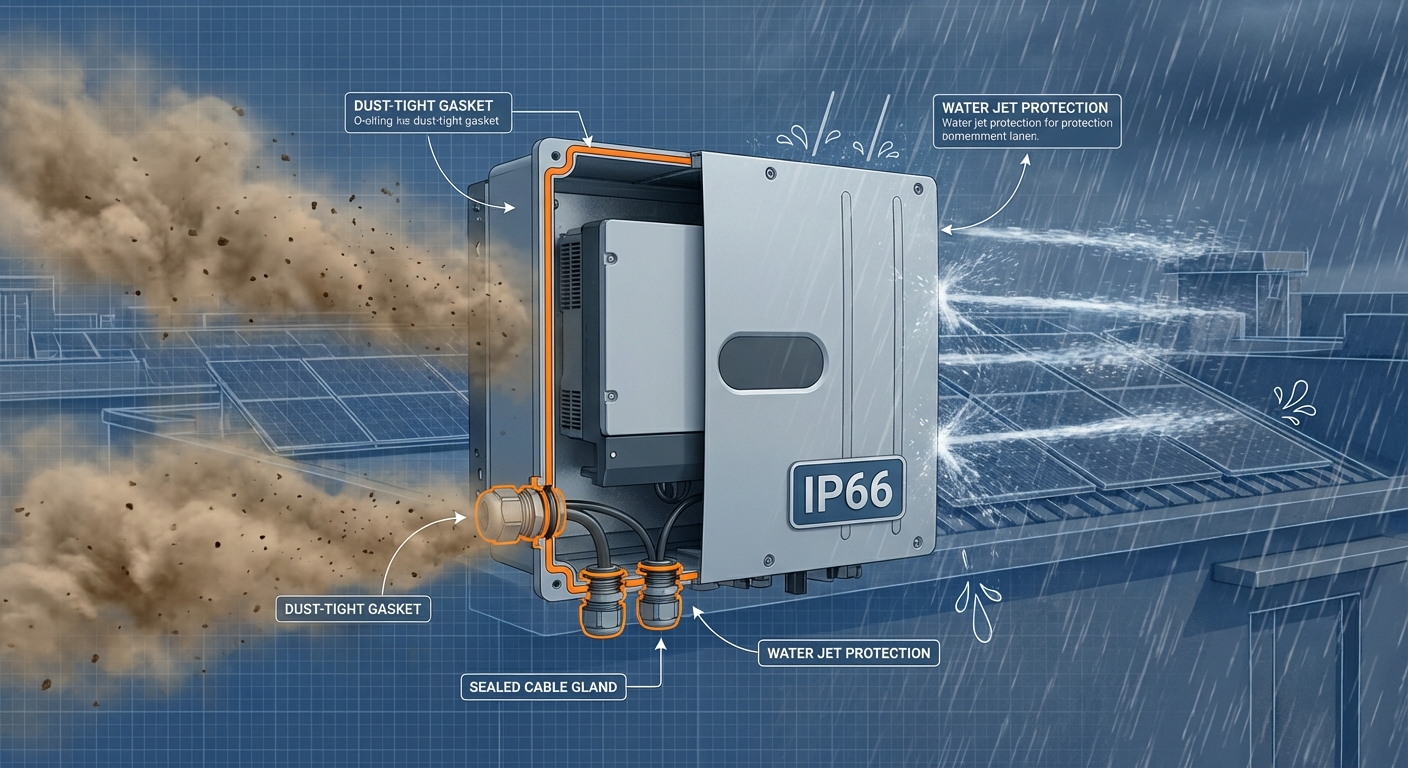
When specifying solar inverters for rooftop installations across India, one technical specification often determines whether your equipment survives harsh environmental conditions or fails prematurely: the IP (Ingress Protection) rating. For solar EPCs, distributors, and facility owners investing in commercial and industrial solar projects, understanding the difference between IP65 and IP66 inverter protection isn’t just technical minutiae—it’s a critical factor affecting system reliability, maintenance costs, and long-term ROI.
India’s diverse climate zones present unique challenges for solar equipment. From the salt-laden coastal humidity of Mumbai and Chennai to the dust storms of Rajasthan, from the intense monsoons of Kerala to the extreme temperature swings of Delhi, solar inverters face environmental stresses that can compromise performance and longevity. The inverter protection standard you choose directly impacts how well your equipment withstands these conditions over its operational lifespan.
This comprehensive comparison analyzes IP65 versus IP66 weather protection ratings specifically for Indian climatic conditions, helping you make informed decisions that balance upfront investment against long-term durability and total cost of ownership.
Understanding IP Ratings: What They Mean for Solar Inverter Protection
The IP rating system, formally defined by the IEC 60529 international standard, provides a standardized method for classifying the degree of protection provided by electrical enclosures against intrusion of solid objects (including dust) and liquids (including water). Unlike vague marketing terms like “weatherproof” or “water-resistant,” IP ratings offer precise, testable specifications that allow meaningful comparisons between equipment.
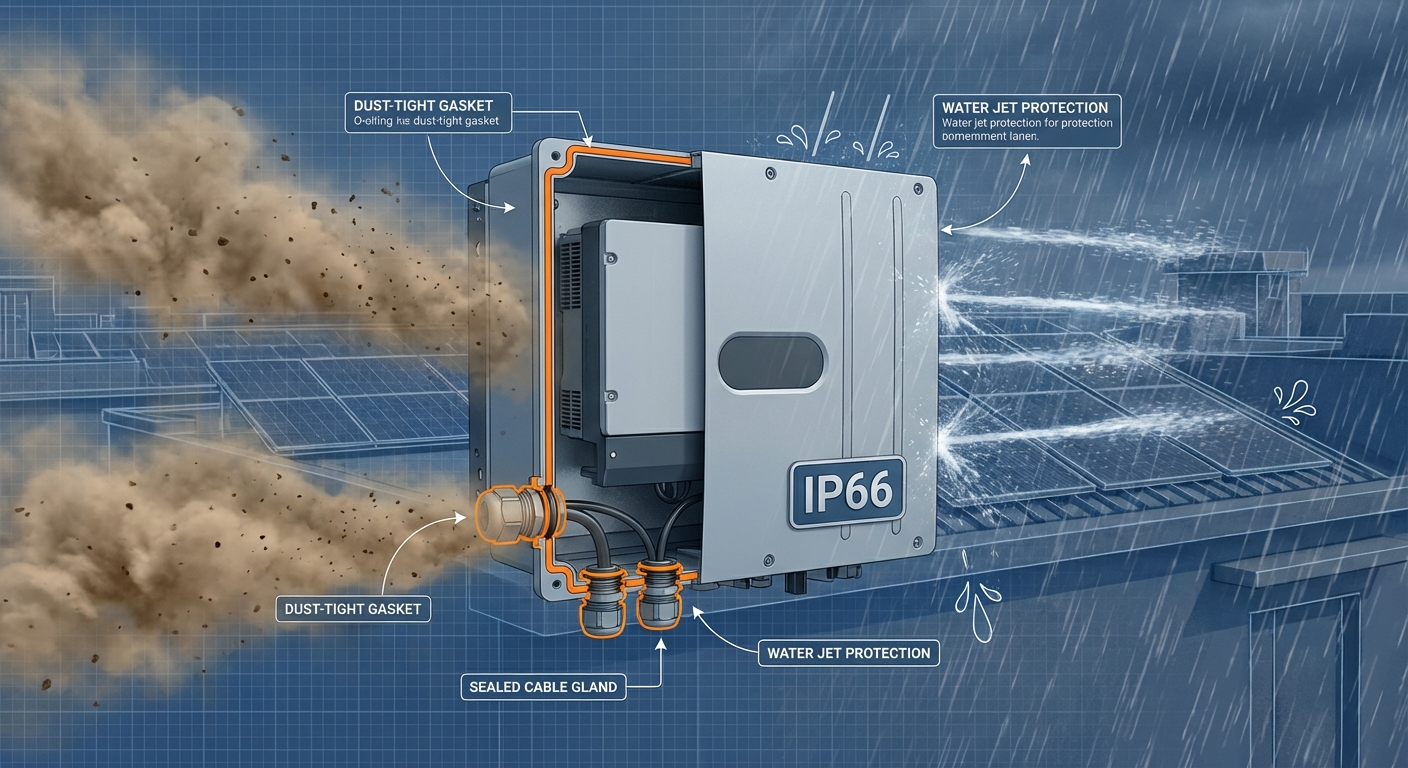
The IP rating consists of two digits, each representing a specific level of protection:
- First digit (0-6): Protection against solid particle ingress, ranging from no protection (0) to complete dust-tight protection (6)
- Second digit (0-9): Protection against liquid ingress, ranging from no protection (0) to protection against high-pressure, high-temperature water jets (9)
For solar inverters installed on Indian rooftops, the first digit is particularly critical. Dust accumulation can infiltrate cooling systems, settle on circuit boards, and create conductive paths that lead to short circuits or component degradation. In regions like Rajasthan, Gujarat, and parts of Haryana, airborne dust particles during summer months can be relentless, making dust-tight protection essential for reliable operation.
The second digit addresses water ingress—a concern that becomes paramount during India’s monsoon season, which delivers intense rainfall across most regions from June through September. Water penetration can cause immediate failures through short circuits or gradual degradation through corrosion of electronic components and connections.
Both IP65 and IP66 ratings achieve the highest level of dust protection (level 6), meaning they are completely dust-tight with no ingress of dust particles even under continuous exposure. The critical difference lies in their water protection capabilities, which we’ll examine in detail throughout this comparison.
IP65 Inverter Protection: Technical Specifications and Capabilities
An IP65-rated solar inverter offers robust protection suitable for many outdoor applications. The “6” confirms dust-tight protection—absolutely no dust particles can enter the enclosure even during prolonged exposure to dusty environments. This level of protection is achieved through precision-engineered gaskets, sealed joints, and carefully designed enclosure geometries that eliminate potential ingress points.
The “5” indicates protection against water jets from any direction. Specifically, IP65 certification requires the enclosure to withstand water projected by a 6.3mm nozzle at a flow rate of 12.5 liters per minute from any direction for at least 3 minutes, with the water pressure at approximately 30 kPa (kilopascals). In practical terms, this means the inverter can handle:
- Moderate to heavy rainfall typical of most Indian monsoon conditions
- Water spray from cleaning operations or adjacent water features
- Splashing from nearby drainage or water runoff
- Brief exposure to wind-driven rain at moderate intensities
IP65 inverters typically feature rubber or silicone gaskets around access panels, sealed cable entry points with compression glands, and overlapping enclosure designs that prevent direct water pathways to internal components. These protection measures are generally sufficient for installations in covered or semi-protected locations, or in regions with moderate weather exposure.
From a cost perspective, IP65-rated inverters are more widely available in the Indian market and typically command lower price points than their IP66 counterparts. For budget-conscious projects in regions with less extreme weather exposure, IP65 protection may represent an acceptable balance between protection and investment.
However, IP65 protection has limitations. The water jet test uses relatively low pressure compared to the forces generated during severe thunderstorms with high winds, or the pressure-washing that might occur during maintenance. In coastal installations where salt-laden moisture is driven by strong winds, or in areas experiencing particularly intense monsoon conditions, IP65 protection may prove insufficient over the long term.
IP66 Inverter Protection: Enhanced Weather Resistance Standards
IP66-rated solar inverters maintain the same dust-tight protection (level 6) as IP65 units but significantly upgrade water ingress protection to level 6. This enhanced rating requires the enclosure to withstand powerful water jets delivered through a 12.5mm nozzle at 100 liters per minute—eight times the flow rate of IP65 testing—at a pressure of 100 kPa for at least 3 minutes from any direction.
This substantial increase in water pressure and volume simulates much more severe conditions, including:
- Intense monsoon downpours with high wind speeds driving rain horizontally
- Coastal installations exposed to storm conditions and wind-driven spray
- High-pressure cleaning operations during maintenance
- Extreme weather events becoming more frequent due to climate variability
Achieving IP66 certification requires more sophisticated enclosure engineering. Manufacturers typically employ multiple sealing layers, advanced gasket materials that maintain elasticity across wide temperature ranges, precision-machined mating surfaces that ensure consistent seal compression, and reinforced cable entry systems that maintain integrity under pressure.
The enhanced inverter protection of IP66 ratings translates to greater confidence in harsh installation environments. For solar EPCs working on coastal commercial projects, industrial facilities in high-rainfall regions, or any installation where equipment replacement would be costly or disruptive, the additional protection margin provides valuable insurance against environmental failures.
IP66 inverters are positioned as premium products in the Indian market, reflecting the additional engineering, materials, and testing required to achieve this certification. Leading manufacturers like Qbits Energy have standardized on IP66 protection across their product range, recognizing that Indian rooftop conditions often demand this higher level of environmental resilience.
Head-to-Head Comparison: IP65 vs IP66 for Indian Climatic Conditions
When evaluating IP65 versus IP66 inverter protection for Indian installations, several performance dimensions warrant careful consideration. Understanding these differences helps solar professionals match protection levels to specific site conditions and client requirements.
Dust Ingress Protection: Identical Performance
Both IP65 and IP66 ratings achieve level 6 dust protection, meaning they are completely dust-tight. Neither rating allows any dust ingress even under continuous exposure to fine particulate matter. For Indian installations facing dust storms, construction site debris, or agricultural dust, both protection levels perform identically. This means your decision should focus entirely on water protection requirements rather than dust concerns.
Water Resistance: The Critical Difference
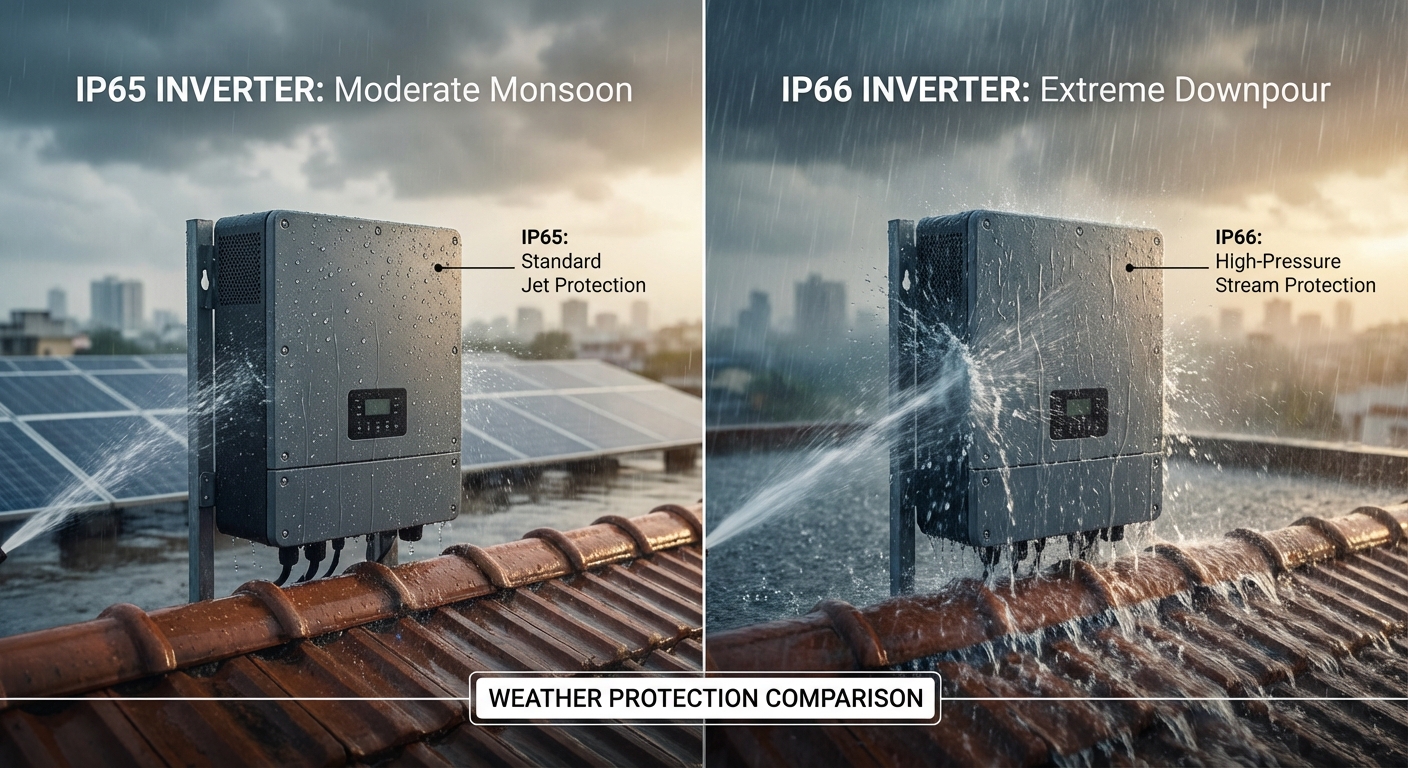
The water protection gap between IP65 and IP66 becomes significant in real-world conditions. IP65’s resistance to low-pressure water jets (30 kPa, 12.5 L/min) handles typical rainfall and moderate weather exposure. IP66’s resistance to high-pressure jets (100 kPa, 100 L/min) provides a substantial safety margin for extreme conditions.
During India’s monsoon season, rainfall intensity can exceed 100mm per hour in many regions, often accompanied by winds exceeding 40-50 km/h. These conditions create water pressure against vertical surfaces that approaches or exceeds IP65 test parameters, particularly when wind drives rain horizontally against inverter enclosures. IP66 protection provides greater assurance that seals will maintain integrity under these stresses.
Monsoon Performance Across Indian Regions
India’s monsoon patterns vary dramatically by region, creating different protection requirements:
Western Ghats and Kerala: These regions receive some of India’s highest rainfall, with annual totals exceeding 3,000mm in many areas. Prolonged exposure to heavy rain over 3-4 month periods tests seal integrity. IP66 protection offers better long-term reliability in these conditions.
Northeast India: Cherrapunji and surrounding areas experience extreme rainfall intensity. For installations in Assam, Meghalaya, and neighboring states, IP66 protection is strongly recommended to ensure equipment survives the monsoon season year after year.
Coastal Maharashtra and Gujarat: Mumbai, Surat, and coastal industrial zones face both intense monsoon rainfall and year-round humidity. The combination of salt-laden air and heavy seasonal rain makes IP66 protection a prudent choice for commercial installations.
Northern Plains: Delhi, Punjab, and Haryana experience shorter but intense monsoon periods with dramatic thunderstorms. While IP65 may suffice for many installations, sites with full weather exposure benefit from IP66’s additional margin.
Extreme Heat and Humidity Resistance
India’s summer temperatures regularly exceed 40°C in many regions, with some areas reaching 45-48°C. High temperatures affect gasket materials, potentially causing hardening, cracking, or loss of elasticity that compromises seal integrity. IP66-rated enclosures typically use higher-grade sealing materials engineered to maintain performance across wider temperature ranges, providing better long-term reliability in extreme heat.
Humidity is equally challenging. Coastal regions and areas with high groundwater levels experience sustained high humidity that can lead to condensation inside enclosures if seals degrade. The superior sealing of IP66 enclosures reduces the risk of moisture infiltration that could cause corrosion or electrical failures over time.
Coastal Installation Considerations
Coastal environments present unique challenges beyond simple water ingress. Salt spray creates conductive deposits on surfaces and accelerates corrosion of metal components. While IP ratings don’t directly address salt resistance, the enhanced sealing of IP66 enclosures provides better protection against salt-laden moisture infiltration. For installations within 5-10 kilometers of coastlines, common for industrial facilities in port cities, IP66 protection significantly reduces long-term maintenance requirements and failure risks.
Regional Climate Analysis: Which Protection Standard Fits Your Location
Selecting appropriate inverter protection requires matching equipment specifications to local environmental conditions. This regional analysis provides guidance for solar professionals working across India’s diverse climate zones.
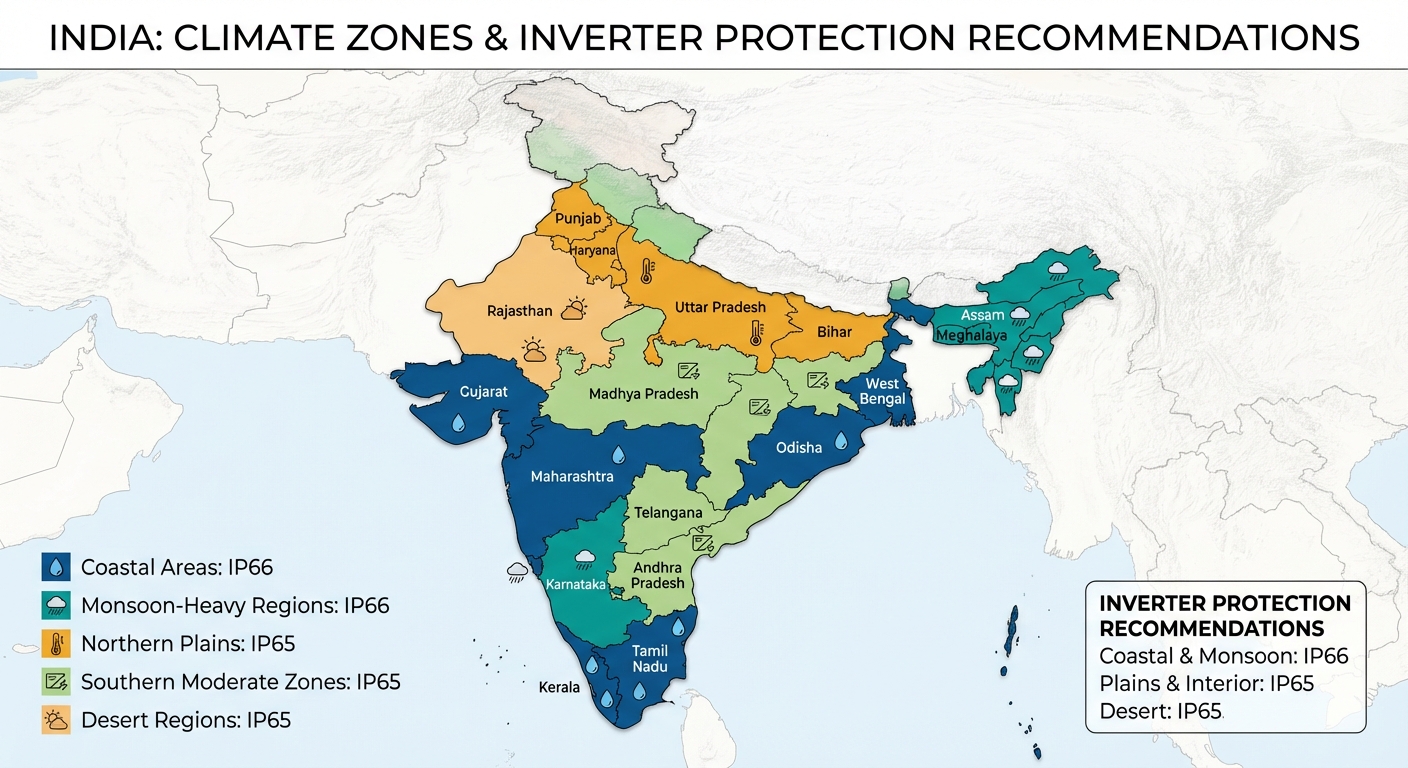
Coastal Regions: Mumbai, Chennai, Kolkata, Visakhapatnam
Climate characteristics: Year-round high humidity (70-90%), salt spray exposure, intense monsoon rainfall, moderate temperature ranges
Recommendation: IP66 protection is strongly recommended for all coastal installations. The combination of salt-laden air, high humidity, and intense seasonal rainfall creates conditions where IP65 protection may prove insufficient over 10-15 year inverter lifespans. The additional investment in IP66 protection pays dividends through reduced maintenance, fewer failures, and extended equipment life.
Special considerations: Installations within 2-3 kilometers of the coast face the most severe salt exposure. Consider additional protective measures such as conformal coating on circuit boards and regular inspection schedules, regardless of IP rating.
Monsoon-Heavy Areas: Kerala, Western Ghats, Northeast India
Climate characteristics: Extreme rainfall intensity (2,000-4,000mm annually), prolonged wet seasons (4-6 months), high humidity, moderate temperatures
Recommendation: IP66 protection is essential for reliable operation. The sustained exposure to heavy rainfall over extended periods tests seal integrity in ways that shorter-duration weather events do not. IP65 protection may survive individual storms but can degrade over repeated monsoon seasons, leading to failures in years 5-8 of operation.
Special considerations: Ensure proper drainage around inverter installations to prevent water pooling. Even IP66-rated equipment can experience issues if mounting locations allow water accumulation around cable entries or base plates.
Northern Plains: Delhi NCR, Punjab, Haryana, Uttar Pradesh
Climate characteristics: Extreme temperature swings (-2°C to 48°C), dust storms, moderate monsoon rainfall, low humidity except during monsoon
Recommendation: IP66 protection is recommended for exposed rooftop installations, though IP65 may suffice for partially sheltered locations or installations with additional protective enclosures. The extreme temperature range challenges gasket materials, making the higher-grade sealing of IP66 units advantageous for long-term reliability.
Special considerations: Dust protection is critical in this region. Both IP65 and IP66 provide adequate dust-tight protection, but ensure regular cleaning of external surfaces to prevent dust buildup that can affect cooling performance.
Southern Regions: Bangalore, Hyderabad, Pune
Climate characteristics: Moderate temperatures (15-35°C), moderate rainfall (600-1,000mm annually), lower humidity than coastal areas
Recommendation: IP65 protection is generally adequate for most installations in these regions, though IP66 provides additional peace of mind and may be preferred for premium commercial projects or installations with extended warranty requirements. The moderate climate reduces environmental stress on equipment, allowing IP65 protection to perform reliably over typical inverter lifespans.
Special considerations: These regions offer the most forgiving environmental conditions for solar equipment. Focus on proper installation practices and adequate ventilation to ensure optimal performance regardless of IP rating.
Desert and Arid Regions: Rajasthan, Gujarat Interior, Parts of Karnataka
Climate characteristics: Extreme heat (up to 48°C), minimal rainfall, frequent dust storms, very low humidity except during brief monsoon
Recommendation: IP66 protection is recommended primarily for its superior sealing materials that better withstand extreme heat. While water ingress is less of a concern in these arid regions, the temperature extremes challenge gasket integrity. The dust-tight protection (level 6) is identical for both ratings and essential for reliable operation in these conditions.
Special considerations: Heat management becomes the primary concern. Ensure adequate ventilation and consider shade structures to prevent inverter enclosures from exceeding rated operating temperatures, which typically max out at 50-60°C ambient.
Long-Term Durability and Maintenance: 10-Year Performance Outlook
The true value of enhanced inverter protection becomes apparent over the operational lifespan of solar installations. Understanding how IP65 and IP66 enclosures age under environmental stress helps solar professionals and facility owners make informed decisions about total cost of ownership.
Seal Degradation Over Time
All gasket materials degrade over time due to environmental exposure. UV radiation, temperature cycling, ozone exposure, and mechanical stress from thermal expansion and contraction gradually reduce gasket elasticity and sealing effectiveness. IP66-rated enclosures typically employ higher-grade gasket materials, often silicone or fluoroelastomer compounds, that maintain their properties longer than the standard rubber gaskets common in IP65 enclosures.
Field data from solar installations suggests that IP65 enclosures may begin showing seal degradation after 5-7 years in harsh environments, while IP66 enclosures maintain effective sealing for 8-12 years or longer. This difference directly impacts maintenance requirements and failure rates as installations age.
Maintenance Requirements and Costs
IP65 inverters in challenging environments may require gasket inspection and replacement every 4-6 years to maintain protection integrity. This maintenance involves:
- Scheduled inspection of all gasket surfaces for cracking, hardening, or compression set
- Replacement of degraded gaskets (material cost: ₹2,000-5,000 per inverter)
- Labor costs for technician site visits (₹3,000-8,000 depending on location and accessibility)
- System downtime during maintenance (lost generation revenue)
IP66 inverters typically extend maintenance intervals to 7-10 years, reducing lifetime maintenance costs and system downtime. For commercial installations with multiple inverters, these savings compound significantly. A 100kW installation with 4-5 inverters might save ₹40,000-60,000 in maintenance costs over a 10-year period by choosing IP66 protection.
Warranty Implications
Many inverter manufacturers tie warranty coverage to proper installation and maintenance, including maintaining enclosure integrity. Environmental ingress due to seal failure may void warranty coverage, leaving facility owners responsible for repair or replacement costs. IP66 protection reduces the risk of seal-related warranty disputes and provides greater confidence in long-term manufacturer support.
Qbits Energy’s 12-year full replacement warranty covers inverters with IP66 protection, reflecting confidence in the long-term durability of this protection standard. This extended warranty period aligns well with the enhanced seal longevity of IP66 enclosures, providing comprehensive protection for the critical middle years of solar system operation. Learn more about inverter lifespan considerations and how protection ratings affect long-term financial planning.
Real-World Failure Rates
Industry data from solar EPCs operating across India indicates that environmental ingress accounts for approximately 15-20% of inverter failures in the first 10 years of operation. IP66-protected inverters show failure rates 40-50% lower than IP65 units in harsh coastal and high-rainfall environments, though the difference narrows in moderate climate zones.
Common failure modes related to inadequate inverter protection include:
- Corrosion of circuit board traces and component leads due to moisture infiltration
- Dust accumulation on cooling fans leading to overheating and thermal shutdowns
- Degradation of internal connectors and terminals from humidity exposure
- Short circuits caused by water ingress during severe weather events
Each of these failure modes becomes less likely with IP66 protection, translating to higher system availability and lower total cost of ownership over the installation’s lifetime.
Cost-Benefit Analysis: ROI Considerations for EPCs and Facility Owners
Making the right choice between IP65 and IP66 inverter protection requires understanding not just the technical differences, but the financial implications over the complete system lifecycle. This analysis helps solar professionals present clear value propositions to clients and make decisions that optimize long-term returns.
Initial Investment Difference
IP66-rated solar inverters typically command a premium of 8-15% over comparable IP65 models in the Indian market. For a typical commercial installation, this translates to:
- 50kW system (2 inverters): Additional investment of ₹20,000-40,000
- 100kW system (4-5 inverters): Additional investment of ₹40,000-80,000
- 500kW system (20-25 inverters): Additional investment of ₹2,00,000-4,00,000
This upfront premium represents the most visible cost difference and often becomes the focal point of purchasing decisions. However, focusing solely on initial cost overlooks the total cost of ownership picture that emerges over 10-15 years of operation.
Maintenance Cost Projections
Over a 10-year operational period, maintenance cost differences between IP65 and IP66 protection become significant:
IP65 maintenance costs (harsh environment):
- Year 5: Gasket inspection and replacement – ₹5,000-8,000 per inverter
- Year 8: Second gasket service – ₹5,000-8,000 per inverter
- Additional inspections and minor repairs – ₹2,000-3,000 per inverter over 10 years
- Total per inverter: ₹12,000-19,000
IP66 maintenance costs (harsh environment):
- Year 8-10: Gasket inspection (replacement often not needed) – ₹3,000-5,000 per inverter
- Minimal additional maintenance – ₹1,000-2,000 per inverter over 10 years
- Total per inverter: ₹4,000-7,000
For a 100kW installation with 5 inverters, this represents a maintenance cost saving of ₹40,000-60,000 over 10 years with IP66 protection, partially or fully offsetting the initial premium.
Downtime and Replacement Cost Considerations
Environmental failures don’t just incur repair costs, they cause system downtime that reduces energy generation and revenue. A typical environmental ingress failure might cause:
- Detection and diagnosis: 1-3 days of downtime
- Parts procurement and shipping: 3-7 days
- Repair or replacement: 1-2 days
- Total downtime: 5-12 days per failure event
For a 100kW commercial system generating 400-450 units per day (depending on location and season), a single failure event causes lost generation of 2,000-5,400 units. At commercial electricity rates of ₹6-8 per unit, this represents ₹12,000-43,000 in lost revenue per failure event.
If IP66 protection prevents even one failure event over 10 years compared to IP65 protection, the avoided downtime cost alone justifies much of the initial premium. In harsh environments where IP65 units might experience 2-3 environmental failures over 10 years while IP66 units experience zero or one, the downtime savings become substantial.
Insurance and Warranty Value
Some commercial solar insurance policies offer premium discounts for installations using higher-rated equipment, recognizing the reduced risk profile. While these discounts are typically modest (2-5% of annual premiums), they accumulate over the policy period.
More significantly, the extended warranty coverage available with premium IP66 inverters provides financial protection that has real value. Qbits Energy’s 12-year full replacement warranty on IP66-protected inverters eliminates replacement costs for environmental failures during the warranty period, transferring risk from the facility owner to the manufacturer. This warranty value should be factored into total cost of ownership calculations.
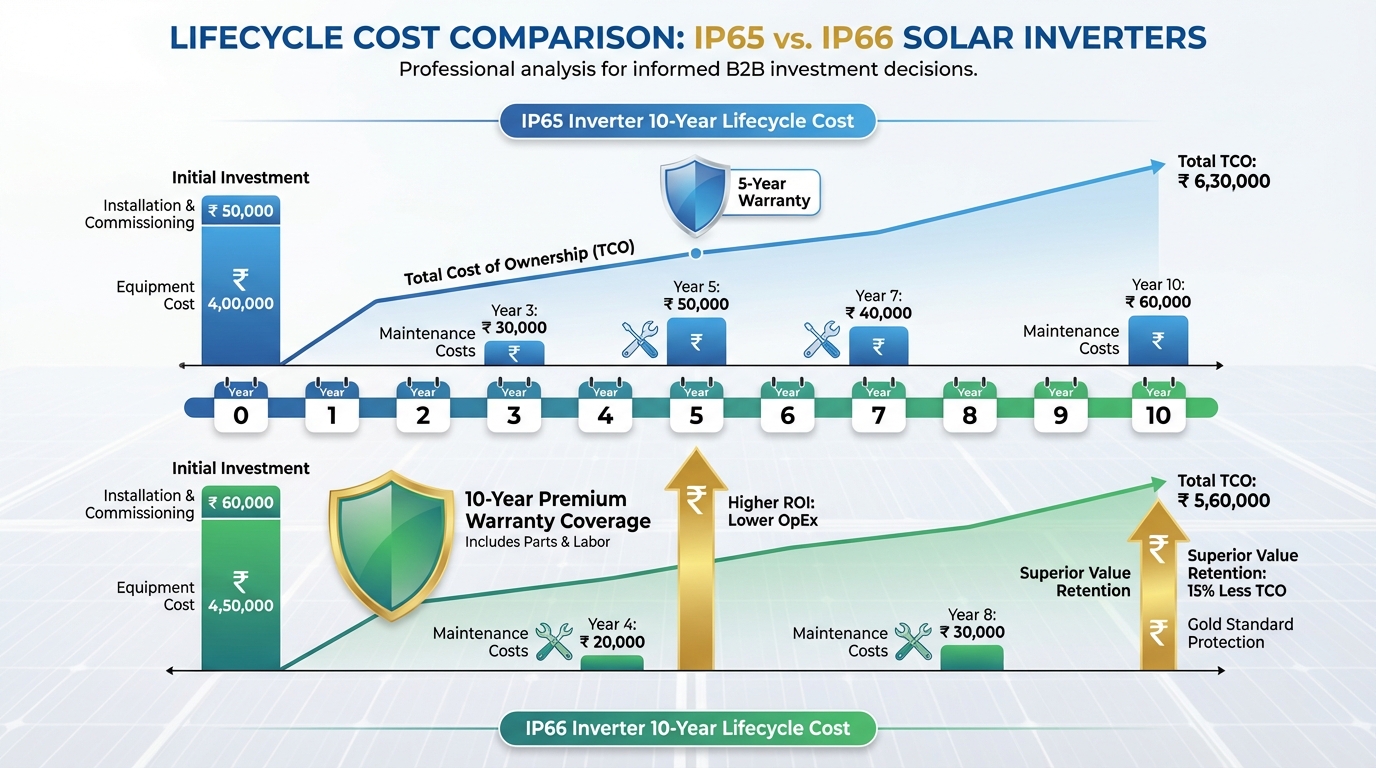
Total Cost of Ownership Calculations
Bringing these factors together for a representative 100kW commercial installation in a challenging environment (coastal or high-rainfall region):
IP65 Total Cost (10 years):
- Initial equipment cost: ₹5,00,000 (baseline)
- Maintenance costs: ₹60,000-95,000
- Expected failure downtime costs: ₹25,000-85,000 (1-2 events)
- Total: ₹5,85,000-6,80,000
IP66 Total Cost (10 years):
- Initial equipment cost: ₹5,60,000 (+12% premium)
- Maintenance costs: ₹20,000-35,000
- Expected failure downtime costs: ₹0-25,000 (0-1 events)
- Total: ₹5,80,000-6,20,000
In this scenario, IP66 protection delivers equal or lower total cost of ownership despite the higher initial investment, while also providing better system reliability and reduced operational hassle.
Break-Even Analysis and Decision Thresholds
The break-even point for IP66 premium investment depends on environmental severity and system size:
- Harsh environments (coastal, high-rainfall): Break-even typically occurs in years 4-6, making IP66 clearly advantageous
- Moderate environments: Break-even occurs in years 7-9, making IP66 worthwhile for risk-averse clients or premium projects
- Mild environments: Break-even may not occur within 10-year timeframe, making IP65 economically defensible
For solar EPCs and distributors, understanding these break-even dynamics helps position the right solution for each client’s specific circumstances and risk tolerance. The analysis also supports value-based selling that moves conversations beyond initial price to total value delivered.
Installation Best Practices: Maximizing Inverter Protection Performance
Even the best inverter protection rating can be compromised by poor installation practices. Solar EPCs and installation teams should follow these guidelines to ensure IP65 or IP66 protection performs as designed throughout the equipment’s operational life.
Proper Mounting Orientation and Positioning
Inverter enclosures should be mounted vertically with cable entries at the bottom to prevent water accumulation around entry points. Tilting the inverter slightly forward (2-3 degrees) helps water drain away from the enclosure rather than pooling on horizontal surfaces. Avoid mounting inverters in locations where water can collect above the unit and potentially find entry paths during heavy rain.
Maintain adequate clearance around the inverter for ventilation, typically 300-500mm on all sides. This clearance not only ensures proper cooling but also allows inspection access to verify seal integrity and identify any environmental damage early.
Shade and Ventilation Requirements
While IP66 protection handles direct weather exposure, providing shade reduces thermal stress on the enclosure and internal components. In regions with extreme heat, consider installing inverters on north-facing walls (in the northern hemisphere) or providing shade structures that don’t impede ventilation. Reduced thermal cycling extends gasket life and improves overall reliability.
Ensure ventilation openings (if present) face downward or are protected by baffles to prevent direct water entry during rain. Some inverters use sealed, fan-less designs that eliminate ventilation openings entirely, providing the most robust environmental protection at the cost of slightly reduced cooling efficiency.
Cable Entry Sealing and Gland Selection
Cable entry points represent the most common failure point for inverter protection. Use only cable glands rated for the same or higher IP level as the inverter enclosure. Each cable should have its own properly sized gland, oversized glands that don’t compress adequately around the cable compromise the seal.
Apply thread sealant or PTFE tape to threaded gland connections and torque to manufacturer specifications. Unused cable entry points should be sealed with blanking plugs, not left open or loosely covered. After installation, perform a visual inspection of all cable entries to verify proper sealing.
Additional Protective Measures
In extremely harsh environments, consider supplementary protection even with IP66-rated equipment:
- Protective canopies: Simple roof structures that shield inverters from direct sun and rain while maintaining ventilation
- Conformal coating: Protective coating applied to circuit boards during manufacturing that provides additional moisture resistance
- Desiccant breathers: For inverters with ventilation, desiccant breathers allow pressure equalization while removing moisture from incoming air
- Drainage channels: Ensure the mounting area has proper drainage to prevent water accumulation around the inverter base
Inspection and Maintenance Schedules
Establish regular inspection schedules appropriate to your environment:
- Harsh environments: Quarterly visual inspections, annual detailed inspection with gasket assessment
- Moderate environments: Semi-annual visual inspections, inspection every 2-3 years with gasket assessment
- Mild environments: Annual visual inspections, detailed inspection every 3-5 years
Inspections should check for gasket compression, seal integrity, cable gland tightness, enclosure damage, and any signs of water or dust ingress. Early detection of seal degradation allows preventive maintenance before failures occur.
For comprehensive guidance on evaluating inverter quality and installation practices, review our detailed guide on solar inverter selection criteria for EPCs.
Common Installation Mistakes That Compromise IP Ratings
Avoid these frequent errors that undermine inverter protection:
- Using incorrect cable glands: Standard cable glands without proper IP rating compromise the entire enclosure protection
- Over-tightening or under-tightening: Both extremes damage gaskets and create leak paths
- Mounting in water collection areas: Even IP66 protection can be overwhelmed by standing water
- Removing or modifying enclosure components: Any modification voids IP certification
- Failing to seal unused entries: Open cable entry points completely compromise protection
- Inadequate clearance: Insufficient space prevents proper ventilation and inspection access
Qbits Energy IP66 Advantage: Engineering for Indian Conditions
Qbits Energy has standardized on IP66 weather protection across its entire range of on-grid and hybrid solar inverters, recognizing that Indian rooftop conditions demand robust environmental resilience. This commitment to premium inverter protection reflects a broader engineering philosophy focused on long-term reliability rather than initial cost optimization.
German-Grade Components and Sealing Technology
Qbits inverters incorporate German-grade electronic components and sealing systems engineered to withstand the temperature extremes, humidity levels, and environmental stresses common across Indian installations. The IP66 enclosures feature multi-layer gasket systems using silicone compounds that maintain elasticity from -20°C to +70°C, ensuring seal integrity across India’s diverse climate zones.
Precision-machined enclosure mating surfaces ensure consistent gasket compression around the entire perimeter, eliminating weak points where water or dust might penetrate. Cable entry systems use industrial-grade compression glands rated for IP66 protection, with each gland individually tested during the manufacturing process.
Comprehensive Testing and Quality Assurance
Every Qbits inverter undergoes more than 1,000 automated quality tests before leaving the factory, including specific environmental stress testing that validates IP66 protection under simulated harsh conditions. These tests include:
- High-pressure water jet testing exceeding IEC 60529 IP66 requirements
- Dust chamber testing with fine particulate matter
- Thermal cycling between temperature extremes
- Humidity chamber testing at 95% relative humidity
- Salt spray testing for coastal installation validation
This rigorous testing regime ensures that IP66 protection performs reliably in real-world Indian conditions, not just in laboratory environments.
12-Year Warranty Coverage
Qbits Energy backs its IP66-protected inverters with a comprehensive 12-year full replacement warranty, among the longest in the Indian solar inverter market. This extended warranty period reflects confidence in the long-term durability of IP66 enclosures and the quality of components protected within them.
The warranty covers environmental failures, providing facility owners with financial protection against the very risks that IP66 protection is designed to mitigate. This alignment between protection standard and warranty coverage demonstrates manufacturer commitment to long-term product performance.
AI-Powered Monitoring for Environmental Stress Detection
Qbits inverters feature AI-powered monitoring systems that track performance parameters and can detect early signs of environmental stress before they cause failures. The system monitors internal temperature patterns, humidity levels (where sensors are present), and performance anomalies that might indicate seal degradation or environmental ingress.
When potential issues are detected, the system sends alerts via WhatsApp, allowing proactive maintenance before minor seal degradation becomes a major failure. This intelligent monitoring complements the physical protection of IP66 enclosures, creating a comprehensive defense against environmental challenges. Learn more about advanced inverter monitoring capabilities and how they enhance system reliability.
Real-World Performance Data
Qbits inverters with IP66 protection have been deployed across diverse Indian environments, from coastal industrial facilities in Gujarat to high-rainfall commercial installations in Kerala to extreme-heat rooftop systems in Rajasthan. Field performance data shows environmental failure rates below 1% over the first five years of operation, validating the effectiveness of IP66 protection in real-world conditions.
This proven performance gives solar EPCs and distributors confidence when specifying Qbits inverters for challenging installations where environmental reliability is critical to project success.
Making the Right Choice: Decision Framework for Solar Professionals
Selecting between IP65 and IP66 inverter protection requires balancing multiple factors specific to each project. This decision framework helps solar EPCs, distributors, and facility owners make informed choices that optimize value for their specific circumstances.
Site Assessment Checklist
Evaluate these factors for each installation:
Environmental exposure:
- Distance from coast (within 10km = high salt exposure)
- Annual rainfall and monsoon intensity
- Frequency of dust storms or airborne particulates
- Temperature extremes and daily temperature range
- Installation location (fully exposed rooftop vs. partially sheltered)
- Prevailing wind direction and intensity
Installation characteristics:
- Accessibility for maintenance (difficult access favors IP66)
- System size and number of inverters (larger systems benefit more from reduced failure rates)
- Expected operational lifespan (15+ year projects favor IP66)
- Availability of monitoring systems for early issue detection
Client requirements:
- Risk tolerance and preference for reliability vs. initial cost
- Warranty expectations and coverage requirements
- Maintenance budget and capabilities
- Downtime sensitivity (critical loads favor IP66)
Risk Evaluation Matrix
Use this matrix to categorize projects and guide protection level selection:
High-risk projects (IP66 strongly recommended):
- Coastal installations within 10km of ocean
- High-rainfall regions (>2,000mm annually)
- Fully exposed rooftop installations without shelter
- Critical facilities where downtime is costly
- Large commercial/industrial installations (>100kW)
- Projects with 15+ year expected lifespan
Moderate-risk projects (IP66 recommended, IP65 acceptable with caveats):
- Inland installations in moderate rainfall zones
- Partially sheltered mounting locations
- Medium-sized commercial installations (25-100kW)
- Projects with regular maintenance programs
- Installations with advanced monitoring systems
Lower-risk projects (IP65 acceptable, IP66 still beneficial):
- Installations in mild climate zones (Bangalore, Pune)
- Well-sheltered mounting locations
- Smaller residential installations
- Projects with budget constraints and regular maintenance access
Budget vs. Protection Trade-Offs
When budget constraints make IP66 protection challenging, consider these alternatives:
- Hybrid approach: Use IP66 inverters for the most exposed locations and IP65 for sheltered positions
- Enhanced installation: Invest in protective canopies or enclosures that reduce environmental exposure for IP65 units
- Extended maintenance: Commit to more frequent inspection and preventive maintenance schedules
- Phased upgrades: Start with IP65 and budget for earlier replacement, transitioning to IP66 at end of first lifecycle
However, for most commercial and industrial projects, the total cost of ownership analysis favors IP66 protection even when initial budgets are tight. The long-term savings in maintenance, downtime, and replacement costs typically justify the modest upfront premium.
Client Expectation Management
Solar professionals should educate clients about the value proposition of enhanced inverter protection:
- Present total cost of ownership comparisons, not just initial equipment costs
- Quantify downtime risks and lost revenue from environmental failures
- Explain warranty implications and long-term manufacturer support
- Share case studies or performance data from similar installations
- Discuss the peace of mind value of reduced failure risk
Most facility owners, once they understand the complete picture, recognize that IP66 protection represents prudent risk management rather than unnecessary premium spending.
Future-Proofing Considerations
Climate patterns are changing, with increasing frequency of extreme weather events across India. Monsoon intensity, heat waves, and storm severity are all trending upward. Equipment specified today will operate in potentially more challenging conditions 10-15 years from now.
IP66 protection provides a margin of safety against these evolving environmental stresses. What might be adequate protection today (IP65) could prove insufficient as climate conditions intensify. For long-term installations, this future-proofing aspect adds value beyond current condition analysis.
Final Recommendations by Project Type
Commercial rooftop installations (50-500kW): IP66 protection recommended for all locations. The system size justifies the investment, and commercial clients typically prioritize reliability over initial cost savings.
Industrial facilities (500kW+): IP66 protection essential. Large installations cannot afford downtime, and the total cost of ownership strongly favors premium protection at this scale.
Residential installations (1-10kW): IP66 recommended for coastal and high-rainfall regions; IP65 acceptable for moderate climates with good maintenance access.
Ground-mount installations: While this comparison focuses on rooftop installations, ground-mount systems face similar environmental challenges. Apply the same regional and risk assessment criteria to determine appropriate protection levels.
For comprehensive guidance on selecting the right inverter for your specific project requirements, explore our detailed resource on evaluating solar inverter manufacturers in India.
Conclusion: Investing in Long-Term Reliability Through Superior Inverter Protection
The choice between IP65 and IP66 inverter protection extends far beyond a simple technical specification, it represents a fundamental decision about risk management, total cost of ownership, and long-term system reliability. While IP65 protection offers adequate environmental resistance for some applications, IP66 protection delivers the robust weather resistance that Indian climatic conditions often demand.
For solar EPCs, distributors, and facility owners working across India’s diverse climate zones, the evidence strongly supports IP66 protection for most commercial and industrial installations. The modest upfront premium, typically 8-15%—is offset by reduced maintenance costs, lower failure rates, extended equipment lifespan, and decreased downtime over the 10-15 year operational period. In harsh coastal and high-rainfall environments, IP66 protection often delivers lower total cost of ownership while providing superior reliability.
The enhanced sealing technology, premium gasket materials, and rigorous testing that characterize IP66-rated inverters translate to real-world performance advantages. These benefits become particularly valuable as installations age and seal integrity becomes critical to continued reliable operation. With climate patterns intensifying and extreme weather events becoming more frequent, the additional protection margin of IP66 ratings provides valuable insurance against evolving environmental challenges.
Qbits Energy’s commitment to IP66 inverter protection across its entire product range reflects an understanding that Indian rooftop conditions demand robust environmental resilience. Combined with German-grade components, comprehensive testing, AI-powered monitoring, and industry-leading 12-year warranty coverage, Qbits inverters deliver the long-term reliability that commercial and industrial solar installations require.
Whether you’re an EPC specifying equipment for a coastal industrial facility, a distributor building your product portfolio, or a facility owner investing in solar infrastructure, choosing inverters with IP66 protection represents a sound investment in system longevity and performance. The superior weather resistance, reduced maintenance requirements, and enhanced reliability deliver value that extends throughout the operational life of your solar installation.
Ready to specify solar inverters engineered for Indian conditions with IP66 inverter protection, 12-year warranty coverage, and AI-powered monitoring? Contact Qbits Energy today to discuss your project requirements and discover how premium protection standards deliver superior long-term value. Explore our complete range of IP66-protected inverters designed specifically for commercial and industrial solar installations across India’s diverse climate zones.
This blog post was written using thestacc.com