



Inverter Maintenance India: Complete Service Guide 2026

Solar inverters are the critical heart of any photovoltaic installation, converting DC power from panels into usable AC electricity. However, in India’s challenging climate conditions—characterized by extreme heat, heavy monsoons, coastal humidity, and pervasive dust—proper inverter maintenance India protocols become essential for protecting your investment and ensuring optimal performance. Without systematic maintenance, even premium inverters can experience efficiency losses of 15-20% within just two years, significantly impacting your solar ROI.
This comprehensive guide provides EPCs, solar installation companies, and facility owners with actionable maintenance protocols specifically designed for Indian conditions. Whether you’re managing residential installations or large-scale C&I projects, implementing these preventive care strategies will help you maintain the industry-leading 98% efficiency rating and maximize your inverter’s operational lifespan well beyond 15 years.
Why Inverter Maintenance India Requires Specialized Protocols
India’s diverse climate zones present unique challenges that demand specialized inverter maintenance India approaches. Unlike temperate regions where standard maintenance schedules suffice, Indian installations face simultaneous threats from multiple environmental factors that accelerate component degradation and compromise system performance.
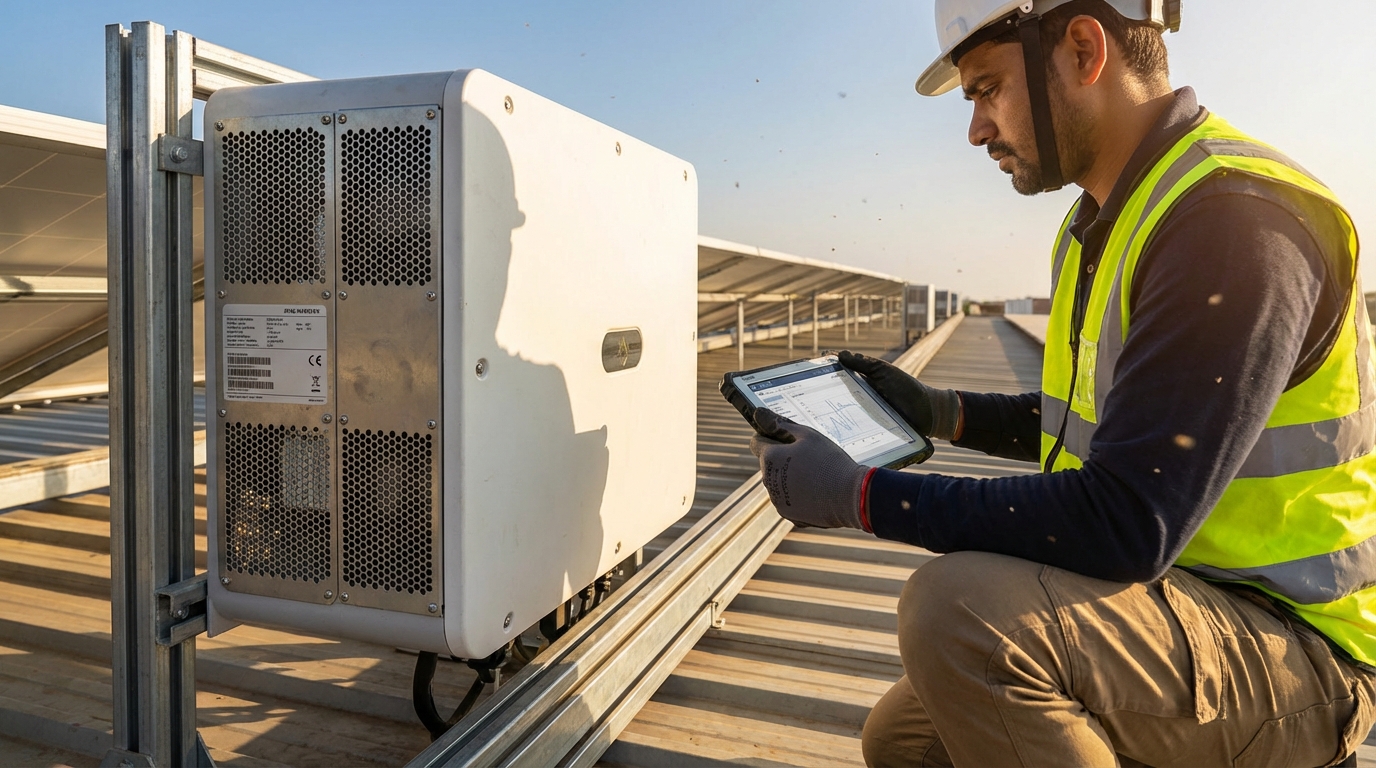
The primary environmental challenges affecting solar inverters across India include:
- Extreme temperature variations: Summer temperatures regularly exceed 45°C in northern and central India, pushing inverter cooling systems to their limits and accelerating electronic component aging
- Dust and particulate matter: Urban and industrial areas experience heavy dust accumulation that clogs ventilation systems, reducing cooling efficiency by up to 30%
- Monsoon humidity: Coastal and monsoon-affected regions face humidity levels above 85%, increasing risks of moisture ingress and corrosion despite IP66 protection
- Grid instability: Voltage fluctuations and power quality issues in many Indian regions stress inverter components, particularly surge protection devices
- Coastal salt exposure: Installations within 10km of coastlines face accelerated corrosion from salt-laden air
Research from the National Institute of Solar Energy indicates that inverters without proper maintenance in Indian conditions experience efficiency degradation of 2-3% annually, compared to just 0.5% in controlled environments. This translates to substantial revenue losses over the typical 25-year solar project lifecycle.
The financial impact is significant: a 100kW commercial installation losing 15% efficiency over five years due to poor maintenance could forfeit ₹3-4 lakhs in electricity generation value. Conversely, systematic preventive maintenance typically costs just ₹15,000-25,000 annually for the same system—delivering an ROI of 1200-1600% on maintenance investment.
Furthermore, warranty compliance depends on documented maintenance. Most manufacturers, including those offering 12-year comprehensive warranties, require proof of regular service intervals. Failure to maintain proper records can void warranty coverage, leaving you financially exposed to expensive component failures.
1. Understanding Your Solar Inverter’s Maintenance Requirements
Different inverter types and configurations require tailored maintenance approaches. Understanding your specific system’s requirements is the foundation of effective inverter maintenance India protocols that preserve both performance and warranty coverage.
On-Grid Inverter Maintenance Essentials
On-grid solar inverters, which synchronize directly with utility power, require specific attention to grid interaction components. These systems must maintain precise voltage and frequency matching with the grid while handling variable solar input throughout the day.
Key maintenance focus areas for on-grid systems include:
- Grid synchronization verification: Monthly checks ensuring proper phase matching and frequency tracking within ±0.5Hz tolerance
- AC output quality monitoring: Regular power quality analysis to verify total harmonic distortion (THD) remains below 5%
- Anti-islanding protection testing: Quarterly verification that safety disconnection functions operate within 2 seconds of grid failure
- Maximum Power Point Tracking (MPPT) efficiency: Monitoring MPPT algorithm performance to ensure 99%+ tracking efficiency
For residential on-grid inverters supporting up to 750W panels, pay particular attention to DC input terminals, as higher panel wattages generate increased current that can accelerate connection point degradation if not properly maintained.
Hybrid Inverter Maintenance Considerations
Hybrid inverters integrate battery storage systems, adding complexity to maintenance requirements. These systems manage three power flows simultaneously—solar input, battery charging/discharging, and grid interaction—requiring more comprehensive service protocols.
Additional maintenance requirements for hybrid systems include:
- Battery integration system checks: Monthly verification of battery communication protocols and state-of-charge accuracy
- Charge controller calibration: Quarterly validation that charging algorithms match battery manufacturer specifications
- Backup mode testing: Monthly simulation of grid failure to verify seamless transition to battery backup within 20 milliseconds
- Battery temperature monitoring: Continuous tracking of battery compartment temperatures to prevent thermal runaway
The complexity of hybrid inverter maintenance makes selecting systems with advanced AI-powered monitoring capabilities particularly valuable, as these systems can automatically detect anomalies across all three power management domains.
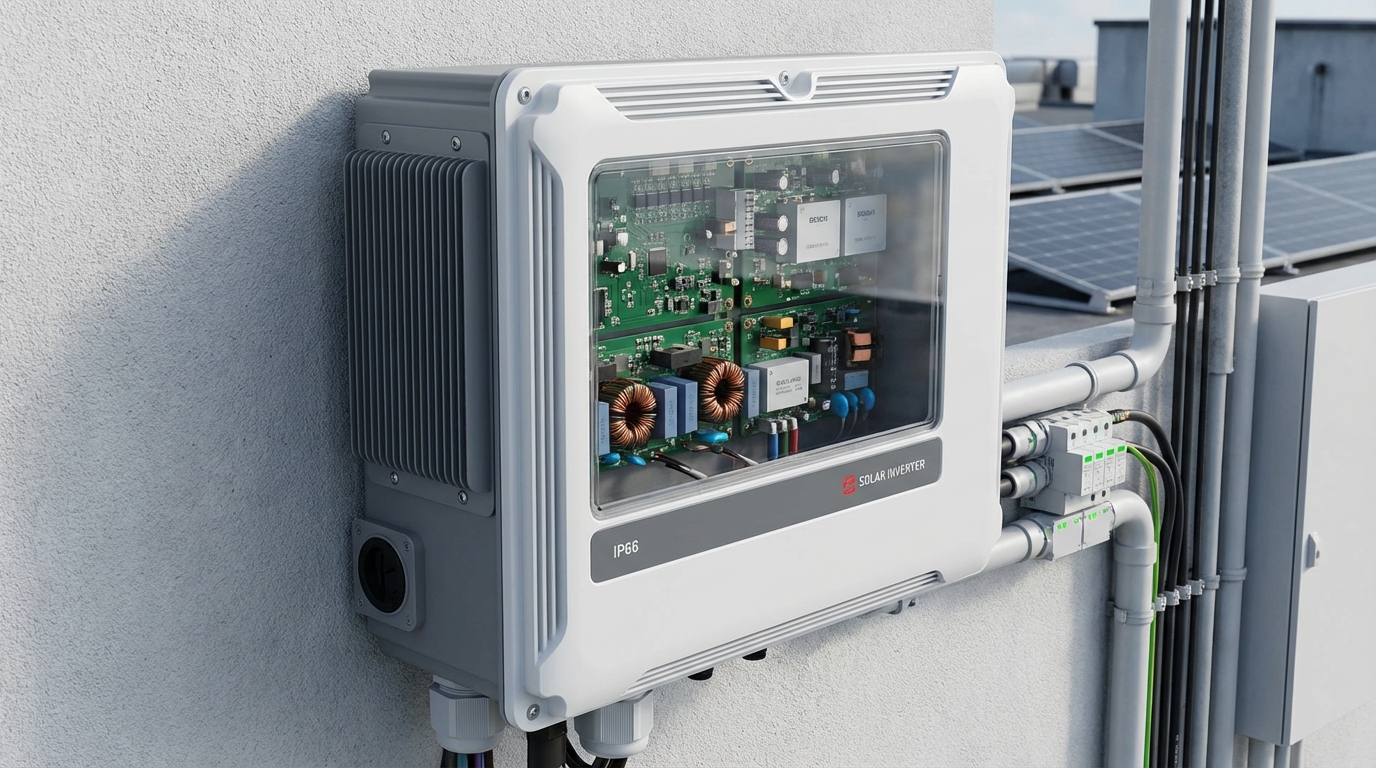
Regardless of inverter type, IP66-rated enclosures designed for harsh rooftop conditions require specific care protocols that balance protection with necessary maintenance access. These weather-resistant enclosures are engineered to withstand dust ingress and water jets, but their protective seals require regular inspection to maintain integrity.
2. Preventive Maintenance Schedule for Indian Climate Conditions
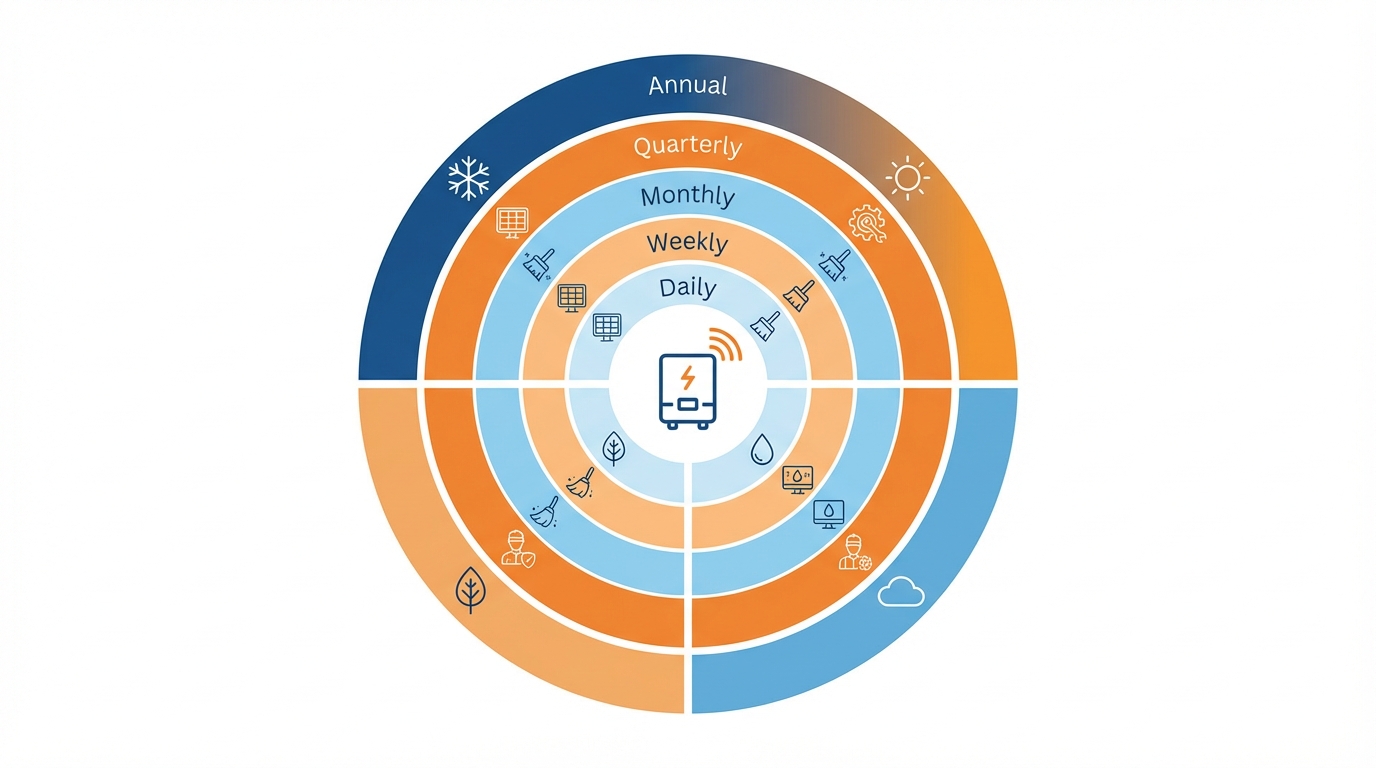
A systematic preventive maintenance schedule tailored to India’s climate patterns is essential for maintaining optimal inverter performance. This schedule balances automated monitoring, routine inspections, and professional service intervals to catch issues before they impact system efficiency or trigger costly failures.
Daily Automated Monitoring Checks
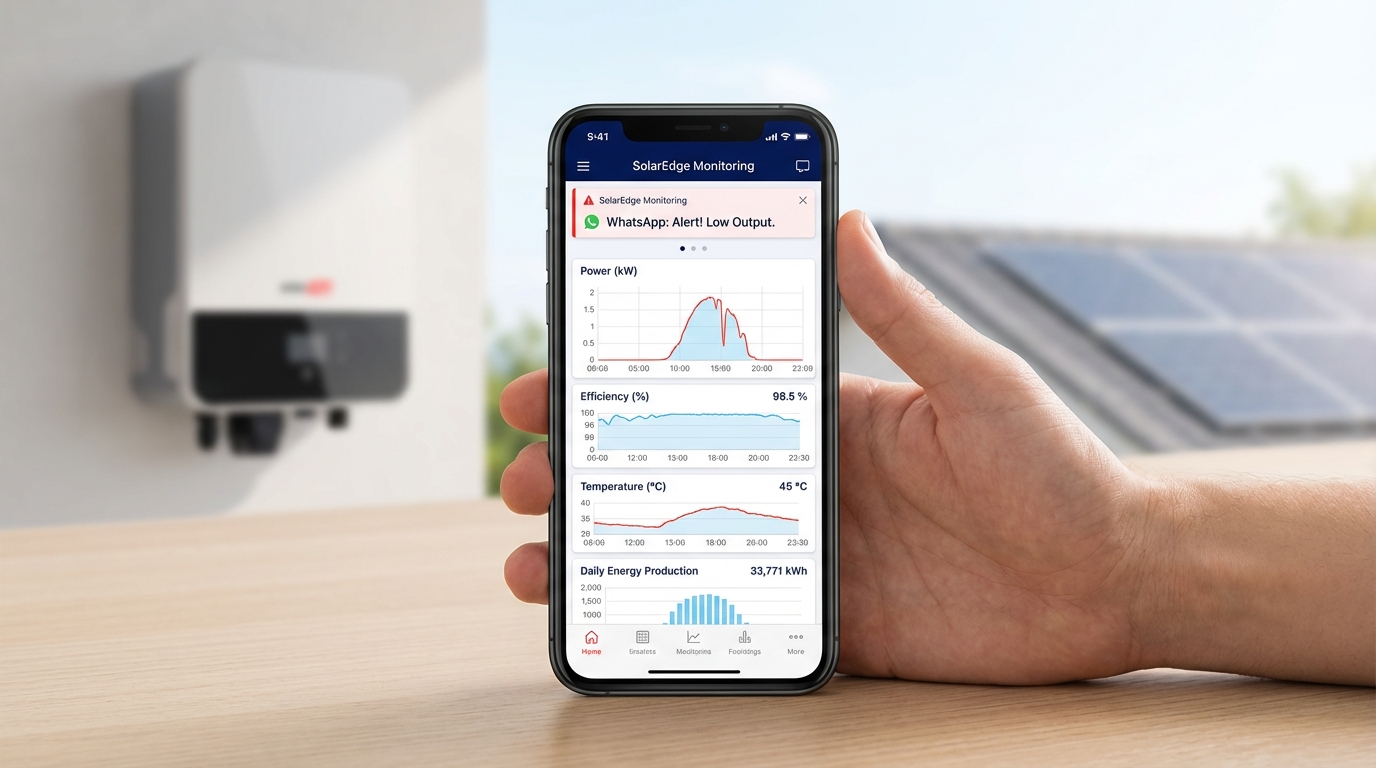
Modern inverters with AI-powered monitoring systems should perform automated daily diagnostics without manual intervention. Configure your monitoring system to track:
- Total energy generation compared to expected output based on irradiation data
- Inverter efficiency percentage (should maintain 98% or higher)
- Internal operating temperature (typically 40-60°C under load)
- Grid voltage and frequency parameters
- Any fault codes or warning messages
Systems with WhatsApp monitoring integration provide real-time alerts directly to your mobile device, enabling immediate response to performance anomalies. Set alert thresholds at 5% below expected generation to catch efficiency degradation early.
Weekly Visual Inspection Protocols
Conduct brief weekly visual inspections, particularly during high-dust seasons (March-June in most regions). These 10-minute checks should verify:
- No visible dust accumulation blocking ventilation grills
- LED status indicators showing normal operation (typically solid green)
- No unusual sounds from cooling fans or internal components
- Ambient area around inverter clear of debris or obstructions
- No signs of moisture, corrosion, or pest intrusion
Monthly Cleaning and Physical Inspection Schedule
Monthly maintenance represents the core of effective inverter maintenance India protocols. Allocate 30-45 minutes per inverter for thorough inspection and cleaning:
- External cleaning: Remove dust from enclosure surfaces and ventilation grills using soft brushes and compressed air
- Connection point inspection: Check all DC and AC terminal connections for tightness and signs of overheating (discoloration)
- Display and indicator verification: Confirm all display functions and indicator lights operate correctly
- Mounting security check: Verify inverter remains securely mounted with no loose bolts or brackets
- Cable management review: Ensure all cables maintain proper routing without stress on connection points
For C&I installations with multiple inverters, implement a rotating schedule that services 25% of units weekly, completing full facility coverage monthly.
Quarterly Professional Service Requirements
Engage qualified service technicians for comprehensive quarterly inspections that include:
- Internal component inspection (requires opening enclosure by authorized personnel only)
- Cooling fan operation and bearing condition assessment
- Capacitor visual inspection for bulging or leakage
- Thermal imaging to identify hot spots indicating component stress
- Insulation resistance testing of DC and AC circuits
- Firmware version verification and updates if available
- Detailed performance testing under various load conditions
Quarterly service typically costs ₹2,500-5,000 per inverter depending on system size and complexity. Ensure your service provider documents all findings and maintains records for warranty compliance.
Annual Comprehensive System Audit
Schedule annual comprehensive audits that examine the entire solar installation, not just the inverter. This holistic assessment should include:
- Complete electrical safety testing including earth continuity and insulation resistance
- Surge protection device (SPD) functionality verification
- String voltage and current measurements to identify underperforming panel strings
- Communication system testing (Wi-Fi, 4G, Bluetooth connectivity)
- Warranty documentation review and renewal processing
- Performance benchmarking against manufacturer specifications
- Predictive maintenance recommendations based on component condition
Seasonal Maintenance Considerations
India’s distinct seasons require specific maintenance focus:
Pre-Monsoon (May-June): Verify IP66 seal integrity, check drainage provisions, ensure all cable glands are properly sealed, and confirm surge protection devices are functional before lightning season.
Post-Monsoon (October-November): Inspect for any moisture ingress, check for corrosion on external components, verify cooling fan operation wasn’t compromised by humidity, and clean any biological growth from enclosure surfaces.
Summer (March-May): Monitor operating temperatures closely, ensure ventilation pathways are completely clear, verify cooling fans operate at full capacity, and consider temporary shading for inverters experiencing thermal derating.
Winter (December-February): Ideal season for comprehensive maintenance activities due to moderate temperatures; schedule major service work and any component replacements during this period.
3. IP66-Rated Inverter Cleaning Procedures
IP66-rated enclosures provide robust protection against dust and water ingress, but they require specific cleaning procedures that maintain seal integrity while removing accumulated contaminants. Improper cleaning techniques can compromise weather protection, leading to premature component failure.
Understanding the IP66 standard is essential: the “6” rating for solids indicates complete dust-tight protection, while the second “6” for liquids means the enclosure can withstand powerful water jets from any direction. This protection depends on properly maintained gaskets and seals that can be damaged by aggressive cleaning methods.
Safe Cleaning Methods for Weather-Protected Enclosures
Follow these protocols for cleaning IP66-rated inverters without compromising protection:
Step 1: Power Assessment – While IP66 enclosures allow cleaning without shutdown, always verify the inverter is operating normally before beginning. Never clean an inverter displaying fault conditions or unusual behavior.
Step 2: Dry Dust Removal – Begin with soft-bristle brushes or compressed air (maximum 40 PSI) to remove loose dust from ventilation grills and enclosure surfaces. Work from top to bottom to prevent dust from settling on already-cleaned areas.
Step 3: Damp Cleaning – For stubborn dirt or coastal salt deposits, use a slightly damp microfiber cloth with clean water only. Never use solvents, detergents, or abrasive cleaners that can degrade gasket materials or enclosure coatings.
Step 4: Ventilation Grill Attention – Use soft brushes or compressed air to clean ventilation grills thoroughly. These areas are critical for cooling efficiency, even 2-3mm of dust accumulation can reduce airflow by 20-30%.
Step 5: Seal Inspection – While cleaning, visually inspect all gaskets and seals around doors, cable glands, and display windows. Look for cracks, hardening, or gaps that could compromise IP66 protection.
Step 6: Drying – Allow all surfaces to air dry completely before closing any access panels. Never use heat guns or high-pressure air that could force moisture into sealed areas.
Cleaning Frequency Based on Location
Adjust cleaning frequency based on your installation environment:
- Urban/Industrial areas: Clean every 2-3 weeks due to heavy particulate pollution and dust accumulation
- Coastal regions: Clean every 3-4 weeks, focusing on salt deposit removal to prevent corrosion
- Rural/Agricultural areas: Clean monthly, with increased frequency during harvest seasons when airborne chaff is prevalent
- Desert/Arid regions: Clean every 1-2 weeks during dust storm seasons, monthly otherwise
Critical Don’ts for Inverter Cleaning
Avoid these common mistakes that can damage inverters or void warranties:
- Never use high-pressure washers: While IP66-rated, the force can damage ventilation components and force water past seals
- Don’t open enclosures: Internal cleaning should only be performed by authorized service technicians to maintain warranty coverage
- Avoid chemical cleaners: Solvents and harsh detergents can degrade protective coatings and gasket materials
- Don’t clean during rain: Even with IP66 protection, avoid maintenance during active rainfall to prevent accidental moisture ingress through temporarily opened access points
- Never use metal tools: Metal scrapers or wire brushes can scratch protective coatings and create corrosion initiation points
Proper cleaning is a cornerstone of effective inverter maintenance India protocols, directly impacting cooling efficiency and long-term reliability. Installations that maintain clean ventilation systems consistently achieve 3-5% higher efficiency compared to neglected units in the same environmental conditions.
4. Monitoring System Checks and Performance Optimization
Advanced monitoring systems transform inverter maintenance India from reactive troubleshooting to proactive performance optimization. AI-powered monitoring platforms provide real-time visibility into system health, enabling early detection of efficiency degradation before it significantly impacts energy generation.
Leveraging AI-Powered Monitoring Capabilities
Modern inverters equipped with intelligent monitoring systems offer capabilities far beyond basic generation tracking. These systems analyze performance patterns, compare actual output against theoretical maximums based on irradiation data, and automatically identify anomalies that indicate maintenance needs.
Key monitoring features to utilize include:
- Real-time efficiency tracking: Continuous calculation of conversion efficiency, with alerts when performance drops below 97% threshold
- String-level diagnostics: Individual MPPT channel monitoring to identify underperforming panel strings requiring attention
- Temperature correlation analysis: AI algorithms that distinguish between normal temperature-related efficiency variations and abnormal thermal issues
- Predictive maintenance alerts: Machine learning models that predict component failures based on performance degradation patterns
- Comparative analysis: Multi-inverter installations can benchmark individual unit performance to identify outliers
WhatsApp Alert Interpretation and Response Protocols
WhatsApp-based monitoring systems provide immediate notifications directly to your mobile device, enabling rapid response to system issues. Understanding alert priorities and appropriate responses is essential for effective maintenance management.
Critical Alerts (Immediate Response Required):
- Complete system shutdown or offline status
- Over-temperature warnings (>75°C internal temperature)
- Ground fault or insulation failure alerts
- DC overvoltage conditions that could damage components
Warning Alerts (Response Within 24 Hours):
- Efficiency drop of 5-10% below expected performance
- Communication system intermittent connectivity
- Fan operation irregularities
- Grid voltage fluctuations outside normal range
Informational Alerts (Monitor and Schedule Maintenance):
- Scheduled maintenance reminders
- Firmware update availability notifications
- Performance optimization suggestions
- Energy generation milestone achievements
Configure alert thresholds appropriately for your installation type. C&I facilities with on-site technical staff can set more sensitive thresholds for early intervention, while remote residential installations may prefer fewer alerts focused on critical issues only.
Connectivity Verification Across Multiple Channels
Inverters with multi-channel connectivity (Wi-Fi, 4G, Bluetooth) provide redundancy that ensures continuous monitoring even if one communication path fails. Verify all connectivity options monthly:
- Wi-Fi connectivity: Check signal strength and router connection stability; weak signals (<-70 dBm) may cause intermittent data gaps
- 4G cellular backup: Verify SIM card status and data plan validity; ensure cellular connection activates when Wi-Fi fails
- Bluetooth local access: Test Bluetooth pairing for on-site diagnostics and configuration access
- Cloud data synchronization: Confirm monitoring data uploads to cloud servers regularly with no extended gaps
Key Performance Metrics to Track
Establish baseline performance metrics during system commissioning, then track these parameters to identify degradation trends:
- Daily energy yield: Compare against expected generation based on irradiation data (±10% variation is normal)
- Peak power output: Maximum instantaneous power should match inverter rating during high-irradiation periods
- Conversion efficiency: Should maintain 98% or higher; investigate if efficiency drops below 96%
- Operating temperature: Typical range 40-60°C under load; consistent readings above 65°C indicate cooling issues
- Grid voltage quality: Should remain within 230V ±10% for single-phase, 400V ±10% for three-phase systems
- Power factor: Should maintain >0.99 for optimal grid interaction
For comprehensive monitoring system guidance, refer to our detailed article on solar inverter monitoring systems in India, which covers advanced diagnostic techniques and monitoring platform selection criteria.
Data Logging and Predictive Maintenance
Historical performance data enables predictive maintenance strategies that prevent failures rather than simply responding to them. Analyze logged data quarterly to identify:
- Gradual efficiency degradation trends suggesting component aging
- Seasonal performance patterns that inform maintenance scheduling
- Recurring fault patterns indicating systematic issues
- Correlation between environmental conditions and performance variations
Advanced monitoring platforms with India-based server infrastructure ensure data security while providing the analytics capabilities necessary for sophisticated predictive maintenance programs.
5. Warranty-Compliant Service Protocols
Comprehensive warranty coverage provides essential financial protection for your solar investment, but maintaining warranty validity requires strict adherence to manufacturer-specified service protocols. Understanding warranty terms and documentation requirements is a critical component of inverter maintenance India best practices.
Understanding 12-Year Warranty Terms
Premium inverters offering 12-year full replacement warranties provide exceptional long-term protection, but these warranties include specific conditions that must be met to maintain coverage. Key warranty provisions typically include:
- Authorized service requirements: All maintenance and repairs must be performed by manufacturer-authorized technicians
- Genuine parts mandate: Any component replacements must use manufacturer-approved genuine parts
- Service interval compliance: Documented proof of maintenance at manufacturer-specified intervals (typically quarterly or semi-annually)
- Installation standards: Initial installation must meet manufacturer specifications for mounting, ventilation clearances, and electrical connections
- Operating condition limits: Warranty may be voided if inverter operates outside specified temperature, humidity, or altitude ranges
Full replacement warranties are particularly valuable compared to repair-only coverage, as they guarantee a complete new unit rather than potentially multiple repair cycles for aging equipment.
Documentation and Record-Keeping Requirements
Meticulous documentation is essential for warranty claim approval. Maintain comprehensive records including:
- Service logs: Dated records of all maintenance activities, including routine cleaning, inspections, and professional service visits
- Performance data: Historical monitoring data showing system operation and any performance anomalies
- Fault reports: Detailed documentation of any faults, error codes, and troubleshooting steps taken
- Parts replacement records: Documentation of any component replacements with part numbers and service provider details
- Environmental incident logs: Records of extreme weather events, power surges, or other environmental factors that may have affected the inverter
Digital warranty systems streamline this documentation process by automatically logging service activities and maintaining centralized records accessible for warranty claims. These systems eliminate the risk of lost paperwork and provide instant verification of warranty status.
Activities That Can Void Warranty Coverage
Be aware of actions that can invalidate warranty protection:
- Unauthorized modifications: Any alterations to inverter hardware, firmware, or configuration outside manufacturer specifications
- Improper installation: Failure to follow installation guidelines regarding mounting, clearances, or electrical connections
- Neglected maintenance: Lack of documented regular maintenance or allowing the inverter to operate in degraded conditions
- Environmental exposure: Installation in locations exceeding specified environmental limits (temperature, humidity, altitude, corrosive atmospheres)
- Electrical misuse: Operating with DC input or AC output parameters outside specified ranges
- Physical damage: Impact damage, water ingress due to seal damage, or pest intrusion resulting from poor site maintenance
Proper Escalation Procedures for Warranty Issues
When warranty service becomes necessary, follow proper escalation procedures to ensure rapid resolution:
Step 1: Initial Diagnosis – Use monitoring system data and basic troubleshooting to clearly document the issue before contacting support.
Step 2: Technical Support Contact – Reach out through official support channels with detailed information including serial number, installation date, fault symptoms, and error codes.
Step 3: Remote Diagnostics – Support teams can often perform remote diagnostics through monitoring systems to verify the issue and determine if on-site service is required.
Step 4: Authorized Service Dispatch – If hardware service is needed, manufacturer will dispatch authorized technicians with genuine replacement parts.
Step 5: Warranty Claim Processing – For full unit replacement, digital warranty systems expedite claim processing and replacement unit shipment.
Maintain direct contact information for manufacturer support teams and establish relationships with local authorized service providers before issues arise. For Qbits inverter owners, dedicated support services provide rapid response to warranty and technical issues.
6. Troubleshooting Common Inverter Issues in India
Understanding common inverter issues specific to Indian operating conditions enables faster diagnosis and resolution, minimizing downtime and generation losses. While comprehensive troubleshooting should be performed by qualified technicians, recognizing symptoms helps facility owners and EPCs respond appropriately.
Voltage Fluctuation and Grid Instability Issues
Grid voltage variations are common across India, particularly in rural areas and during peak demand periods. Inverters must disconnect from the grid when voltage exceeds safe operating ranges, causing intermittent shutdowns.
Symptoms: Frequent disconnection/reconnection cycles, “grid overvoltage” or “grid undervoltage” fault codes, reduced daily generation hours.
Diagnosis: Monitor grid voltage over 24-hour periods to identify patterns. Voltage consistently outside 200-250V (single-phase) or 360-440V (three-phase) indicates grid quality issues.
Solutions: Install voltage stabilizers for severe cases, adjust inverter grid protection settings within manufacturer-allowed ranges, coordinate with utility provider for grid infrastructure improvements, consider hybrid systems with battery backup to ride through short voltage disturbances.
Overheating in Extreme Summer Temperatures
Ambient temperatures exceeding 45°C combined with direct sun exposure can push inverter internal temperatures above safe operating limits, triggering thermal derating or shutdown.
Symptoms: Reduced output during peak afternoon hours, “over-temperature” warnings, cooling fan running continuously, hot enclosure surfaces (>60°C).
Diagnosis: Monitor inverter operating temperature through monitoring system. Temperatures consistently above 70°C indicate inadequate cooling.
Solutions: Ensure minimum clearances around inverter (typically 30cm on all sides), verify cooling fan operation, install temporary sunshades during extreme heat periods, consider relocating inverter to shaded location if thermal issues persist, clean ventilation grills to restore airflow.
Dust Accumulation Affecting Cooling Efficiency
Dust accumulation is perhaps the most common maintenance issue in India, progressively reducing cooling efficiency and leading to thermal stress on components.
Symptoms: Gradually increasing operating temperatures over weeks/months, reduced efficiency during hot periods, visible dust buildup on ventilation grills.
Diagnosis: Visual inspection reveals dust accumulation; temperature monitoring shows upward trend despite consistent ambient conditions.
Solutions: Implement regular cleaning schedule appropriate for location (every 2-4 weeks), use compressed air or soft brushes for ventilation grills, consider installing inverter in less dust-exposed location if possible, verify IP66 seals prevent internal dust ingress.
Moisture Ingress During Monsoon Season
Despite IP66 protection, compromised seals or improper installation can allow moisture ingress during heavy monsoons, causing corrosion and electrical faults.
Symptoms: Insulation resistance faults, ground fault errors, corrosion visible on external terminals, condensation inside display window, intermittent operation during/after rain.
Diagnosis: Visual inspection for water entry points, insulation resistance testing showing values below 1MΩ, correlation between faults and rainfall events.
Solutions: Inspect and replace damaged gaskets/seals, verify all cable glands properly sealed, ensure inverter mounting prevents water pooling, check drainage provisions, apply corrosion-resistant coatings to external terminals, consider installing protective canopy for severe exposure.
Communication System Failures
Monitoring connectivity issues prevent remote diagnostics and performance tracking, though the inverter continues operating normally.
Symptoms: No data updates in monitoring platform, “offline” status despite inverter operating, inability to access inverter remotely.
Diagnosis: Check Wi-Fi signal strength, verify router operation, confirm 4G SIM card status and data plan validity, test Bluetooth connectivity for local access.
Solutions: Relocate Wi-Fi router closer to inverter or install range extender, replace or recharge 4G SIM card, verify monitoring platform server status, update communication module firmware, check for interference from nearby electronic equipment.
DC/AC Surge Protection Device Status
Surge protection devices (SPDs) sacrifice themselves to protect inverter components during voltage spikes, requiring replacement after major surge events.
Symptoms: SPD indicator showing fault/replacement status, inverter operating but vulnerable to future surges, recent lightning storm or major grid disturbance.
Diagnosis: Visual inspection of SPD status indicators (typically green=OK, red=replace), electrical testing of SPD functionality.
Solutions: Replace failed SPDs immediately with manufacturer-approved units, investigate cause of surge event, verify proper grounding of entire solar installation, consider upgrading to higher-capacity SPDs in lightning-prone areas.
When to Call Professional Service
While basic troubleshooting and maintenance can be performed by facility staff, certain situations require professional service:
- Any fault requiring enclosure opening or internal component access
- Persistent faults that don’t resolve with basic troubleshooting
- Efficiency degradation exceeding 5% without obvious cause
- Any electrical safety concerns (ground faults, insulation failures)
- Warranty service requirements
- Component replacement needs
- Annual comprehensive system audits
Attempting repairs beyond your expertise can void warranties and create safety hazards. Establish relationships with qualified service providers before issues arise to ensure rapid response when professional service becomes necessary.
7. Cost-Effective Maintenance Strategies for Residential and C&I Installations
Implementing cost-effective inverter maintenance India strategies requires balancing service quality with budget constraints while ensuring warranty compliance and optimal system performance. Different installation scales demand different approaches to maximize maintenance ROI.
Annual Maintenance Cost Benchmarks
Understanding typical maintenance costs helps budget appropriately and evaluate service provider proposals:
Residential Systems (3-10kW):
- Annual professional service: ₹3,000-6,000 per year
- Cleaning supplies and basic tools: ₹500-1,000 per year
- Monitoring platform subscription (if applicable): ₹0-2,000 per year
- Total annual cost: ₹3,500-9,000 (approximately 0.5-1% of system cost)
Commercial Systems (25-100kW):
- Quarterly professional service: ₹15,000-30,000 per year
- Monthly in-house maintenance: ₹6,000-12,000 per year (staff time)
- Monitoring and diagnostics: ₹5,000-10,000 per year
- Total annual cost: ₹26,000-52,000 (approximately 0.3-0.5% of system cost)
Industrial Systems (500kW-1MW+):
- Comprehensive maintenance contract: ₹1.5-3 lakhs per year
- Dedicated monitoring and analytics: ₹20,000-50,000 per year
- Spare parts inventory: ₹50,000-1 lakh per year
- Total annual cost: ₹2.2-4.5 lakhs (approximately 0.2-0.3% of system cost)
These costs represent preventive maintenance investments that typically deliver 10-15x ROI through avoided downtime, maintained efficiency, and extended equipment lifespan.
In-House vs Outsourced Maintenance Decision Framework
Determining the optimal balance between in-house and outsourced maintenance depends on installation scale, technical capabilities, and geographic factors:
In-House Maintenance Makes Sense When:
- You have multiple installations totaling >200kW capacity
- Technical staff with electrical/electronics background are available
- Installations are geographically concentrated
- You can invest in diagnostic tools and training
- Daily/weekly monitoring and basic troubleshooting are required
Outsourced Maintenance Is Preferable When:
- Single or small residential installations
- No technical staff available on-site
- Installations are geographically dispersed
- Warranty requires authorized service provider involvement
- Complex diagnostics or component replacement needed
Many successful C&I installations adopt hybrid approaches: in-house staff handle daily monitoring, weekly inspections, and basic cleaning, while outsourced professionals perform quarterly comprehensive service and any repair work.
Bulk Service Contracts for Multi-Site C&I Installations
Organizations with multiple solar installations can negotiate favorable bulk service contracts that reduce per-site costs by 20-40%. Effective bulk contracts should include:
- Fixed annual fee covering all routine maintenance across all sites
- Guaranteed response times for service calls (typically 24-48 hours)
- Centralized monitoring dashboard covering entire installation portfolio
- Quarterly performance reports with benchmarking across sites
- Priority access to spare parts and replacement units
- Annual training for in-house facility staff
When negotiating bulk contracts, ensure service providers have sufficient technical capacity and geographic coverage to service all your locations effectively.
ROI of Preventive Maintenance vs Reactive Repairs
The financial case for systematic preventive maintenance is compelling:
Preventive Maintenance Approach:
- Annual cost: ₹15,000 for 50kW system
- Maintains 98% efficiency throughout warranty period
- Extends inverter lifespan to 15+ years
- Minimal unplanned downtime (typically <0.5% annually)
- Warranty remains valid for full term
Reactive Repair Approach:
- Lower annual cost initially: ₹5,000 for basic monitoring only
- Efficiency degrades to 90-93% over 5 years
- Inverter lifespan reduced to 8-10 years
- Unplanned downtime averages 2-3% annually
- Major component failures cost ₹50,000-1.5 lakhs for repairs
- Warranty may be voided due to maintenance neglect
For a 50kW system generating ₹4 lakhs annually in electricity value, the reactive approach loses approximately ₹40,000 per year in reduced generation, plus ₹1-2 lakhs in repair costs over 10 years. The preventive approach costs ₹1.5 lakhs over 10 years but maintains full generation value, a net benefit of ₹5-6 lakhs.
Training Facility Staff for Basic Maintenance Tasks
For C&I installations, training facility staff to perform basic maintenance tasks significantly reduces ongoing costs while improving system uptime:
Essential Training Topics:
- Safety protocols for working with solar electrical systems
- Monitoring system interpretation and alert response
- Visual inspection procedures and fault identification
- Proper cleaning techniques for IP66-rated enclosures
- Basic troubleshooting and when to escalate to professionals
- Documentation and record-keeping for warranty compliance
Many inverter manufacturers offer training programs for facility staff, often included with bulk equipment purchases or service contracts. This investment typically pays for itself within 6-12 months through reduced service call frequency.
Leveraging Remote Monitoring to Reduce Site Visits
Advanced monitoring systems dramatically reduce the need for physical site visits, cutting maintenance costs while improving response times:
- Remote diagnostics identify 70-80% of issues without site visits
- Predictive alerts enable planned maintenance during scheduled visits rather than emergency calls
- Multi-site monitoring allows single technician to oversee dozens of installations
- Historical data analysis identifies systematic issues requiring one-time fixes rather than repeated interventions
For geographically dispersed installations, robust monitoring systems can reduce site visit frequency by 50-60% while actually improving maintenance effectiveness through better-informed interventions.
8. Maximizing Inverter Lifespan and Maintaining 98% Efficiency
Achieving maximum inverter lifespan while maintaining peak efficiency requires understanding the factors that drive component aging and implementing strategies to mitigate degradation. With proper care, premium inverters can deliver 15-20 years of reliable service while maintaining efficiency above 97%.
Best Practices for Extending Operational Life Beyond 15 Years
Several key practices significantly extend inverter operational life:
Thermal Management: Heat is the primary enemy of electronic components. Maintaining inverter operating temperatures below 60°C under load can double component lifespan compared to operation at 75°C. Ensure adequate ventilation, clean cooling pathways, and consider supplemental cooling for extreme environments.
Voltage Stress Minimization: Operating inverters at the lower end of their DC input voltage range reduces stress on power electronics. When designing systems, configure string voltages to operate at 60-80% of maximum inverter input voltage rather than pushing limits.
Load Cycling Reduction: Frequent on/off cycling stresses components more than steady operation. Proper system sizing that keeps inverters operating at 30-80% capacity most of the time reduces cycling stress compared to oversized systems that frequently start and stop.
Environmental Protection: While IP66 enclosures provide robust protection, additional measures like protective canopies, corrosion-resistant coatings on terminals, and pest barriers further extend equipment life in harsh environments.
Proactive Component Replacement: Certain components have predictable lifespans shorter than the inverter itself. Replacing cooling fans every 5-7 years and electrolytic capacitors every 8-10 years prevents these wear items from causing system failures.
Environmental Factors Affecting Longevity
Understanding how environmental factors accelerate aging helps prioritize protective measures:
- Temperature: Every 10°C increase in operating temperature roughly halves electronic component lifespan (Arrhenius equation)
- Humidity: Sustained humidity above 85% accelerates corrosion and can cause electrical tracking on circuit boards
- UV exposure: Direct sunlight degrades enclosure materials and labels; inverters should be mounted in shaded locations when possible
- Coastal salt: Salt-laden air causes rapid corrosion of external components; installations within 10km of coastlines require enhanced protection
- Dust and particulates: Abrasive dust can wear cooling fan bearings and accumulation reduces cooling efficiency
- Altitude: Installations above 2000m experience reduced cooling efficiency due to thinner air, requiring derating or enhanced cooling
For detailed guidance on selecting inverters designed for longevity, see our comprehensive article on solar inverter lifespan and financial planning.
Component Replacement Schedules
Proactive replacement of wear components prevents unexpected failures:
Cooling Fans (5-7 year replacement cycle): Fan bearings wear over time, leading to noise, vibration, and eventual failure. Replace fans before failure occurs to prevent thermal damage to other components. Cost: ₹2,000-5,000 per fan.
Electrolytic Capacitors (8-10 year replacement cycle): These components have limited lifespans due to electrolyte evaporation. Bulging or leaking capacitors indicate imminent failure. Replacement requires professional service. Cost: ₹8,000-15,000 depending on inverter size.
Communication Modules (as needed): Wi-Fi/4G modules may require replacement if connectivity becomes unreliable. Cost: ₹3,000-8,000.
Display Units (as needed): LCD displays can fade or fail over time but don’t affect inverter operation. Replacement is optional. Cost: ₹4,000-10,000.
Schedule these replacements during annual maintenance windows to minimize disruption and combine service costs.
Efficiency Monitoring and Degradation Thresholds
Systematic efficiency monitoring enables early detection of performance degradation:
Baseline Establishment: During commissioning, measure peak efficiency under optimal conditions (high irradiation, moderate temperature). This becomes your reference point.
Continuous Tracking: Monitor conversion efficiency daily through your monitoring system. Calculate efficiency as: (AC output power / DC input power) × 100.
Action Thresholds:
- 98-97% efficiency: Normal operation, no action required
- 97-95% efficiency: Schedule inspection within 2 weeks to identify cause
- 95-93% efficiency: Immediate professional service required
- Below 93% efficiency: Critical issue requiring urgent attention
Efficiency degradation can result from dust accumulation (most common), component aging, connection resistance increases, or cooling system issues. Identifying and addressing the root cause quickly prevents permanent damage.
Proper Ventilation and Heat Management
Effective thermal management is the single most important factor in maximizing inverter lifespan:
- Clearance requirements: Maintain minimum 30cm clearance on all sides, 50cm above for natural convection cooling
- Mounting location: Install in shaded areas protected from direct sun; north-facing walls are ideal in India
- Ventilation pathway: Ensure unobstructed airflow from bottom intake to top exhaust vents
- Ambient temperature: If possible, locate inverters in areas with ambient temperatures below 40°C
- Supplemental cooling: For extreme environments, consider installing external fans or evaporative cooling systems
- Thermal monitoring: Set monitoring alerts for operating temperatures exceeding 65°C
Surge Protection Maintenance
Surge protection devices are critical for protecting inverters from voltage spikes caused by lightning, grid switching, or other transients:
- Inspect SPD status indicators monthly (green=OK, red=replace)
- Replace failed SPDs immediately, they provide no protection once failed
- Verify proper grounding of entire solar installation annually
- Consider upgrading to higher-capacity SPDs in lightning-prone regions
- Document all surge events and SPD replacements for warranty purposes
Quality surge protection can prevent inverter damage costing ₹1-3 lakhs from lightning strikes or grid transients, making SPD maintenance one of the highest-ROI activities.
System Upgrades and Firmware Updates
Manufacturers periodically release firmware updates that improve performance, add features, or fix bugs:
- Check for firmware updates quarterly through monitoring platform or manufacturer website
- Review update release notes to understand improvements and any risks
- Schedule updates during low-generation periods (early morning or evening)
- Ensure stable communication connection before initiating updates
- Document firmware versions in maintenance records
- Never interrupt firmware updates in progress, this can brick the inverter
Firmware updates can sometimes improve efficiency by 0.5-1% through optimized algorithms, delivering meaningful generation increases at zero hardware cost.
Inverter Maintenance India: Your Action Plan
Implementing comprehensive inverter maintenance India protocols protects your solar investment, maximizes energy generation, and ensures reliable operation throughout your system’s 25-year design life. The strategies outlined in this guide provide EPCs, solar installation companies, and facility owners with actionable frameworks for maintaining peak inverter performance despite India’s challenging environmental conditions.
The key takeaways for effective inverter maintenance include:
- Establish systematic schedules: Implement daily monitoring, weekly inspections, monthly cleaning, quarterly professional service, and annual comprehensive audits tailored to Indian climate patterns
- Leverage advanced monitoring: Utilize AI-powered monitoring systems with WhatsApp alerts to detect issues early and enable predictive maintenance strategies
- Maintain warranty compliance: Document all maintenance activities meticulously and use only authorized service providers to preserve your 12-year warranty coverage
- Prioritize thermal management: Keep inverters cool through proper ventilation, regular cleaning, and strategic mounting locations to maximize component lifespan
- Invest in preventive care: Preventive maintenance delivers 10-15x ROI compared to reactive repair approaches through maintained efficiency and avoided downtime
For solar installation companies and EPCs, selecting inverters designed for Indian conditions with robust monitoring capabilities and comprehensive warranty support significantly reduces long-term maintenance burden. When evaluating inverter options, consider our detailed guide on solar inverter selection criteria for EPCs to ensure you choose systems that balance performance, reliability, and maintainability.
Facility owners managing existing installations should immediately implement the preventive maintenance schedules outlined in this guide, starting with establishing baseline performance metrics and configuring monitoring system alerts. Even installations that have experienced maintenance neglect can recover much of their lost efficiency through systematic cleaning, professional service, and ongoing preventive care.
The solar industry in India continues to evolve rapidly, with advanced inverter technologies incorporating AI-powered diagnostics, predictive maintenance algorithms, and enhanced environmental protection. Staying current with these developments and implementing best-practice inverter maintenance India protocols ensures your solar investment delivers maximum returns throughout its operational life.
Qbits inverters are engineered specifically for Indian conditions, combining IP66 weather protection, AI-powered WhatsApp monitoring, and 12-year comprehensive warranties with German-grade components designed for longevity. Our systems simplify maintenance through intelligent diagnostics while providing the robust protection necessary for harsh rooftop environments. Whether you’re an EPC seeking reliable products for your installations or a facility owner looking to optimize existing system performance, proper maintenance protocols are essential for success.
Take the first step toward optimizing your solar inverter performance today. Contact our technical team for personalized maintenance guidance, or explore our complete range of on-grid and hybrid inverters designed for maximum reliability in Indian conditions. For EPCs and distributors interested in partnering with a manufacturer committed to long-term product support and customer success, discover our partnership opportunities and join India’s next-generation solar inverter revolution.
This blog post was written using thestacc.com