



Complete Guide to Solar Inverters in India: Types, Selection & Installation (2026)

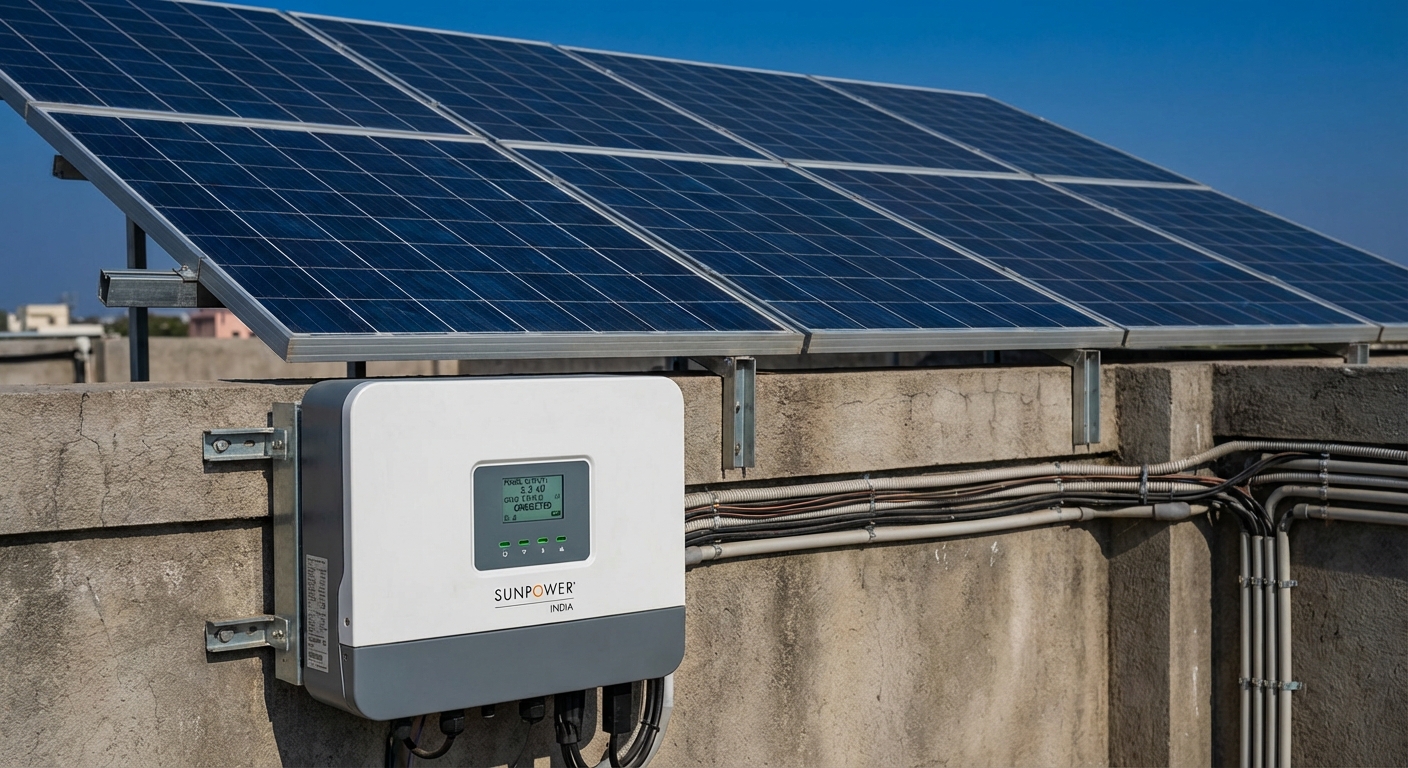
As India accelerates toward its ambitious renewable energy targets, solar inverters have emerged as the critical component that determines the success, efficiency, and longevity of solar power installations. Whether you’re a solar EPC managing multiple projects, a distributor evaluating product portfolios, or a facility owner investing in commercial solar infrastructure, understanding solar inverters in India is essential for making informed decisions that impact your bottom line for decades to come.
This comprehensive guide covers everything you need to know about solar inverters in the Indian market—from technical specifications and types to selection criteria, installation best practices, and warranty considerations. By the end, you’ll have the knowledge to specify, procure, and deploy inverters that deliver optimal performance in India’s unique climatic and operational conditions.
Understanding Solar Inverters: The Heart of Your Solar Power System
A solar inverter is far more than a simple conversion device—it’s the intelligent brain of your solar power system. While solar panels capture sunlight and convert it into direct current (DC) electricity, the inverter performs the critical function of transforming that DC power into alternating current (AC) electricity that can power your facilities, feed into the grid, or charge battery systems.
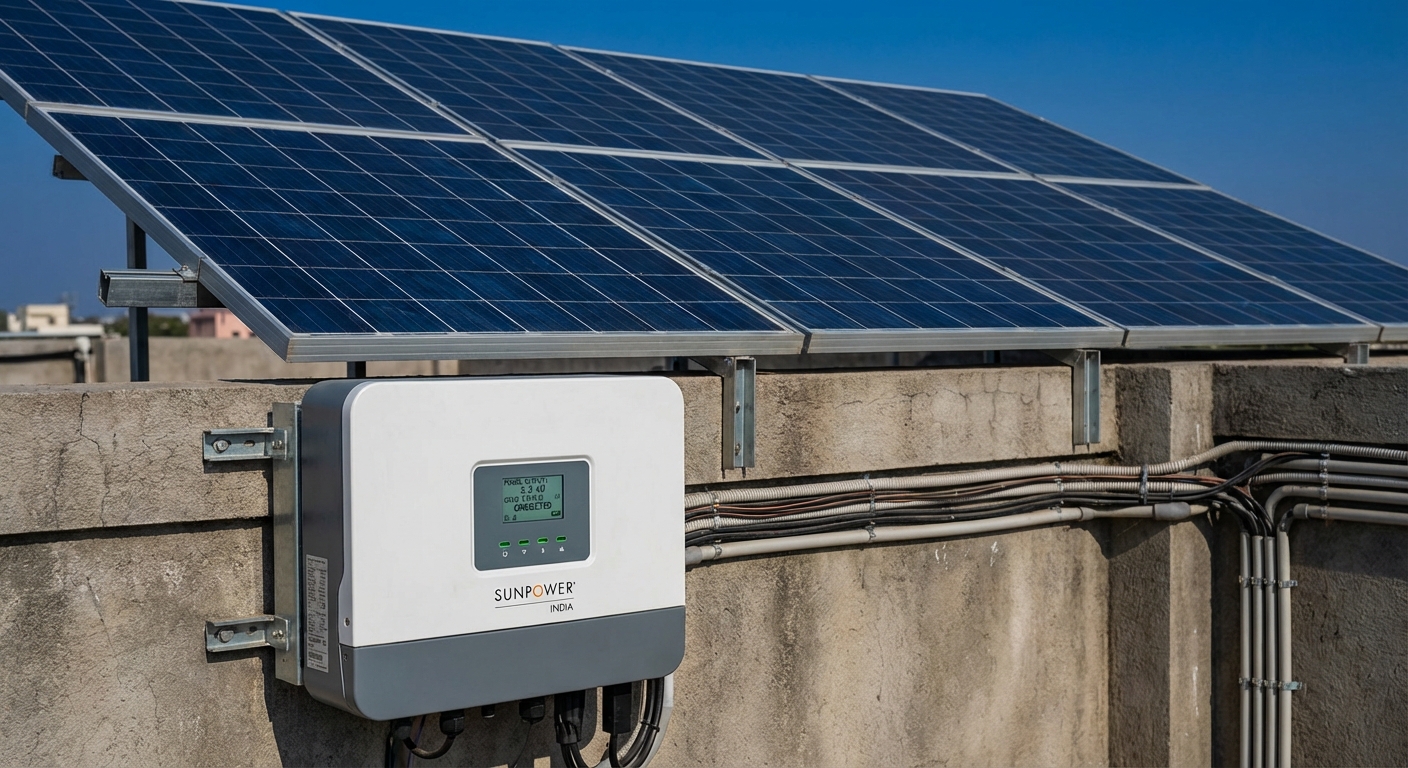
The quality and capabilities of your inverter directly influence several critical performance factors:
- System Efficiency: Modern inverters achieve up to 98% efficiency, meaning minimal energy loss during conversion. Even a 2-3% efficiency difference translates to significant revenue impact over a 25-year system lifespan.
- Power Quality: Inverters regulate voltage, frequency, and waveform to ensure clean power that meets grid standards and protects sensitive equipment.
- System Monitoring: Advanced inverters provide real-time performance data, fault detection, and remote diagnostics—essential for EPCs managing distributed installations.
- Safety Protection: Built-in surge protection, anti-islanding features, and automatic shutdown capabilities protect both equipment and personnel.
- Return on Investment: Inverter reliability, warranty coverage, and efficiency directly impact the financial performance of solar installations.
The Indian solar market has witnessed remarkable evolution in inverter technology. Early installations often relied on imported inverters not optimized for Indian conditions—leading to premature failures due to extreme heat, humidity, and voltage fluctuations. Today’s next-generation inverters are engineered specifically for the Indian environment, incorporating advanced protection features, intelligent monitoring, and components designed to withstand the subcontinent’s challenging operating conditions.
Types of Solar Inverters Available in India
Selecting the right inverter type is the first critical decision in system design. Each category serves distinct applications and offers different capabilities. Understanding these differences ensures you match technology to requirements.
On-Grid Solar Inverters: Grid-Tied Solutions
On-grid inverters, also called grid-tied or grid-connected inverters, are designed to work in synchronization with the utility power grid. These systems do not include battery storage and are the most common choice for commercial and industrial installations focused on reducing electricity costs through net metering.
Key characteristics of on-grid systems include:
- Grid Synchronization: The inverter continuously monitors grid voltage and frequency, synchronizing output to match utility power parameters precisely.
- Net Metering Capability: Excess solar generation is exported to the grid, earning credits or revenue based on state policies and utility agreements.
- No Battery Required: This reduces upfront costs and eliminates battery maintenance and replacement expenses.
- Automatic Shutdown: Anti-islanding protection automatically disconnects the system during grid outages, ensuring safety for utility workers.
- Higher Efficiency: Without battery charging/discharging losses, on-grid systems typically achieve better overall efficiency.
For residential applications, on-grid inverters typically range from 1 kW to 10 kW capacity, designed to support modern high-wattage panels up to 750W. These systems are ideal for homeowners looking to reduce electricity bills while maintaining grid connection for nighttime and cloudy-day power needs.
For commercial and industrial installations, on-grid inverters scale from 10 kW to several megawatts. These systems often feature modular designs allowing capacity expansion as energy needs grow. C&I installations benefit from demand charge reduction, power factor improvement, and significant operational cost savings over the system lifetime.
Hybrid Solar Inverters: The Best of Both Worlds
Hybrid inverters represent the most versatile solution, combining grid-tied functionality with battery integration capabilities. These intelligent systems can simultaneously manage solar generation, battery charging/discharging, grid interaction, and load supply—optimizing energy flow based on time-of-use tariffs, grid availability, and user preferences.
Hybrid systems offer several strategic advantages:
- Backup Power Capability: During grid outages, the system seamlessly switches to battery power, maintaining critical loads without interruption—essential for facilities that cannot tolerate downtime.
- Energy Arbitrage: Store solar energy during the day and discharge during evening peak hours when grid electricity is most expensive, maximizing financial returns.
- Grid Independence: Reduce reliance on utility power, protecting against rate increases and supply instability.
- Future-Proof Design: Many hybrid inverters can operate without batteries initially, with battery integration added later as needs evolve or costs decline.
- Smart Energy Management: AI-powered algorithms optimize when to use solar, battery, or grid power based on real-time conditions and cost factors.
Hybrid inverters are particularly valuable for commercial facilities with critical operations, manufacturing units requiring uninterrupted power, and regions experiencing frequent grid instability. While upfront costs are higher than on-grid systems, the operational flexibility and backup capability often justify the investment for mission-critical applications.
Critical Technical Specifications for Solar Inverters in India
Beyond the basic inverter type, several technical specifications determine real-world performance, reliability, and suitability for Indian operating conditions. Understanding these parameters enables informed comparisons and ensures you select inverters that deliver promised performance over their operational lifetime.
Efficiency Ratings: Understanding the 98% Standard
Inverter efficiency measures how much DC power from panels is successfully converted to usable AC power. A 98% efficiency rating means only 2% of generated energy is lost as heat during conversion. While this may seem minimal, consider the impact over 25 years:
For a 100 kW commercial installation generating 150,000 kWh annually, the difference between 96% and 98% efficiency represents 3,000 kWh per year—equivalent to ₹18,000-24,000 in lost revenue annually at typical commercial tariffs, or ₹4.5-6 lakhs over the system lifetime.
Look for inverters with European efficiency ratings (weighted average across different load levels) rather than just peak efficiency, as real-world conditions rarely maintain optimal load continuously.
DC Oversizing Capability
Modern inverters support DC oversizing—connecting more panel capacity than the inverter’s rated AC output. Up to 100% DC oversizing (2:1 DC-to-AC ratio) allows you to:
- Maximize energy harvest during low-light conditions (morning, evening, cloudy days)
- Compensate for panel degradation over time
- Achieve rated inverter output for more hours per day
- Reduce per-watt installation costs by optimizing inverter utilization
For example, a 50 kW inverter with 100% oversizing capability can handle up to 100 kW of panel capacity, clipping output only during peak sun hours while significantly improving overall energy yield.
High-Wattage Panel Support
Solar panel technology has advanced rapidly, with modern modules reaching 650W-750W per panel. Your inverter must support these higher-wattage panels to avoid compatibility issues and maximize system performance. Inverters designed for legacy 300-400W panels may have insufficient input voltage ranges or MPPT (Maximum Power Point Tracking) capabilities for today’s high-efficiency modules.
Ensure your inverter specifications explicitly support up to 750W panel compatibility to future-proof your installations and take advantage of the latest panel technology.
Low Start-Up Voltage and MPPT Performance
Start-up voltage determines how early in the morning and late in the evening your system begins generating power. Inverters with low start-up voltage (150-200V) capture more energy during low-light conditions compared to units requiring 250V+ to begin operation.
Multiple MPPT (Maximum Power Point Tracking) channels allow the inverter to optimize power extraction from panel strings with different orientations, shading conditions, or tilt angles—critical for complex rooftop installations where uniform conditions are impossible.
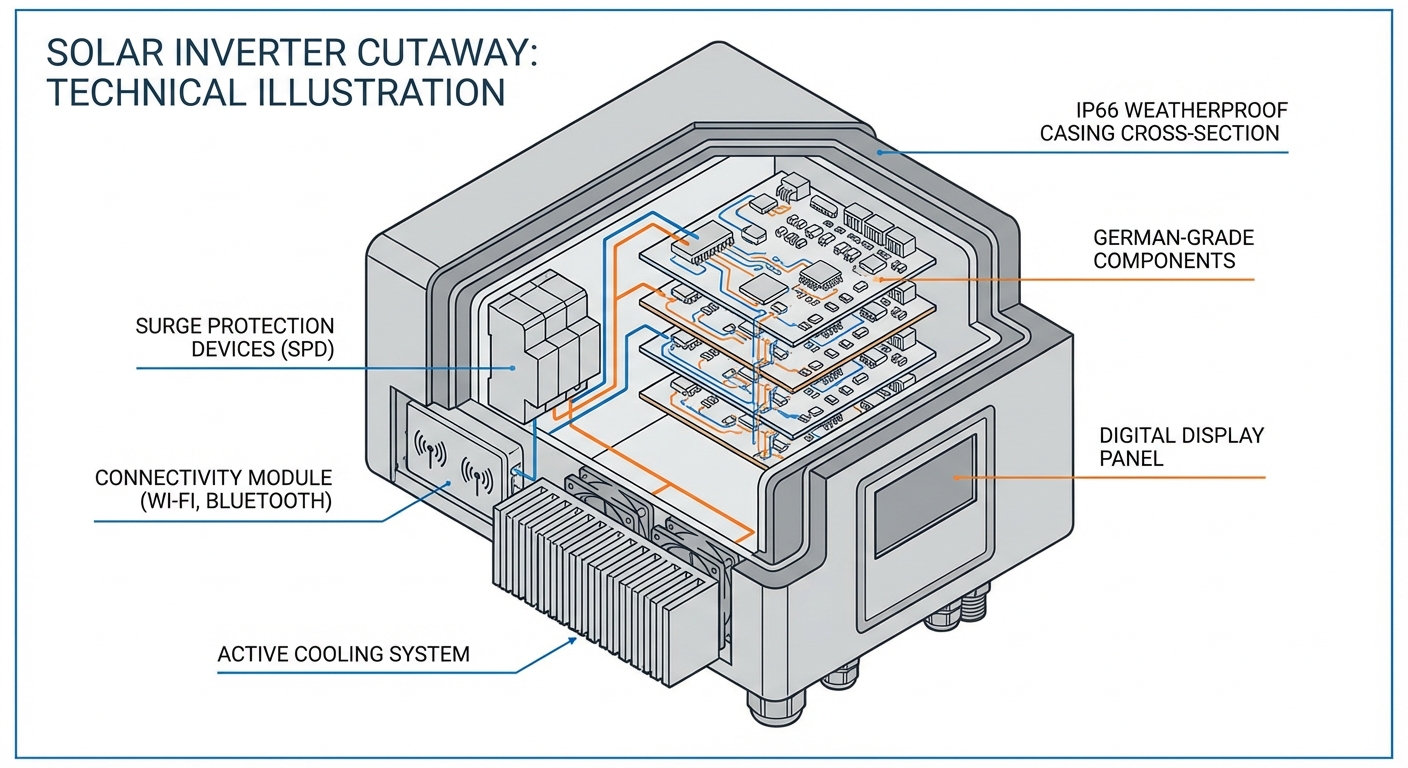
Weather Protection: The IP66 Standard
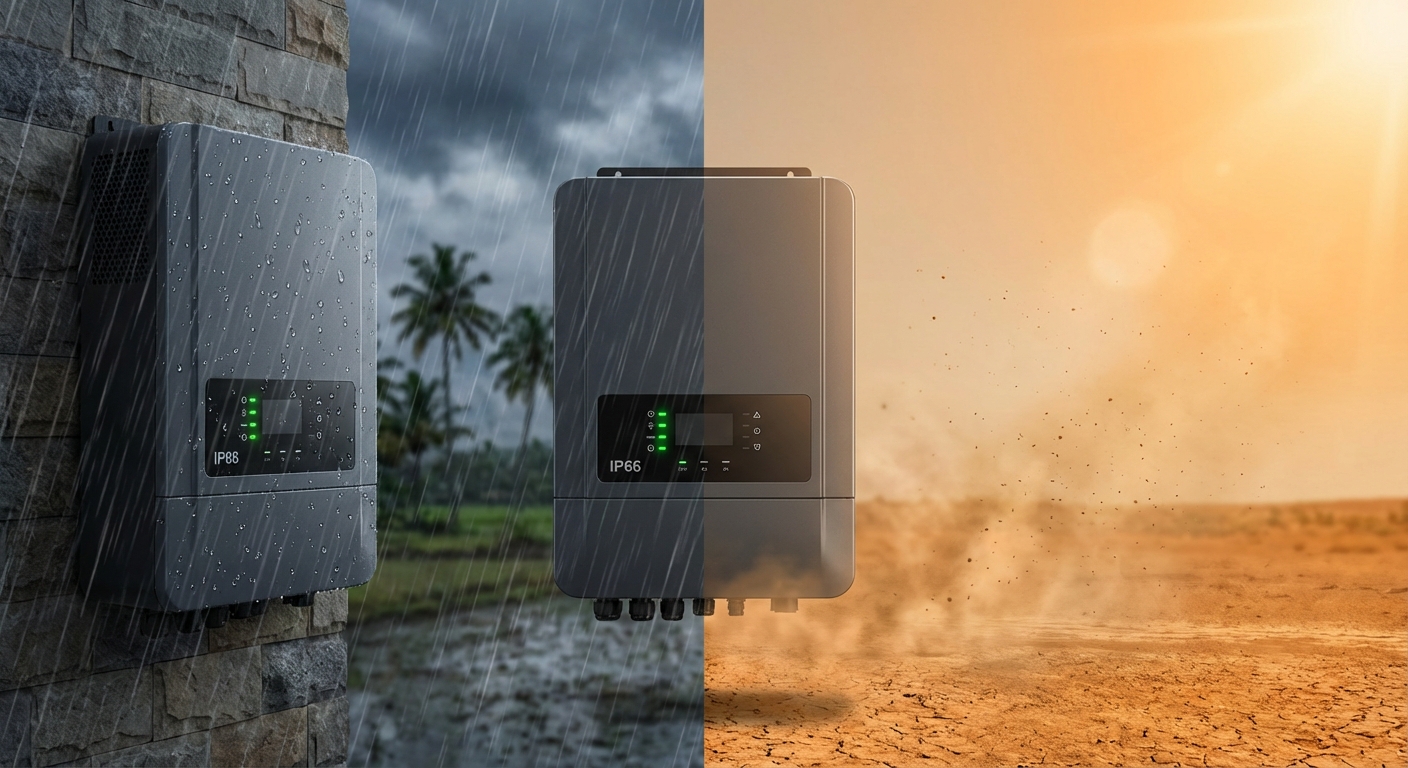
Indian rooftop installations face extreme environmental challenges: temperatures exceeding 50°C, monsoon rains, coastal humidity, and pervasive dust. The IP (Ingress Protection) rating indicates how well the inverter enclosure protects internal electronics from these threats.
IP66 rating provides:
- Complete dust protection: No ingress of dust particles, even in extremely dusty environments
- High-pressure water resistance: Protection against powerful water jets from any direction—essential for monsoon conditions
- Extended operational life: Internal components remain protected from environmental degradation
Inverters with lower IP ratings (IP54, IP55) may be suitable for indoor installations but risk premature failure in exposed rooftop conditions common throughout India.
Surge Protection Devices (SPD)
India’s electrical grid experiences frequent voltage fluctuations, and lightning strikes pose significant risks to solar installations. Integrated DC and AC surge protection devices safeguard your investment by:
- Diverting voltage spikes away from sensitive electronics
- Protecting against lightning-induced surges
- Preventing damage from grid voltage fluctuations
- Reducing insurance claims and downtime
Quality inverters include multi-stage SPD protection on both DC (panel side) and AC (grid side) connections, with replaceable surge arrestors that can be serviced without replacing the entire inverter.
Connectivity and Communication
Modern inverters are IoT-enabled devices offering multiple connectivity options:
- Wi-Fi: Direct connection to local networks for monitoring and control
- 4G/LTE: Cellular connectivity for remote installations without reliable internet
- Bluetooth: Local commissioning and troubleshooting via smartphone apps
- RS485/Modbus: Integration with building management systems and SCADA platforms
These connectivity options enable the advanced monitoring and diagnostic capabilities that separate next-generation inverters from legacy equipment.
Selecting the Right Solar Inverter: Residential vs Commercial Installations
Inverter selection criteria differ significantly between residential and commercial applications. Understanding these distinctions ensures you specify appropriate equipment for each project type.
Residential Solar Inverter Selection (1-10 kW)
For residential installations, key selection factors include:
- Capacity Matching: Size the inverter to match household consumption patterns, typically 3-10 kW for Indian homes. Consider future load growth from electric vehicles or appliances.
- Aesthetic Integration: Compact, quiet designs that integrate cleanly with home architecture without visual or noise pollution.
- User-Friendly Monitoring: Homeowners need simple, intuitive monitoring through smartphone apps—preferably with familiar interfaces like WhatsApp rather than complex technical dashboards.
- Warranty and Support: Long warranty periods (12+ years) with accessible service networks provide peace of mind for homeowners unfamiliar with solar technology.
- Safety Features: Rapid shutdown, arc fault detection, and ground fault protection ensure family safety.
For residential projects, hybrid inverters are increasingly popular despite higher costs, as homeowners value backup power capability during grid outages—particularly in regions with unreliable utility supply.
Commercial & Industrial Inverter Selection (10 kW+)
Commercial and industrial installations demand different priorities:
- Scalability: Modular designs allowing capacity expansion as facility energy needs grow, with multiple inverters operating in parallel.
- Reliability and Uptime: Industrial facilities cannot tolerate downtime. Look for inverters with redundancy features, hot-swappable components, and proven MTBF (Mean Time Between Failures) data.
- Advanced Monitoring: Detailed performance analytics, fault diagnostics, and integration with facility management systems enable proactive maintenance and optimization.
- Power Quality: Low total harmonic distortion (THD) and power factor correction protect sensitive industrial equipment and avoid utility penalties.
- Thermal Management: Industrial inverters must maintain performance in high-temperature environments with robust cooling systems and temperature derating specifications.
- Warranty and Service: Comprehensive warranty coverage with rapid response service agreements minimize financial risk and operational disruption.
For C&I installations, on-grid inverters typically offer the best ROI when backup power isn’t critical, while hybrid systems make sense for facilities with critical loads or opportunities for demand charge management through battery integration.
Capacity Sizing Methodology
Proper inverter sizing requires analyzing several factors:
- Panel Array Capacity: Total DC wattage of your solar array, accounting for planned DC oversizing (typically 1.2-1.5x inverter AC rating)
- Load Profile: Peak demand, average consumption, and load patterns throughout the day
- Grid Export Limits: Some utilities restrict export capacity, requiring inverter sizing below total panel capacity
- Future Expansion: Plan for load growth or additional panel capacity over the system lifetime
- Climate Factors: High-temperature environments may require derating inverter capacity by 10-15%
Working with experienced EPCs ensures proper sizing that balances upfront costs, performance optimization, and future flexibility.
Weather Protection and Durability for Indian Conditions
India’s diverse climate zones present unique challenges for solar inverter reliability. From the humid coastal regions of Kerala and Tamil Nadu to the extreme heat of Rajasthan and the dusty plains of North India, inverters must withstand conditions that would quickly degrade equipment designed for temperate European climates.
Temperature Extremes and Thermal Management
Rooftop temperatures in India regularly exceed 50°C during summer months, while inverter internal temperatures can reach 70-80°C under load. Electronic components degrade faster at elevated temperatures, following the Arrhenius equation—every 10°C increase roughly doubles the degradation rate.
Quality inverters address thermal challenges through:
- German-Grade Components: Industrial-grade capacitors, MOSFETs, and circuit boards rated for extended high-temperature operation
- Advanced Cooling Systems: Intelligent fan control, heat sink design, and thermal management algorithms
- Temperature Derating: Clear specifications showing performance at 45°C, 50°C, and 55°C ambient temperatures
- Conformal Coating: Protective coatings on circuit boards prevent corrosion from humidity and salt air
Inverters using consumer-grade components or lacking proper thermal design may function adequately during cool seasons but experience premature failure or performance degradation during peak summer months—precisely when solar generation and revenue are highest.
Monsoon and Humidity Protection
India’s monsoon season brings torrential rains, high humidity, and rapid temperature fluctuations that create condensation inside inadequately sealed enclosures. The IP66 weather protection standard ensures inverters remain operational through these challenging conditions.
Beyond the IP rating, look for:
- Stainless steel or corrosion-resistant enclosure materials
- Sealed cable entry points with weatherproof glands
- Internal moisture barriers protecting sensitive electronics
- Drainage provisions preventing water accumulation
Dust and Pollution Resistance
Airborne dust, particularly in North Indian cities and industrial areas, infiltrates equipment and creates insulating layers on heat sinks, reducing cooling efficiency. The “6” dust protection rating in IP66 certification ensures complete sealing against even fine particulate matter.
Quality Testing and Validation
Manufacturing quality directly impacts field reliability. Leading manufacturers implement comprehensive testing protocols—1000+ automated quality tests per unit—validating performance under simulated stress conditions before products reach customers.
These tests include:
- Thermal cycling (repeated heating and cooling)
- Humidity chamber testing
- Voltage surge simulation
- Vibration and mechanical stress
- Long-duration burn-in testing
- Grid simulation across various voltage and frequency conditions
Manufacturers with established quality systems and legacy backing—such as those supported by established industrial groups—provide greater confidence in long-term reliability compared to new market entrants without proven track records.
Smart Monitoring and AI-Powered Performance Tracking
The ability to monitor, diagnose, and optimize solar system performance remotely has transformed how EPCs and facility owners manage their installations. Modern inverters function as intelligent data platforms, providing unprecedented visibility into system operation.
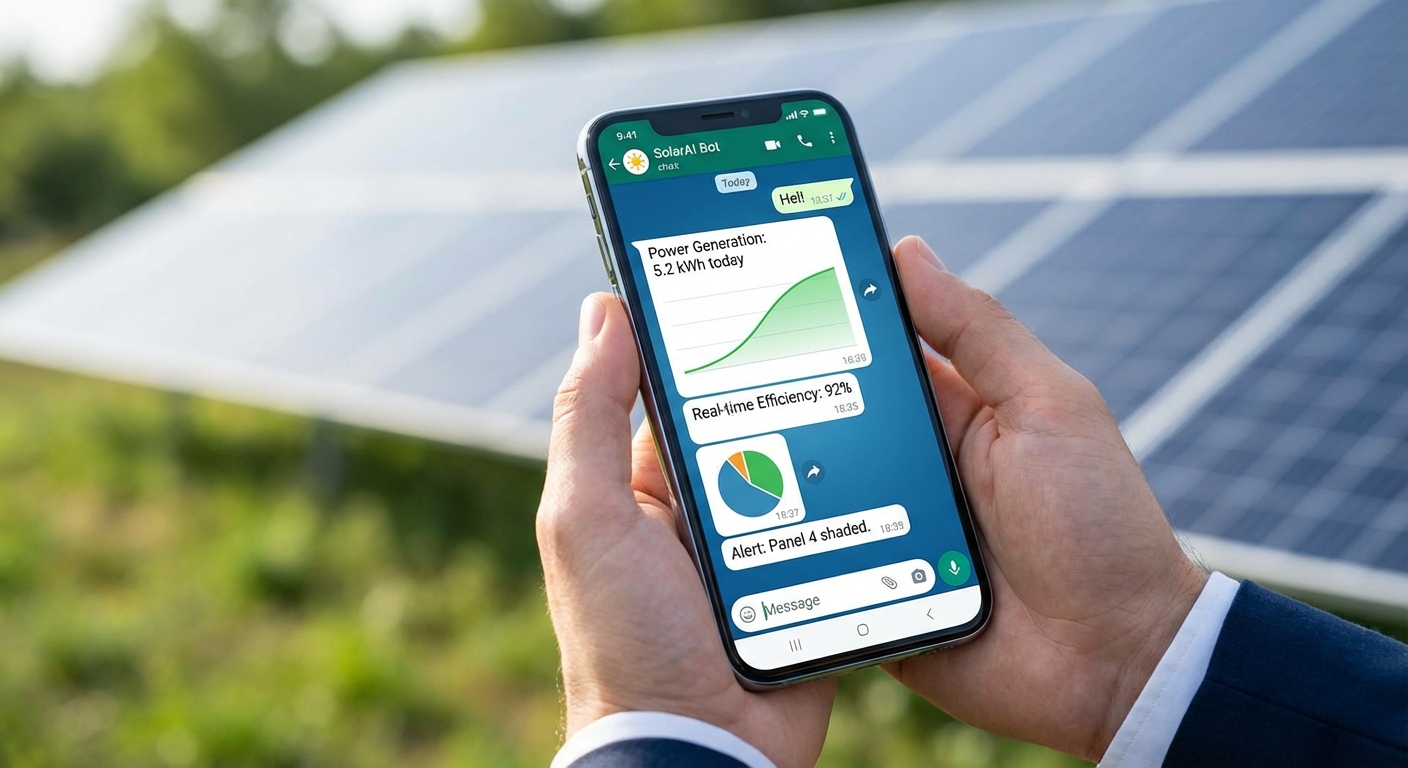
Real-Time Performance Monitoring
Advanced monitoring systems provide continuous visibility into critical parameters:
- Power Generation: Real-time and historical energy production data
- Efficiency Metrics: Actual vs. expected performance based on irradiance conditions
- Grid Parameters: Voltage, frequency, and power quality measurements
- Environmental Data: Panel temperature, ambient conditions, and irradiance levels
- Financial Performance: Energy savings, grid export revenue, and ROI tracking
AI-Powered WhatsApp Monitoring
Traditional monitoring platforms require logging into web portals or specialized apps—creating friction that reduces engagement. AI-powered WhatsApp monitoring represents a breakthrough in accessibility, delivering system status, alerts, and performance reports through the messaging platform already used by over 500 million Indians.
This approach offers several advantages:
- Zero Learning Curve: Users interact with their solar system through familiar WhatsApp conversations
- Instant Alerts: Fault notifications, underperformance warnings, and maintenance reminders arrive as WhatsApp messages
- Conversational Interface: Ask questions like “How much energy did I generate today?” and receive instant AI-generated responses
- Multi-Site Management: EPCs can monitor dozens of installations through a single WhatsApp interface
- Reduced Support Burden: Automated responses to common questions reduce call center load
Remote Diagnostics and Troubleshooting
When issues occur, remote diagnostic capabilities dramatically reduce resolution time and service costs:
- Fault Code Analysis: Detailed error logs help technicians diagnose problems before dispatching
- Performance Comparison: Compare actual vs. expected output to identify underperforming strings or panels
- Remote Parameter Adjustment: Modify inverter settings without site visits
- Firmware Updates: Deploy software improvements and bug fixes over-the-air
For EPCs managing distributed installations across multiple states, remote diagnostics can reduce service costs by 40-60% while improving response times and customer satisfaction.
Data Security and Privacy
With increasing connectivity comes data security concerns. Ensure your monitoring platform provides:
- India-based server infrastructure for data sovereignty
- Encrypted communication channels
- Role-based access controls
- Compliance with data protection regulations
Systems storing data on international servers may face regulatory challenges and expose sensitive facility information to foreign jurisdictions.
Installation Process and Best Practices
Even the highest-quality inverter will underperform if improperly installed. Following best practices during installation ensures optimal performance, safety, and longevity.
Site Assessment and Inverter Placement
Proper inverter location balances several factors:
- Temperature Management: Install in the coolest available location, preferably shaded from direct sunlight. Every 10°C reduction in operating temperature extends component life significantly.
- Ventilation: Ensure adequate airflow around the inverter, maintaining minimum clearances specified by the manufacturer (typically 30-50 cm on all sides).
- Accessibility: Position for easy access during maintenance and troubleshooting while securing against unauthorized access.
- Cable Routing: Minimize DC cable length to reduce voltage drop and power loss. Keep DC and AC cables separated to avoid electromagnetic interference.
- Weather Protection: Even IP66-rated inverters benefit from additional protection from direct rain and sun exposure when possible.
Electrical Safety Requirements
Solar installations involve high DC voltages (up to 1000V) that pose serious safety risks. Proper installation requires:
- Qualified Personnel: Only certified electricians with solar-specific training should perform installations
- DC Isolation: Install DC disconnect switches allowing safe inverter maintenance
- AC Protection: Appropriate circuit breakers and disconnects on the AC side
- Grounding: Proper earthing of all metallic components per NEC/IEC standards
- Surge Protection: Install external SPDs in addition to inverter-integrated protection for comprehensive defense
- Arc Fault Protection: For systems above certain voltages, arc fault detection and interruption may be required
Commissioning and Testing
Before energizing the system, comprehensive testing validates proper installation:
- Visual Inspection: Verify all connections, cable routing, and mechanical mounting
- Insulation Testing: Measure insulation resistance on DC and AC circuits
- Polarity Verification: Confirm correct positive/negative DC connections
- Grid Parameter Check: Verify voltage and frequency are within acceptable ranges
- Functional Testing: Confirm inverter starts properly and synchronizes with grid
- Protection Testing: Validate anti-islanding and fault protection functions
- Monitoring Setup: Configure communication systems and verify data transmission
BIS/IEC Certification Requirements
In India, solar inverters must carry BIS (Bureau of Indian Standards) certification to be legally installed and eligible for subsidies or incentives. The BIS certification process validates:
- Compliance with IS 61683 (efficiency testing)
- Compliance with IS 62109 (safety requirements)
- Grid interconnection standards
- Electromagnetic compatibility (EMC)
Additionally, IEC (International Electrotechnical Commission) certifications demonstrate compliance with global standards, providing confidence in product quality and safety.
Always verify that inverters carry current, valid certifications before procurement. Using non-certified equipment can void warranties, create liability issues, and disqualify projects from government incentive programs.
Warranty, Support, and Long-Term Reliability
The inverter warranty is one of the most critical factors in total cost of ownership calculations. Since inverters typically represent 10-15% of total system cost but are the component most likely to require replacement during the 25-year system lifetime, warranty coverage directly impacts financial returns.
Understanding Warranty Terms
Not all warranties are created equal. Key distinctions include:
- Full Replacement vs. Repair: 12-year full replacement warranties provide a new unit if failure occurs, while repair warranties may involve refurbished components or partial coverage.
- Coverage Scope: Does the warranty cover parts only, or parts and labor? Who pays shipping costs for warranty claims?
- Response Time: What is the guaranteed response time for warranty claims? Days of downtime translate directly to lost revenue.
- Exclusions: What conditions void the warranty? Improper installation, unauthorized modifications, or environmental damage may not be covered.
- Transferability: Can the warranty transfer to new owners if the property is sold?
Standard industry warranties range from 5-10 years, making 12-year full replacement coverage a significant differentiator that reduces long-term financial risk.
Digital Warranty Systems
Traditional paper-based warranty documentation creates challenges: documents get lost, claim processes are slow, and verification is difficult. Digital warranty systems solve these problems by:
- Automatically registering products upon installation
- Providing instant warranty verification via serial number lookup
- Streamlining claim submission and tracking
- Maintaining permanent digital records accessible from anywhere
- Reducing claim processing time from weeks to days
For EPCs managing multiple projects, digital warranty systems simplify administration and ensure warranty coverage is properly documented for all installations. You can download warranty documentation instantly for your records and customer handover packages.
Manufacturer Support and Service Networks
Warranty coverage is only valuable if the manufacturer has the infrastructure to honor it. Evaluate:
- Service Network: Does the manufacturer have authorized service centers in your operating regions?
- Spare Parts Availability: Are replacement parts readily available, or will warranty claims face long delays?
- Technical Support: Is knowledgeable technical support available via phone, email, or chat?
- Company Stability: Is the manufacturer backed by established corporate entities that will be in business for the warranty duration?
Manufacturers backed by established industrial groups with decades of operational history provide greater confidence in long-term support compared to startups or companies without proven track records.
Expected Lifespan and Maintenance
While warranties typically cover 10-12 years, quality inverters often operate successfully for 15-20 years with proper maintenance. Maintenance requirements are minimal but important:
- Cleaning: Periodically clean ventilation openings and heat sinks to maintain cooling efficiency
- Inspection: Annual visual inspection of connections, cable condition, and enclosure integrity
- Firmware Updates: Apply manufacturer-released firmware updates to improve performance and fix bugs
- Fan Replacement: Cooling fans may require replacement after 5-10 years of operation
- Capacitor Replacement: Electrolytic capacitors have finite lifespans and may need replacement after 10-15 years
Proactive maintenance extends inverter life and prevents unexpected failures that disrupt energy production.
Certifications and Compliance Standards in India
Navigating India’s regulatory landscape for solar equipment requires understanding multiple certification and compliance requirements.
BIS Certification
The Bureau of Indian Standards (BIS) certification is mandatory for solar inverters sold in India. The certification process involves:
- Product testing at BIS-approved laboratories
- Factory inspection and quality system audit
- Ongoing surveillance to ensure continued compliance
- BIS marking on certified products
Key BIS standards for solar inverters include:
- IS 61683: Photovoltaic systems – Power conditioners – Procedure for measuring efficiency
- IS 62109-1 & IS 62109-2: Safety of power converters for use in photovoltaic power systems
IEC International Standards
While BIS certification is mandatory for the Indian market, IEC (International Electrotechnical Commission) certifications demonstrate compliance with globally recognized standards:
- IEC 61727: Photovoltaic (PV) systems – Characteristics of the utility interface
- IEC 62116: Test procedure of islanding prevention measures for utility-interconnected photovoltaic inverters
Grid Connectivity Requirements
State electricity boards and distribution companies (DISCOMs) have specific requirements for grid-connected solar systems:
- Anti-islanding protection to prevent backfeeding during grid outages
- Voltage and frequency ride-through capabilities
- Power quality standards (harmonic distortion limits)
- Remote monitoring and control capabilities for large installations
Requirements vary by state and utility, so verify local regulations before system design.
Subsidy and Incentive Eligibility
Government subsidy programs, such as the PM-KUSUM scheme for agricultural solar and rooftop solar subsidies, require:
- BIS-certified equipment
- Approved manufacturer/supplier lists
- Minimum warranty periods
- Domestic content requirements (for certain programs)
Ensure your inverter selection meets all eligibility criteria to avoid disqualification from incentive programs that significantly improve project economics.
Cost Considerations and ROI Analysis
While inverter costs represent a relatively small portion of total system investment, the quality and features you select significantly impact long-term financial performance.
Inverter Cost as System Percentage
Inverters typically represent 10-15% of total solar system cost for grid-tied installations, and 15-20% for hybrid systems with battery integration. This relatively modest percentage means that choosing quality equipment adds minimal upfront cost while providing substantial long-term benefits.
Price vs. Quality Trade-offs
The solar inverter market spans a wide price range, from budget imports to premium European brands. Consider these factors when evaluating options:
- Component Quality: German-grade components cost more but deliver superior reliability and longevity in harsh conditions
- Warranty Coverage: Extended warranties (12+ years) have real value that should be factored into cost comparisons
- Efficiency Differences: A 2% efficiency advantage generates thousands of rupees in additional revenue annually
- Monitoring Capabilities: Advanced monitoring reduces O&M costs and improves performance
- Brand Reputation: Established manufacturers are more likely to honor warranties and provide long-term support
The lowest-cost option rarely delivers the best total cost of ownership. A mid-premium inverter with proven reliability, comprehensive warranty, and advanced features typically optimizes the cost-benefit equation.
Impact of Efficiency on Long-Term Savings
Let’s quantify the financial impact of efficiency differences:
Example: 100 kW Commercial Installation
- Annual generation: 150,000 kWh
- Commercial tariff: ₹8/kWh
- System lifetime: 25 years
Scenario 1: 96% Efficient Inverter
- Usable energy: 144,000 kWh/year
- Annual value: ₹11,52,000
- 25-year value: ₹2.88 crores
Scenario 2: 98% Efficient Inverter
- Usable energy: 147,000 kWh/year
- Annual value: ₹11,76,000
- 25-year value: ₹2.94 crores
Difference: ₹6 lakhs over system lifetime
If the higher-efficiency inverter costs ₹50,000-1,00,000 more upfront, the investment pays for itself many times over through improved energy yield.
Warranty Value in ROI Calculations
Inverter replacement costs include not just equipment but also labor, downtime, and lost production. A comprehensive warranty eliminates these risks during the coverage period.
Consider a scenario where an inverter fails in year 8:
- With 12-year warranty: Free replacement, minimal downtime, no out-of-pocket cost
- With 5-year warranty: ₹2-4 lakhs replacement cost, installation labor, 1-2 weeks downtime losing ₹25,000-50,000 in production
The extended warranty effectively provides insurance worth lakhs of rupees, justifying a modest premium in initial equipment cost.
Total Cost of Ownership Over 25 Years
Comprehensive TCO analysis includes:
- Initial equipment and installation cost
- Energy production value (accounting for efficiency)
- Maintenance and service costs
- Probability-weighted replacement costs
- Monitoring and O&M expenses
- Downtime and lost production risk
When analyzed over the full system lifetime, premium inverters with superior efficiency, extended warranties, and proven reliability consistently deliver better financial returns than budget alternatives—despite higher upfront costs.
Frequently Asked Questions About Solar Inverters in India
What size inverter do I need for my installation?
Inverter sizing depends on your solar array capacity and load requirements. For grid-tied systems, the inverter AC rating typically ranges from 0.8x to 1.0x your total panel capacity, with DC oversizing up to 2:1 (100% oversizing) common for optimizing performance. For example, a 50 kW panel array might use a 40-50 kW inverter. Consult with experienced EPCs who can analyze your specific load profile, panel configuration, and local conditions to determine optimal sizing.
How long do solar inverters last in Indian conditions?
Quality inverters designed for Indian conditions typically last 15-20 years with proper maintenance, though warranties usually cover 10-12 years. Lifespan depends heavily on component quality, thermal management, and operating environment. Inverters using German-grade components and robust cooling systems withstand India’s extreme temperatures better than equipment designed for temperate climates. Regular maintenance, including cleaning and ventilation checks, extends operational life.
Can I upgrade my inverter later or add more panels?
Yes, but with limitations. You can replace an inverter with a higher-capacity unit if you add more panels, though this involves additional costs and electrical work. Many modern inverters support DC oversizing up to 100%, allowing you to add panels up to that limit without inverter replacement. For significant capacity expansion, modular systems with multiple inverters offer more flexibility—you can add additional inverter units rather than replacing existing equipment. Plan for potential expansion during initial system design to minimize future costs.
What happens during grid failures with on-grid inverters?
On-grid inverters automatically shut down during grid outages due to anti-islanding protection—a safety feature preventing backfeeding that could endanger utility workers. Your solar system will not provide power during outages unless you have a hybrid inverter with battery backup. Hybrid systems can seamlessly switch to battery power during grid failures, maintaining critical loads. If backup power is essential for your facility, specify hybrid inverters during system design rather than attempting to retrofit later.
How do I monitor my inverter performance?
Modern inverters offer multiple monitoring options. Most provide smartphone apps with real-time performance data, historical analytics, and fault alerts. Advanced systems like AI-powered WhatsApp monitoring deliver status updates and alerts through familiar messaging platforms, eliminating the need to log into separate apps. For commercial installations, web-based dashboards provide detailed analytics, and integration with building management systems enables centralized monitoring. Ensure your inverter includes connectivity options (Wi-Fi, 4G, Bluetooth) that match your site infrastructure.
What maintenance is required for solar inverters?
Solar inverters require minimal but important maintenance. Annual tasks include: cleaning ventilation openings and heat sinks to maintain cooling efficiency, visual inspection of cable connections and enclosure condition, and verification that monitoring systems are functioning properly. Every 2-3 years, check and tighten electrical connections. Cooling fans may need replacement after 5-10 years. Apply firmware updates as released by manufacturers to improve performance and fix bugs. Most maintenance can be performed during routine solar panel cleaning visits, minimizing additional service costs.
Are imported inverters better than Indian-manufactured ones?
Not necessarily. While European brands like Fronius have strong reputations, next-generation Indian manufacturers now produce inverters specifically engineered for Indian conditions using German-grade components and advanced manufacturing processes. Indian-manufactured inverters offer advantages including: designs optimized for India’s extreme temperatures and weather, local service networks for faster warranty support, India-based data servers for security and compliance, and competitive pricing without import duties. Evaluate inverters based on specifications, certifications, warranty terms, and manufacturer reputation rather than country of origin alone.
Making the Right Choice: Partner with Proven Technology
Selecting the right solar inverter for your Indian installation requires balancing technical specifications, quality considerations, warranty coverage, and total cost of ownership. The decisions you make today will impact system performance and financial returns for the next 25 years.
Key selection criteria to prioritize include:
- Proven reliability in Indian conditions: IP66 weather protection, thermal management for extreme temperatures, and quality components designed for harsh environments
- Comprehensive warranty coverage: 12-year full replacement warranties that protect your investment and reduce long-term financial risk
- Advanced monitoring capabilities: AI-powered systems that provide real-time visibility, remote diagnostics, and proactive maintenance alerts
- High efficiency ratings: 98% efficiency that maximizes energy yield and revenue over the system lifetime
- Manufacturer reputation and support: Established companies with proven track records, local service networks, and corporate backing ensuring long-term support
For solar EPCs, distributors, and facility owners seeking inverters that combine cutting-edge technology with proven reliability, Qbits Energy represents India’s next generation of solar inverter manufacturing. Engineered with AI-powered monitoring, German-grade components, and comprehensive 12-year warranties, Qbits inverters are specifically designed to excel in Indian operating conditions while delivering the advanced features modern installations demand.
Whether you’re specifying equipment for residential rooftops or large-scale commercial installations, partnering with manufacturers who understand India’s unique requirements ensures your projects deliver optimal performance and long-term value. Explore our complete range of on-grid and hybrid inverters designed for Indian conditions, or contact our technical team to discuss your specific project requirements.
For distributors and channel partners looking to add a trusted inverter brand to their portfolio, Qbits offers comprehensive support, digital warranty systems, and competitive positioning. Learn more about becoming a Qbits partner and accessing our complete product line, technical training, and business development resources.
The solar revolution in India is accelerating, and the inverters you choose today will determine whether your installations deliver on their promise of clean, reliable, cost-effective power for decades to come. Make informed decisions based on technical merit, proven performance, and comprehensive support—your long-term success depends on it.
For additional support, technical documentation, or warranty information, visit our support portal or contact our customer service team. Stay connected with the latest innovations and industry insights by following us on LinkedIn, Instagram, and YouTube.