



Inverter MPPT: 8 Critical Selection Factors (2026)


Choosing the right inverter MPPT configuration is one of the most consequential decisions an EPC or solar installer makes. In India’s demanding climate, where rooftop temperatures regularly exceed 50°C and irradiance patterns shift dramatically across seasons, a poorly matched MPPT setup can silently drain 10–15% of your system’s annual energy yield. That loss compounds over a 25-year project life into a significant ROI gap. This guide breaks down the 8 most critical inverter MPPT selection factors so you can make confident, data-backed decisions for every project.

What Is Inverter MPPT and Why It Matters for Indian Solar Projects
Maximum Power Point Tracking (MPPT) is the algorithm inside a solar inverter that continuously adjusts the electrical operating point of the PV array to extract the maximum available power at any given moment. Solar panels don’t produce a fixed output. Their power curve shifts constantly with changes in irradiance, temperature, shading, and soiling. The MPPT circuit finds and locks onto the peak of that curve, hundreds of times per second.
For Indian solar projects, inverter MPPT performance is especially critical. High ambient temperatures push panel voltages down. Dust accumulation on panels in arid regions creates uneven soiling. Monsoon cloud cover causes rapid irradiance fluctuations. Urban rooftops often have complex layouts with mixed orientations. Each of these conditions challenges the MPPT algorithm differently. An inverter with a slow, imprecise, or narrow-range MPPT system will consistently underperform against one engineered for these real-world conditions.
For EPCs and installers, understanding inverter MPPT specifications is not optional. It is the technical foundation of every energy yield estimate you present to a client. Get it right, and your systems deliver on their promised returns. Get it wrong, and you face performance complaints, warranty disputes, and damaged client relationships. The 8 factors below give you a structured framework for evaluating any inverter’s MPPT capabilities before you commit to a project.
For a broader view of inverter selection criteria beyond MPPT, see our guide on Solar Inverter Selection: 10 Critical Criteria for EPCs.
1. Number of MPPT Channels: Matching Your Panel Configuration
The number of independent MPPT inputs on an inverter determines how many separate string groups it can optimize simultaneously. A single-MPPT inverter treats the entire array as one electrical unit. A dual or multi-MPPT inverter can track different strings independently, each at its own optimal operating point.
When Multiple MPPT Channels Are Essential
- Split roof orientations: If panels face east and west, or south and south-west, they receive different irradiance profiles throughout the day. A single MPPT will compromise between the two, underperforming on both. Separate MPPT channels allow each orientation to be tracked independently.
- Partial shading scenarios: Strings affected by shading from water tanks, parapets, or adjacent structures should be isolated on their own MPPT channel to prevent shading losses from dragging down unaffected strings.
- Mixed panel configurations: When different panel wattages or models are used in the same system (common in retrofit projects), separate MPPT channels prevent mismatched strings from limiting each other.
Red flag: Specifying a single-MPPT inverter for a rooftop with two or more distinct orientations is one of the most common and costly MPPT mistakes in Indian commercial installations. Always map the roof layout before selecting the number of MPPT channels.
As a general rule, plan for one MPPT channel per distinct string group with a unique irradiance profile. For residential systems under 10 kW with a single south-facing roof, a dual-MPPT inverter provides adequate flexibility. For commercial rooftops above 20 kW with complex layouts, look for inverters with three or more independent MPPT inputs.
2. MPPT Voltage Range: Compatibility with High-Wattage Panels
Every inverter MPPT circuit operates within a defined voltage window. Strings must stay within this range for the inverter to track power effectively. With modern high-wattage panels (400W to 750W and beyond), string voltages are higher than ever. Selecting an inverter with a narrow or mismatched MPPT voltage range is a technical error that no amount of monitoring can fix after installation.
Key Voltage Parameters to Verify
- Voc (Open Circuit Voltage): The maximum voltage a string can produce. Must stay below the inverter’s maximum DC input voltage, especially in cold morning conditions when panel voltages peak.
- Vmpp (Maximum Power Point Voltage): The operating voltage at peak power. Must fall within the inverter’s MPPT voltage range throughout the day and across all seasons.
- Start-up voltage: The minimum voltage at which the MPPT begins tracking. A lower start-up voltage means the inverter begins generating earlier in the morning and continues later in the evening, adding meaningful kWh to annual yield.
In Indian summer conditions, panel temperatures can reach 70°C or higher on rooftops. At these temperatures, panel Vmpp drops significantly due to the negative temperature coefficient of voltage. Your MPPT voltage range must accommodate this lower operating voltage without the inverter dropping out of tracking. Always run temperature-corrected string sizing calculations, not just standard test condition (STC) values.
Qbits inverters support panels up to 750W with a wide MPPT voltage range and low start-up voltage, specifically engineered for the high-wattage panel configurations that are now standard in Indian residential and C&I projects. Explore Qbits inverter specifications to verify compatibility with your panel selection.
3. MPPT Tracking Efficiency: The Percentage That Defines Your Yield
MPPT tracking efficiency is the ratio of power actually extracted by the inverter to the theoretical maximum power available from the panels at any instant. It is expressed as a percentage, and the difference between 97% and 99.5% tracking efficiency is not trivial. Over a 25-year system life, that 2.5% gap translates directly into lost generation and reduced client returns.
Understanding the Numbers
Most inverter datasheets report peak MPPT efficiency, which is measured under ideal, stable conditions. What matters more in practice is weighted average MPPT efficiency, which accounts for performance across the full range of irradiance levels, including the low-light conditions that make up a significant portion of daily generation hours in India.
MPPT algorithms vary in their approach. The traditional Perturb and Observe (P&O) method is simple but can oscillate around the maximum power point rather than locking onto it precisely. Incremental Conductance algorithms are more accurate but computationally heavier. The most advanced inverters now use AI-based adaptive tracking that learns irradiance patterns and adjusts tracking speed and step size dynamically, achieving near-perfect tracking efficiency even during rapid cloud transients.
When evaluating inverter MPPT datasheets, look for efficiency curves that show performance at 10%, 20%, 50%, and 100% of rated power. An inverter that maintains above 98% MPPT efficiency across this full range is genuinely high-performing. Be skeptical of datasheets that only report peak efficiency without the full curve.
4. DC Oversizing Ratio: Maximizing Generation Without Clipping
DC oversizing refers to installing a PV array with a higher DC capacity than the inverter’s rated AC output. For example, connecting 10 kWp of panels to an 8 kW inverter gives a DC:AC ratio of 1.25. This is standard practice in solar design because panels rarely produce their rated output under real-world conditions. Oversizing allows the inverter to operate closer to its rated output for more hours per day, improving capacity utilization and energy yield.
Why Oversizing Matters for MPPT Performance
When the DC array produces more power than the inverter can convert, the inverter limits output through a process called clipping. The MPPT algorithm deliberately moves the operating point away from the true maximum power point to cap output at the inverter’s rated capacity. Some clipping is acceptable and economically justified. Excessive clipping wastes generation and reduces ROI.
Inverters that support up to 100% DC oversizing give EPCs maximum design flexibility. This capability is particularly valuable in India, where morning and evening irradiance is lower and panels rarely hit their STC ratings. A higher DC:AC ratio captures more energy during shoulder hours without significant clipping losses at peak irradiance.
The optimal DC oversizing ratio for Indian conditions typically falls between 1.2 and 1.4, depending on location, panel tilt, and orientation. For sites with high peak irradiance and minimal cloud cover (Rajasthan, Gujarat), keep the ratio closer to 1.2 to limit clipping. For sites with more diffuse irradiance (coastal Karnataka, Kerala), ratios up to 1.4 can be justified. Always model clipping losses in your energy simulation software before finalizing the design.
5. Shading Tolerance and Partial Shading Performance

Partial shading is the most complex challenge for any inverter MPPT system. When even a small portion of a solar array is shaded, the I-V curve of the affected string develops multiple local power peaks. A basic MPPT algorithm may lock onto a local maximum rather than the true global maximum, leaving significant power on the table.
Global MPPT vs. Local MPPT
Standard MPPT algorithms use a narrow search window and can get trapped at a local power peak. Global MPPT (GMPPT) algorithms perform a wider voltage sweep across the full operating range to identify the true global maximum power point, even when the I-V curve has multiple peaks due to partial shading. This distinction is critical for Indian urban rooftop installations, where shading from water tanks, staircase structures, parapets, and adjacent buildings is nearly universal.
In practice, the energy yield difference between a standard MPPT and a global MPPT inverter in a partially shaded system can exceed 5–8% annually. For a 50 kW commercial system, that difference represents thousands of units of lost generation per year.
When to Combine MPPT Inverters with Module-Level Electronics
For systems with severe or unavoidable shading, consider combining a multi-MPPT inverter with DC optimizers or microinverters at the module level. This approach provides the finest granularity of power optimization but adds cost and complexity. For most Indian rooftop projects, a well-designed multi-MPPT inverter with global MPPT capability provides the best balance of performance and cost-effectiveness.
Learn how advanced monitoring can help you detect and quantify shading losses in real time in our article on Solar Inverter Monitoring Systems in India (2026).
6. Low-Light and High-Temperature MPPT Performance
India’s solar generation profile is not just about peak irradiance hours. The hours immediately after sunrise and before sunset, as well as overcast monsoon days, contribute meaningfully to annual energy yield. An inverter MPPT system that performs well only at high irradiance levels is leaving generation on the table every single day.
Low-Light MPPT Performance
The key metric here is start-up voltage. An inverter that begins MPPT tracking at a lower voltage will start generating earlier in the morning and continue later in the evening. Across 365 days, this can add 3–5% to annual yield compared to an inverter with a higher start-up threshold. Look for inverters with start-up voltages below 150V for residential systems and below 200V for commercial string inverters.
Also examine the efficiency curve at low load percentages (10, 20% of rated power). Some inverters show excellent peak efficiency but drop sharply at low irradiance. A flat efficiency curve across the full load range indicates a well-designed MPPT circuit and power stage.
High-Temperature MPPT Performance
Thermal derating is a real concern in Indian installations. When an inverter’s internal temperature rises above its rated operating threshold, it reduces output power to protect its components. This derating directly affects MPPT performance because the inverter is no longer tracking at the panel’s true maximum power point. It is deliberately operating below it.
Inverters with IP66 weather protection and efficient thermal management maintain MPPT accuracy even in harsh rooftop conditions. Look for inverters with wide operating temperature ranges and low thermal derating rates. An inverter that begins derating at 45°C ambient will underperform significantly during Indian summer afternoons. One rated to operate at full capacity up to 50°C or higher is a better fit for the Indian climate.
7. MPPT Monitoring and Real-Time Performance Visibility
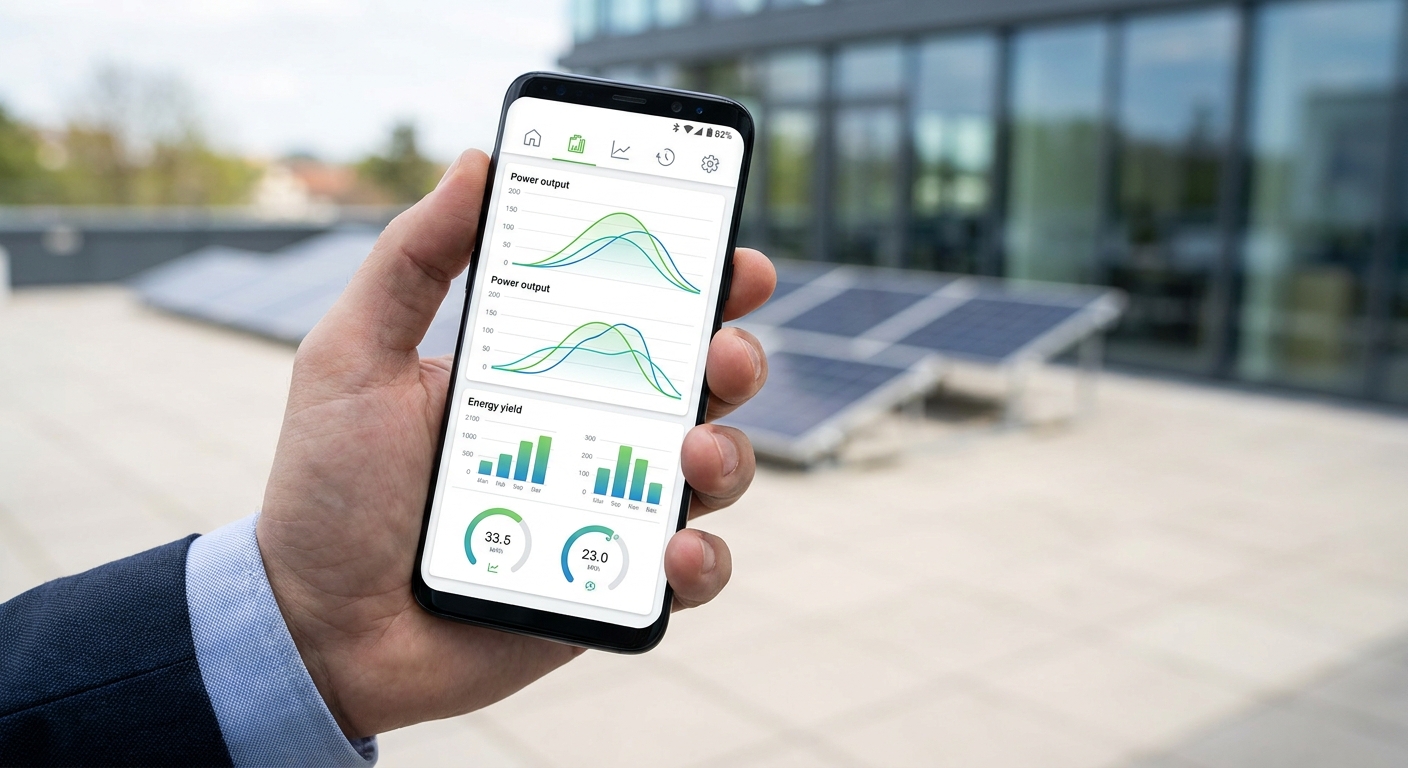
Even the best inverter MPPT system can underperform due to soiling, connection degradation, or panel faults. Without per-channel monitoring visibility, these issues go undetected for months, silently eroding energy yield and client returns. Real-time MPPT monitoring is not a luxury feature. It is an operational necessity for any EPC that takes performance guarantees seriously.
What Good MPPT Monitoring Looks Like
- Per-MPPT channel power and voltage data: Allows you to compare performance across strings and immediately identify underperforming channels.
- Historical yield curves: Compare today’s generation profile against historical baselines to detect gradual degradation or sudden faults.
- Real-time alerts: Instant notifications when MPPT performance drops below expected thresholds, enabling rapid fault response.
- Remote diagnostics: The ability to diagnose MPPT issues without a site visit reduces O&M costs and response times.
AI-Powered WhatsApp Monitoring for Indian Installers
Qbits inverters feature an AI-powered WhatsApp monitoring system that delivers real-time performance alerts directly to installers and end-users via WhatsApp. This approach is uniquely suited to the Indian market, where WhatsApp is the dominant communication platform for both residential and commercial clients. When an MPPT channel underperforms, the system sends an immediate alert with actionable data, enabling faster fault resolution and better client communication.
The monitoring system supports Wi-Fi, 4G, and Bluetooth connectivity, ensuring reliable data transmission even from remote or poorly connected installation sites. For EPCs managing large portfolios of installations, this level of visibility transforms reactive maintenance into proactive performance management.
For a comprehensive look at monitoring options available to Indian solar installers, read our detailed guide on Solar Inverter Monitoring Systems in India (2026).
8. Inverter MPPT Warranty and Long-Term Reliability
The MPPT circuit is one of the most electronically complex and thermally stressed components inside a solar inverter. It operates continuously, switching at high frequency, tracking power curves hundreds of times per second, for the entire operational life of the system. The quality of components used in the MPPT circuit directly determines inverter lifespan and long-term tracking accuracy.
What Component Quality Signals
Inverters built with German-grade electronic components in the MPPT and power conversion stages offer measurably better long-term reliability than those built to minimum cost specifications. Key components include the MPPT controller IC, power MOSFETs or IGBTs, capacitors, and inductors. Degradation in any of these components causes MPPT tracking accuracy to drift over time, reducing energy yield without triggering any obvious fault condition.
A manufacturer that subjects every unit to 1,000+ automated quality tests before shipment is validating MPPT circuit performance under simulated operating conditions. This level of quality assurance is a meaningful differentiator from manufacturers who rely on batch sampling.
Warranty as a Reliability Signal
A 12-year full replacement warranty is a strong signal of manufacturer confidence in MPPT circuit quality. Short warranty periods (3, 5 years) on inverters are often a sign that the manufacturer expects component degradation to begin affecting performance within that window. For EPCs offering long-term performance guarantees to clients, the inverter warranty period is a direct input into your risk model.
BIS/IEC certification provides a baseline assurance that the inverter’s MPPT performance meets defined standards. However, certification is a floor, not a ceiling. Look for manufacturers who exceed certification requirements through additional quality processes.
To understand how inverter quality and warranty terms affect the full financial picture of a solar project, see our Solar Inverter Lifespan: Complete Financial Planning Guide.
Red Flags to Avoid When Evaluating Inverter MPPT Specifications
Not all inverter MPPT claims are equal. Some manufacturers present misleading or incomplete data that looks impressive on a datasheet but fails in the field. Here are the most important red flags to watch for during inverter MPPT evaluation:
- Missing or vague MPPT efficiency data: If a datasheet only states “high MPPT efficiency” without a specific percentage or efficiency curve, treat it as a red flag. Reputable manufacturers publish full efficiency curves across the load range.
- Narrow MPPT voltage range: An MPPT range that doesn’t accommodate modern 400W, 750W panels at temperature-corrected voltages will cause tracking failures or require costly string redesigns.
- Single MPPT on complex rooftops: Specifying a single-MPPT inverter for a system with multiple orientations or significant shading is a design error that no software optimization can fully compensate for.
- No global MPPT algorithm: For any Indian urban rooftop installation, the absence of a global MPPT capability is a significant performance risk given the near-universal presence of partial shading sources.
- No per-channel monitoring: An inverter that only reports total system output without per-MPPT channel visibility makes fault detection and performance optimization nearly impossible.
- Short warranty periods: Warranties under 5 years on inverters should prompt serious questions about component quality and manufacturer confidence in long-term MPPT reliability.
How to Match Inverter MPPT Specs to Your Solar Panel Configuration

Translating the 8 factors above into a practical selection process requires a structured approach. Here is a step-by-step checklist for EPCs and installers evaluating inverter MPPT compatibility with a specific panel configuration.
MPPT Compatibility Checklist
- Document panel specifications: Record Voc, Vmpp, Isc, and Impp at STC for your selected panel model. Note the temperature coefficient of voltage (typically -0.28% to -0.35%/°C).
- Calculate temperature-corrected string voltages: Apply the temperature coefficient to calculate Voc at minimum site temperature (for maximum voltage) and Vmpp at maximum panel temperature (for minimum operating voltage). Both values must fall within the inverter’s acceptable range.
- Map roof layout and shading sources: Identify distinct orientations, tilt angles, and shading sources. Each distinct group requires its own MPPT channel.
- Verify DC oversizing headroom: Calculate your planned DC:AC ratio and confirm the inverter supports it. For Indian conditions, target 1.2, 1.4.
- Confirm global MPPT capability: For any system with identified shading sources, verify the inverter uses a global MPPT algorithm.
- Check monitoring granularity: Confirm per-MPPT channel data is available through the monitoring platform.
- Validate warranty terms: Confirm the warranty period, coverage scope (repair vs. full replacement), and the manufacturer’s India-based support infrastructure.
Worked Example: 10 kW Dual-Orientation Rooftop in India
Consider a 10 kW residential rooftop in Ahmedabad with panels split across a south-facing slope (6 kWp) and an east-facing slope (4 kWp). The selected panels are 500W modules with a Voc of 49.5V and a Vmpp of 41.2V. Minimum site temperature is 5°C; maximum panel temperature is estimated at 75°C.
Temperature-corrected Voc at 5°C: 49.5V × (1 + 0.003 × (5 – 25)) = 52.5V per panel. A string of 12 panels gives 630V maximum, which must stay below the inverter’s maximum DC input voltage (typically 1000V for commercial inverters). Temperature-corrected Vmpp at 75°C: 41.2V × (1 – 0.003 × (75 – 25)) = 35.0V per panel. A string of 12 panels gives 420V minimum operating voltage, which must fall within the MPPT range.
This system requires a dual-MPPT inverter with an MPPT range that accommodates 420V, 630V per string, global MPPT capability for the east-facing slope (which will be partially shaded by the south-facing slope’s structure in the afternoon), and per-channel monitoring to track the performance difference between the two orientations.
On-Grid vs. Hybrid MPPT Considerations
Hybrid inverters add battery charging to the MPPT equation. The inverter must simultaneously optimize PV generation and manage battery charge/discharge cycles. This creates additional demands on the MPPT algorithm, particularly during transitions between grid-connected and battery-priority modes. When selecting a hybrid inverter for battery-integrated systems, verify that the MPPT performance specifications are maintained during battery charging, not just during grid-export mode. Some hybrid inverters show reduced MPPT efficiency when the battery charging circuit is active.
For a detailed comparison of on-grid and hybrid inverter architectures and their implications for system design, see our guide on Solar Inverter Manufacturers in India: Complete Evaluation Guide for EPCs & Distributors (2026).
Frequently Asked Questions About Inverter MPPT
How many MPPT channels do I need for my system?
The minimum number of MPPT channels equals the number of distinct string groups with different irradiance profiles. For a simple single-orientation rooftop, one MPPT channel is sufficient. For systems with two or more orientations, or with significant shading sources affecting different parts of the array, use one MPPT channel per distinct group. When in doubt, choose an inverter with more MPPT channels than you think you need. The flexibility is worth the marginal cost.
What is a good MPPT efficiency percentage?
Look for inverters with a peak MPPT tracking efficiency of 99% or higher and a weighted average efficiency above 98% across the full load range. Be cautious of datasheets that only report peak efficiency. The weighted average, which accounts for low-irradiance performance, is the more meaningful metric for real-world energy yield.
Does MPPT work during cloudy weather?
Yes. MPPT is especially important during cloudy conditions because irradiance fluctuates rapidly, and the maximum power point shifts continuously. A fast, accurate MPPT algorithm captures more energy during these transient conditions than a slow or imprecise one. Look for inverters with high-speed MPPT tracking (sampling rates above 100 Hz) for best performance during variable irradiance.
Can I mix different panel brands on the same MPPT channel?
It is technically possible but not recommended. Panels with different electrical characteristics (Vmpp, Isc) on the same MPPT channel will cause the inverter to compromise between their individual optimal operating points, reducing overall yield. If you must mix panel types, assign each type to its own MPPT channel. This is another reason why multi-MPPT inverters offer greater design flexibility.
How does MPPT affect hybrid inverter battery charging?
In a hybrid inverter, the MPPT circuit must balance PV generation between immediate load consumption, battery charging, and grid export simultaneously. The MPPT algorithm needs to be sophisticated enough to maintain optimal PV tracking while the battery management system adjusts charging current dynamically. Verify that the hybrid inverter’s MPPT specifications are tested and rated under battery-charging conditions, not just grid-export conditions.
Make Inverter MPPT Your Competitive Advantage
Inverter MPPT performance is the technical core of every solar system’s energy yield. The 8 factors covered in this guide, from the number of MPPT channels and voltage range compatibility to tracking efficiency, shading tolerance, and warranty-backed reliability, give EPCs and installers a rigorous framework for making inverter selections that deliver on their promised returns. In India’s demanding climate and increasingly competitive solar market, the difference between a good MPPT specification and a great one shows up in every monthly generation report your clients receive.
Qbits inverters are engineered specifically for Indian conditions, with wide MPPT voltage ranges supporting panels up to 750W, global MPPT algorithms for shading tolerance, AI-powered WhatsApp monitoring for real-time performance visibility, and a 12-year full replacement warranty backed by German-grade components and 1,000+ automated quality tests per unit. If you are evaluating inverter MPPT options for your next project, we invite you to take a closer look.
Inquire now on WhatsApp to discuss your project’s MPPT requirements with our technical team, or explore the full Qbits inverter range to review detailed MPPT specifications. EPCs and distributors looking to add a high-performance, India-engineered inverter brand to their portfolio can apply to become a Qbits partner. For technical support on existing installations, visit our support portal.
This blog post was written using thestacc.com