



On-Grid vs Hybrid Solar Inverters in India: Which Type Delivers Better ROI in 2026?

Choosing between on-grid and hybrid solar inverters represents one of the most critical decisions for solar installation companies, EPCs, and facility owners in India. As the solar industry evolves in 2026, this choice directly impacts project economics, energy independence, and long-term return on investment. With India’s grid infrastructure varying significantly across regions and electricity tariff structures becoming increasingly complex, understanding the nuanced differences between on-grid vs hybrid inverter systems is essential for making informed investment decisions.
This comprehensive comparison analyzes upfront costs, long-term savings potential, battery integration benefits, grid dependency factors, and performance during power outages—all within the context of Indian market conditions. Whether you’re an EPC planning a commercial installation or a distributor advising clients on inverter selection, this guide provides the technical and financial insights needed to determine which inverter type delivers superior ROI for specific project requirements.
Understanding On-Grid and Hybrid Solar Inverters: The Foundation of Your Solar Investment
Before diving into cost comparisons and ROI calculations, it’s crucial to understand the fundamental operational differences between on-grid and hybrid solar inverters, as these differences drive all downstream decisions regarding system design, performance, and economics.
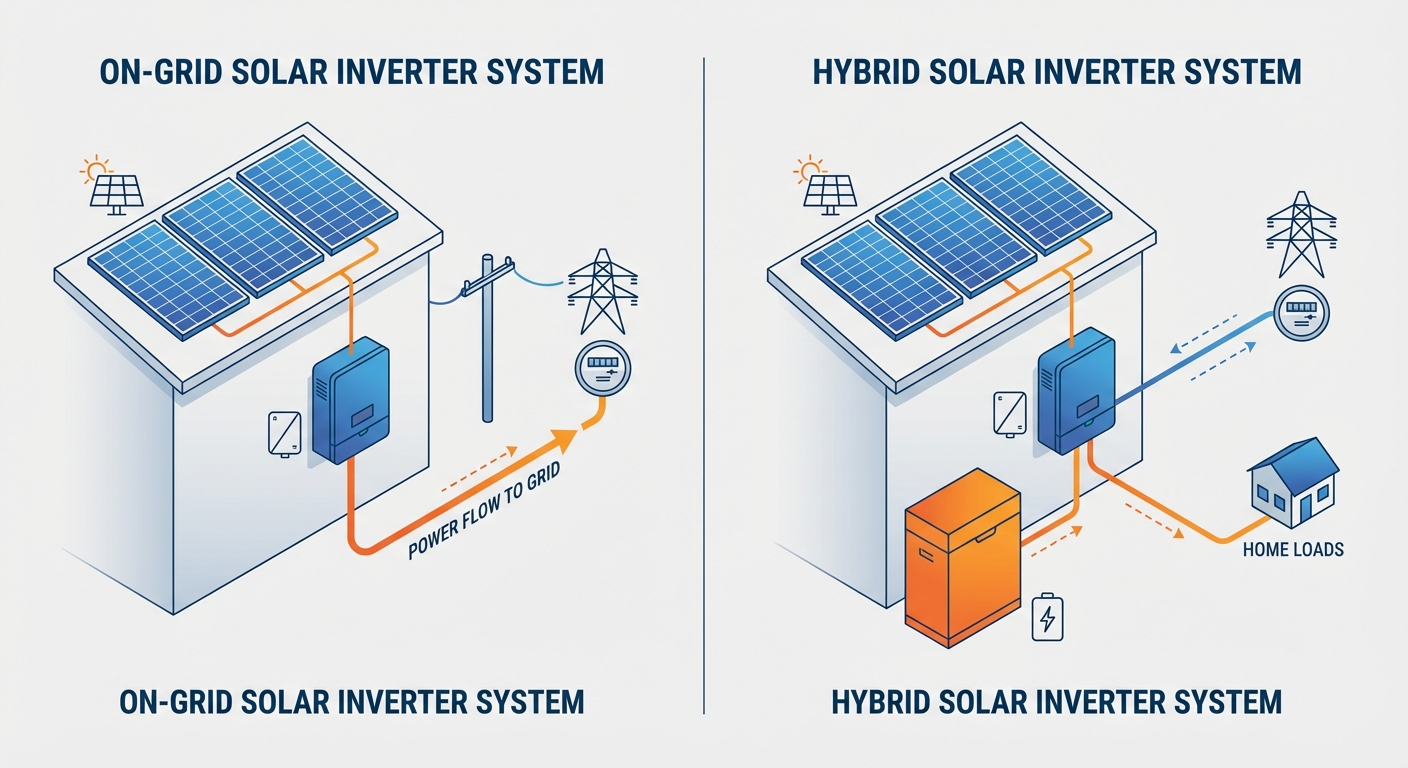
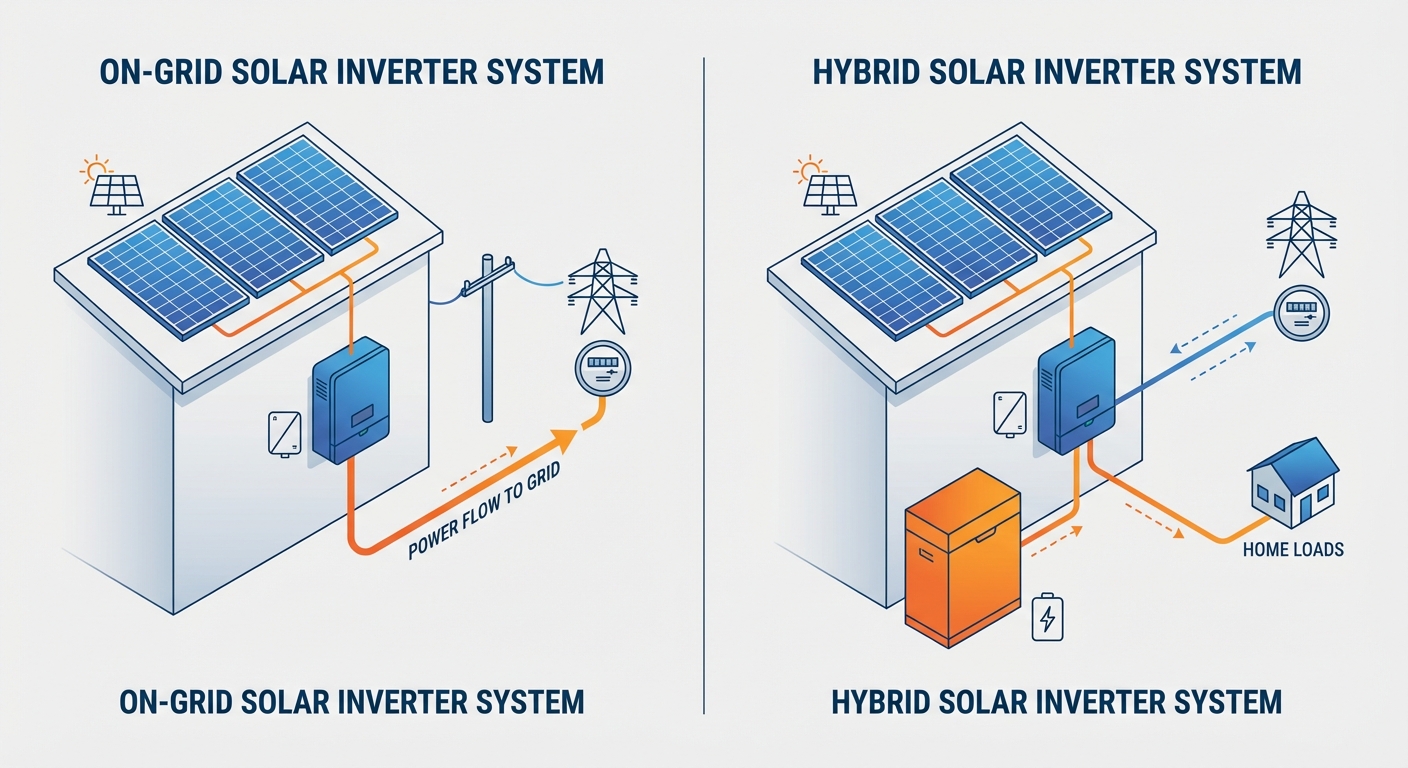
On-grid solar inverters, also known as grid-tied inverters, convert DC electricity generated by solar panels into AC electricity that synchronizes with the utility grid. These systems operate in direct connection with the electrical grid, feeding excess solar generation back to the utility network through net metering arrangements. The key characteristic of on-grid inverters is their dependency on grid availability—when the grid goes down, the inverter automatically shuts off for safety reasons, even if the sun is shining and panels are generating power.
Modern on-grid inverters from manufacturers like Qbits feature advanced capabilities including 98% efficiency ratings, support for high-wattage panels up to 750W, and up to 100% DC oversizing capability. These technical specifications enable maximum energy harvest from solar installations while maintaining grid code compliance and safety standards required by Indian regulations.
Hybrid solar inverters represent the next evolution in solar technology, combining the grid-connection capabilities of on-grid inverters with integrated battery management systems. These sophisticated devices can simultaneously manage power flow between solar panels, battery storage, grid connection, and connected loads. The defining advantage of hybrid inverters is their ability to provide backup power during grid outages by drawing from battery reserves, offering energy independence that on-grid systems cannot match.
Hybrid inverters incorporate intelligent energy management algorithms that optimize when to charge batteries, when to export to the grid, and when to supply loads from different sources based on time-of-use tariffs and user preferences. This flexibility makes hybrid systems particularly valuable in regions with unreliable grid supply or for facilities where power continuity is mission-critical.
Key Technical Differences
The technical architecture of these two inverter types creates distinct operational characteristics:
- Power Flow Management: On-grid inverters manage bidirectional power flow between panels and grid only, while hybrid inverters manage multi-directional flow between panels, batteries, grid, and loads
- Grid Dependency: On-grid systems require active grid connection to operate; hybrid systems can function in grid-tied, off-grid, or hybrid modes
- Component Complexity: Hybrid inverters integrate battery charge controllers and energy management systems that on-grid inverters lack
- Monitoring Capabilities: Both types support advanced monitoring, but hybrid systems provide additional battery health, charge/discharge cycles, and backup power analytics
- Safety Features: Both require anti-islanding protection, but hybrid systems need additional battery safety management including temperature monitoring and charge balancing
For solar installers and EPCs working in the Indian market, understanding these technical foundations is essential for proper system sizing, component selection, and setting accurate client expectations regarding system capabilities and limitations.
Upfront Cost Analysis: Initial Investment Comparison
The initial capital expenditure represents the most visible difference between on-grid and hybrid solar inverter systems, and often becomes the primary decision factor for cost-sensitive projects. However, a comprehensive cost analysis must look beyond the inverter price tag to include all system components and installation requirements.
On-Grid Inverter System Costs
On-grid solar inverter systems typically represent the lower upfront investment option. For a standard residential installation in India (3-5 kW capacity), the inverter component generally accounts for approximately 10-15% of total system cost. Commercial and industrial installations benefit from economies of scale, with inverter costs per kW decreasing as system size increases.
The cost structure for on-grid systems includes:
- Inverter unit: The core component, with pricing varying based on capacity, efficiency ratings, and component quality
- DC and AC surge protection devices (SPDs): Essential for protecting against voltage fluctuations common in Indian grid conditions
- Monitoring systems: Wi-Fi, 4G, or Bluetooth connectivity modules for remote system management
- Installation and commissioning: Labor costs for professional installation and grid interconnection
- Grid interconnection fees: Utility charges for net metering setup and approvals
Quality considerations significantly impact pricing. Inverters built with German-grade electronic components and subjected to rigorous quality testing (1000+ automated tests per unit) command premium pricing but deliver superior reliability and longevity. For EPCs and installers, this quality differential directly affects warranty claims, maintenance costs, and customer satisfaction over the system’s operational life.
Hybrid Inverter System Costs
Hybrid solar inverter systems require substantially higher initial investment due to the addition of battery storage and more sophisticated power management electronics. The battery bank typically represents 40-50% of the total system cost, making it the single largest expense component.
Complete hybrid system costs include:
- Hybrid inverter unit: Generally 20-40% more expensive than equivalent-capacity on-grid inverters due to integrated battery management and multi-mode operation capabilities
- Battery storage system: Lithium-ion batteries (recommended for longevity and efficiency) or lead-acid alternatives (lower upfront cost but shorter lifespan)
- Battery management system (BMS): Often integrated into hybrid inverters but may require separate components for larger installations
- Enhanced surge protection: Additional protection for battery systems against voltage spikes
- Monitoring and control systems: More sophisticated monitoring to track battery health, charge cycles, and backup power availability
- Installation complexity: Higher labor costs due to battery installation, additional wiring, and system configuration
For a comparable 5 kW residential system, hybrid installations typically cost 60-80% more than on-grid alternatives when including adequate battery capacity (5-10 kWh) for meaningful backup power. Commercial installations may see slightly lower percentage premiums due to bulk purchasing and installation efficiencies.
Hidden Costs and Long-Term Considerations
Beyond the obvious component costs, several hidden expenses affect total cost of ownership:
Maintenance requirements: Hybrid systems require periodic battery maintenance and eventual replacement (typically 5-10 years for lithium-ion, 3-5 years for lead-acid), while on-grid inverters have minimal maintenance needs beyond cleaning and periodic inspections.
Space requirements: Battery systems require dedicated, climate-controlled space, potentially adding infrastructure costs for commercial installations.
Insurance and safety compliance: Battery storage may increase insurance premiums and require additional safety certifications.
However, the value of comprehensive warranty coverage cannot be overstated. A 12-year full replacement warranty significantly reduces long-term risk and total cost of ownership compared to standard 5-year warranties common in the industry. For EPCs and installers, strong warranty support from manufacturers like Qbits translates to reduced service calls, lower warranty claim processing burden, and enhanced customer confidence.
Long-Term Savings and ROI Calculation for Indian Solar Projects
While upfront costs favor on-grid systems, the complete ROI picture emerges only when analyzing long-term savings, payback periods, and total cost of ownership over the system’s operational lifetime. Indian electricity tariff structures, net metering policies, and regional grid reliability all significantly impact these calculations.
Payback Period Analysis
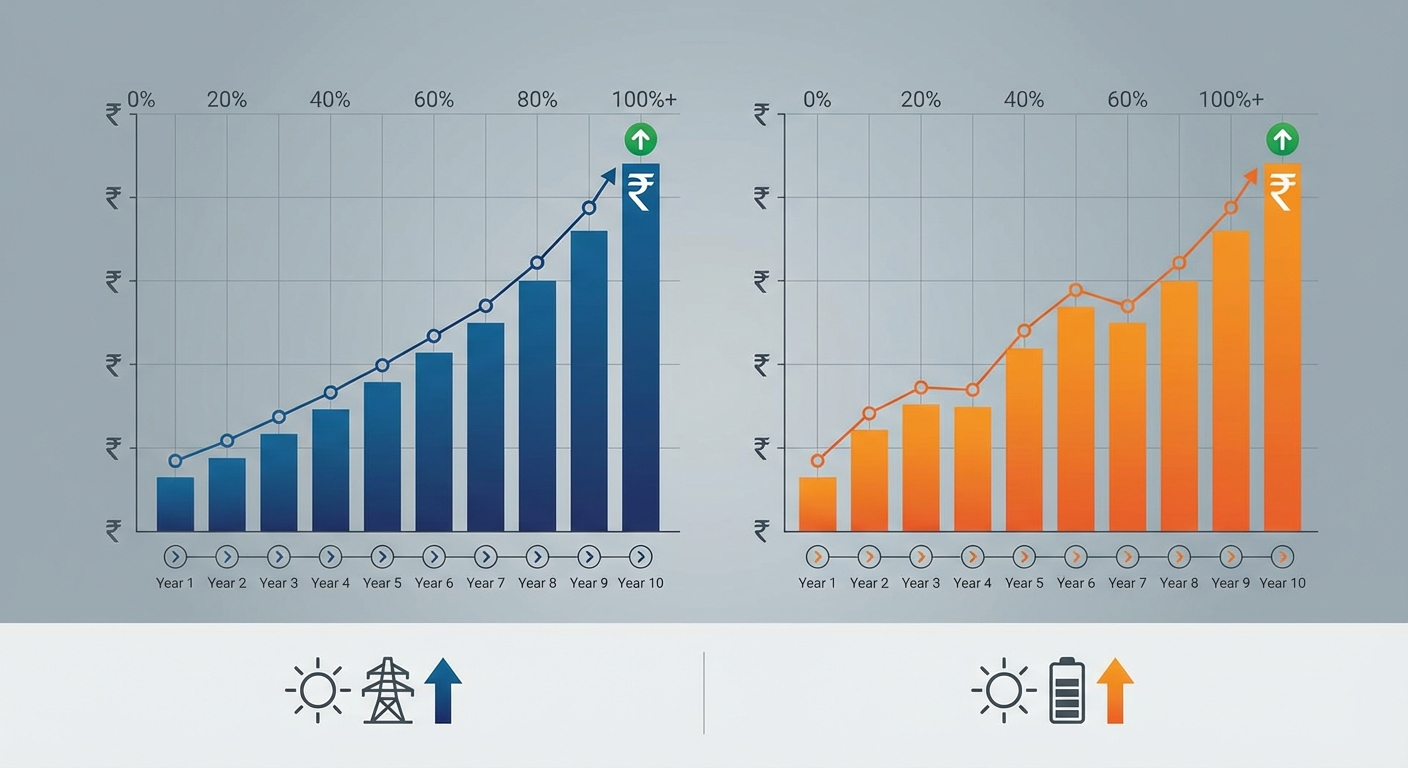
On-grid solar systems in India typically achieve payback periods of 4-6 years for residential installations and 3-5 years for commercial and industrial projects, depending on local electricity rates and solar irradiation levels. The calculation is relatively straightforward: divide total system cost by annual electricity bill savings from solar generation and net metering credits.
Hybrid system payback periods extend to 7-10 years for residential installations due to higher upfront costs. However, this calculation becomes more complex and favorable when factoring in:
- Avoided backup power costs: Savings from eliminating diesel generator operation during outages
- Time-of-use tariff optimization: Using stored solar energy during peak-rate evening hours instead of expensive grid power
- Business continuity value: For commercial facilities, avoiding revenue loss from power outages
- Grid electricity price escalation: As utility rates increase 5-8% annually in India, stored solar energy becomes increasingly valuable
Electricity Bill Savings with Indian Tariff Structures
India’s diverse electricity tariff structures significantly impact inverter selection and ROI calculations. States with favorable net metering policies and high retail electricity rates (₹7-12 per kWh for commercial consumers) make on-grid systems highly attractive, as every unit of solar generation directly offsets expensive grid consumption.
For hybrid systems, the value proposition strengthens in scenarios with:
- Time-of-use (TOU) tariffs: Where evening peak rates are 2-3x higher than daytime rates, storing midday solar generation for evening use delivers substantial savings
- Demand charges: Commercial consumers facing high demand charges can use battery storage to reduce peak demand from the grid
- Poor net metering rates: In states where export rates are significantly lower than import rates, self-consumption through battery storage becomes economically superior
A typical 100 kW commercial installation in Maharashtra with TOU tariffs might save ₹12-15 lakhs annually with an on-grid system, while a hybrid system with 50 kWh battery storage could save ₹15-18 lakhs by optimizing energy usage patterns and avoiding peak-rate consumption.
Impact of Net Metering Policies
Net metering regulations vary significantly across Indian states, directly affecting on-grid system economics. States with 1:1 net metering (where exported solar energy receives full retail rate credit) maximize on-grid ROI. However, many states have moved to net billing or reduced export rates, diminishing the value of grid export.
In regions with unfavorable net metering policies, hybrid systems gain competitive advantage by maximizing self-consumption rather than relying on grid export credits. The ability to store excess solar generation for later use becomes economically superior to exporting at reduced rates.
Battery Lifecycle Costs and Replacement Considerations
A realistic hybrid system ROI calculation must account for battery replacement costs. Lithium-ion batteries typically deliver 4,000-6,000 charge cycles, translating to 8-12 years of service life with daily cycling. Lead-acid batteries require replacement every 3-5 years, significantly impacting total cost of ownership.
For a 10 kWh lithium-ion battery system, expect replacement costs of ₹4-6 lakhs in current market conditions. However, battery prices continue declining approximately 10-15% annually, meaning replacement costs in 2034-2036 will likely be substantially lower than today’s prices.
Warranty Protection Impact on Total Cost of Ownership
The quality of warranty coverage dramatically affects long-term economics. Standard 5-year warranties leave system owners exposed to potential inverter failures during years 6-25 of system operation. A 12-year full replacement warranty provides comprehensive protection during the critical mid-life period when component failures become more likely.
For EPCs and installers, strong manufacturer warranty support reduces service costs, minimizes customer disputes, and protects profit margins. The digital warranty systems and responsive support infrastructure offered by manufacturers like Qbits streamline warranty claim processing and reduce administrative burden.
When calculating true ROI, factor in the risk-adjusted cost of potential inverter replacement. An on-grid system with 12-year warranty coverage may deliver superior risk-adjusted returns compared to a cheaper alternative with limited warranty protection, even if the initial purchase price is higher.
Grid Dependency and Power Outage Performance
Grid reliability varies dramatically across India, from relatively stable urban networks to rural areas experiencing frequent outages. This variability makes grid dependency and backup power capability critical factors in inverter selection, particularly for commercial and industrial installations where power interruptions directly impact operations and revenue.
On-Grid Inverter Performance During Grid Failures
On-grid solar inverters are designed with mandatory anti-islanding protection that automatically disconnects the system when grid power fails. This safety feature prevents solar systems from energizing grid lines during maintenance or outages, protecting utility workers and preventing equipment damage.
The practical implication: on-grid systems provide zero backup power during outages, regardless of available sunlight or solar generation capacity. For facilities in areas with reliable grid supply, this limitation poses minimal concern. However, in regions experiencing frequent or prolonged outages, on-grid systems fail to deliver energy independence or business continuity benefits.
Some advanced on-grid inverters offer limited backup functionality through separate backup circuits, but this requires additional equipment and doesn’t provide the seamless backup integration of true hybrid systems.
Hybrid Inverter Backup Power Capabilities
Hybrid solar inverters excel in power outage scenarios by seamlessly transitioning to battery power when grid supply fails. Modern hybrid systems detect grid failure within milliseconds and switch to backup mode without interrupting connected loads—a critical capability for sensitive equipment and continuous operations.
Key backup power considerations include:
- Backup capacity: Determined by battery size, typically ranging from 2-3 hours of full-load backup for residential systems to 4-8 hours for properly sized commercial installations
- Critical load management: Ability to prioritize essential loads during outages, extending backup duration by disconnecting non-critical equipment
- Solar charging during outages: Hybrid systems continue charging batteries from solar panels during daytime outages, potentially providing indefinite backup for appropriately sized systems
- Seamless transition: Automatic switchover without manual intervention or load interruption
For commercial and industrial facilities, the value of backup power extends beyond convenience to business continuity. A manufacturing facility avoiding even one production shutdown due to grid failure may justify the entire hybrid system premium through prevented revenue loss.
Indian Grid Stability Considerations by Region
Grid reliability analysis should inform inverter selection based on installation location:
Tier 1 cities (Mumbai, Delhi, Bangalore, Chennai): Relatively stable grid supply with infrequent outages makes on-grid systems economically attractive for most applications. Hybrid systems remain valuable for critical facilities requiring guaranteed uptime.
Tier 2/3 cities and industrial areas: Moderate grid reliability with periodic outages during peak demand or weather events. Hybrid systems deliver measurable value through backup capability and reduced reliance on diesel generators.
Rural and remote areas: Frequent outages and voltage fluctuations make hybrid systems strongly preferred, as they provide energy independence and protection against grid instability.
Additionally, consider regional voltage fluctuation patterns. Areas with significant voltage instability benefit from inverters with robust surge protection (DC and AC SPDs) and wide input voltage ranges—features that quality manufacturers incorporate into both on-grid and hybrid models.
Business Continuity Benefits for C&I Installations
For commercial and industrial facilities, power outage costs extend far beyond electricity bills:
- Production losses: Manufacturing downtime costs can reach lakhs per hour for automated facilities
- Data center operations: Server downtime risks data loss and service level agreement violations
- Retail and hospitality: Power outages directly impact customer experience and revenue
- Cold storage and pharmaceuticals: Temperature-sensitive operations require guaranteed power continuity
- Healthcare facilities: Life-critical equipment demands uninterruptible power supply
In these scenarios, hybrid inverter systems function as integrated backup power solutions, potentially eliminating or reducing reliance on diesel generators. The operational cost savings from avoided diesel consumption, reduced generator maintenance, and eliminated fuel logistics can significantly improve hybrid system ROI calculations.
Battery Integration Benefits and Considerations
Battery storage integration represents the defining capability of hybrid inverters, transforming solar installations from simple grid-connected generators into sophisticated energy management systems. Understanding battery integration benefits and practical considerations is essential for determining whether hybrid systems justify their premium pricing for specific applications.
Energy Independence Advantages
Battery storage fundamentally changes the relationship between solar installations and the electrical grid. Rather than immediately exporting excess solar generation or consuming it in real-time, hybrid systems store energy for strategic use:
Self-consumption optimization: Maximize use of self-generated solar power rather than relying on grid electricity, particularly valuable in regions with unfavorable net metering policies or high retail electricity rates.
Grid independence: Reduce dependence on utility supply, providing protection against grid outages, voltage fluctuations, and future electricity price increases.
Energy security: Maintain critical operations during extended grid failures by combining battery storage with solar generation for sustained off-grid operation.
For facilities in areas with unreliable grid supply or those prioritizing energy independence for strategic reasons, these benefits justify hybrid system investment regardless of pure financial ROI calculations.
Time-of-Use Tariff Optimization
Battery storage enables sophisticated energy arbitrage strategies under time-of-use (TOU) tariff structures. The operational logic is straightforward but powerful:
- Charge batteries from solar generation during midday when panels produce excess power
- Discharge batteries during evening peak hours when grid electricity rates are highest
- Minimize grid consumption during expensive peak periods
- Optimize grid consumption during low-rate periods if needed
For commercial consumers facing TOU tariffs with 2-3x peak-to-off-peak rate differentials, this optimization delivers substantial savings. A 50 kW commercial installation with 40 kWh battery storage might shift 30-35 kWh of daily consumption from peak to off-peak rates, saving ₹200-300 daily or ₹6-9 lakhs annually.
Advanced hybrid inverters with AI-powered monitoring and intelligent energy management can automatically optimize charge/discharge patterns based on tariff schedules, weather forecasts, and historical consumption patterns—maximizing savings without manual intervention.
Battery Technology Options
Battery selection significantly impacts hybrid system performance, longevity, and economics:
Lithium-ion batteries represent the premium choice for solar applications:
- Higher efficiency (95%+ round-trip) compared to lead-acid (80-85%)
- Longer lifespan: 4,000-6,000 cycles (8-12 years) vs. 1,500-2,000 cycles (3-5 years) for lead-acid
- Deeper discharge capability: 80-90% depth of discharge vs. 50% for lead-acid
- Compact size and lighter weight
- Minimal maintenance requirements
- Better performance in high-temperature conditions common in India
Lead-acid batteries offer lower upfront costs but inferior total cost of ownership:
- Significantly lower initial investment (40-50% less than lithium-ion)
- Proven technology with established supply chains
- Shorter lifespan requiring more frequent replacement
- Regular maintenance requirements including water topping and equalization charging
- Limited depth of discharge reduces usable capacity
For professional installations, lithium-ion batteries deliver superior long-term value despite higher upfront costs. The extended lifespan, higher efficiency, and reduced maintenance requirements result in lower total cost of ownership over the system’s operational life.
Sizing Battery Capacity for Different Applications
Proper battery sizing balances backup power requirements, self-consumption goals, and economic optimization:
Residential applications: Typical sizing ranges from 5-10 kWh, providing 3-5 hours of backup for essential loads (lighting, fans, refrigeration, internet) or 1-2 hours for full household consumption.
Commercial installations: Capacity requirements vary dramatically based on critical load identification and backup duration goals. A 50 kW commercial system might pair with 30-50 kWh battery storage for 2-4 hours of critical load backup.
Industrial facilities: Large installations may require 100+ kWh battery banks for meaningful backup capability, with sizing driven by specific process requirements and business continuity needs.
Oversizing batteries beyond practical backup needs rarely makes economic sense unless optimizing for TOU arbitrage or anticipating future load growth. Work with experienced EPCs to model actual consumption patterns, critical load requirements, and outage frequency to determine optimal battery capacity.
Maintenance and Monitoring Requirements
Battery systems require ongoing monitoring and maintenance to ensure optimal performance and longevity:
Monitoring requirements: Track battery state of charge, charge/discharge cycles, cell voltages, temperature, and overall health metrics. Modern hybrid inverters with integrated monitoring systems provide real-time battery analytics through smartphone apps and web portals.
Maintenance considerations: Lithium-ion batteries require minimal maintenance beyond periodic visual inspections and ensuring proper ventilation. Lead-acid batteries demand regular water level checks, terminal cleaning, and equalization charging.
Temperature management: Battery performance and longevity depend heavily on operating temperature. Installations in hot climates benefit from climate-controlled battery enclosures or proper ventilation to prevent excessive heat buildup.
Advanced monitoring systems with WhatsApp alerts and AI-powered diagnostics enable proactive maintenance by identifying potential issues before they cause system failures—a critical capability for EPCs managing multiple installations across wide geographic areas.
Performance Comparison: Efficiency, Monitoring, and Reliability
Beyond the fundamental operational differences between on-grid and hybrid inverters, performance characteristics including efficiency ratings, monitoring capabilities, and long-term reliability significantly impact system economics and user satisfaction. These factors often receive insufficient attention during inverter selection but directly affect energy harvest, operational costs, and total cost of ownership.
Efficiency Ratings and Real-World Performance
Inverter efficiency determines how much DC power from solar panels successfully converts to usable AC power. Even small efficiency differences compound significantly over system lifetime:
Peak efficiency vs. weighted efficiency: Marketing materials often highlight peak efficiency (typically 97-98.5% for quality inverters), but weighted efficiency across varying load conditions better represents real-world performance. Look for European efficiency ratings that account for typical operating conditions.
Modern on-grid and hybrid inverters from quality manufacturers achieve 98% efficiency ratings, meaning only 2% of generated solar energy is lost during conversion. Over a 25-year system lifetime, a 100 kW installation with 98% efficiency generates approximately 50,000 kWh more electricity than a 95% efficient alternative—worth ₹3-5 lakhs at current electricity rates.
Hybrid inverters historically suffered slight efficiency penalties due to additional battery charging/discharging losses. However, current-generation hybrid inverters match on-grid efficiency for grid-tied operation, with battery round-trip efficiency (95%+ for lithium-ion) as a separate consideration for stored energy.
Advanced Monitoring Capabilities
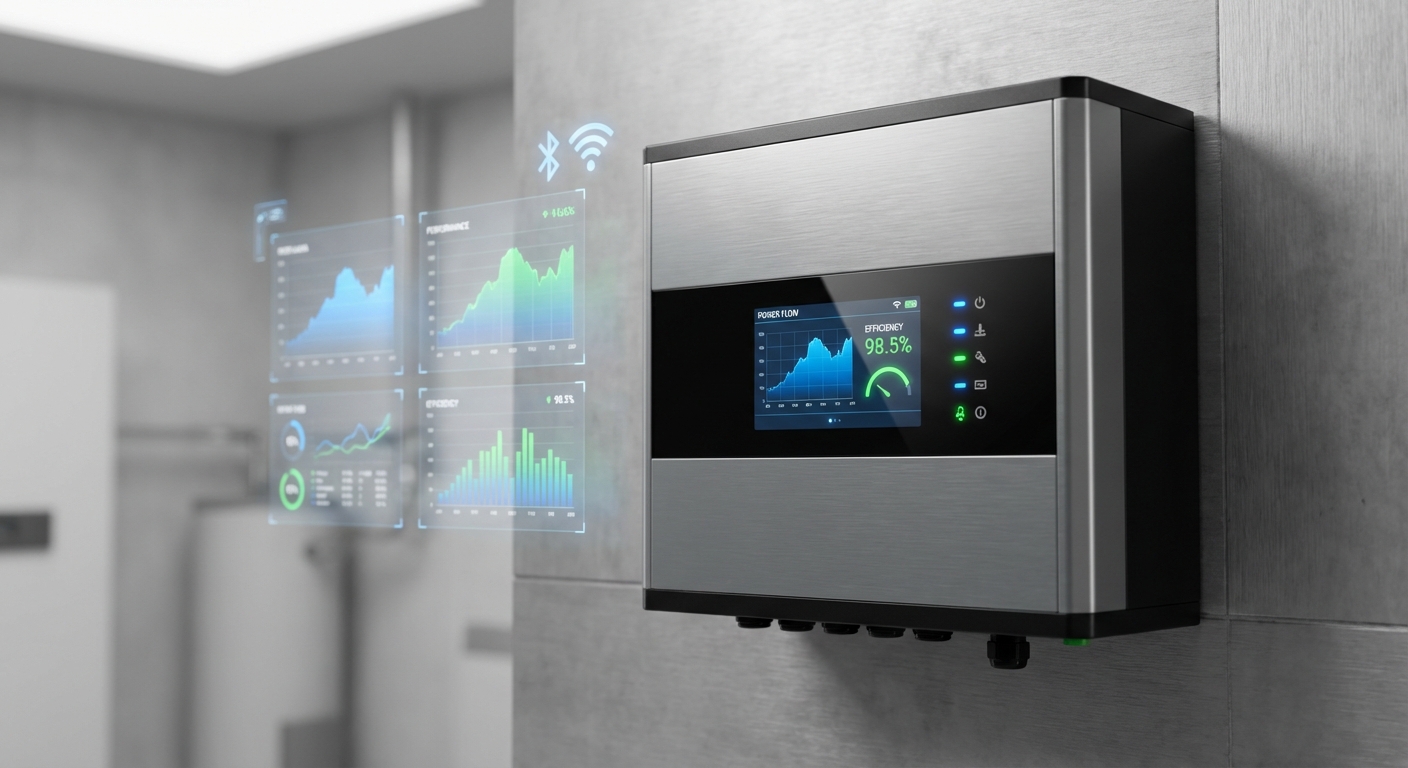
Sophisticated monitoring systems transform solar installations from passive generators into actively managed energy assets. Both on-grid and hybrid inverters benefit from advanced monitoring, though hybrid systems provide additional battery and energy management insights:
Real-time performance monitoring: Track instantaneous generation, consumption, grid import/export, and system efficiency through web portals and smartphone applications.
AI-powered diagnostics: Intelligent monitoring systems identify performance anomalies, predict potential failures, and recommend preventive maintenance—reducing downtime and maximizing energy production.
WhatsApp monitoring integration: Innovative monitoring solutions deliver system alerts, performance summaries, and diagnostic information directly through WhatsApp, providing accessible monitoring without requiring dedicated apps or complex interfaces.
Multi-site management: For EPCs and installers managing multiple installations, centralized monitoring platforms enable efficient fleet management, comparative performance analysis, and streamlined customer support.
Connectivity options: Wi-Fi, 4G, and Bluetooth connectivity ensure reliable data transmission across diverse installation environments, from urban rooftops with strong internet connectivity to remote industrial sites requiring cellular communication.
For commercial installations, advanced monitoring delivers measurable value through optimized performance, reduced maintenance costs, and rapid issue resolution. The ability to remotely diagnose problems and dispatch technicians with specific repair information minimizes downtime and service costs.
Weather Protection and Durability
Indian rooftop conditions present harsh operating environments for solar inverters: intense heat, monsoon moisture, dust accumulation, and coastal salt exposure all threaten equipment longevity. Weather protection ratings directly impact reliability and lifespan:
IP66 weather protection provides comprehensive defense against dust ingress and powerful water jets, essential for rooftop installations exposed to monsoon rains and regular cleaning. This rating ensures inverters withstand harsh environmental conditions without compromising internal electronics.
Quality inverters incorporate additional environmental protections:
- Conformal coating: Protective coating on circuit boards prevents corrosion from humidity and salt exposure
- Wide operating temperature range: Reliable operation from -25°C to +60°C ambient temperature
- Passive or active cooling: Efficient thermal management prevents overheating during peak generation periods
- UV-resistant enclosures: Prevent degradation from intense solar exposure
For installations in coastal areas, industrial environments with airborne contaminants, or regions with extreme weather conditions, premium weather protection justifies higher initial investment through extended equipment lifespan and reduced failure rates.
DC Oversizing and Panel Compatibility
Modern solar panels continue increasing in wattage, with 500-750W panels becoming standard for commercial installations. Inverter compatibility with high-wattage panels and DC oversizing capability directly impacts system design flexibility and energy harvest:
DC oversizing capability allows connecting more solar panel capacity than the inverter’s rated AC output. Quality inverters support up to 100% DC oversizing (2:1 DC-to-AC ratio), enabling system designers to maximize energy harvest during morning, evening, and cloudy conditions without oversizing the inverter.
For example, a 50 kW inverter with 100% oversizing capability can handle 100 kW of solar panel capacity. While the inverter limits peak output to 50 kW during optimal midday conditions, the oversized array generates significantly more energy during sub-optimal conditions—increasing total annual energy production by 10-15%.
Support for 750W+ panels ensures compatibility with current and future panel technologies, protecting system investment and enabling upgrades or expansions without inverter replacement.
Surge Protection and Voltage Fluctuation Handling
Indian grid conditions present significant challenges from voltage fluctuations, power surges, and lightning strikes. Robust protection systems are essential for equipment longevity:
DC and AC surge protection devices (SPDs) protect against voltage spikes from lightning strikes and grid disturbances. Quality inverters incorporate integrated SPDs or support external protection devices for comprehensive system protection.
Wide input voltage range: Inverters capable of operating across wide grid voltage ranges (typically 140-280V for single-phase, 340-480V for three-phase) maintain operation during grid voltage fluctuations that would shut down less robust alternatives.
Anti-islanding protection: Mandatory safety feature that disconnects inverters from the grid during outages, protecting utility workers and preventing equipment damage.
For installations in areas with unstable grid supply or frequent lightning activity, comprehensive surge protection and wide voltage tolerance are non-negotiable requirements that directly impact system reliability and longevity.
Quality Assurance and Manufacturing Standards
Component quality and manufacturing rigor separate premium inverters from budget alternatives. Key quality indicators include:
German-grade electronic components: Premium capacitors, semiconductors, and circuit boards deliver superior reliability and longevity compared to standard-grade components.
Comprehensive quality testing: Rigorous testing protocols (1000+ automated tests per unit) identify potential failures before products reach customers, reducing field failure rates and warranty claims.
BIS/IEC certification: Compliance with Indian and international standards ensures safety, performance, and grid code compliance.
Manufacturing legacy: Established manufacturers with proven track records provide greater confidence in long-term support, spare parts availability, and warranty fulfillment compared to new market entrants.
For EPCs and installers, partnering with quality-focused manufacturers reduces warranty claims, service calls, and customer complaints—protecting profit margins and reputation while delivering superior value to end customers.
Which Inverter Type is Right for Your Project?
Selecting between on-grid and hybrid solar inverters requires balancing multiple factors including budget constraints, energy independence goals, grid reliability, and specific application requirements. This decision matrix helps solar installers, EPCs, and facility owners determine the optimal inverter type for their specific circumstances.
On-Grid Inverters Are Optimal When:
- Budget constraints are primary concern: Limited capital availability makes lower upfront investment essential
- Grid reliability is excellent: Installations in areas with stable grid supply and infrequent outages
- Favorable net metering policies: Regions offering 1:1 net metering or attractive export rates maximize on-grid economics
- No backup power requirements: Facilities without critical loads or alternative backup power arrangements
- Maximizing simple ROI: Projects prioritizing fastest payback period and simplest system design
- Residential installations in urban areas: Homes in tier 1 cities with reliable grid supply and good net metering
- Large commercial installations: Economies of scale make on-grid systems highly cost-effective for large rooftop or ground-mount arrays
Hybrid Inverters Are Optimal When:
- Backup power is essential: Facilities requiring guaranteed uptime during grid outages
- Grid reliability is poor: Areas experiencing frequent or prolonged power outages
- Time-of-use tariffs apply: Commercial consumers can optimize energy costs through strategic battery discharge during peak-rate periods
- Energy independence is prioritized: Strategic goals include reducing grid dependency regardless of pure financial ROI
- Unfavorable net metering: Regions with poor export rates make self-consumption through battery storage economically superior
- Critical operations: Manufacturing, data centers, healthcare, or other facilities where power interruptions cause significant losses
- Diesel generator replacement: Facilities currently relying on backup generators can eliminate fuel costs and maintenance through hybrid solar
- Future-proofing: Anticipating grid instability, changing tariff structures, or evolving energy independence requirements
Residential vs. Commercial & Industrial Considerations
Residential installations typically favor on-grid systems in urban areas with reliable grid supply, as backup power requirements are often limited to essential loads and payback period sensitivity is high. However, residential hybrid systems make sense in areas with frequent outages or for homeowners prioritizing energy independence and backup capability.
Commercial and industrial installations present more complex decision criteria. Large rooftop arrays benefit from on-grid economies of scale, but facilities with critical operations, TOU tariffs, or high outage costs often justify hybrid system premiums through business continuity benefits and demand charge optimization.
Regional Factors Affecting Inverter Selection
Geographic and regulatory considerations significantly impact optimal inverter selection:
State net metering policies: Research specific state regulations regarding solar export rates, net metering caps, and interconnection requirements.
Grid stability by region: Assess historical outage frequency, voltage stability, and utility infrastructure quality in the installation area.
Local electricity tariff structures: Analyze whether flat-rate, TOU, or demand-based tariffs apply to the facility.
Solar irradiation levels: Higher solar resource areas generate more energy, improving ROI for both system types but particularly benefiting on-grid systems with favorable net metering.
Climate and environmental conditions: Coastal areas, industrial zones, and regions with extreme weather require inverters with superior weather protection and durability.
Budget Constraints and Financing Options
Financial considerations often determine feasible inverter options:
Capital availability: Organizations with limited upfront capital may find on-grid systems more accessible, while those with adequate capital can consider hybrid systems for long-term benefits.
Financing and incentives: Explore available solar financing options, government subsidies, and accelerated depreciation benefits that may improve hybrid system economics.
Total cost of ownership analysis: Look beyond initial investment to consider warranty coverage, maintenance costs, and long-term reliability when comparing options.
For EPCs and installers, offering both on-grid and hybrid options with clear ROI analysis for each enables customers to make informed decisions aligned with their specific requirements and constraints.
Best Practices for Inverter Selection and Installation
Regardless of whether on-grid or hybrid inverters best suit a specific project, following industry best practices for inverter selection, installation, and ongoing support ensures optimal system performance, longevity, and customer satisfaction.
Quality Certification Requirements
Verify that inverters meet essential certification and compliance standards:
BIS certification: Mandatory for solar inverters sold in India, ensuring compliance with Indian standards for safety and performance.
IEC standards compliance: International Electrotechnical Commission standards provide globally recognized quality and safety benchmarks.
Grid code compliance: Ensure inverters meet specific utility interconnection requirements for the installation region.
Never compromise on certification requirements to save costs—non-compliant equipment risks utility rejection, safety hazards, and warranty voidance.
Importance of Warranty Coverage and Manufacturer Support
Warranty terms and manufacturer support infrastructure directly impact long-term system economics and customer satisfaction:
Warranty duration: Seek inverters with comprehensive warranty coverage extending well beyond standard 5-year terms. A 12-year full replacement warranty provides exceptional protection during the critical mid-life period when component failures become more likely.
Warranty terms: Understand what the warranty covers—full replacement, repair, or pro-rated coverage. Full replacement warranties provide superior protection and simpler claim resolution.
Digital warranty systems: Modern warranty management platforms streamline claim submission, tracking, and resolution, reducing administrative burden for installers and EPCs.
Manufacturer support infrastructure: Evaluate manufacturer responsiveness, technical support availability, spare parts inventory, and service network coverage in your operating regions.
Track record and stability: Partner with established manufacturers with proven longevity—warranty coverage is only valuable if the manufacturer remains in business to honor it.
For solar installers and EPCs, strong manufacturer partnerships with responsive support reduce service costs, minimize customer complaints, and protect reputation. The value of reliable manufacturer support often exceeds initial product cost differences.
Installation Considerations for Indian Rooftop Conditions
Proper installation practices maximize inverter performance and longevity in challenging Indian rooftop environments:
Location selection: Install inverters in shaded, well-ventilated locations to minimize heat exposure. Avoid direct sunlight, which reduces efficiency and accelerates component aging.
Mounting and accessibility: Ensure secure mounting with adequate clearance for ventilation and maintenance access. Follow manufacturer specifications for mounting orientation and clearances.
Cable management: Use appropriate cable sizing, routing, and protection to minimize voltage drop and prevent damage from weather, rodents, or physical impact.
Surge protection installation: Properly install and ground DC and AC surge protection devices according to manufacturer specifications and local electrical codes.
Commissioning and testing: Conduct comprehensive commissioning including insulation testing, polarity verification, grid synchronization testing, and monitoring system setup.
Documentation: Provide customers with complete system documentation including wiring diagrams, equipment specifications, warranty information, and maintenance schedules.
Smart Monitoring Setup and Remote Management
Maximize the value of advanced monitoring capabilities through proper setup and configuration:
Connectivity setup: Configure Wi-Fi, 4G, or Bluetooth connectivity based on site conditions and available infrastructure. Ensure reliable data transmission for consistent monitoring.
Monitoring platform registration: Register systems with manufacturer monitoring platforms and configure user access for customers and service teams.
Alert configuration: Set up appropriate alerts for system faults, performance anomalies, and maintenance requirements. Configure delivery through email, SMS, or WhatsApp based on customer preferences.
Customer training: Provide customers with training on monitoring system access, interpretation of performance data, and response to common alerts.
Fleet management: For EPCs managing multiple installations, establish centralized monitoring dashboards for efficient multi-site management and comparative performance analysis.
Effective monitoring systems enable proactive maintenance, rapid issue resolution, and optimized system performance—delivering measurable value to customers while reducing service costs for installers.
Partnering with Reliable Inverter Manufacturers
The manufacturer relationship significantly impacts project success, customer satisfaction, and long-term profitability for solar installers and EPCs:
Product quality and reliability: Partner with manufacturers demonstrating commitment to quality through rigorous testing, premium components, and proven field performance.
Technical support: Evaluate manufacturer technical support responsiveness, expertise, and availability during installation, commissioning, and ongoing operation.
Training and enablement: Seek manufacturers offering comprehensive training programs, installation guides, and technical resources to support your team’s expertise development.
Business support: Consider manufacturers providing business development support, marketing resources, and channel partner programs to help grow your solar installation business.
Innovation and product roadmap: Partner with manufacturers investing in product development, staying current with technology trends, and supporting emerging requirements like high-wattage panels and advanced monitoring.
For solar professionals looking to establish or expand their inverter partnerships, manufacturers like Qbits offer comprehensive support including 12-year warranties, AI-powered monitoring systems, and dedicated channel partner programs. Explore partnership opportunities to access quality products, technical support, and business development resources.
Conclusion: Making the Right Choice for Your Solar Investment
The decision between on-grid vs hybrid solar inverters fundamentally shapes project economics, system capabilities, and long-term value delivery. While on-grid systems offer lower upfront costs and faster payback periods in areas with reliable grid supply and favorable net metering, hybrid inverters provide energy independence, backup power capability, and strategic advantages for facilities prioritizing business continuity or operating under time-of-use tariff structures.
For solar installers, EPCs, and facility owners navigating this decision in 2026, the optimal choice depends on careful analysis of:
- Budget constraints and available capital for initial investment
- Grid reliability and historical outage patterns in the installation region
- Electricity tariff structures and net metering policies
- Backup power requirements and business continuity priorities
- Long-term energy independence goals beyond pure financial ROI
- Total cost of ownership including warranty coverage and maintenance requirements
Regardless of inverter type selection, prioritize quality, certification, and manufacturer support. The difference between premium inverters built with German-grade components, subjected to rigorous quality testing, and backed by comprehensive 12-year warranties versus budget alternatives often determines whether solar investments deliver promised returns or become sources of ongoing maintenance costs and customer dissatisfaction.
As India’s solar market continues evolving with increasing panel wattages, advancing battery technologies, and changing grid dynamics, working with innovative manufacturers committed to product development and customer support ensures your solar installations remain competitive and deliver long-term value.
Ready to specify the right inverter solution for your next solar project? Qbits offers both on-grid and hybrid solar inverters engineered with AI-powered monitoring, IP66 weather protection, and industry-leading 12-year warranties. Explore our complete product range or contact our technical team for project-specific recommendations and support.
For solar professionals seeking reliable inverter partnerships with comprehensive technical and business support, join the Qbits channel partner network to access quality products, competitive pricing, and dedicated support for growing your solar installation business.