



Inverter TCO: Complete Budget Planning Guide for 2026

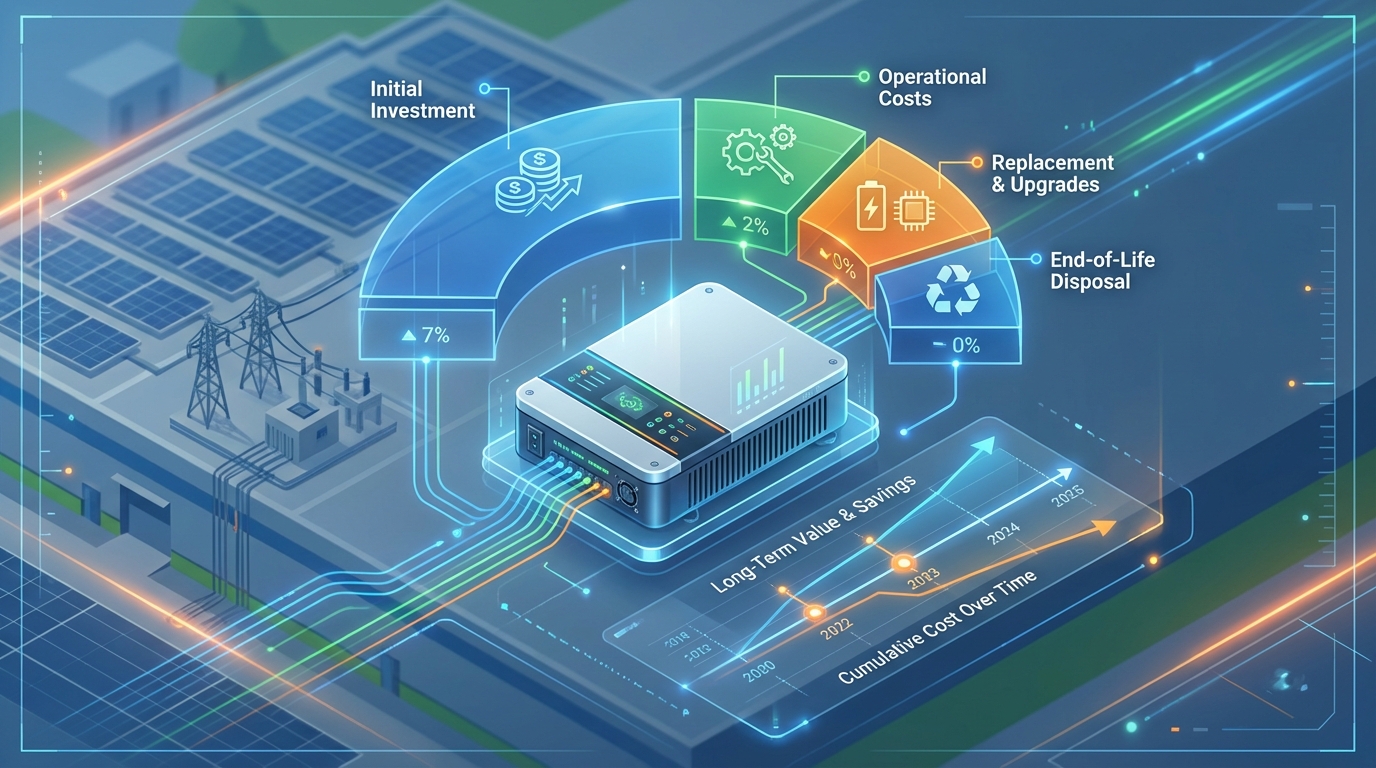
When evaluating solar inverters for your next project, the purchase price is just the beginning of the story. For EPCs, solar distributors, and facility owners across India, understanding inverter TCO (Total Cost of Ownership) is critical to making investment decisions that maximize profitability over the system’s lifetime. While a budget inverter might seem attractive at ₹30,000, a premium option at ₹50,000 could actually cost less over 12-15 years when you factor in efficiency losses, maintenance expenses, warranty coverage, and replacement costs.
This comprehensive guide breaks down every component of inverter TCO, providing EPCs and commercial facility owners with a framework to evaluate solar inverters based on lifetime value rather than sticker price. By the end, you’ll have actionable strategies to optimize your inverter budget planning and select products that deliver the best return on investment for residential and C&I solar installations.
Understanding Inverter TCO: Beyond the Sticker Price
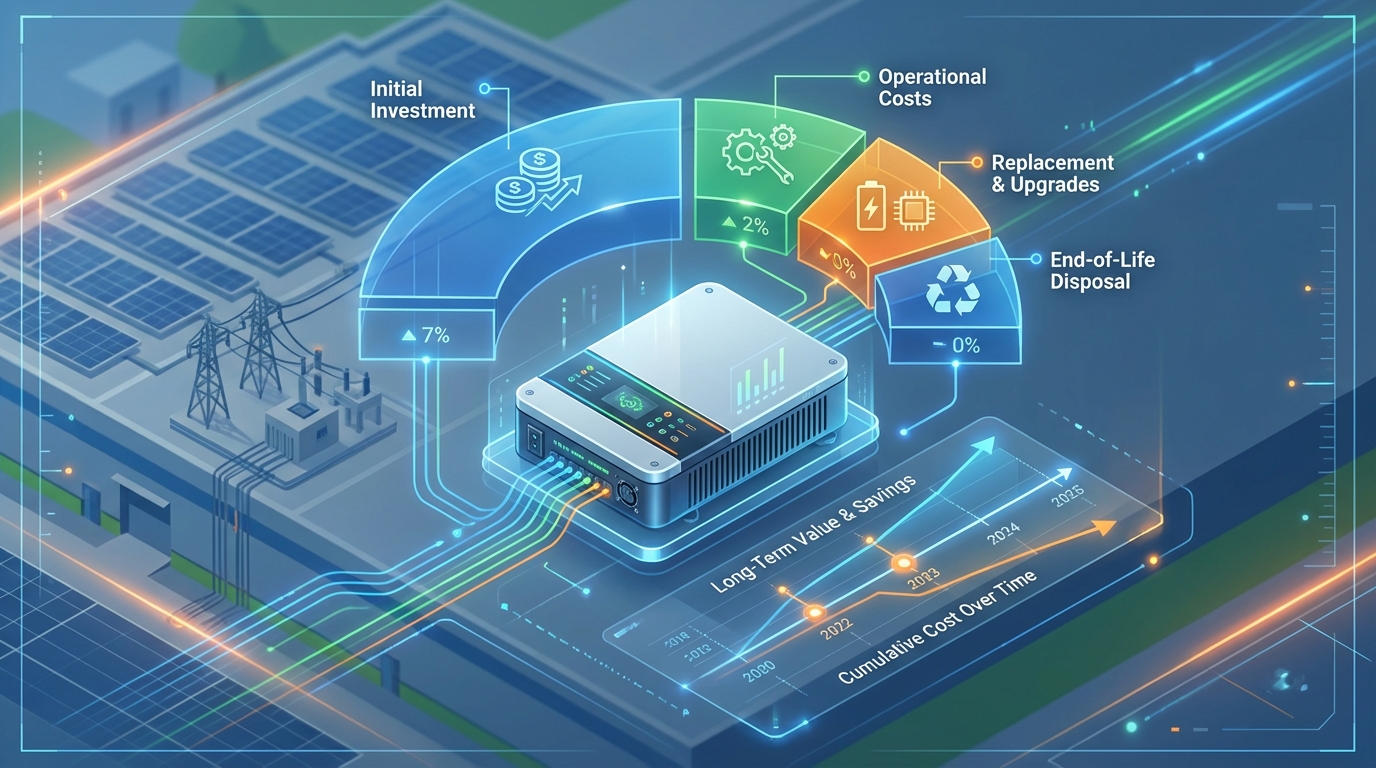
Total Cost of Ownership (TCO) represents the complete financial picture of owning and operating a solar inverter from purchase through end-of-life. Unlike simple price comparison, inverter TCO analysis accounts for upfront costs, operational expenses, efficiency-related revenue losses, warranty value, and eventual replacement costs. For a typical commercial solar installation in India, TCO can be 150-200% of the initial purchase price over a 12-year period.
Most EPCs and facility owners make a critical mistake by focusing exclusively on initial inverter cost when preparing project budgets. This approach overlooks substantial expenses that emerge during operation. A low-cost inverter with 95% efficiency, minimal warranty coverage, and poor weather protection can cost ₹80,000-₹1,20,000 more than a premium alternative over its operational life when you calculate lost energy generation, frequent repairs, and early replacement.
Understanding inverter TCO matters because it directly impacts project profitability and client satisfaction. For solar installation companies, accurate TCO projections help you price projects competitively while protecting margins. For facility owners investing in commercial solar, TCO analysis ensures you select inverters that deliver promised returns rather than becoming financial liabilities.
The key components of inverter TCO include upfront investment (equipment, installation, monitoring setup), operational costs (maintenance, monitoring fees, insurance), efficiency losses (revenue foregone due to suboptimal performance), warranty value (protection against repair and replacement expenses), and end-of-life costs (disposal, replacement, or upgrade expenses). Each component varies significantly across inverter manufacturers India, making systematic TCO comparison essential for informed decision-making.
1. Upfront Costs: Initial Investment Components
The upfront investment phase encompasses all expenses incurred before your solar inverter begins generating revenue. For residential installations (5-10 kW), initial costs typically range from ₹35,000 to ₹75,000 depending on inverter type and features. Commercial and industrial systems (50-100 kW+) see upfront investments between ₹3,50,000 and ₹8,00,000.
Inverter purchase price forms the largest upfront component, varying based on capacity, technology, and brand positioning. On-grid inverters generally cost 15-25% less than hybrid inverter India options with battery integration capability. However, hybrid models offer future flexibility that can reduce long-term TCO if battery storage becomes necessary. Premium inverters with German-grade components and extensive quality testing command 20-40% higher prices than mass-market alternatives, but this premium often translates to lower operational costs.
Installation labor and electrical work add ₹5,000-₹15,000 for residential systems and ₹25,000-₹60,000 for commercial installations. These costs depend on mounting complexity, cable runs, and electrical panel upgrades required. Inverters with simplified installation processes and comprehensive documentation reduce labor time and associated expenses.
Monitoring system setup represents a growing portion of upfront costs as smart connectivity becomes standard. Basic monitoring with Wi-Fi connectivity adds ₹2,000-₹5,000, while advanced systems with 4G backup, Bluetooth, and AI-powered analytics can cost ₹8,000-₹15,000. However, robust monitoring significantly reduces operational costs by enabling remote diagnostics and predictive maintenance.
Surge protection devices (SPDs) for both DC and AC sides are essential in India’s variable grid conditions. Quality SPDs cost ₹3,000-₹8,000 but prevent inverter damage that could result in ₹20,000-₹50,000 replacement expenses. This protection becomes particularly valuable in regions with frequent lightning strikes or grid instability.
Certification and compliance costs for BIS/IEC standards are typically included in inverter pricing from reputable manufacturers, but imported products may require additional testing and documentation, adding ₹5,000-₹15,000 to project costs. Transportation and logistics for commercial-scale inverters can add another ₹2,000-₹10,000 depending on project location and accessibility.
2. Operational Costs: Ongoing Expenses Over Inverter Lifespan
Operational expenses accumulate throughout the inverter’s working life, often exceeding initial purchase costs for systems with poor reliability or inadequate monitoring. Annual operational costs for residential inverters typically range from ₹2,000-₹6,000, while commercial systems incur ₹15,000-₹40,000 annually depending on maintenance requirements and monitoring complexity.
Annual maintenance and inspection costs vary dramatically based on inverter quality and monitoring capabilities. Traditional inverters requiring quarterly physical inspections cost ₹4,000-₹8,000 annually in labor and travel expenses. Advanced inverters with AI-powered remote monitoring reduce this to ₹1,500-₹3,000 for annual physical verification, as most diagnostics occur remotely.
Monitoring system fees represent an ongoing expense that many EPCs overlook during initial budgeting. Cloud-based monitoring platforms charge ₹500-₹2,000 annually per inverter for data storage, analytics, and alert services. However, these fees deliver substantial value by identifying performance issues before they become costly failures. Some manufacturers include monitoring services in their warranty packages, effectively reducing TCO.
Preventive maintenance including cleaning, connection tightening, and firmware updates costs ₹1,000-₹3,000 annually for residential systems. Commercial installations require more extensive maintenance at ₹8,000-₹20,000 annually. Inverters with IP66 weather protection require less frequent cleaning and inspection, reducing these costs by 30-40% compared to units with basic enclosures.
Inverter troubleshooting and diagnostic costs emerge when performance issues arise. Systems without intelligent monitoring require technician site visits at ₹2,000-₹5,000 per visit for diagnosis alone. Advanced monitoring systems with WhatsApp alerts and remote diagnostics eliminate most diagnostic visits, saving ₹6,000-₹15,000 annually for commercial installations.
Insurance premiums for solar equipment typically cost 0.3-0.5% of system value annually. Inverters with comprehensive warranties and proven reliability may qualify for reduced insurance rates, saving ₹1,000-₹3,000 annually on residential systems and ₹5,000-₹15,000 on commercial installations.
3. Efficiency Losses: The Hidden Cost of Poor Performance
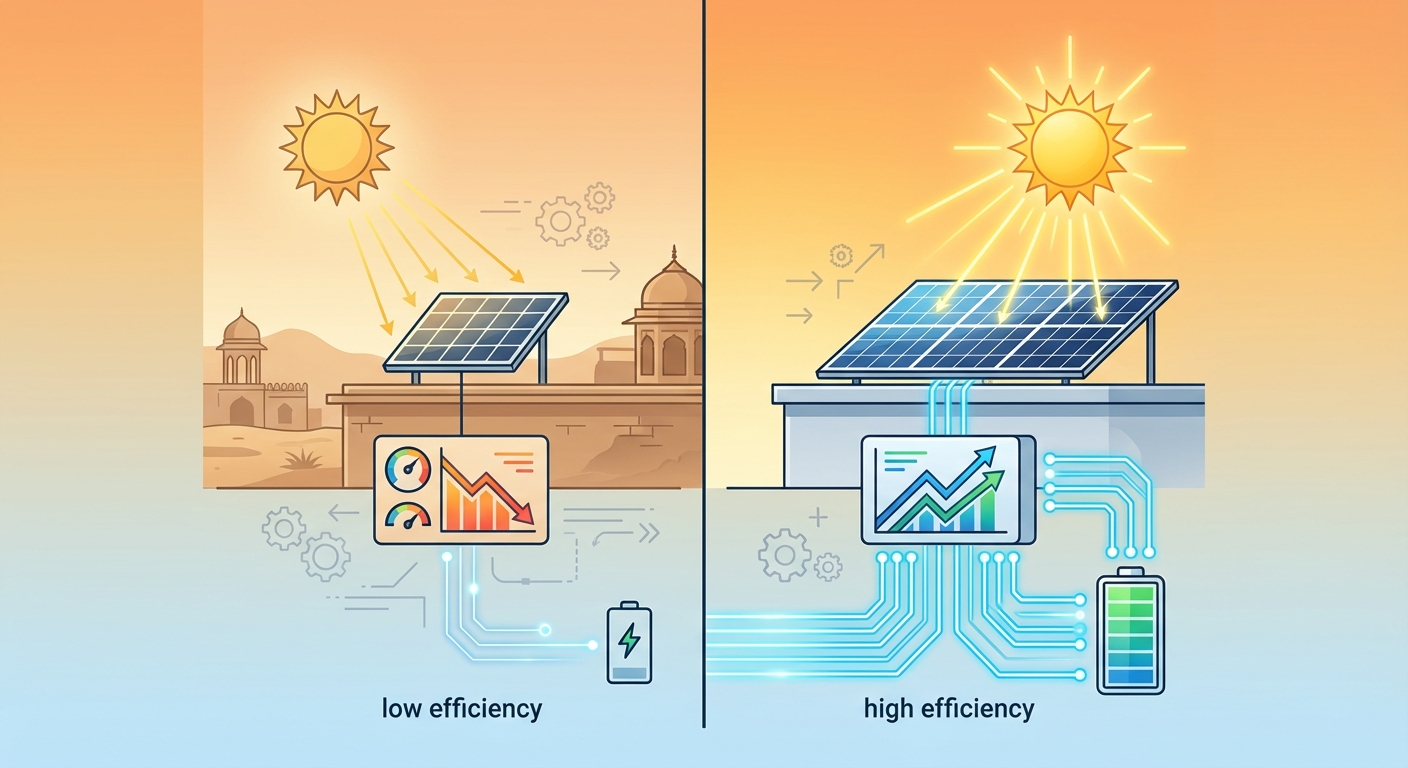
Efficiency losses represent the most significant yet frequently overlooked component of inverter TCO. Every percentage point of efficiency difference translates directly to revenue foregone over the system’s lifetime. For a 10 kW residential system in India generating 15,000 kWh annually, the difference between 95% and 98% efficiency costs approximately ₹4,500 per year in lost generation at ₹10 per kWh tariff rates.
Over a 12-year period, this 3% efficiency gap results in ₹54,000 in lost revenue for a single residential installation. For commercial systems generating 150,000 kWh annually, the same efficiency difference costs ₹45,000 per year or ₹5,40,000 over 12 years. These figures demonstrate why inverter efficiency deserves equal weight to purchase price in TCO calculations.
Inverter efficiency isn’t static. Performance degradation over time compounds efficiency losses. Budget inverters may start at 96% efficiency but decline to 93-94% after 5-7 years due to component aging and thermal stress. Premium inverters with German-grade components and robust thermal management maintain 97-98% efficiency throughout their operational life, preserving revenue generation capacity.
Temperature derating significantly impacts inverter performance in India’s climate. Inverters operating in 45-50°C rooftop environments without adequate thermal management can experience 5-8% efficiency losses during peak generation hours. Advanced thermal design and IP66-rated enclosures that protect against heat buildup maintain optimal efficiency even in harsh conditions, adding ₹15,000-₹30,000 in preserved revenue annually for commercial systems.
DC oversizing capability affects energy harvest and efficiency-related TCO. Inverters supporting 100% DC oversizing capture more energy during optimal conditions without clipping losses, increasing annual generation by 3-5%. For a 50 kW commercial system, this translates to ₹15,000-₹25,000 in additional annual revenue. When evaluating inverter selection criteria, DC oversizing capability should factor prominently in TCO analysis.
Low start-up voltage extends daily generation hours by enabling earlier morning and later evening operation. Inverters with 120V start-up voltage versus 150V alternatives generate an additional 30-45 minutes daily, adding 2-3% to annual energy yield. Over 12 years, this seemingly minor specification difference contributes ₹20,000-₹35,000 in additional revenue for residential systems.
4. Warranty Value: Calculating Protection and Replacement Costs
Warranty coverage represents a critical but often undervalued component of inverter TCO. The difference between standard 5-year and extended 12-year warranty coverage can impact TCO by ₹40,000-₹80,000 for residential systems and ₹2,00,000-₹4,00,000 for commercial installations when you account for repair costs, replacement expenses, and system downtime.
Standard warranty terms across inverter brands India typically offer 5 years with repair-based coverage. Under these warranties, manufacturers repair failed components but don’t guarantee replacement units or cover labor costs. Out-of-warranty repairs for inverters cost ₹8,000-₹25,000 for component replacement plus ₹3,000-₹6,000 in labor and diagnostics. A single major failure in year 6-12 can eliminate the savings from choosing a budget inverter.
Extended 12-year warranty options with full replacement coverage provide substantial TCO advantages. These warranties eliminate repair costs during the coverage period and guarantee system performance. For a ₹50,000 inverter, 12-year full replacement warranty coverage has an actuarial value of approximately ₹15,000-₹20,000 based on typical failure rates and repair costs.
Warranty claim process efficiency directly impacts TCO through system downtime costs. Traditional warranty processes requiring physical inspection, approval workflows, and component shipping can result in 15-30 days of system downtime. For a 50 kW commercial system, each day of downtime costs ₹1,500-₹2,500 in lost generation. Digital warranty systems with streamlined claim processing reduce downtime to 3-7 days, saving ₹18,000-₹57,500 per warranty event.
Manufacturer support quality and service network coverage affect warranty value realization. Inverters from manufacturers with limited service presence in India may have warranty coverage on paper, but practical claim resolution takes months. Manufacturers with established service networks and local support teams deliver faster resolution, reducing downtime costs and preserving system ROI.
Full replacement warranties versus repair warranties create significant TCO differences. Repair warranties leave you with aging equipment that may experience repeated failures, while replacement warranties provide new units with full remaining warranty coverage. Over a 12-year period, this difference can amount to ₹30,000-₹60,000 in avoided repair costs and improved reliability for residential systems.
5. Replacement and Upgrade Costs: Planning for End-of-Life
Replacement costs represent the final major component of inverter TCO, yet many EPCs and facility owners fail to budget for this inevitable expense. Understanding expected inverter lifespan and planning replacement timelines prevents budget surprises and system downtime.
Expected inverter lifespan varies from 8-10 years for budget models to 12-15 years for premium units with superior components and thermal management. This lifespan difference directly impacts TCO. For a solar installation with a 25-year design life, budget inverters require 2-3 replacements while premium inverters need only 1-2 replacements, creating a ₹50,000-₹1,00,000 TCO difference for residential systems.
Disposal and decommissioning costs for old inverters add ₹2,000-₹5,000 per unit for proper electronic waste handling. As environmental regulations tighten, these costs will increase. Manufacturers offering take-back programs reduce disposal expenses and environmental impact.
Technology upgrade opportunities during replacement cycles can improve system performance. Replacing a 10-year-old inverter with current technology supporting 750W panels and advanced monitoring capabilities can increase system generation by 5-8%. However, compatibility considerations with existing DC infrastructure and monitoring systems may require additional investment of ₹8,000-₹15,000.
Salvage value of replaced inverters partially offsets replacement costs. Working inverters removed during upgrades can be sold for 15-25% of original purchase price, recovering ₹5,000-₹12,000 for residential units. However, failed inverters have minimal salvage value beyond scrap metal recovery.
Future-proofing investments in inverters with 750W panel support and 100% DC oversizing capability reduce upgrade costs. As panel technology advances, inverters supporting higher wattage modules avoid premature replacement, extending useful life by 2-4 years and saving ₹25,000-₹50,000 in replacement expenses.
Battery integration costs for hybrid inverter upgrades represent a significant consideration for systems initially installed as on-grid. Retrofitting battery capability to on-grid systems costs ₹80,000-₹2,00,000 depending on capacity. Installing hybrid inverters initially, even without immediate battery connection, reduces future upgrade costs by 60-70%.
6. Inverter TCO Calculation Framework: Step-by-Step Analysis

Calculating inverter TCO requires a systematic framework that accounts for all cost components across the system’s operational life. This step-by-step methodology enables accurate comparison between inverter options and supports data-driven investment decisions.
The complete inverter TCO formula is: TCO = Upfront Costs + (Annual Operational Costs × Years) + Efficiency Loss Value + Warranty Gap Costs + Replacement Costs – Salvage Value. Each component requires careful estimation based on manufacturer specifications, local market conditions, and project-specific factors.
Time value of money considerations require discounting future costs to present value. Using a 6-8% discount rate typical for solar projects in India, ₹10,000 in maintenance costs 10 years from now has a present value of approximately ₹5,000-₹6,000. This discounting affects TCO calculations significantly for long-term expenses like replacement costs.
Sample TCO calculation for a 10 kW residential system demonstrates the methodology. Budget inverter option: ₹35,000 upfront + (₹5,000 annual operations × 10 years) + ₹54,000 efficiency losses + ₹25,000 warranty gap costs + ₹40,000 replacement = ₹2,04,000 total. Premium inverter option: ₹55,000 upfront + (₹3,000 annual operations × 12 years) + ₹18,000 efficiency losses + ₹0 warranty gap + ₹0 replacement = ₹1,09,000 total. The premium inverter delivers ₹95,000 lower TCO despite 57% higher purchase price.
For commercial 100 kW systems, TCO differences become even more pronounced. Budget option: ₹4,50,000 upfront + (₹35,000 × 10 years) + ₹5,40,000 efficiency losses + ₹2,00,000 warranty gap + ₹5,00,000 replacement = ₹20,40,000. Premium option: ₹7,00,000 upfront + (₹20,000 × 12 years) + ₹1,80,000 efficiency losses + ₹0 warranty gap + ₹0 replacement = ₹11,20,000. The premium inverter saves ₹9,20,000 in TCO over 12 years.
Sensitivity analysis reveals how variables impact total ownership costs. A 1% change in inverter efficiency affects residential system TCO by approximately ₹18,000 over 12 years. A 2-year change in replacement timeline impacts TCO by ₹30,000-₹40,000. Understanding these sensitivities helps EPCs identify which specifications deserve premium investment.
ROI calculation integrating TCO data provides the complete financial picture. For the residential example above, the premium inverter’s ₹20,000 additional upfront investment delivers ₹95,000 in TCO savings, representing a 475% return over 12 years or approximately 40% annually. This ROI far exceeds typical solar project returns and justifies premium inverter selection.
Break-even analysis determines when premium inverter investments pay for themselves. In most scenarios, premium inverters with superior efficiency and warranty coverage break even within 2-4 years through reduced operational costs and higher energy generation. After break-even, all additional savings flow directly to project profitability.
7. TCO Optimization Strategies for EPCs and Facility Owners
Optimizing inverter TCO requires strategic selection aligned with project type, client needs, and long-term performance goals. EPCs and facility owners can implement several proven strategies to minimize total ownership costs while maximizing system reliability and revenue generation.
Selecting inverters with optimal TCO for different project types starts with matching specifications to application requirements. Residential projects benefit most from inverters with extended warranties and high efficiency, as these systems operate for 20-25 years with minimal professional oversight. Commercial installations should prioritize advanced monitoring and robust weather protection to minimize operational costs and maximize uptime.
Balancing upfront costs with long-term operational savings requires looking beyond initial budget constraints. While budget inverters reduce project capital requirements, they increase operational expenses and reduce client satisfaction through higher failure rates and lower generation. Premium inverters with 12-year warranties and 98% efficiency deliver better client outcomes and reduce EPC service burden.
Leveraging AI-powered monitoring reduces maintenance costs by 40-60% through predictive diagnostics and remote troubleshooting. Advanced monitoring systems with WhatsApp alerts enable immediate issue identification without site visits, saving ₹8,000-₹20,000 annually in diagnostic expenses for commercial installations. The monitoring system investment of ₹8,000-₹15,000 pays for itself within the first year through reduced service costs.
Weather protection through IP66-rated enclosures significantly impacts replacement frequency and operational costs. Inverters with comprehensive weather sealing survive harsh rooftop conditions 3-5 years longer than basic enclosures, reducing replacement costs and extending revenue generation. In coastal or high-humidity regions, IP66 protection can reduce TCO by ₹30,000-₹60,000 over system lifetime.
Quality testing standards correlate directly with reliability and TCO. Inverters undergoing 1000+ automated quality tests during manufacturing exhibit 60-70% lower failure rates than mass-produced alternatives. This reliability translates to reduced warranty claims, lower maintenance costs, and extended operational life. When comparing inverter options, manufacturing quality processes deserve significant weight in TCO analysis.
German-grade components versus mass-market alternatives create substantial TCO differences through improved reliability and performance stability. While German-grade components add 15-25% to manufacturing costs, they reduce failure rates by 50-60% and maintain efficiency specifications throughout operational life. Over 12 years, this quality difference saves ₹40,000-₹80,000 in repairs and efficiency losses for residential systems.
Comprehensive inverter selection criteria that minimize TCO include efficiency above 97.5%, warranty coverage of 10+ years with full replacement terms, IP65 or IP66 weather protection, advanced monitoring with remote diagnostics, support for 750W+ panels with DC oversizing, proven quality testing processes, and established manufacturer service networks. Inverters meeting these criteria consistently deliver 30-50% lower TCO than budget alternatives.
8. Real-World Inverter TCO Scenarios: India Market Analysis

Real-world TCO scenarios demonstrate how theoretical calculations translate to actual project outcomes across India’s diverse solar market. These case studies reveal the financial impact of inverter selection decisions on residential and commercial installations.
TCO comparison between premium and budget inverter brands over 12 years shows consistent patterns. Budget inverters from mass-market manufacturers typically cost ₹35,000-₹40,000 for 10 kW residential systems but incur ₹1,80,000-₹2,20,000 in total ownership costs. Premium inverters from established manufacturers cost ₹50,000-₹60,000 upfront but deliver ₹1,00,000-₹1,30,000 total ownership costs. The ₹50,000-₹90,000 TCO advantage of premium inverters stems primarily from superior efficiency, extended warranty coverage, and longer operational life.
Residential installation TCO case study for a 7 kW system in Pune illustrates typical outcomes. The homeowner initially selected a ₹38,000 budget inverter to minimize upfront costs. Over 8 years, the system experienced two warranty repairs (₹12,000 total), required quarterly maintenance visits (₹32,000 total), and generated 4% less energy than projected due to efficiency degradation (₹48,000 lost revenue). Total 8-year TCO reached ₹1,30,000. A comparable premium inverter at ₹52,000 with 12-year warranty, remote monitoring, and stable 98% efficiency would have delivered ₹82,000 TCO over the same period, saving ₹48,000.
Commercial and industrial TCO analysis for a 100 kW rooftop system in Gujarat demonstrates even more dramatic differences. The facility owner selected inverters based on lowest bid pricing at ₹4,80,000 for the complete inverter package. After 6 years, the system had experienced three inverter failures requiring replacement (₹1,80,000), ongoing efficiency issues reducing generation by 6% (₹3,60,000 lost revenue), and frequent maintenance visits (₹1,20,000). Six-year TCO reached ₹11,40,000. Alternative premium inverters at ₹7,20,000 with comprehensive monitoring, IP66 protection, and 12-year warranty would have delivered ₹8,40,000 TCO over the same period, saving ₹3,00,000 despite 50% higher initial cost.
Impact of harsh Indian weather conditions on TCO becomes evident in field performance data. Inverters without adequate thermal management and weather protection in Rajasthan and Maharashtra experience 40-50% higher failure rates than protected units. This translates to ₹25,000-₹60,000 in additional TCO for residential systems and ₹2,00,000-₹5,00,000 for commercial installations over 10-12 years.
Grid stability issues and surge protection value significantly affect TCO in regions with variable power quality. Areas experiencing frequent voltage fluctuations and lightning strikes see inverter failure rates 3-4 times higher for units without comprehensive surge protection. Investing ₹5,000-₹8,000 in quality DC and AC SPDs prevents ₹40,000-₹80,000 in inverter replacement costs, delivering 500-1000% ROI on protection equipment.
Remote monitoring ROI and reduced site visit costs create substantial TCO advantages for geographically distributed installations. EPCs managing 50+ residential systems reduce annual service costs by ₹2,00,000-₹4,00,000 through remote diagnostics versus traditional quarterly site visits. For individual commercial installations, remote monitoring saves ₹15,000-₹30,000 annually in diagnostic and routine inspection expenses.
How inverter manufacturers India approach TCO varies significantly. International brands often focus on upfront product quality with premium pricing but limited local service networks, creating warranty claim challenges. Domestic manufacturers may offer competitive pricing but inconsistent component quality affecting long-term reliability. Leading Indian manufacturers like Qbits combine German-grade components, comprehensive 12-year warranties, AI-powered monitoring, and established service networks to optimize TCO across all components rather than just minimizing purchase price.
Making Informed Inverter Investment Decisions Based on TCO
Understanding and applying inverter TCO analysis transforms solar project economics from uncertain to predictable. EPCs and facility owners who master TCO calculations consistently deliver better project outcomes, higher client satisfaction, and improved profitability compared to those focused solely on minimizing upfront costs.
Key takeaways for inverter TCO budget planning include recognizing that purchase price represents only 25-40% of total ownership costs, efficiency differences of 2-3% create ₹50,000-₹5,00,000 in lifetime cost variations depending on system size, warranty coverage from 5 to 12 years saves ₹40,000-₹4,00,000 in repair and replacement expenses, and advanced monitoring reduces operational costs by 40-60% through remote diagnostics and predictive maintenance.
Red flags in low-cost inverter offerings that indicate high TCO risk include efficiency ratings below 96%, warranty coverage under 5 years or repair-only terms, absence of advanced monitoring capabilities, lack of IP65/IP66 weather protection, limited manufacturer service network in India, unclear component sourcing and quality testing processes, and inability to support 750W+ panels or DC oversizing. Inverters exhibiting multiple red flags typically deliver 50-100% higher TCO than premium alternatives.
Questions to ask inverter manufacturers about lifetime costs should include: What is the complete warranty coverage including labor and replacement terms? What efficiency degradation should we expect over 10-12 years? What monitoring capabilities are included and are there ongoing subscription fees? What is your average inverter lifespan in Indian climate conditions? What is your service network coverage and average warranty claim resolution time? What quality testing processes do you employ during manufacturing? What weather protection rating do your inverters carry?
Qbits inverters optimize TCO through several integrated features designed specifically for Indian market conditions. The 12-year full replacement warranty eliminates repair costs and replacement expenses during the coverage period, saving ₹40,000-₹2,00,000 depending on system size. Consistent 98% efficiency with German-grade components preserves revenue generation throughout operational life, adding ₹30,000-₹3,00,000 in value over budget alternatives. AI-powered WhatsApp monitoring with remote diagnostics reduces operational costs by ₹8,000-₹25,000 annually through eliminated site visits. IP66 weather protection extends operational life by 3-5 years in harsh rooftop conditions, saving ₹35,000-₹4,00,000 in premature replacement costs. Support for 750W panels with 100% DC oversizing future-proofs installations and maximizes energy harvest, adding 3-5% to lifetime generation value.
For EPCs and facility owners ready to optimize their solar investments through comprehensive TCO analysis, the next step is evaluating specific inverter options against your project requirements. Qbits offers detailed TCO calculators and technical consultation to help you quantify lifetime costs for your residential or commercial installations. Explore our complete inverter range featuring on-grid and hybrid models engineered for optimal TCO performance, or connect with our technical team to discuss how our 12-year warranty, 98% efficiency, and AI-powered monitoring can reduce your inverter TCO by 30-50% compared to conventional alternatives. Make your next solar project more profitable by choosing inverters based on lifetime value, not just purchase price.
This blog post was written using thestacc.com