



Inverter Suppliers India: Complete Vendor Evaluation Guide


The solar energy sector in India is experiencing unprecedented growth, with installations projected to exceed 100 GW of cumulative capacity by the end of 2026. For solar EPCs and installation companies, selecting the right inverter suppliers India has become a mission-critical decision that directly impacts project profitability, customer satisfaction, and long-term business reputation. Unlike commodity purchases, inverter procurement requires careful evaluation of manufacturing capabilities, warranty infrastructure, technical support networks, and commercial terms that align with your project pipeline and business objectives.
This comprehensive guide provides solar EPCs with a systematic framework for evaluating and selecting inverter suppliers India, covering everything from quality certifications and after-sales support to regional supplier mapping and vendor relationship management strategies tailored specifically for the Indian solar market in 2026.
Understanding the Indian Solar Inverter Supply Landscape in 2026
The Indian solar inverter market has matured significantly over the past five years, with a diverse ecosystem of domestic manufacturers, international brands with local assembly operations, and pure import-based suppliers. As of 2026, the market is characterized by increasing localization driven by government initiatives like the Production Linked Incentive (PLI) scheme and Approved List of Models and Manufacturers (ALMM) requirements.

Domestic manufacturing capacity has expanded substantially, with several Indian companies now producing inverters with German-grade electronic components and advanced features like AI-powered monitoring systems. Companies like Qbits Energy represent this new generation of Indian manufacturers, combining precision engineering with intelligent performance features specifically designed for Indian grid conditions and weather challenges.
The market segmentation among inverter suppliers India typically falls into three categories:
- Premium domestic manufacturers: Focus on quality components, extended warranties (10-12 years), and comprehensive after-sales networks with advanced monitoring capabilities
- International brands with local presence: Global companies with assembly or manufacturing facilities in India, offering established brand reputation with varying levels of local support infrastructure
- Value-focused suppliers: Cost-competitive options with basic features and standard warranty terms, suitable for price-sensitive residential projects
Regional manufacturing hubs have emerged across India, with significant concentrations in Gujarat, Maharashtra, Tamil Nadu, and Uttar Pradesh. This geographic distribution affects delivery timelines, logistics costs, and the ability to provide rapid technical support for projects in different regions.
The shift toward higher-wattage solar panels (750W and above) has created new technical requirements for inverter suppliers. EPCs must now verify that their chosen suppliers offer products with adequate DC oversizing capability (ideally 100% or higher) to accommodate modern high-efficiency panels without compromising system performance or warranty coverage.
Critical Supplier Assessment Criteria for EPCs
Developing a structured evaluation framework is essential when assessing inverter suppliers India. Your supplier selection directly impacts project execution timelines, warranty claim experiences, and ultimately your reputation with end customers. A comprehensive assessment should examine multiple dimensions of supplier capability beyond just product specifications and pricing.
Start by evaluating manufacturing capabilities and production capacity. Visit supplier facilities when possible to observe production processes, quality control stations, and testing infrastructure. Look for automated assembly lines, climate-controlled manufacturing environments, and comprehensive testing protocols. Suppliers conducting 1000+ automated quality tests per unit demonstrate a commitment to reliability that translates into fewer field failures and warranty claims.
Financial stability serves as a critical indicator of long-term supplier viability. Request financial statements, assess credit ratings, and investigate the supplier’s backing or parent company structure. A supplier with strong financial foundations and established business legacy (such as those backed by diversified industrial groups) is better positioned to honor warranty commitments over the 10-25 year lifespan of solar installations.
Production capacity and scalability matter significantly for EPCs with growing project pipelines. Verify the supplier’s monthly production volume, lead times during peak seasons, and ability to handle bulk orders without compromising quality. Suppliers with flexible production capacity can accommodate your business growth without forcing you to onboard additional vendors.
Technical expertise and R&D investment indicate a supplier’s ability to keep pace with evolving technology. Evaluate whether the supplier develops proprietary monitoring systems, invests in component research, and regularly updates product lines to incorporate new features like AI-powered monitoring or enhanced weather protection ratings.
Quality Certifications and Compliance Standards
Quality certifications provide objective validation of product safety, performance, and manufacturing processes. When evaluating inverter suppliers India, certain certifications are mandatory while others serve as differentiators indicating superior quality commitment.
The Bureau of Indian Standards (BIS) certification is mandatory for selling inverters in India. Verify that your supplier maintains current BIS certification for all product models you plan to procure. Request certification numbers and validate them through the BIS website to ensure authenticity.
International Electrotechnical Commission (IEC) standards provide globally recognized benchmarks for inverter performance and safety. Key IEC standards for solar inverters include IEC 62109 (safety requirements) and IEC 61683 (efficiency measurement). Suppliers adhering to these standards demonstrate commitment to international quality benchmarks.
ISO certifications for quality management (ISO 9001) and environmental management (ISO 14001) indicate systematic approaches to manufacturing excellence and sustainability. These certifications require regular audits and continuous improvement processes that benefit product consistency and reliability.
Component-level certifications matter as much as finished product certifications. Inquire about the source and quality grade of critical components like IGBTs, capacitors, and transformers. Suppliers using German-grade electronic components or components from established manufacturers typically deliver superior longevity and performance stability.
Grid compliance certifications ensure inverters meet Indian electricity grid codes and can safely interconnect with utility networks. The Central Electricity Authority (CEA) regulations specify technical requirements for grid-connected systems. Verify that your supplier’s products comply with these regulations and have undergone grid compatibility testing.
Weather protection ratings significantly impact inverter lifespan in India’s diverse climate conditions. Look for IP66 weather protection or higher, which ensures dust-tight enclosures and protection against powerful water jets. This rating is particularly important for rooftop installations exposed to monsoon conditions and coastal environments with salt-laden air.
Warranty Infrastructure and After-Sales Support Networks
Warranty terms and after-sales support infrastructure represent one of the most critical differentiators among inverter suppliers India. A generous warranty period means little without the service network and processes to honor warranty claims efficiently. Your evaluation should examine both warranty terms and the practical infrastructure supporting those commitments.
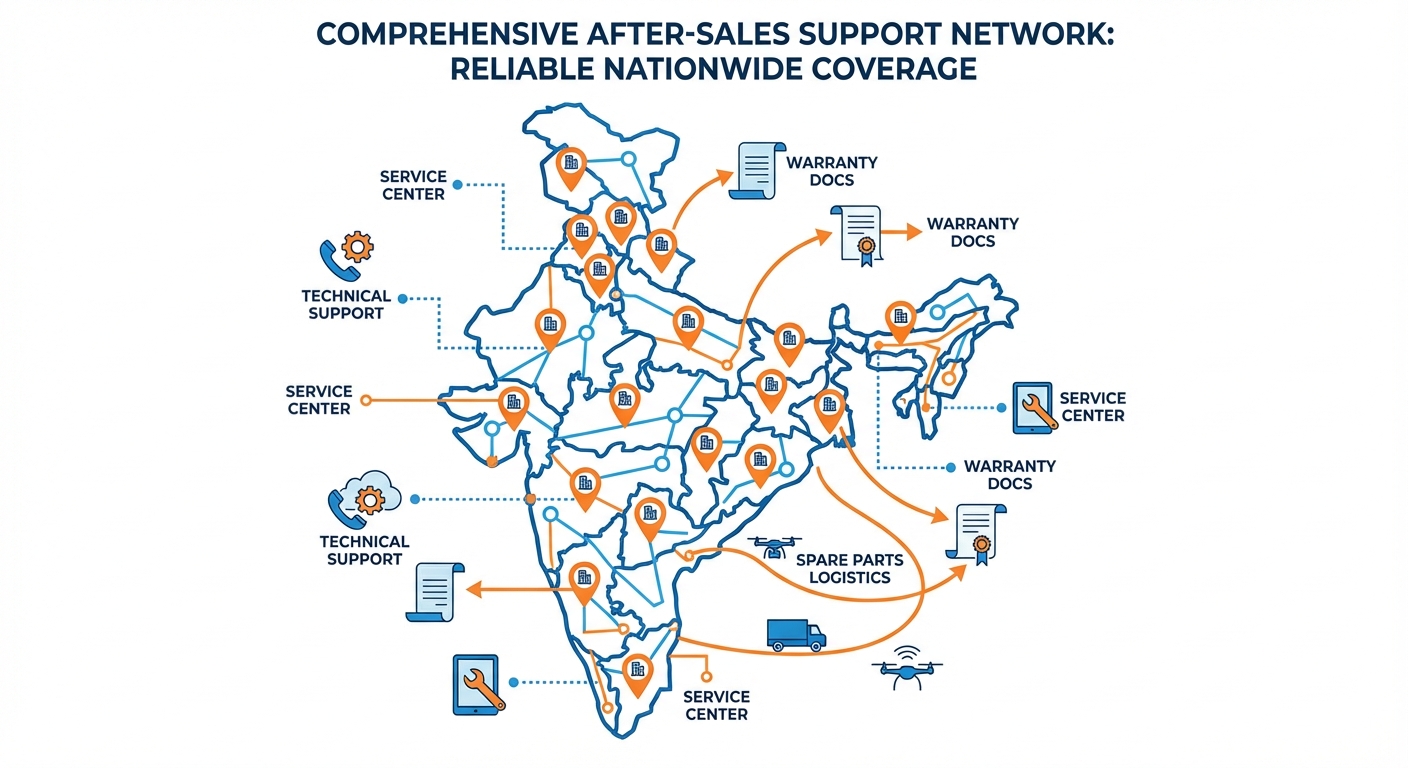
Standard warranty periods in the Indian market range from 5 to 12 years, with premium manufacturers offering 12-year full replacement warranties. Longer warranty periods reduce total cost of ownership for end customers and minimize your exposure to warranty-related service calls. However, verify whether the warranty covers full replacement or just repair, as replacement warranties provide greater certainty and faster resolution.
Service center distribution across India directly impacts response times and customer satisfaction. Map the supplier’s service centers against your typical project locations. Suppliers with service presence in tier-2 and tier-3 cities can provide faster support for projects outside major metros. Request specific service center addresses and verify their operational status through direct contact.
Response time commitments and Service Level Agreements (SLAs) should be clearly defined in supplier contracts. Look for suppliers offering 24-48 hour response times for warranty claims and defined resolution timelines. Digital warranty systems that allow online claim submission and tracking provide transparency and reduce administrative burden compared to paper-based processes.
Technical support availability extends beyond warranty claims to include pre-sales design assistance, commissioning support, and troubleshooting guidance. Evaluate whether the supplier provides dedicated technical support contacts, offers training programs for your installation teams, and maintains comprehensive technical documentation. Some advanced suppliers offer AI-powered WhatsApp monitoring that enables real-time performance tracking and proactive issue detection, reducing the need for reactive support calls.
Spare parts availability and logistics capabilities determine how quickly failed units can be repaired or replaced. Suppliers maintaining adequate spare parts inventory across regional warehouses can minimize system downtime. Inquire about spare parts stocking policies, lead times for critical components, and whether the supplier provides advance replacement units while warranty claims are processed.
The quality of field service technicians matters as much as their availability. Ask about technician training programs, certification requirements, and technical competency levels. Suppliers investing in comprehensive technician training deliver more effective troubleshooting and reduce repeat service calls.
Technical Capabilities and Product Portfolio Assessment
The technical specifications and product range offered by inverter suppliers India must align with your project requirements and customer segments. A comprehensive product portfolio allows you to source multiple inverter types from a single supplier, simplifying procurement, training, and after-sales support.
Evaluate the supplier’s product range across different categories. For residential projects, verify availability of on-grid inverters in the 1-10 kW range with support for high-wattage panels up to 750W. Commercial and industrial projects require inverters in the 10-100+ kW range with robust parallel operation capabilities and advanced monitoring features. Hybrid inverters with battery integration capability are increasingly important as energy storage adoption grows in India.
Technical performance specifications directly impact system efficiency and customer satisfaction. Key metrics to evaluate include:
- Conversion efficiency: Look for 98% or higher maximum efficiency, with European efficiency above 97% for real-world performance
- Start-up voltage: Lower start-up voltage (typically below 150V) enables earlier morning generation and better low-light performance
- DC oversizing capability: Minimum 100% oversizing allows flexibility in system design and accommodates high-wattage panels
- Operating temperature range: Wide temperature range (-25°C to +60°C or better) ensures reliable operation across India’s climate zones
- Maximum input voltage: Higher voltage ratings (1000V or above) provide design flexibility and reduce DC cable costs in large installations
Monitoring and smart features have evolved from optional add-ons to essential capabilities. Modern inverter suppliers India should offer comprehensive monitoring through multiple connectivity options including Wi-Fi, 4G, and Bluetooth. Advanced suppliers provide AI-powered monitoring systems that deliver real-time alerts, performance analytics, and predictive maintenance capabilities through convenient interfaces like WhatsApp.
Protection features safeguard both the inverter and connected equipment. Verify that suppliers include DC and AC surge protection devices (SPDs), anti-islanding protection, ground fault monitoring, and arc fault detection. These features are particularly important in India where grid instability and lightning strikes pose significant risks to solar installations.
Innovation and R&D capabilities indicate whether a supplier can keep pace with evolving technology and customer expectations. Assess the supplier’s track record of product updates, new feature introductions, and responsiveness to market feedback. Suppliers with active R&D programs are better positioned to support emerging requirements like vehicle-to-grid integration or advanced grid services.
For specialized applications, evaluate customization capabilities. Some projects require specific communication protocols, custom enclosures for harsh environments, or integration with building management systems. Suppliers with engineering teams capable of customization provide greater flexibility for complex projects.
To dive deeper into technical selection criteria, refer to our detailed guide on Solar Inverter Selection: 10 Critical Criteria for EPCs, which provides a comprehensive framework for evaluating inverter specifications against project requirements.
Delivery Timelines and Supply Chain Reliability
Supply chain reliability has emerged as a critical consideration for EPCs following global disruptions in recent years. When evaluating inverter suppliers India, assess their ability to deliver products on schedule and maintain consistent supply even during market volatility or demand surges.
Lead time expectations vary significantly among suppliers based on their manufacturing model. Domestic manufacturers with local production typically offer 2-4 week lead times for standard products, while suppliers dependent on imports may require 6-12 weeks. Clarify whether quoted lead times represent production time only or include delivery to your project site.
Inventory management practices directly impact product availability. Suppliers maintaining adequate finished goods inventory can fulfill urgent orders and accommodate project timeline changes. Request information about typical inventory levels for products you commonly specify and minimum order quantities that trigger production runs.
Supply chain resilience became critically important following component shortages and logistics disruptions in 2020-2022. Evaluate suppliers’ risk mitigation strategies including:
- Diversified component sourcing from multiple suppliers and geographies
- Strategic inventory buffers for critical components
- Flexible manufacturing capacity to ramp up production during demand spikes
- Established relationships with logistics providers for reliable transportation
- Contingency plans for managing supply disruptions
Logistics capabilities and delivery networks affect both cost and reliability. Suppliers with established distribution networks across India can deliver to remote project sites more efficiently than those relying on third-party logistics for every shipment. Inquire about delivery coverage, typical transit times to your project regions, and whether the supplier handles installation site delivery or only ships to central warehouses.
Handling bulk orders requires production capacity and inventory management sophistication. For large projects requiring 50+ inverters, verify the supplier’s ability to fulfill the entire order within your project timeline without compromising quality through rushed production. Request references from other EPCs who have placed similar-sized orders.
Communication and order tracking systems provide visibility into order status and help you manage project timelines. Suppliers offering online order tracking, proactive status updates, and dedicated account management deliver better customer experience and reduce administrative overhead.
Pricing Structures and Commercial Terms for Inverter Suppliers India
Understanding pricing structures and commercial terms is essential for accurate project costing and maintaining healthy margins. Inverter suppliers India employ various pricing models, and the lowest unit price rarely represents the best total value when you factor in warranty coverage, support quality, and long-term reliability.
Pricing models typically fall into three categories. List price models establish standard prices with defined discount structures based on order volume. Volume-based pricing offers tiered discounts as order quantities increase, rewarding larger purchases. Project-based pricing provides custom quotes for significant projects, allowing negotiation based on total project value and strategic relationship potential.
Volume-based pricing and bulk discounts can significantly impact your project economics. Typical discount structures offer 5-10% reductions for orders above certain quantity thresholds (often 25, 50, or 100 units). However, balance volume discounts against inventory carrying costs and the risk of technology obsolescence if you stock excessive inventory.
Payment terms and credit facilities affect your working capital requirements. Standard terms in the Indian market range from advance payment for new customers to 30-60 day credit terms for established relationships. Some suppliers offer extended payment terms for large projects or provide financing options through partnerships with financial institutions. Negotiate payment terms that align with your project cash flows and customer payment schedules.
Total cost of ownership extends beyond purchase price to include warranty coverage, support quality, and expected lifespan. A supplier offering 12-year full replacement warranty with comprehensive support infrastructure may deliver lower total cost than a cheaper alternative with 5-year warranty and limited support, even if the initial purchase price is 10-15% higher. Our guide on Solar Inverter Lifespan: Complete Financial Planning Guide provides detailed frameworks for calculating total cost of ownership.
Price stability and contract terms protect you from market volatility. In periods of component price fluctuations or currency movements, suppliers with price protection clauses or fixed-price contracts for defined periods provide greater certainty for project budgeting. Negotiate annual rate contracts for your expected volume to lock in pricing and simplify procurement.
Hidden costs and fee structures can erode apparent price advantages. Clarify whether quoted prices include:
- Delivery and freight charges to your project locations
- Packaging and handling fees
- Warranty registration or activation fees
- Technical support charges or service call fees
- Monitoring platform subscription costs
- Training and commissioning support
For insights into developing competitive pricing strategies while maintaining quality standards, explore our article on Solar Inverter Pricing Strategies for EPCs (2026).
Regional Supplier Mapping Across India
The geographic distribution of inverter suppliers India affects delivery costs, support response times, and your ability to visit facilities for audits or relationship building. Understanding regional supplier concentrations helps you identify partners aligned with your primary project locations and expansion plans.
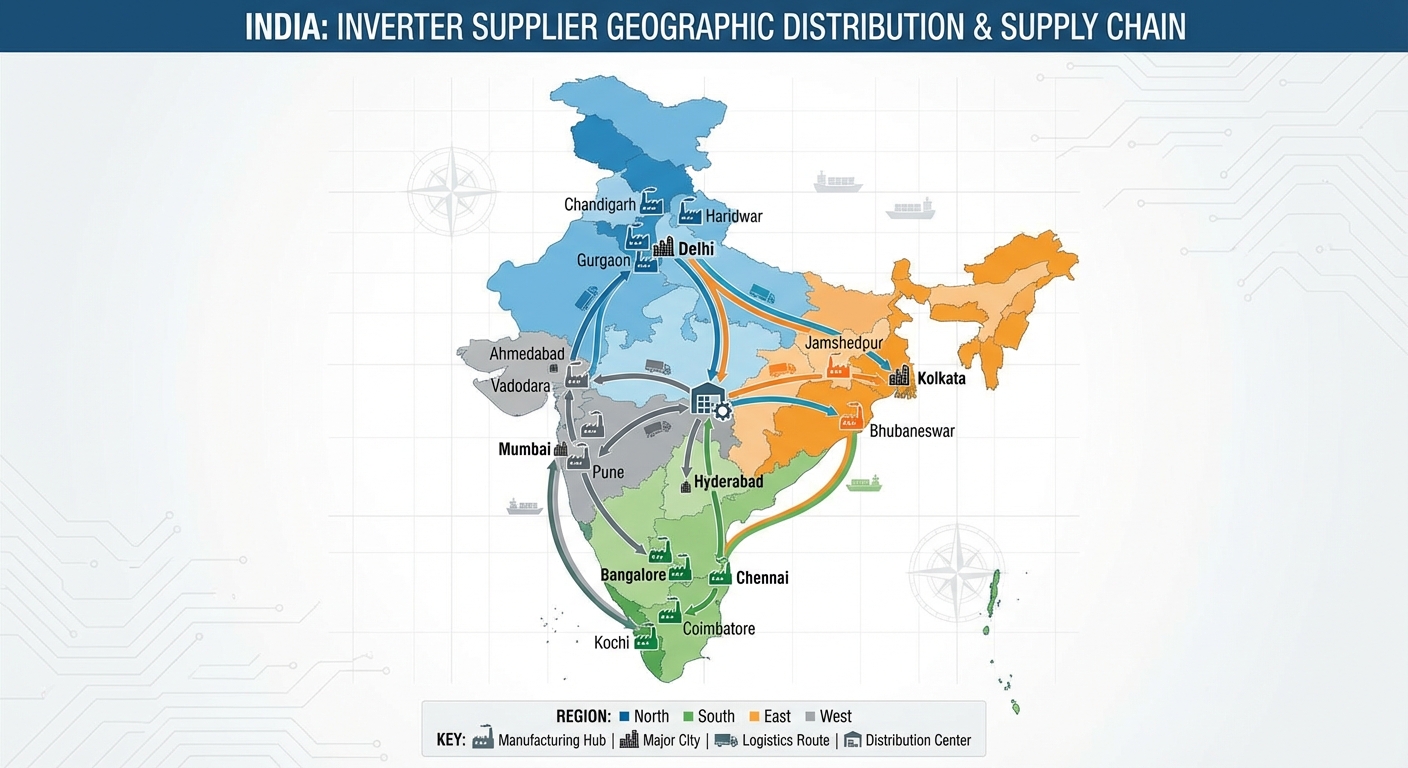
North India hosts several inverter manufacturers and assembly operations, particularly in Uttar Pradesh and Delhi NCR. This region serves as a strategic hub for projects across northern states including Punjab, Haryana, Rajasthan, and Uttarakhand. Suppliers based in this region typically offer competitive logistics for projects in the Hindi belt and can provide faster support for installations in these states.
West India, particularly Gujarat and Maharashtra, represents the largest concentration of solar manufacturing in India. Gujarat’s solar manufacturing ecosystem includes multiple inverter suppliers benefiting from the state’s renewable energy focus and industrial infrastructure. Maharashtra, especially the Pune and Mumbai regions, hosts both domestic manufacturers and Indian operations of international brands. This region provides excellent access to projects across western and central India.
South India, with significant concentrations in Tamil Nadu and Karnataka, has emerged as a major solar manufacturing hub. Tamil Nadu’s industrial base supports several inverter manufacturers, while Karnataka’s technology ecosystem attracts companies focusing on smart inverters and advanced monitoring systems. Suppliers in this region efficiently serve projects across southern states and offer proximity to major ports for component imports.
East India has fewer established inverter manufacturers but is seeing emerging suppliers in West Bengal and Odisha. The region’s growing solar market is creating opportunities for local manufacturing, though many EPCs in eastern states currently source from suppliers in other regions.
Strategic location considerations for EPCs include proximity to your primary project regions, access to the supplier’s service network, and logistics efficiency. If your projects concentrate in specific regions, prioritizing suppliers with strong presence in those areas can reduce delivery costs and improve support responsiveness. However, balance regional considerations against overall supplier quality and capability.
For a comprehensive analysis of manufacturing capabilities across different suppliers, review our Solar Inverter Manufacturers in India: Complete Evaluation Guide for EPCs & Distributors (2026).
Procurement Best Practices for Solar EPCs
Implementing systematic procurement practices when selecting inverter suppliers India reduces risk, ensures quality consistency, and builds foundation for successful long-term partnerships. The following best practices have proven effective for leading EPCs across the Indian solar market.
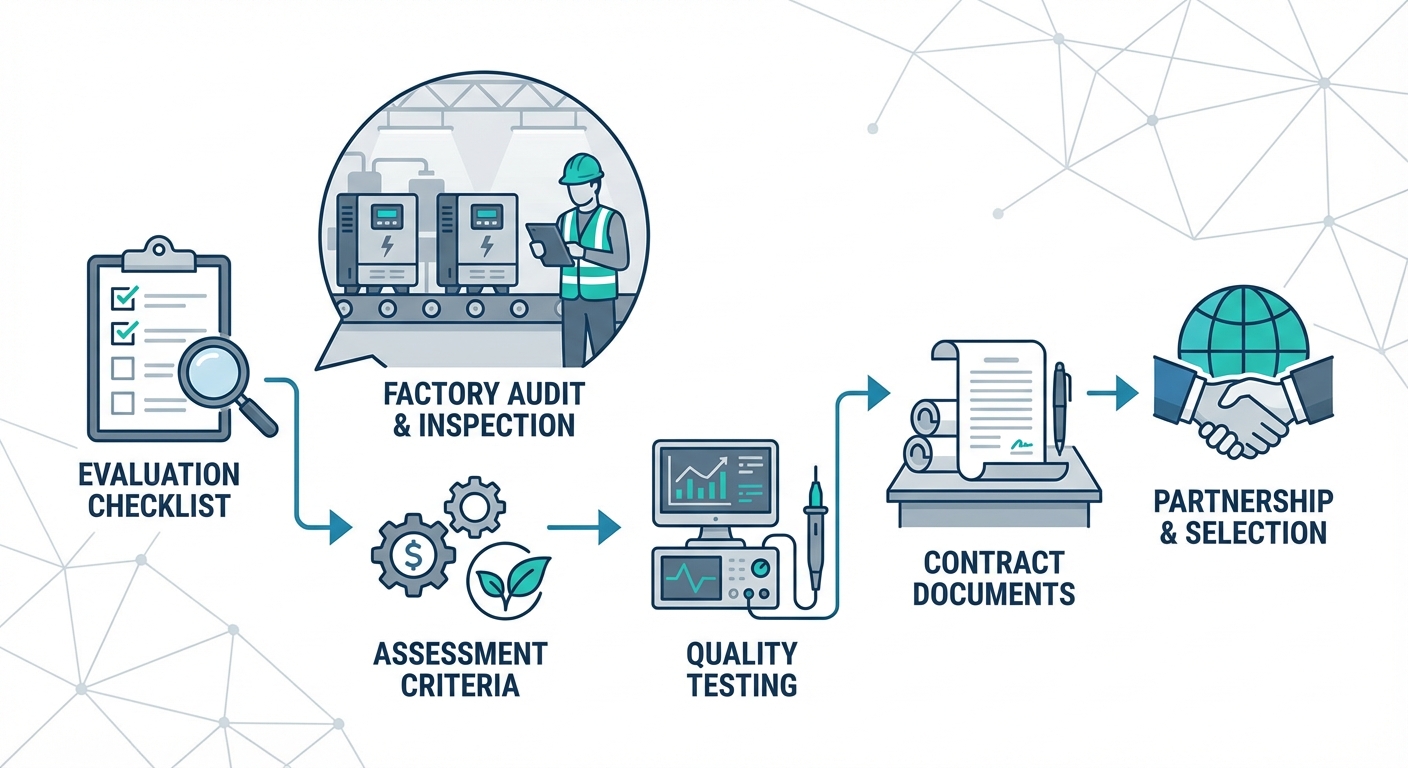
Develop a supplier evaluation scorecard that quantifies assessment criteria with weighted scoring. Assign points across categories including product quality (25%), warranty and support (20%), pricing and commercial terms (20%), delivery reliability (15%), technical capabilities (10%), and financial stability (10%). This structured approach enables objective comparison across multiple suppliers and provides documentation for your selection rationale.
Conduct factory audits and site visits for suppliers you’re seriously considering. Virtual presentations cannot substitute for observing actual manufacturing processes, quality control procedures, and facility organization. During visits, examine production equipment, testing infrastructure, component storage conditions, and quality documentation systems. Speak directly with production managers and quality control personnel to assess technical competency and quality culture.
Implement sample testing and pilot project approaches before committing to large-scale procurement. Order sample units for laboratory testing and field evaluation. Install pilot systems at reference sites where you can monitor performance over several months. This approach identifies potential issues before they affect major projects and validates supplier claims about performance and reliability.
Conduct thorough reference checks with other EPCs and installers using the supplier’s products. Request references for projects similar in scale and application to yours. Contact references directly to inquire about product performance, warranty claim experiences, support responsiveness, and overall satisfaction. Pay particular attention to how suppliers handle problems and warranty situations, as this reveals their true commitment to customer support.
Negotiate comprehensive contracts that clearly define product specifications, delivery timelines, payment terms, warranty coverage, support commitments, and performance guarantees. Include provisions for handling defective products, delivery delays, and specification changes. Well-drafted contracts protect both parties and provide clear frameworks for resolving disputes.
Implement risk mitigation strategies in your supplier selection. Avoid single-source dependency by qualifying at least two suppliers for each product category. This approach provides supply continuity if one supplier faces production issues and creates competitive pressure that benefits pricing and service quality. However, balance multi-sourcing against the complexity of managing multiple supplier relationships and training requirements.
Establish clear quality acceptance criteria including incoming inspection procedures, testing requirements, and acceptance/rejection protocols. Document these criteria in purchase orders and supplier agreements. Consistent quality verification protects your reputation and ensures customers receive products meeting promised specifications.
Vendor Relationship Management Strategies
Building strong relationships with inverter suppliers India creates competitive advantages beyond product pricing. Effective vendor relationship management improves support responsiveness, provides early access to new products, and can unlock preferential commercial terms as your partnership matures.
Establish clear communication protocols defining primary contacts, escalation paths, and communication channels for different situations. Designate account managers on both sides who serve as primary coordination points. Define when to use email, phone, or in-person meetings for various issues. Clear protocols prevent miscommunication and ensure issues reach appropriate decision-makers quickly.
Implement performance monitoring and KPI tracking to objectively assess supplier performance over time. Track metrics including on-time delivery percentage, product defect rates, warranty claim resolution time, technical support responsiveness, and documentation accuracy. Share performance data with suppliers quarterly to recognize strong performance and address areas needing improvement.
Adopt collaborative problem-solving approaches when issues arise. Frame problems as shared challenges requiring joint solutions rather than adversarial blame assignment. Suppliers who feel treated as partners rather than vendors invest more effort in supporting your success and prioritizing your needs during capacity constraints or supply challenges.
Engage in joint business planning and forecasting with strategic suppliers. Share your project pipeline visibility, growth plans, and emerging customer requirements. This transparency helps suppliers plan production capacity, inventory levels, and product development to better serve your needs. In return, request visibility into supplier capacity plans, new product roadmaps, and potential supply constraints.
Provide constructive feedback on products and services, both positive and negative. Suppliers value feedback that helps them improve products and processes. When you identify product issues or feature gaps, document them clearly and suggest potential solutions. Suppliers often prioritize product improvements requested by significant customers.
Manage multi-supplier relationships strategically if you work with multiple inverter suppliers. Clearly communicate your supplier strategy so each understands their role in your portfolio. Avoid playing suppliers against each other in ways that damage trust, but do leverage competitive dynamics to ensure you receive fair pricing and strong support.
Invest in relationship building beyond transactional interactions. Attend supplier events, invite suppliers to your project sites, and facilitate interactions between your technical teams and supplier engineering staff. Strong personal relationships improve communication effectiveness and create goodwill that benefits both parties during challenging situations.
Red Flags and Warning Signs in Supplier Selection
Recognizing warning signs early in the evaluation process can prevent costly mistakes when selecting inverter suppliers India. The following red flags should trigger additional scrutiny or reconsideration of supplier selection.
Reluctance to provide facility access or factory visits suggests potential concerns about manufacturing conditions, quality processes, or actual production capabilities. Legitimate manufacturers welcome customer visits and view them as opportunities to demonstrate capabilities and build confidence.
Inability to provide verifiable certifications or reluctance to share certification numbers for independent verification indicates potential compliance issues. Always verify BIS and other certifications directly with issuing authorities rather than relying solely on certificates provided by suppliers.
Vague or unrealistic warranty terms including unclear coverage definitions, excessive exclusions, or warranty periods significantly exceeding industry norms without corresponding support infrastructure raise questions about the supplier’s ability to honor commitments. Request detailed warranty documentation and verify service center locations.
Pricing significantly below market rates (typically 20%+ below comparable products) often indicates compromises in component quality, manufacturing processes, or support infrastructure. While competitive pricing is desirable, prices far below market norms should trigger investigation into what corners are being cut.
Poor documentation quality including incomplete technical specifications, unclear installation manuals, or missing compliance documentation suggests inadequate engineering processes and quality systems. Professional manufacturers maintain comprehensive, well-organized documentation.
Limited or no customer references particularly for suppliers claiming significant market presence raises questions about actual market acceptance and customer satisfaction. Established suppliers readily provide multiple customer references across different project types and regions.
Frequent management or ownership changes create uncertainty about business continuity and long-term warranty support. While occasional changes are normal, frequent turnover in leadership or ownership structure suggests instability.
Negative feedback patterns from multiple independent sources about warranty claim handling, product reliability, or support responsiveness indicate systemic issues rather than isolated incidents. Pay particular attention to feedback about how suppliers handle problems, as this reveals their true commitment to customer support.
Pressure tactics or aggressive sales approaches including demands for immediate decisions, limited-time offers creating artificial urgency, or reluctance to provide adequate evaluation time suggest suppliers more focused on closing sales than building sustainable partnerships.
Future-Proofing Your Supplier Partnerships in 2026 and Beyond
The solar industry continues evolving rapidly, and your relationships with inverter suppliers India should position your business for emerging opportunities and changing market dynamics. Forward-thinking supplier selection considers not just current capabilities but future readiness across multiple dimensions.
Emerging technology capabilities will differentiate leading suppliers in coming years. Evaluate suppliers’ roadmaps for integrating artificial intelligence, machine learning, and advanced analytics into inverter monitoring and control systems. AI-powered monitoring systems that provide predictive maintenance, performance optimization, and automated troubleshooting represent the next generation of inverter intelligence. Suppliers investing in these capabilities will help you deliver superior value to customers.
Energy storage integration is transitioning from niche application to mainstream requirement. Verify that your inverter suppliers offer robust hybrid inverter portfolios with seamless battery integration, advanced energy management algorithms, and support for emerging battery chemistries. As battery costs decline and time-of-use tariffs expand, hybrid systems will become increasingly important across residential and commercial segments.
Scalability and growth alignment ensure your supplier relationships support your business expansion. Assess whether suppliers have production capacity, geographic coverage, and product range to grow with your business. Suppliers with expansion plans aligned to your growth trajectory make better long-term partners than those focused solely on current market segments.
Sustainability and ESG considerations are becoming important differentiators as corporate customers and financing institutions prioritize environmental and social responsibility. Evaluate suppliers’ environmental practices, labor standards, and governance structures. Suppliers with strong ESG credentials help you meet customer requirements and align with global sustainability trends.
Digital transformation readiness affects how effectively suppliers can integrate with your business systems and customer platforms. Look for suppliers offering API access for monitoring data, digital warranty systems, online ordering and tracking, and integration capabilities with project management tools. Digital-first suppliers reduce administrative burden and enable better customer experiences.
Regulatory adaptation capabilities determine how well suppliers navigate India’s evolving policy landscape. The solar sector faces ongoing changes in grid codes, safety standards, and quality requirements. Suppliers with strong regulatory affairs teams and proactive compliance approaches minimize disruption from regulatory changes.
Customer-centric innovation distinguishes suppliers who view customers as partners in product development from those with purely product-push approaches. Engage with suppliers who solicit customer feedback, involve customers in beta testing new features, and demonstrate responsiveness to market needs. These suppliers develop products better aligned with actual field requirements.
Understanding advanced monitoring capabilities can significantly enhance your value proposition to customers. Explore our detailed analysis in Solar Inverter Monitoring Systems in India (2026) to learn how next-generation monitoring features create competitive advantages.
Making Your Supplier Selection Decision
Selecting the right inverter suppliers India represents one of the most impactful decisions for your solar EPC business. The supplier relationships you build directly influence project profitability, customer satisfaction, warranty claim experiences, and your long-term reputation in the market. By applying the comprehensive evaluation framework outlined in this guide, you can make informed decisions that balance quality, support, pricing, and strategic alignment.
The Indian solar inverter market in 2026 offers diverse options across quality tiers, price points, and capability levels. Premium domestic manufacturers like Qbits Energy combine advanced features including AI-powered WhatsApp monitoring, German-grade electronic components, 12-year full replacement warranties, and comprehensive support infrastructure specifically designed for Indian conditions. These capabilities address the core challenges EPCs face including warranty support reliability, remote monitoring requirements, and long-term product durability.
Your supplier selection should align with your business strategy, customer segments, and competitive positioning. Companies focused on premium residential and commercial segments benefit from partnering with suppliers offering advanced features, extended warranties, and superior support. Value-focused EPCs serving price-sensitive markets may prioritize different supplier attributes while still maintaining acceptable quality standards.
Remember that supplier relationships evolve over time. Start with clear evaluation criteria, implement pilot programs to validate capabilities, and build partnerships gradually based on demonstrated performance. The most successful EPC-supplier relationships are built on mutual transparency, aligned incentives, and collaborative problem-solving.
As you evaluate inverter suppliers India for your business, consider how each potential partner supports your growth objectives, enhances your customer value proposition, and positions you for emerging market opportunities. The right supplier relationships create competitive advantages that extend far beyond product pricing.
Ready to partner with a next-generation inverter manufacturer designed for the Indian solar market? Explore Qbits Energy’s complete product portfolio featuring AI-powered monitoring, 12-year warranties, and IP66 weather protection. For EPCs and distributors interested in building strategic partnerships, become a Qbits partner to access competitive pricing, technical support, and comprehensive business development resources. Contact our team today to discuss how Qbits can support your project pipeline with reliable, intelligent inverter solutions engineered for Indian conditions.
This blog post was written using thestacc.com