



Solar Inverter Payback Period in India: ROI Guide 2026

For EPCs, facility owners, and solar distributors across India, understanding the solar inverter payback period is one of the most critical steps in evaluating any solar investment. The inverter is the financial heart of your solar system. It converts sunlight into usable electricity, and its efficiency, reliability, and warranty coverage directly determine how quickly your investment pays for itself. In 2026, with electricity tariffs rising and solar adoption accelerating across India, getting the inverter payback calculation right can mean the difference between a project that delivers strong returns and one that quietly erodes margins.
This guide breaks down everything you need to know about inverter payback in the Indian context: how to calculate it, what factors drive it, and how inverter quality choices compound over a 25-year system life. Whether you are evaluating a 10 kW rooftop system or a multi-MW commercial installation, the principles here apply directly to your decision-making process.
What Is Solar Inverter Payback Period and Why It Matters in India
The inverter payback period is the time it takes for the energy savings generated by your solar inverter to equal the total cost of purchasing, installing, and maintaining it. It is a subset of the broader solar system payback calculation, but it deserves its own analysis because the inverter is the component most likely to be replaced during a 25-year system life and the one whose efficiency rating most directly affects annual energy yield.
In India, the average grid electricity tariff for commercial and industrial consumers ranges from ₹6 to ₹12 per kWh depending on the state and consumption slab. With solar generation costs now well below ₹3 per kWh in most regions, the savings potential is substantial. However, those savings are only realized if your inverter is converting solar energy efficiently and reliably, year after year. A poorly chosen inverter with a high failure rate or low efficiency can extend your payback period by two to four years, significantly reducing the project’s internal rate of return (IRR).
For EPCs bidding on commercial and industrial projects, the inverter payback calculation also affects how you present ROI to clients. Clients who understand that a premium inverter with a 12-year warranty and 98% efficiency delivers a shorter effective payback period are more likely to approve higher-quality specifications, protecting your project margins and reputation.
Key Insight: In the Indian solar market, inverter replacement is one of the top three causes of unexpected project costs. Choosing an inverter with strong warranty coverage is not just a quality decision — it is a financial risk management decision.
Key Factors That Determine Your Inverter Payback Timeline
The inverter payback timeline is shaped by several interconnected variables. Understanding each one helps you build a more accurate financial model and make better procurement decisions.
1. Inverter Purchase and Installation Cost
The upfront cost of the inverter, including installation charges, is the starting point of your payback calculation. In India, on-grid inverter prices vary widely based on brand, capacity, and feature set. Premium inverters with advanced monitoring, higher efficiency ratings, and longer warranties carry a higher upfront cost, but this premium is often recovered quickly through better performance and avoided replacement costs.
2. Inverter Efficiency Rating
Efficiency is the single most important performance variable in inverter payback calculations. A 98% efficient inverter converts 98% of the DC power from your solar panels into usable AC electricity. A 95% efficient inverter loses 5% of every unit generated. On a 100 kW system generating 150,000 kWh per year, that 3% efficiency gap translates to 4,500 kWh of lost generation annually. At ₹8 per kWh, that is ₹36,000 in lost savings every year, compounding over the system’s lifetime.
3. Degradation Rate and Long-Term Performance
Inverters degrade over time. Budget inverters with lower-grade components tend to show faster performance degradation, reducing their effective efficiency in years 5 through 12. Premium inverters built with German-grade electronic components maintain their rated efficiency for longer, protecting your annual savings and extending the period of peak payback performance.
4. Maintenance and Replacement Costs
Unplanned maintenance and inverter replacement are the hidden costs that most payback calculations underestimate. An inverter failure on a commercial rooftop system can mean days of zero generation, emergency service costs, and potential replacement expenses running into lakhs of rupees. These costs directly extend your payback period and reduce overall project IRR.
5. Local Electricity Tariffs and Net Metering Policies
India’s net metering regulations allow grid-connected solar systems to export surplus power and receive credit against consumption. States like Gujarat, Maharashtra, Rajasthan, and Karnataka have active net metering frameworks that accelerate inverter payback by monetizing every unit of excess generation. Higher local tariffs and favorable net metering policies shorten payback periods significantly.
For a deeper look at how to evaluate inverters across these dimensions, see our guide on Solar Inverter Selection: 10 Critical Criteria for EPCs.
How to Calculate Inverter Payback Period: Step-by-Step Formula
Calculating your inverter payback period accurately requires a structured approach. Here is a practical step-by-step framework used by experienced EPCs and project finance teams in India.
Step 1: Determine Total Inverter Cost
Add the inverter purchase price, installation charges, and any associated balance-of-system costs (wiring, mounting, surge protection devices). This is your total inverter investment (TII).
Step 2: Calculate Annual Energy Savings
Use this formula:
- Annual Generation (kWh) = System Capacity (kW) × Peak Sun Hours per Day × 365 × Inverter Efficiency
- Annual Savings (₹) = Annual Generation × Local Electricity Tariff (₹/kWh)
Step 3: Account for Degradation
Apply an annual degradation factor of 0.5% to 0.8% for premium inverters and 1% to 1.5% for budget inverters. This reduces your annual savings figure in each successive year of the projection.
Step 4: Apply the Payback Formula
Simple Payback Period = Total Inverter Investment ÷ Annual Energy Savings (Year 1)
For a more accurate discounted payback period, apply a discount rate of 8% to 10% to reflect the time value of money in the Indian market.
Real-World Example: 50 kW Commercial System
Consider a 50 kW rooftop system in Gujarat with 5.5 peak sun hours per day and a commercial tariff of ₹9 per kWh:
- Premium Inverter (98% efficiency): Annual generation = 50 × 5.5 × 365 × 0.98 = 98,175 kWh. Annual savings = ₹8,83,575.
- Budget Inverter (95% efficiency): Annual generation = 50 × 5.5 × 365 × 0.95 = 95,131 kWh. Annual savings = ₹8,56,181.
- Annual savings gap = ₹27,394 per year in favor of the premium inverter.
If the premium inverter costs ₹1,20,000 more upfront, that premium is recovered in approximately 4.4 years purely from the efficiency advantage, before accounting for avoided replacement costs and warranty benefits.
For a comprehensive financial planning framework that extends beyond the inverter to the full system lifecycle, refer to our Solar Inverter Lifespan: Complete Financial Planning Guide.
Premium vs Budget Inverters: Inverter Payback Comparison
The inverter payback debate between premium and budget options is one of the most consequential decisions in solar project planning. The upfront cost difference is visible; the long-term cost difference is where the real story lies.
Upfront Cost vs Total Cost of Ownership
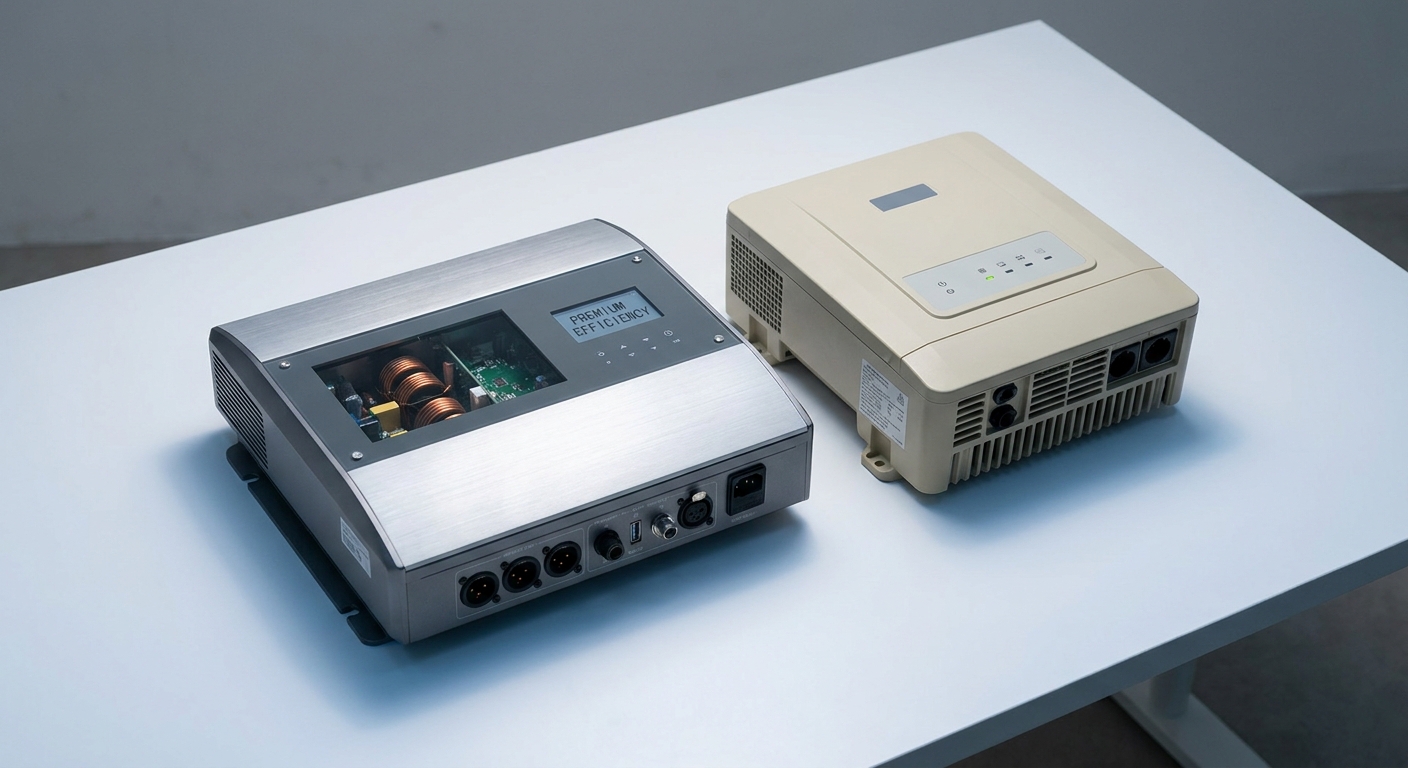
Budget inverters typically cost 20% to 35% less upfront than premium alternatives. This makes them attractive in competitive bid situations. However, total cost of ownership (TCO) over a 25-year system life tells a very different story. Consider the following cost categories:
- Replacement cost: Budget inverters with 5-year warranties often require replacement at years 6 to 8. A single replacement on a commercial inverter can cost ₹80,000 to ₹2,50,000 depending on capacity, plus installation and downtime losses.
- Lost generation: The efficiency gap of 2% to 3% compounds annually. Over 25 years, this can represent 5% to 8% of total lifetime generation lost.
- Maintenance costs: Budget inverters with lower IP ratings and standard components require more frequent servicing in India’s harsh rooftop environments, where dust, heat, and monsoon humidity accelerate component wear.
- Monitoring gaps: Without intelligent monitoring, performance degradation goes undetected for months, silently extending your payback period.
25-Year TCO Case Study: Premium vs Budget
For a 100 kW commercial system in Maharashtra with a ₹10/kWh tariff:
- Premium Inverter (98% efficiency, 12-year warranty): Higher upfront cost, one potential replacement at year 13, consistent efficiency, AI monitoring catching losses early. Estimated 25-year TCO: ₹8,50,000 (inverter costs only).
- Budget Inverter (95% efficiency, 5-year warranty): Lower upfront cost, likely two replacements (years 6 and 14), efficiency losses compounding, higher maintenance frequency. Estimated 25-year TCO: ₹12,00,000 to ₹14,00,000 (inverter costs only).
- TCO advantage of premium inverter: ₹3,50,000 to ₹5,50,000 over 25 years, plus the value of avoided downtime and lost generation.
The inverter payback period for the premium option, when measured against its true TCO advantage, is typically 3 to 5 years shorter than a surface-level comparison suggests.
How Inverter Efficiency Ratings Accelerate Inverter Payback
Efficiency is not just a specification on a datasheet. It is a financial multiplier that affects every rupee of savings your solar system generates over its lifetime. Understanding how inverter efficiency drives inverter payback is essential for making informed procurement decisions.
The Real Value of 98% Efficiency
At 98% efficiency, a Qbits inverter converts 98 units of every 100 units of DC power into usable AC electricity. The 2% conversion loss is among the lowest in the industry. For a 200 kW commercial system generating 3,00,000 kWh per year, the difference between 98% and 95% efficiency is 9,000 kWh annually. At ₹9 per kWh, that is ₹81,000 in additional savings every year, directly accelerating your inverter payback timeline.
Low Start-Up Voltage in Indian Conditions
India’s solar irradiance profile includes early morning and late afternoon periods of lower light intensity, particularly during monsoon months and winter. Inverters with low start-up voltage begin generating power earlier in the day and continue later, capturing generation that higher start-up voltage inverters miss. This advantage is especially significant in states like West Bengal, Odisha, and the northeastern region where cloud cover is more frequent.
IP66 Protection and Maintenance Cost Reduction
India’s rooftop environments are among the most demanding in the world. Dust storms in Rajasthan, coastal salt air in Gujarat and Tamil Nadu, and monsoon humidity across the country all accelerate inverter component wear. IP66-rated weather protection prevents dust and water ingress, reducing the frequency of internal cleaning, component replacement, and service calls. Each avoided service visit directly improves your net annual savings and shortens the effective inverter payback period.
AI-Powered Monitoring and Performance Optimization
Qbits’ AI-powered WhatsApp monitoring system provides real-time performance alerts, generation data, and fault notifications directly to your smartphone. For EPCs managing multiple installations and facility owners without dedicated solar operations teams, this means performance losses are detected and corrected within hours rather than weeks. Studies in the Indian solar market indicate that unmonitored systems lose 5% to 12% of annual generation to undetected faults and soiling. Intelligent monitoring effectively recovers this generation, accelerating inverter payback by six months to over a year on commercial systems.
Learn more about how smart monitoring systems protect your investment in our detailed guide on Solar Inverter Monitoring Systems in India (2026).
Warranty Coverage and Its Direct Impact on Inverter ROI
Warranty coverage is often treated as a secondary consideration in inverter procurement. In reality, it is one of the most powerful financial instruments in your inverter payback calculation. A warranty is a contractual guarantee against replacement costs, and in the Indian solar market, where inverter failure rates vary significantly across brands, warranty terms can make or break a project’s financial model.
The Financial Value of a 12-Year Warranty
The average commercial solar inverter in India has a useful life of 10 to 15 years. A 12-year full replacement warranty means that if your inverter fails at any point within that window, the manufacturer replaces it at no cost to you. For a 100 kW commercial inverter, a replacement unit plus installation can cost ₹1,50,000 to ₹3,00,000. A 12-year warranty effectively insures this risk, improving your project’s financial certainty and making it more bankable for lenders and investors.
Standard 5-Year Warranty: The Hidden Cost
Most budget inverter brands offer 5-year warranties, with optional extensions at additional cost. If your inverter fails in year 7 or year 9, you bear the full replacement cost. For EPCs who have committed to long-term O&M contracts, this is a direct margin risk. For facility owners, it is an unbudgeted capital expense that disrupts cash flow projections and extends the effective inverter payback period.
Digital Warranty Systems and Claim Efficiency
The speed and ease of warranty claims also affects your financial exposure. Qbits’ digital warranty system allows EPCs and facility owners to initiate and track warranty claims online, reducing resolution time and minimizing generation downtime. You can download and register your warranty directly through the Qbits support portal, ensuring your coverage is documented and accessible when you need it.
Warranty Coverage and Project Bankability
For commercial and industrial projects seeking debt financing, lenders increasingly require inverter warranties of 10 years or more as a condition of project bankability. A 12-year warranty from a manufacturer with a proven track record and a strong balance sheet (such as Qbits, backed by the Heaven Group legacy) strengthens your project’s financing case and can improve loan terms, further accelerating effective inverter payback through lower financing costs.
On-Grid vs Hybrid Inverter Payback: Which Delivers Faster ROI?
The choice between on-grid and hybrid inverters is one of the most consequential decisions in solar system design, and it has a direct bearing on inverter payback timelines. Both inverter types serve different use cases, and the right choice depends on your energy consumption profile, grid reliability, and financial objectives.
On-Grid Inverter Payback for Commercial Installations
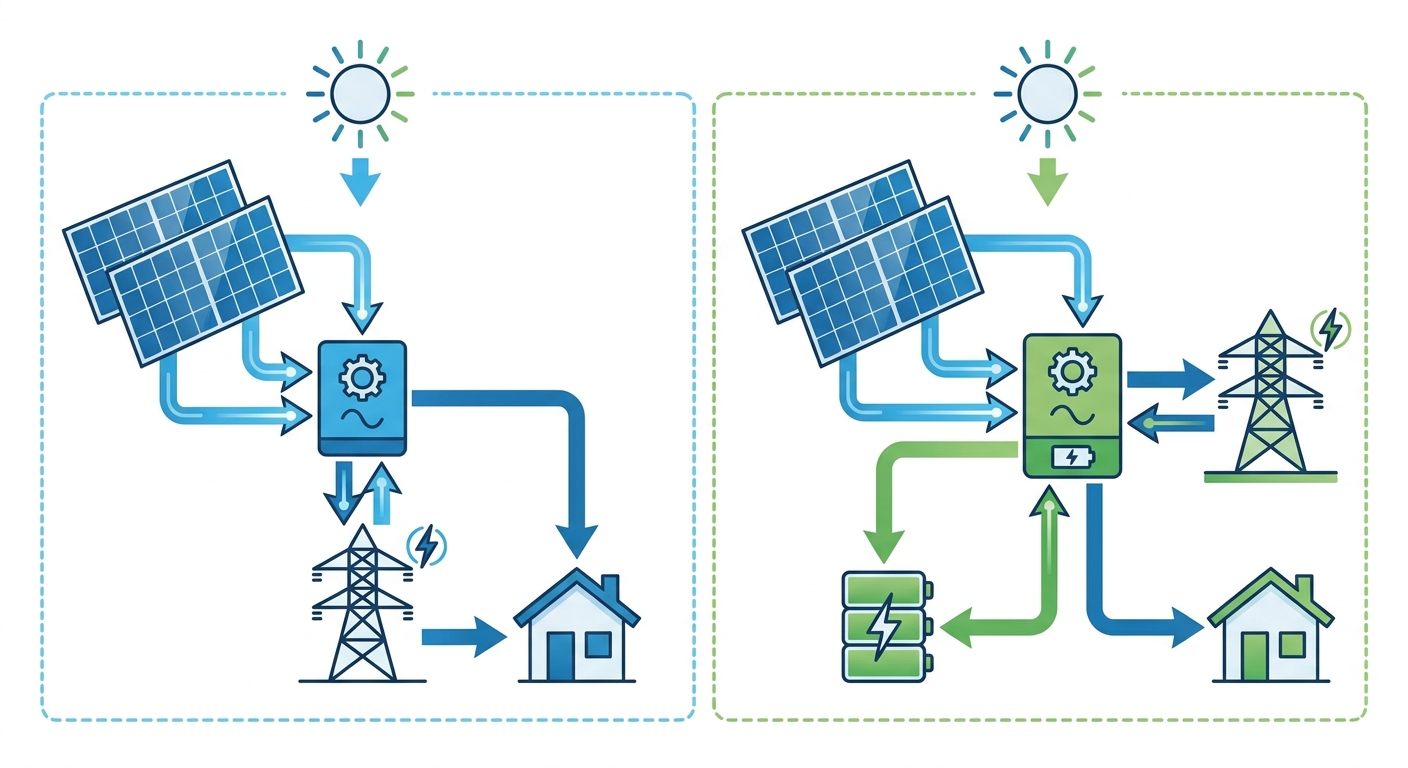
On-grid inverters are the most cost-effective choice for facilities with reliable grid connectivity and high daytime energy consumption. Without the added cost of battery storage, on-grid systems have lower upfront investment and shorter simple payback periods, typically ranging from 4 to 7 years for commercial installations in India depending on system size, tariff rates, and inverter quality. Qbits’ on-grid commercial and industrial inverters, with 98% efficiency and IP66 protection, are designed to maximize generation and minimize losses in this configuration.
Hybrid Inverter Payback with Battery Storage
Hybrid inverters integrate battery storage, allowing facilities to store excess solar generation and use it during peak tariff hours or grid outages. The payback period for hybrid systems is longer due to the added cost of battery storage, typically ranging from 6 to 10 years. However, in regions with frequent power cuts, high peak tariffs, or time-of-use pricing, the financial case for hybrid systems strengthens considerably. Qbits’ hybrid inverters with battery integration are designed for facilities where energy security and peak shaving are as important as simple generation savings.
When Hybrid Inverters Make Financial Sense in India
Hybrid inverters deliver superior ROI in specific scenarios:
- Facilities in states with high peak-hour tariffs (above ₹12/kWh) where battery discharge during peak hours generates significant savings
- Industrial facilities with critical loads that cannot tolerate grid outages
- Locations with unreliable grid supply where diesel generator costs are currently high
- Facilities planning to scale battery capacity as battery prices continue to decline
Net Metering and Its Impact on On-Grid Payback
India’s net metering framework, governed by the Ministry of New and Renewable Energy (MNRE) and implemented at the state level, allows on-grid solar system owners to export surplus power to the grid and receive credit at a defined rate. Active net metering policies in states like Gujarat, Karnataka, and Rajasthan can reduce on-grid inverter payback periods by 12 to 18 months by monetizing generation that would otherwise be curtailed. For more information on India’s net metering framework, refer to the Ministry of New and Renewable Energy (MNRE) guidelines.
For a detailed comparison of inverter types and their suitability for different project profiles, see our guide on Solar Inverter Manufacturers in India: Complete Evaluation Guide for EPCs & Distributors (2026).
Maximizing Inverter Payback: Best Practices for EPCs and Facility Owners
Selecting the right inverter is the foundation of a strong inverter payback outcome, but the decisions you make during installation, commissioning, and ongoing operations are equally important. Here are the best practices that experienced EPCs and facility owners use to protect and accelerate their inverter ROI.

Right-Size Your Inverter and Leverage DC Oversizing
Inverter undersizing leads to clipping losses during peak generation hours, while oversizing increases upfront costs without proportional benefit. Qbits inverters support up to 100% DC oversizing, allowing EPCs to connect a larger panel array to a given inverter capacity. This improves the inverter’s capacity utilization factor and accelerates payback by increasing annual generation without proportionally increasing inverter cost.
Implement Real-Time Monitoring from Day One
Performance losses that go undetected for weeks or months are among the most common causes of extended payback periods. Qbits’ AI-powered WhatsApp monitoring system, with Wi-Fi, 4G, and Bluetooth connectivity, ensures that generation data, fault alerts, and performance trends are available in real time. EPCs managing multiple sites can monitor their entire portfolio from a single interface, catching issues before they become costly. Follow Qbits on Instagram and LinkedIn for monitoring tips and product updates.
Follow a Preventive Maintenance Schedule
Preventive maintenance, including periodic cleaning, connection checks, and firmware updates, extends inverter life and maintains peak efficiency. For IP66-rated inverters like those from Qbits, the maintenance burden is lower than for standard inverters, but a structured annual inspection schedule is still recommended. Each year of extended inverter life beyond the warranty period is a year of pure savings with no replacement cost risk.
Protect Against Surge Events with SPDs
Voltage surges from lightning strikes and grid fluctuations are a leading cause of inverter failure in India, particularly in rural and semi-urban areas with unstable grid infrastructure. Qbits inverters include integrated DC and AC Surge Protection Devices (SPDs), providing a critical layer of protection that reduces failure risk and protects your payback timeline from unexpected replacement costs.
Document Everything for Warranty and Financing
Maintain complete records of inverter installation, commissioning reports, performance data, and warranty registration. This documentation is essential for warranty claims, O&M contract management, and project refinancing. Qbits’ digital warranty system makes this process straightforward, with online registration and claim tracking available through the Qbits support portal.
For guidance on inverter pricing strategies that help EPCs optimize project margins while delivering strong client ROI, see our article on Solar Inverter Pricing Strategies for EPCs (2026).
Frequently Asked Questions About Solar Inverter Payback in India
What is the average inverter payback period in India in 2026?
For commercial and industrial on-grid systems, the average inverter payback period in India ranges from 4 to 7 years, depending on system size, local electricity tariff, inverter efficiency, and net metering availability. Premium inverters with 98% efficiency and 12-year warranties typically achieve payback at the lower end of this range. Residential systems have slightly longer payback periods due to lower tariff rates and smaller system sizes.
Does a higher efficiency inverter always pay back faster?
In most cases, yes. A higher efficiency inverter generates more usable electricity from the same solar panel array, increasing annual savings. The payback advantage of a 98% efficient inverter over a 95% efficient one is typically 0.5 to 1.5 years on a commercial system, depending on system size and local tariff. The advantage is most pronounced in high-tariff states and large-capacity installations.
How does inverter replacement affect overall system payback?
An unplanned inverter replacement is one of the most significant financial disruptions in a solar project’s lifecycle. Replacement costs, including the new unit, installation, and generation downtime, can add 6 to 18 months to the effective system payback period. This is why warranty coverage is a critical financial consideration, not just a service feature. A 12-year full replacement warranty eliminates this risk for the majority of the inverter’s useful life.
Is a 12-year warranty worth the premium cost?
For commercial and industrial installations, a 12-year warranty almost always delivers positive financial value. The cost of a single inverter replacement, including parts, labor, and downtime losses, typically exceeds the warranty premium by a factor of 3 to 5. For EPCs with O&M commitments and facility owners with long-term energy cost reduction goals, the 12-year warranty is a sound financial investment that directly improves inverter payback certainty.
How does net metering affect inverter payback in India?
Net metering accelerates inverter payback by monetizing surplus solar generation that would otherwise be wasted. In states with active net metering frameworks and favorable export tariffs, on-grid system payback periods can be reduced by 12 to 24 months compared to self-consumption-only scenarios. The exact impact depends on your consumption profile, system sizing, and the net metering tariff applicable in your state. For the latest net metering regulations, refer to the MNRE official portal.
What role does inverter monitoring play in payback optimization?
Intelligent monitoring is one of the most undervalued tools for protecting inverter payback timelines. Real-time performance data allows EPCs and facility owners to detect soiling losses, shading issues, string faults, and efficiency degradation before they compound into significant generation losses. AI-powered monitoring systems, like the WhatsApp-based platform offered by Qbits, can recover 5% to 12% of annual generation that would otherwise be lost to undetected faults, directly improving annual savings and shortening the effective payback period.
Make Your Inverter Payback Work Harder with Qbits
Every percentage point of efficiency, every year of warranty coverage, and every real-time alert from an intelligent monitoring system translates directly into a shorter inverter payback period and a stronger return on your solar investment. Qbits solar inverters are engineered specifically for the Indian market, combining 98% efficiency, German-grade components, IP66 weather protection, and a 12-year full replacement warranty to deliver the most financially robust inverter payback profile available to EPCs and facility owners in India today.
If you are evaluating inverters for an upcoming project or looking to upgrade your current portfolio, the Qbits team is ready to help you build a detailed payback analysis tailored to your specific system size, location, and financial objectives. Explore the full Qbits product range to find the right inverter for your project, or send us a WhatsApp inquiry today and get a personalized inverter payback consultation from our engineering team. EPCs and distributors looking to add Qbits to their portfolio can also apply to become a Qbits partner and access dedicated technical and commercial support.
This blog post was written using thestacc.com