



Solar Inverter Monitoring Systems in India (2026)

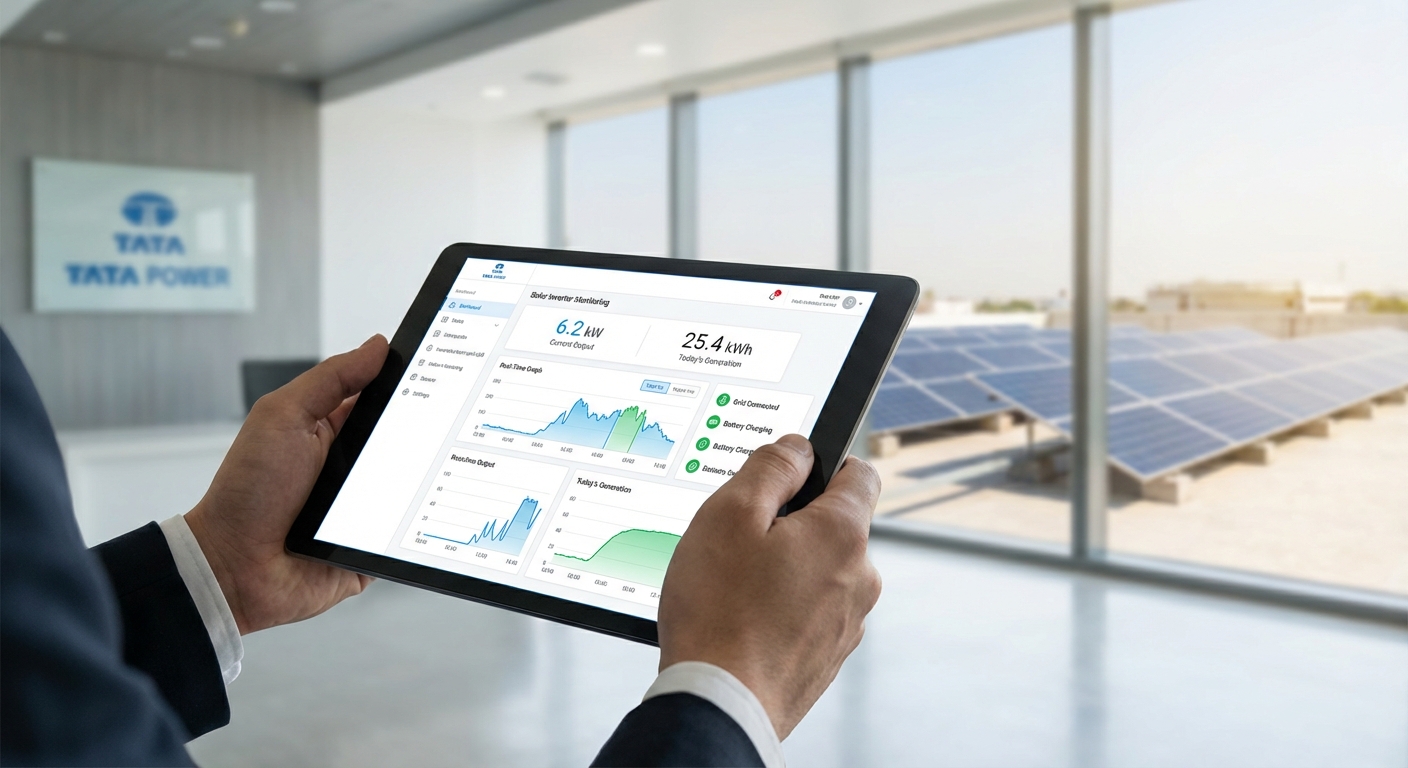
In India’s rapidly expanding solar energy landscape, installing solar panels and inverters is just the beginning. The real value lies in continuous inverter monitoring—the ability to track, analyze, and optimize your solar system’s performance in real time. For EPCs, distributors, and facility owners across India, modern inverter monitoring systems have evolved from basic LCD displays to sophisticated AI-powered platforms that deliver WhatsApp alerts, remote diagnostics, and predictive maintenance capabilities.
With over 70 GW of installed solar capacity in India as of 2026 and ambitious targets ahead, the difference between a profitable solar installation and an underperforming asset often comes down to monitoring. This comprehensive guide walks you through everything you need to know about solar inverter monitoring systems available in India—from understanding connectivity options to setting up advanced tracking features that maximize uptime and ROI.
Understanding Solar Inverter Monitoring Systems
Solar inverter monitoring is the continuous tracking and analysis of your solar power system’s performance through connected devices and software platforms. Unlike the simple LED indicators of older inverters, modern inverter monitoring systems provide granular, real-time data about every aspect of your installation’s operation.
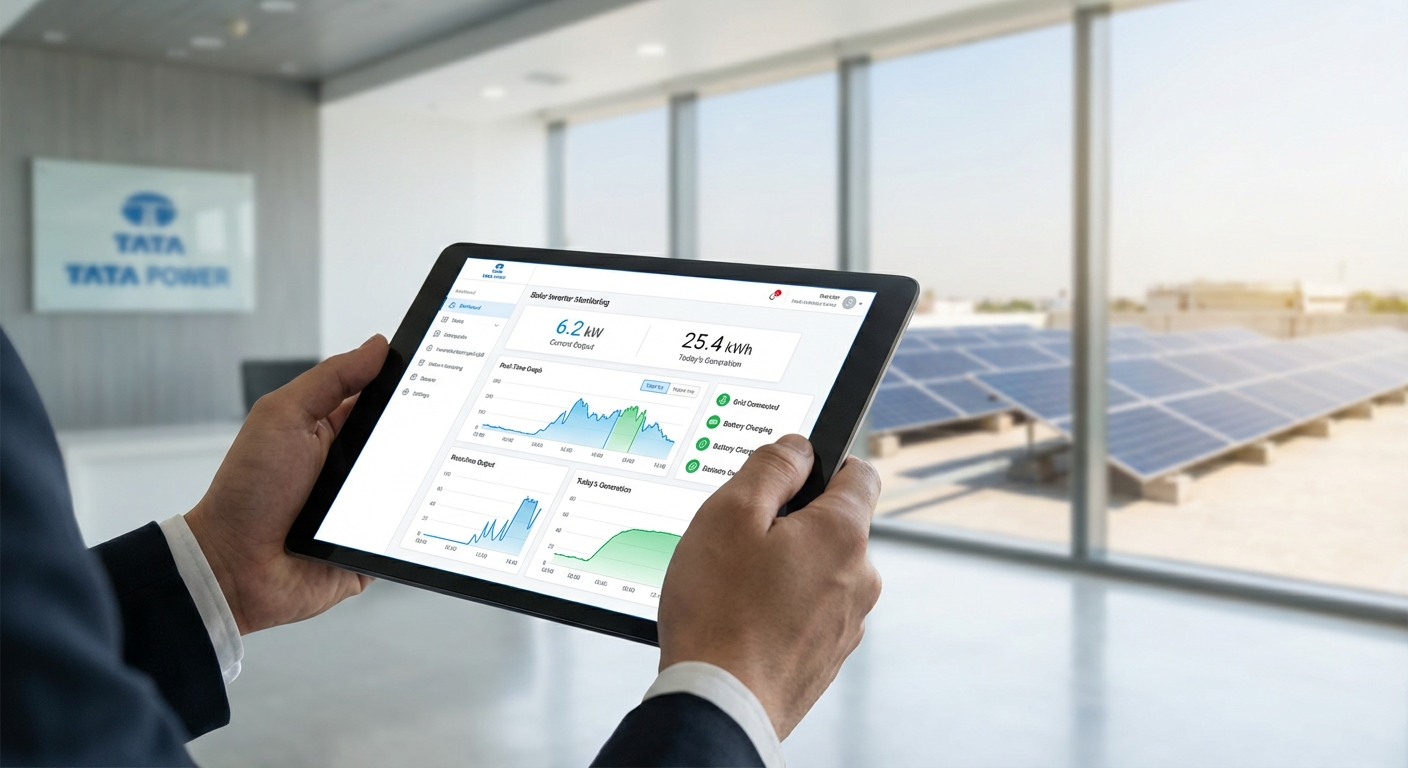
At its core, inverter monitoring captures critical performance metrics including instantaneous power output, cumulative energy generation, voltage and current levels, grid parameters, and system health indicators. For EPCs managing multiple installations across India, this data becomes invaluable for ensuring client satisfaction and meeting performance guarantees.
The evolution of monitoring technology has been remarkable. Early systems required physical site visits to check basic LCD readouts. Second-generation systems introduced local Wi-Fi connectivity with basic mobile apps. Today’s third-generation platforms leverage AI-powered monitoring with multi-channel connectivity (Wi-Fi, 4G, Bluetooth), intelligent alert systems, and predictive analytics that can identify potential failures before they occur.
The ROI impact is substantial. Studies show that properly monitored solar installations in India achieve 15-25% higher lifetime energy yields compared to unmonitored systems. This improvement comes from faster fault detection, optimized maintenance scheduling, and data-driven performance optimization. For a 100 kW commercial installation, this can translate to lakhs of rupees in additional revenue over the system’s lifetime.
Key Performance Metrics Tracked
Effective inverter monitoring systems track several categories of data:
- Power Generation Metrics: Real-time AC power output, DC input power, daily/monthly/lifetime energy production, and performance ratio calculations
- Electrical Parameters: DC voltage and current from solar arrays, AC voltage and frequency to the grid, power factor, and harmonic distortion levels
- System Health Indicators: Inverter temperature, efficiency percentages, fault codes, surge protection device status, and component health scores
- Environmental Data: Solar irradiance levels, ambient temperature, and panel temperature when integrated sensors are available
- Financial Metrics: Energy cost savings, carbon offset calculations, and ROI tracking based on local electricity tariffs
For EPCs and facility owners in India, understanding these metrics is essential for selecting the right inverter and ensuring long-term system performance.
Types of Inverter Monitoring Technologies Available in India
The Indian solar market offers several connectivity options for inverter monitoring, each suited to different installation scenarios and requirements. Understanding these technologies helps EPCs and facility owners choose the right monitoring solution for their specific needs.
Wi-Fi Connectivity for Residential Installations
Wi-Fi monitoring is the most common solution for residential and small commercial installations where reliable internet connectivity is available. Modern solar inverters with built-in Wi-Fi modules connect directly to the site’s existing wireless network, eliminating the need for additional hardware. This approach offers low setup costs and seamless integration with mobile apps and web portals.
The primary limitation is range and reliability. Wi-Fi signals may struggle to reach rooftop-mounted inverters in multi-story buildings or installations with significant distance from the router. For these scenarios, Wi-Fi extenders or mesh network systems can bridge the gap.
4G/Cellular Monitoring for Remote Commercial Sites
For commercial and industrial installations in areas with limited Wi-Fi infrastructure, 4G cellular monitoring provides reliable connectivity. This technology uses a SIM card and cellular data connection to transmit monitoring data to cloud servers, making it ideal for remote locations, agricultural installations, and distributed solar portfolios.
In India’s context, 4G monitoring has become increasingly viable with widespread network coverage and affordable data plans. EPCs managing installations across multiple states particularly benefit from cellular monitoring’s independence from local network infrastructure. The trade-off is ongoing data costs, though these are typically minimal (₹200-500 per month) compared to the value of continuous monitoring.
Bluetooth for Local Configuration and Diagnostics
Bluetooth connectivity serves a complementary role in inverter monitoring. While not suitable for continuous remote monitoring due to its limited range (typically 10-30 meters), Bluetooth enables technicians to configure settings, perform diagnostics, and access detailed system data during installation and maintenance visits without requiring network connectivity.
Advanced inverters combine Bluetooth with Wi-Fi or 4G for maximum flexibility—Bluetooth for on-site configuration and troubleshooting, and Wi-Fi/4G for continuous remote monitoring.
AI-Powered Monitoring vs Traditional Systems
The latest generation of inverter monitoring systems in India incorporates artificial intelligence to move beyond simple data collection to intelligent analysis. AI-powered platforms like those offered by next-generation manufacturers analyze patterns in performance data to predict potential failures, optimize system parameters, and provide actionable recommendations.
Traditional monitoring systems alert you when something goes wrong. AI-powered monitoring tells you when something is about to go wrong, enabling preventive action that minimizes downtime. For EPCs managing warranty obligations and performance guarantees, this predictive capability is transformative.
1. Setting Up Your Inverter Monitoring System
Proper setup is crucial for reliable inverter monitoring. This step-by-step process ensures your monitoring system delivers accurate data and timely alerts from day one.
Pre-Installation Requirements and Network Assessment
Before beginning the physical setup, assess your site’s connectivity infrastructure. For Wi-Fi monitoring, verify that the wireless network signal reaches the inverter location with adequate strength (minimum -70 dBm). Use a smartphone Wi-Fi analyzer app to check signal quality at the inverter mounting location.
For 4G monitoring, confirm cellular network coverage at the site. In India, Jio and Airtel typically offer the most reliable coverage for solar monitoring applications. Obtain a dedicated SIM card with an appropriate data plan—most monitoring systems consume 50-200 MB per month.
Document network credentials, including Wi-Fi passwords and any firewall or security settings that might affect connectivity. Many corporate and industrial networks require MAC address whitelisting or specific port configurations for IoT devices.
Hardware Components Needed for Monitoring
Modern solar inverters from manufacturers like Qbits come with built-in monitoring capabilities, but verify that your system includes:
- Integrated monitoring module: Wi-Fi, 4G, or Bluetooth connectivity built into the inverter
- External dongles (if required): Some inverter models use plug-in monitoring dongles for connectivity
- Antenna: External antennas for improved signal strength in challenging locations
- Surge protection: Ensure communication lines have appropriate surge protection devices
- Power supply: Verify the monitoring module has adequate power from the inverter’s auxiliary supply
Step-by-Step Wi-Fi Configuration Process
Follow this systematic approach for Wi-Fi setup:
- Power on the inverter: Ensure the inverter is receiving DC power from the solar array and has completed its startup sequence
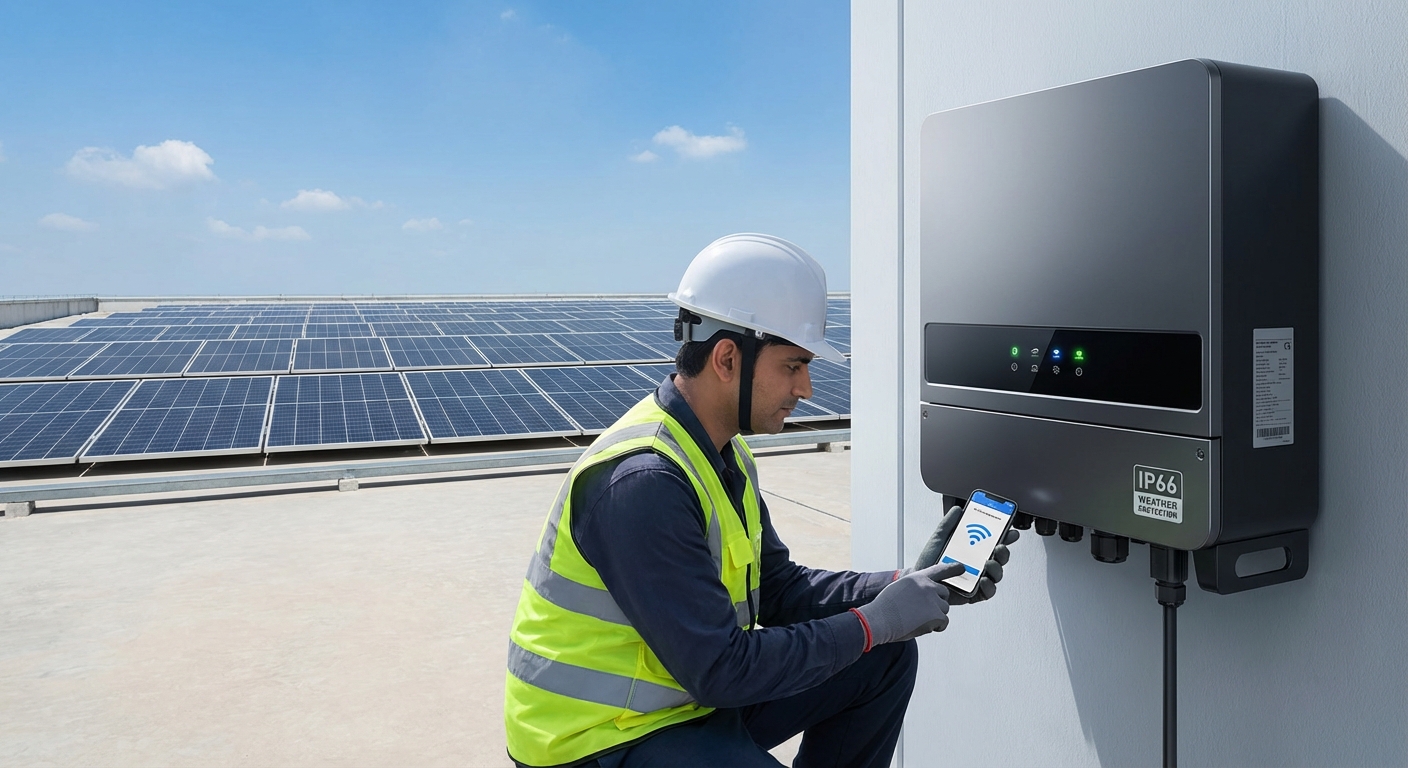
- Access configuration mode: Most inverters create a temporary Wi-Fi access point for initial setup. Look for a network name (SSID) that includes the inverter’s serial number
- Connect your smartphone or laptop: Join the inverter’s temporary Wi-Fi network using the default password (typically printed on the inverter label or in the manual)
- Open the configuration interface: Launch the manufacturer’s mobile app or navigate to the inverter’s IP address (commonly 192.168.10.1) in a web browser
- Select your Wi-Fi network: Choose your site’s Wi-Fi network from the list of available networks and enter the password
- Verify connection: The inverter will disconnect from its temporary network and connect to your Wi-Fi. Confirm successful connection through the app or web interface
- Register the device: Create an account on the manufacturer’s monitoring platform and register your inverter using its serial number
- Configure alert preferences: Set up notification thresholds and contact information for alerts
4G Dongle Setup for Cellular Monitoring
For cellular monitoring, the process varies slightly:
- Insert the SIM card: Install an activated SIM card with data plan into the 4G dongle or inverter’s SIM slot
- Configure APN settings: Enter the Access Point Name (APN) settings for your cellular provider (available from the provider’s website)
- Verify cellular connection: Check that the dongle’s LED indicators show successful network registration
- Register on monitoring platform: Complete device registration through the manufacturer’s platform
- Test data transmission: Verify that monitoring data appears on the platform within 5-10 minutes
Common Setup Challenges and Troubleshooting
EPCs frequently encounter these setup issues:
- Weak Wi-Fi signal: Install a Wi-Fi extender or use a higher-gain antenna on the inverter
- Firewall blocking: Corporate networks may block IoT device communication; work with IT teams to whitelist the monitoring platform’s IP addresses
- Incorrect APN settings: Double-check cellular provider’s APN configuration for 4G monitoring
- Time zone errors: Ensure the inverter’s time zone is set correctly for accurate energy production reporting
- Registration failures: Verify that the serial number is entered correctly and that the device hasn’t been previously registered under a different account
For installations using advanced inverters with IP66 weather protection and German-grade components, proper monitoring setup ensures you can leverage the full warranty and support capabilities. Learn more about selecting reliable inverter manufacturers that provide comprehensive monitoring support.
2. Configuring WhatsApp Alerts and Notifications
One of the most innovative developments in inverter monitoring for the Indian market is AI-powered WhatsApp integration. This technology transforms how EPCs and facility owners receive and respond to system alerts, leveraging India’s widespread WhatsApp adoption for instant, accessible notifications.
How AI-Powered WhatsApp Monitoring Works
Advanced monitoring systems integrate with WhatsApp Business API to deliver intelligent alerts directly to your mobile device. Unlike email notifications that may go unread or SMS alerts with character limitations, WhatsApp messages provide rich, formatted information with the immediacy that solar system management requires.
The AI component analyzes system data to distinguish between minor fluctuations and genuine issues requiring attention. This intelligent filtering prevents alert fatigue—the tendency to ignore notifications when overwhelmed by false alarms. The system learns normal performance patterns for your specific installation and only alerts you to meaningful deviations.
Setting Up Alert Preferences and Thresholds
Effective WhatsApp monitoring requires thoughtful configuration of alert parameters:
- Performance thresholds: Set alerts for power output dropping below expected levels (typically 80% of predicted generation based on irradiance)
- Fault notifications: Configure immediate alerts for critical faults like grid disconnection, over-temperature conditions, or surge protection device activation
- Maintenance reminders: Schedule periodic notifications for routine maintenance tasks, cleaning schedules, and warranty milestone checks
- Daily summaries: Opt for end-of-day performance summaries showing total energy generated, system uptime, and any issues encountered
- Recipient management: Add multiple WhatsApp numbers for different stakeholders, site managers, maintenance teams, and facility owners can each receive relevant alerts
Types of Alerts: Performance Drops, Faults, Maintenance Reminders
A well-configured monitoring system delivers several categories of WhatsApp alerts:
Critical Fault Alerts notify you immediately of conditions requiring urgent attention: grid failures, inverter shutdowns, DC overvoltage conditions, or communication losses. These messages include fault codes, timestamps, and recommended actions.
Performance Alerts inform you when energy generation falls below expected levels, even if no specific fault is detected. This might indicate soiling on panels, shading issues, or gradual component degradation. The AI system compares actual output to predicted output based on weather data and historical performance.
Maintenance Reminders help EPCs stay ahead of scheduled service requirements. These include panel cleaning schedules (particularly important during India’s dry seasons), inverter filter inspections, and warranty documentation deadlines.
Milestone Notifications celebrate positive achievements like cumulative energy generation milestones, carbon offset achievements, or system uptime records. These messages are valuable for client reporting and stakeholder engagement.
Managing Multiple Installations Through WhatsApp
For EPCs managing portfolios of solar installations across India, WhatsApp monitoring becomes a centralized command center. Advanced platforms allow you to:
- Receive consolidated alerts from multiple sites in a single WhatsApp conversation
- Use interactive commands to query specific system status (e.g., “Status Site-Mumbai-01”)
- Acknowledge alerts and assign them to specific technicians for follow-up
- Receive comparative performance reports across your installation portfolio
- Access quick diagnostic information without logging into separate web portals
This streamlined approach significantly reduces the time EPCs spend monitoring distributed installations, allowing faster response to issues and more efficient resource allocation.
3. Tracking Real-Time Performance Metrics
Once your inverter monitoring system is configured, understanding how to interpret and act on performance data becomes crucial. Real-time metrics provide the foundation for optimizing system performance and maximizing solar ROI.
Essential Metrics: Power Output, Voltage, Current, Frequency
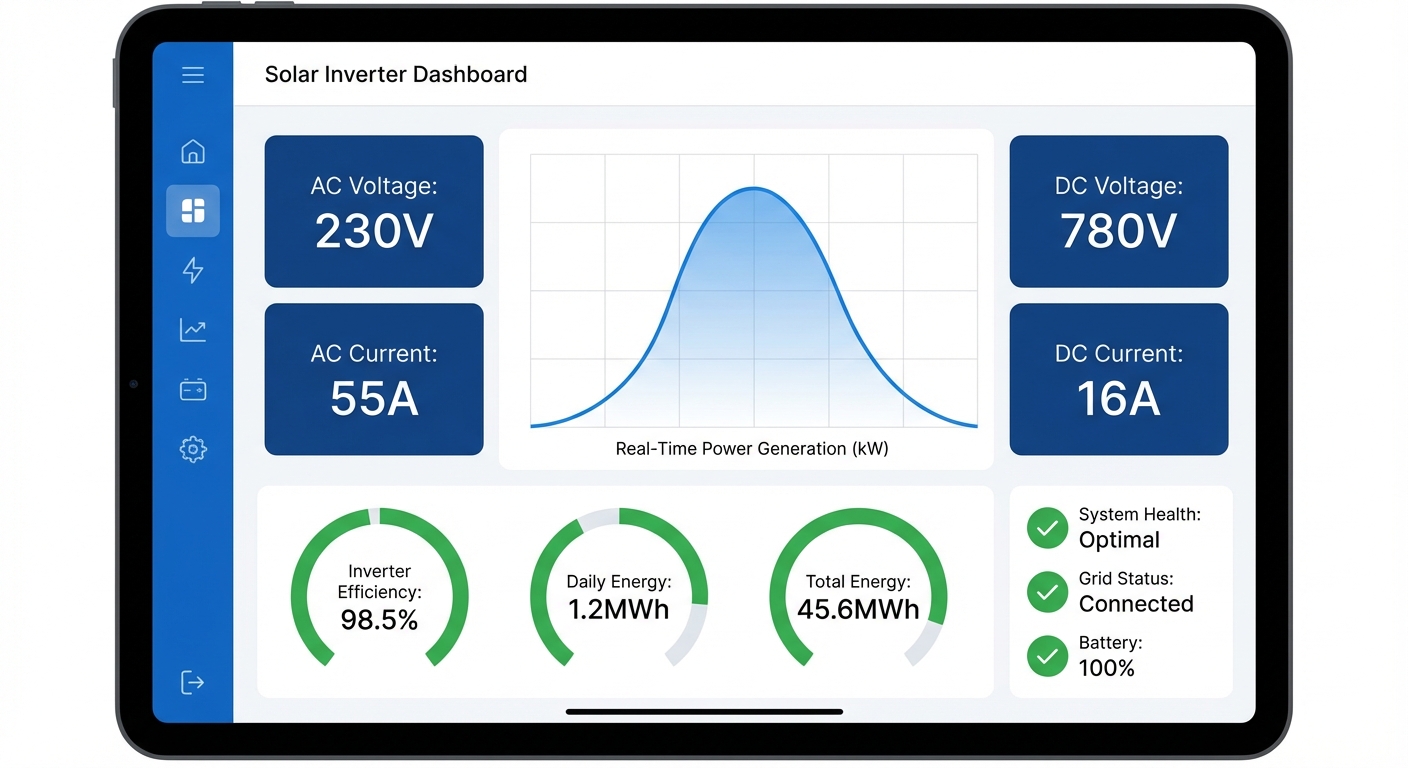
The most fundamental metrics in inverter monitoring are electrical parameters that indicate system health and performance:
AC Power Output shows the instantaneous power being delivered to the grid or facility load, measured in kilowatts (kW). This value fluctuates throughout the day based on solar irradiance and should follow a predictable curve, low in morning and evening, peaking around midday. Unexpected drops during peak sun hours indicate potential issues.
DC Input Power from the solar array should closely match AC output when accounting for inverter efficiency (typically 96-98% for quality inverters). A significant gap between DC input and AC output suggests inverter inefficiency or faults.
Voltage Levels on both DC and AC sides must remain within specified ranges. In India, AC voltage should be 230V ±10% for single-phase systems and 400V ±10% for three-phase installations. DC voltage depends on array configuration but should remain stable under consistent irradiance.
Grid Frequency in India is standardized at 50 Hz. Modern inverters monitor frequency continuously and disconnect if it deviates beyond acceptable limits (typically 47.5-51.5 Hz) to protect both the inverter and grid infrastructure.
Energy Generation Tracking (Daily, Monthly, Lifetime)
Cumulative energy metrics provide the big picture of system performance:
Daily Energy shows total kilowatt-hours (kWh) generated each day. Compare this against predicted generation based on system size and local irradiance to calculate performance ratio. Consistent underperformance indicates issues requiring investigation.
Monthly Energy helps identify seasonal patterns and long-term trends. In India, generation typically peaks during summer months (March-May) and dips during monsoon season (June-September). Understanding these patterns helps set realistic expectations and identify anomalies.
Lifetime Energy tracks total system output since commissioning. This metric is crucial for ROI calculations, warranty claims, and demonstrating system value to stakeholders. For a well-designed system in India, expect 1,400-1,800 kWh per kWp annually, depending on location.
Efficiency Monitoring and Performance Ratio
Inverter efficiency is the ratio of AC output power to DC input power. Quality inverters maintain 96-98% efficiency across most of their operating range. Monitoring efficiency over time helps identify degradation or component issues. A sudden drop in efficiency often precedes complete failure, making this an important predictive metric.
Performance Ratio (PR) is the most comprehensive measure of system health, comparing actual energy generation to theoretical maximum generation under ideal conditions. PR accounts for all system losses, inverter efficiency, cable losses, soiling, shading, and temperature effects. Well-maintained systems in India typically achieve PR values of 75-85%. Values below 70% indicate significant issues requiring attention.
Grid Parameters and Power Quality Indicators
Advanced inverter monitoring tracks power quality metrics that affect both system performance and grid compliance:
- Power Factor: Measures the phase relationship between voltage and current. Modern inverters maintain power factor near unity (1.0) for optimal efficiency
- Total Harmonic Distortion (THD): Indicates the quality of AC output waveform. Lower THD (below 5%) ensures compatibility with sensitive electronic equipment
- Grid Export/Import: For hybrid systems and net metering installations, tracking energy flow to and from the grid is essential for billing and optimization
- Reactive Power: Some grid codes require inverters to provide reactive power support for voltage regulation
Environmental Data Integration
When integrated with weather sensors, inverter monitoring systems provide context for performance analysis:
Solar Irradiance data allows calculation of expected vs. actual generation. If irradiance is high but generation is low, the issue lies with the solar system rather than weather conditions.
Temperature Monitoring helps explain efficiency variations. Solar panels lose approximately 0.4-0.5% efficiency for each degree Celsius above 25°C. In India’s hot climate, this can result in 10-15% efficiency reduction during peak summer.
How to Interpret Dashboard Data Effectively
For EPCs and facility managers, effective data interpretation requires understanding normal patterns and recognizing anomalies:
- Compare against predictions: Use historical data and weather forecasts to set expected generation ranges. Investigate when actual performance falls outside these ranges
- Look for trends, not just snapshots: A single day of low generation might be weather-related, but a week-long trend indicates a real issue
- Correlate multiple metrics: Low power output combined with normal voltage but low current suggests array issues; normal current but low voltage indicates potential connection problems
- Use comparative analysis: For multi-inverter installations, compare performance across inverters. If one underperforms while others operate normally, the issue is localized
- Monitor during different conditions: Check performance during morning startup, midday peak, and evening shutdown to identify time-specific issues
Effective inverter monitoring transforms raw data into actionable insights, enabling proactive management that maximizes system uptime and energy generation.
4. Leveraging Monitoring Data for Preventive Maintenance
The true value of inverter monitoring extends beyond real-time tracking to predictive maintenance, using data patterns to prevent failures before they occur. This proactive approach dramatically reduces downtime and maintenance costs while extending system lifespan.
Identifying Performance Degradation Patterns
Gradual performance degradation often precedes complete system failure. Monitoring data reveals these patterns through subtle changes over weeks or months:
Declining efficiency trends might indicate dust accumulation on cooling fans, degrading capacitors, or thermal stress on components. When inverter efficiency drops from 98% to 95% over several months, schedule preventive maintenance before it reaches critical levels.
Increasing startup time or delayed grid synchronization can signal aging components or firmware issues. Modern monitoring systems track these parameters automatically, alerting you to changes that might otherwise go unnoticed.
Temperature anomalies provide early warning of cooling system problems. If inverter operating temperature gradually increases despite consistent ambient conditions, investigate fan operation, ventilation, or thermal paste degradation.
Early Fault Detection Before System Failure
Advanced monitoring systems detect fault precursors that traditional systems miss:
Intermittent faults that resolve themselves often indicate loose connections, marginal components, or environmental stress. While the system continues operating, these intermittent issues predict eventual failure. Monitoring logs capture these events even if they occur overnight or during periods when no one is watching.
String-level monitoring (when available) identifies underperforming solar strings before they affect overall system output. A single faulty panel or connection in a string can reduce that string’s output by 20-30%, but might only reduce total system output by 2-3%—easy to miss without detailed monitoring.
Surge protection device status tracking ensures that SPDs remain functional. In India’s monsoon season, lightning-induced surges are common. Monitoring systems that track SPD health ensure your inverter remains protected.
Predictive Maintenance Scheduling
Data-driven maintenance scheduling optimizes resource allocation and minimizes disruption:
Instead of fixed maintenance intervals (e.g., quarterly service regardless of need), predictive maintenance schedules service based on actual system condition. An inverter operating in a clean, temperature-controlled environment might require less frequent maintenance than one exposed to dusty, high-temperature conditions.
For EPCs managing multiple installations, predictive maintenance enables efficient route planning, servicing multiple nearby sites during a single trip when monitoring data indicates they’re all approaching maintenance thresholds.
Seasonal optimization uses monitoring data to schedule maintenance during low-generation periods. In India, performing major maintenance during monsoon season (when generation is naturally lower) minimizes revenue impact compared to scheduling during peak summer months.
Historical Data Analysis for Optimization
Long-term monitoring data reveals optimization opportunities:
- Cleaning schedule optimization: Track generation recovery after panel cleaning to determine optimal cleaning frequency for your location. In dusty regions, monthly cleaning might be justified; in cleaner areas, quarterly may suffice
- Tilt angle adjustment: Seasonal performance analysis can inform decisions about adjustable mounting systems or future installation designs
- Capacity planning: Historical generation data helps facility owners plan for expansion or battery storage integration
- Warranty documentation: Comprehensive monitoring records provide evidence for warranty claims and performance guarantee verification
Reducing Downtime and Maximizing Uptime
The ultimate goal of preventive maintenance is maximizing system availability. Industry data shows that monitored systems achieve 98-99% uptime compared to 90-95% for unmonitored systems. For a 100 kW commercial installation, this 4-9% uptime improvement translates to 35,000-80,000 additional kWh annually, worth ₹2-5 lakhs at typical commercial electricity rates.
Monitoring enables faster response when issues do occur. Instead of waiting for a customer complaint or scheduled site visit to discover a problem, EPCs receive immediate alerts and can dispatch technicians with appropriate parts and information. This reduces mean time to repair (MTTR) from days to hours.
5. Best Practices for Multi-Site Monitoring Management
For EPCs and distributors managing portfolios of solar installations across India, effective multi-site monitoring requires systematic approaches and standardized processes.
Centralized Dashboard Management for EPCs
A centralized monitoring platform provides a single-pane-of-glass view of all installations under management. Quality monitoring systems allow EPCs to:
- View aggregate performance across all sites with drill-down capability to individual installations
- Sort and filter sites by performance metrics, alert status, or geographic location
- Identify underperforming installations quickly through comparative dashboards
- Generate portfolio-wide reports for business analysis and client communication
- Monitor SLA compliance and warranty obligations across the entire portfolio
Setting Up User Hierarchies and Access Controls
Proper access management ensures stakeholders see relevant information without overwhelming them with unnecessary data:
Administrator access for EPCs provides full configuration control, user management, and access to all installations. Technician access grants diagnostic capabilities and maintenance logging without configuration changes. Client access shows performance data and energy generation for their specific installation without exposing other sites or sensitive configuration details.
This hierarchical approach protects sensitive information while ensuring each stakeholder has the data they need for their role.
Standardizing Alert Protocols Across Installations
Consistent alert configuration across your portfolio ensures reliable monitoring and prevents alert fatigue:
- Develop standard alert thresholds based on installation type (residential, commercial, industrial)
- Create escalation procedures for different alert severities (immediate response for critical faults, next-business-day for performance alerts)
- Implement alert acknowledgment workflows to ensure issues are tracked and resolved
- Use alert analytics to refine thresholds over time, reducing false positives while maintaining sensitivity to real issues
Remote Troubleshooting Workflows
Effective monitoring enables many issues to be diagnosed and sometimes resolved remotely, reducing site visit costs:
- Alert reception: Receive notification via WhatsApp or monitoring platform
- Data review: Access historical data leading up to the alert to understand context
- Remote diagnostics: Use monitoring platform to check detailed system parameters and fault logs
- Remote resolution: For configuration issues or software problems, implement fixes remotely
- Site visit dispatch: If physical intervention is required, dispatch technicians with specific diagnostic information and required parts
- Verification: Confirm resolution through monitoring data before closing the ticket
Performance Benchmarking Across Sites
Comparative analysis across your installation portfolio reveals best practices and identifies underperformers:
Compare performance ratio across similar installations (same size, location, and orientation) to identify outliers. An installation with PR of 72% when similar sites achieve 80% requires investigation, even if no specific faults are reported.
Benchmark maintenance costs and downtime across sites to identify installations requiring additional attention or those demonstrating best practices worth replicating.
Reporting and Documentation for Clients
Professional reporting builds client confidence and demonstrates value:
- Automated monthly reports: Configure systems to generate and email monthly performance summaries to clients
- Custom dashboards: Provide clients with branded web portals showing their installation’s performance
- Performance guarantee verification: Use monitoring data to document compliance with contractual performance guarantees
- Maintenance logs: Maintain comprehensive records of all service activities, accessible through the monitoring platform
- ROI documentation: Calculate and report energy cost savings, payback progress, and environmental benefits
Advanced Monitoring Features for Commercial Installations
Large commercial and industrial solar installations in India require monitoring capabilities beyond basic residential systems. Advanced features provide the granular control and data needed for complex installations.
DC Oversizing Monitoring and Optimization
Modern inverters support DC oversizing, connecting more solar panel capacity than the inverter’s rated AC output. This strategy maximizes energy generation during non-peak hours while accepting some clipping during peak irradiance. Advanced monitoring tracks:
- Clipping frequency and duration: How often and for how long the inverter operates at maximum capacity
- Clipped energy estimation: Calculating potential energy lost to clipping vs. additional energy gained during morning/evening hours
- Optimal oversizing ratio: Using historical data to determine the ideal DC-to-AC ratio for your specific location and load profile
For commercial installations in India, DC oversizing ratios of 110-130% are common, with monitoring data helping optimize this balance.
Surge Protection Device Status Tracking
Quality inverters include integrated surge protection devices (SPDs) on both DC and AC sides. Advanced monitoring systems track SPD health and alert when replacement is needed. This is particularly important in India, where lightning strikes during monsoon season can damage unprotected equipment.
SPD monitoring prevents the false sense of security that comes from having surge protection that has already sacrificed itself protecting against a previous surge event.
Battery Integration Monitoring for Hybrid Systems
Hybrid inverters with battery storage require additional monitoring parameters:
- Battery state of charge (SOC): Current charge level as a percentage of total capacity
- Charge/discharge cycles: Tracking cycle count for warranty and lifespan estimation
- Battery health metrics: Capacity fade, internal resistance, and cell voltage balance
- Energy flow visualization: Showing solar generation, battery charging, load consumption, and grid interaction simultaneously
- Time-of-use optimization: Monitoring system effectiveness in shifting energy consumption to lower-rate periods
Grid Export/Import Tracking for Net Metering
For installations with net metering agreements, detailed tracking of energy flow to and from the grid is essential:
Monitor cumulative energy exported to the grid for billing reconciliation with utility companies. Track energy imported during low-generation periods to calculate net energy consumption. Compare monitoring system data against utility meter readings to identify discrepancies early.
API Integration with Building Management Systems
Large commercial facilities often integrate solar monitoring with building management systems (BMS) for holistic energy management. Modern monitoring platforms provide APIs (Application Programming Interfaces) that enable:
- Real-time solar generation data feeding into energy dashboards
- Automated load shifting based on solar availability
- Coordinated control of HVAC, lighting, and other loads to maximize solar self-consumption
- Unified reporting combining solar generation with overall facility energy consumption
Data Security and Local Server Storage Considerations
For sensitive commercial and government installations, data security is paramount. Advanced monitoring systems offer:
Local server deployment keeps all monitoring data within India, addressing data sovereignty concerns. Encrypted communication protects data transmission between inverters and monitoring platforms. Role-based access control ensures only authorized personnel can access sensitive system information. Audit logging tracks all configuration changes and data access for security compliance.
For EPCs working with government facilities or security-conscious commercial clients, these features are often mandatory requirements.
Maximizing Solar ROI Through Effective Inverter Monitoring
The ultimate measure of inverter monitoring success is its impact on return on investment. Comprehensive monitoring delivers value across multiple dimensions that directly affect the financial performance of solar installations in India.
Quantifying the Financial Impact of Monitoring
The cost of monitoring systems (typically ₹5,000-15,000 per installation) is minimal compared to the value they deliver:
Increased energy generation through faster fault detection and optimized maintenance typically improves lifetime energy yield by 15-25%. For a 50 kW commercial installation generating 75,000 kWh annually, this represents 11,250-18,750 additional kWh per year, worth ₹90,000-1,50,000 annually at ₹8/kWh commercial rates.
Reduced maintenance costs through predictive maintenance and remote diagnostics can cut service expenses by 30-40%. Instead of routine quarterly site visits regardless of need, service is performed only when monitoring data indicates it’s required.
Extended equipment lifespan results from early problem detection and optimal operating conditions. Preventing a single inverter failure through early detection can save ₹50,000-2,00,000 in replacement costs.
Warranty claim support is streamlined with comprehensive monitoring records. When issues occur, detailed performance data expedites warranty processing and provides evidence for claims.
Performance Guarantee Verification
For EPCs offering performance guarantees to clients, monitoring provides the documentation needed to verify compliance. Detailed generation records, performance ratio calculations, and uptime statistics demonstrate that contractual obligations are being met.
Conversely, when systems underperform due to factors outside the EPC’s control (excessive shading, grid unavailability, client-caused issues), monitoring data provides evidence protecting the EPC from unwarranted claims.
Client Reporting and Transparency Benefits
Professional monitoring and reporting build client confidence and differentiate EPCs in a competitive market. Clients who can see real-time performance data and receive regular reports are more satisfied and more likely to provide referrals and repeat business.
Transparency through monitoring also educates clients about solar system operation, setting realistic expectations and reducing support calls based on misunderstandings about normal system behavior.
Long-Term System Optimization Strategies
Years of monitoring data enable continuous improvement:
- Identify optimal panel cleaning schedules based on actual soiling impact
- Refine maintenance procedures based on failure patterns across your installation portfolio
- Improve future system designs using lessons learned from existing installations
- Optimize inverter sizing and configuration for specific applications and locations
- Develop predictive models for energy generation that improve accuracy over time
Implementing Advanced Monitoring Solutions
For EPCs, distributors, and facility owners ready to leverage advanced inverter monitoring, selecting the right technology partner is crucial. Modern solar inverters with built-in AI-powered monitoring, multi-channel connectivity (Wi-Fi, 4G, Bluetooth), and intelligent WhatsApp alerts provide the foundation for effective system management.
Quality manufacturers offer comprehensive monitoring platforms that integrate seamlessly with their inverters, providing the reliability and support needed for long-term success. When evaluating inverter options, prioritize manufacturers that demonstrate commitment to monitoring innovation and ongoing platform development.
Qbits inverters feature advanced monitoring capabilities designed specifically for the Indian market, including AI-powered WhatsApp alerts, multi-channel connectivity, and comprehensive performance tracking. With 12-year warranties backed by detailed monitoring data and IP66 weather protection ensuring reliable operation in harsh rooftop conditions, Qbits provides the complete monitoring solution that EPCs and facility owners need. Explore Qbits monitoring-enabled inverters to see how advanced tracking technology can transform your solar installations.
Whether you’re an EPC managing a portfolio of installations across India, a distributor seeking value-added services for your clients, or a facility owner maximizing your solar investment, effective inverter monitoring is no longer optional, it’s essential for achieving optimal performance and ROI in 2026 and beyond.
Ready to implement advanced inverter monitoring for your solar installations? Contact our team to discuss monitoring solutions tailored to your specific requirements, or become a partner to offer cutting-edge monitoring technology to your clients. For technical support with existing monitoring systems, visit our support portal for comprehensive assistance.
The future of solar energy in India is intelligent, connected, and data-driven. With proper inverter monitoring systems in place, you can ensure every installation under your management operates at peak performance, delivering maximum value to your clients and strengthening your position in India’s rapidly growing solar market.
This blog post was written using thestacc.com